
The AI-Search Glossary: What AEO, GEO, Citations, and Visibility Actually Mean
A practitioner's glossary of AEO, GEO, prompt tracking, AI citations, and brand visibility—and the sales-deck spin that blurs them.
September 24, 2026
•
min read


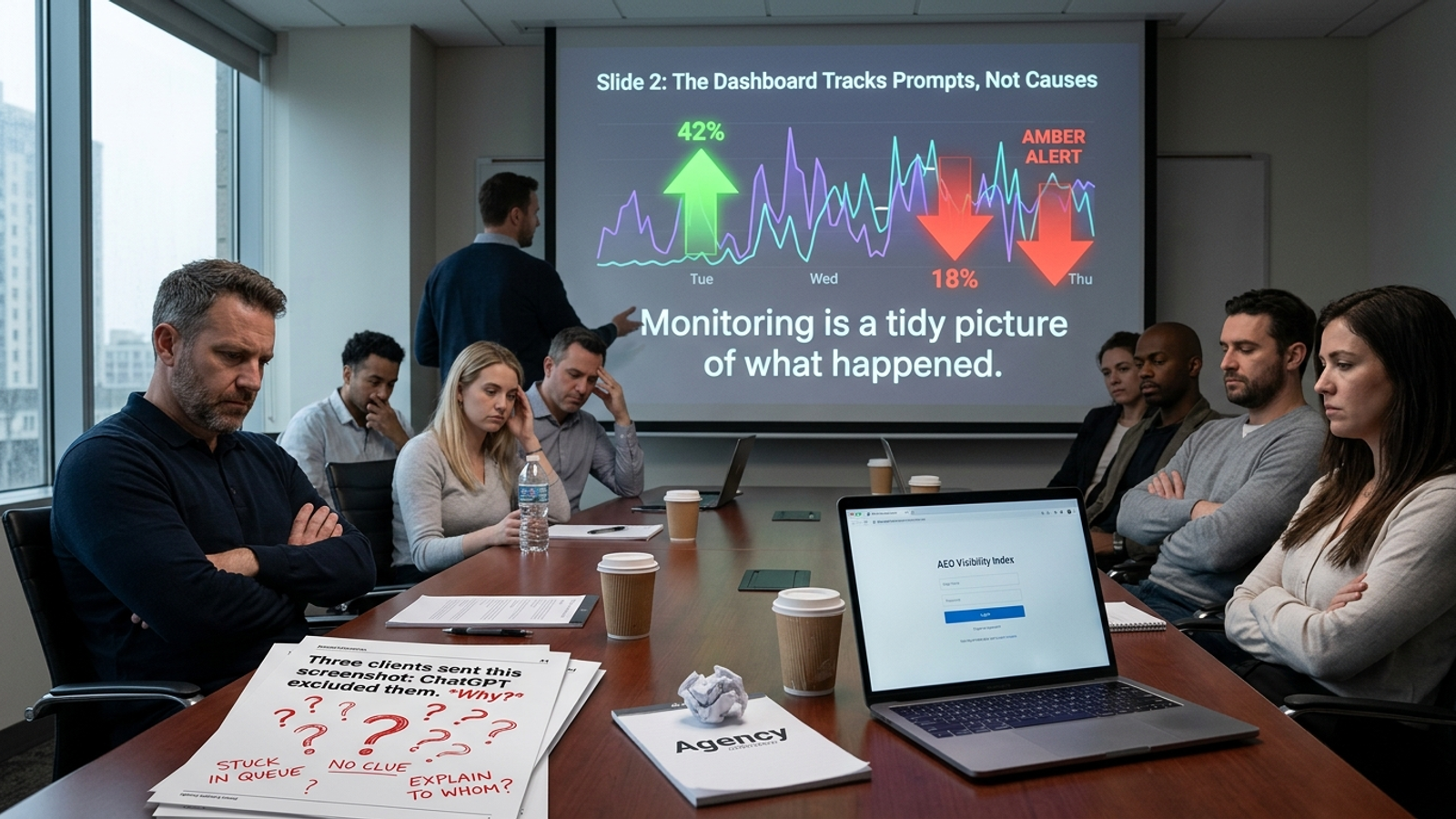
Please turn to the title slide. Three of your largest retainers forwarded you the same kind of screenshot on Sunday: ChatGPT answered “best mid-market inventory management software” with five competitors and no mention of their company. Each email asked some version of Why aren’t we here?
It is now Monday morning. Your search lead is muttering about vector weights, your account managers have a quarterly business review coming up, and nobody wants to say, “We don’t know why that answer chose those names.” Fortunately, you have booked this demonstration. Our twenty-minute presentation will show you how to sell Answer Engine Optimization without troubling your team with the mechanics of an answer engine.
Agencies searching for the best AEO software for agencies often think they need a way to improve client visibility. For the purposes of this deck, they need something much easier to procure: a convincing explanation of why the improvement is already underway.
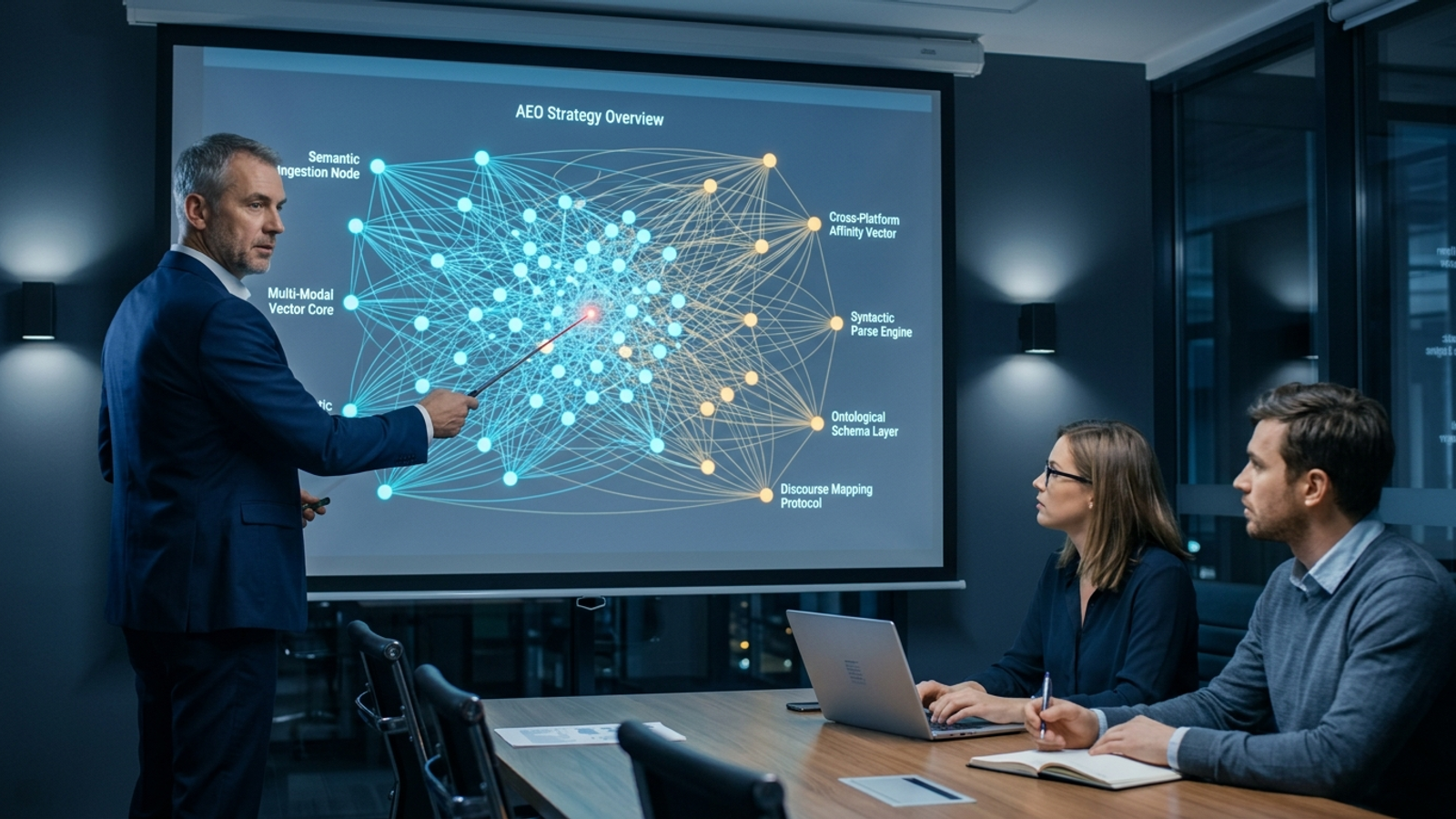
Project twelve glowing spheres connected by neon filaments against a charcoal background. Label three Entity Resolution, Semantic Clustering, and Multi-Modal Grounding. When the client leans forward, deliver the line in a calm voice: “Our proprietary platform directly manages and optimizes your enterprise knowledge graph across all frontier LLMs.”
Do not pause. Someone may ask whose knowledge graph you mean: Google’s, Wikidata, the client’s internal schema, or the JSON-LD file your platform added to a staging page. Click to the next animation. The goal is not to explain data ingestion. The goal is to make whatever happened sound too expensive to cancel.
Behind the glowing spheres sits a five-line Schema.org script containing the company’s address and a few basic attributes. Structured markup can help a crawler understand a page. It does not give your vendor a private control panel for what ChatGPT or Gemini recommends when a buyer asks an unbranded question. But the diagram has done its work: nobody in the room wants to be the person who asks whether an RDF triple is the same thing as a database table.
Presenter note: If you cannot name the data you changed or where it appears, keep the animation moving.
Now reveal the feature every AEO tool for agencies knows how to sell: a prompt tracker. Fill the screen with violet and teal lines measuring Share of Model or an AI Visibility Index. The platform sends twenty selected prompts to an LLM repeatedly, checks whether the client’s name or domain appears in the answers, and plots the percentage. It is a tidy picture of what those checks returned.
On Tuesday the line says 42%. On Thursday it says 18%, and an amber alert appears. Did the model change? Did it retrieve different pages? Did a competitor get picked up in a discussion thread? The chart cannot tell you. Observing an answer is not the same as knowing what caused it, let alone changing the conditions that produced it.
This distinction is best handled in the presentation with another chart. The client asks what you did this month about AI Overviews; you export fifty pages of graphs. Monitoring makes for a reassuring PDF. Diagnosing a missing mention may require looking at crawlability, indexation, the pages an engine can reach, and the sources it appears to trust. That work is less photogenic, so it belongs outside the deck.
Presenter note: When the line falls, call it an insight. Do not call it a fix.
A prospect will eventually ask which tools help a business get featured in Google AI Overviews rather than merely monitor mentions. This is your cue to show an integration diagram: WordPress, Webflow, Shopify, and HubSpot, all connected by clean arrows to your platform. The promise is irresistible. The software detects gaps, drafts forty articles overnight, and publishes them directly to the client’s site. No waiting for a senior strategist. No waiting for anyone, really.
Here is the workflow you need not narrate. The tool takes prompts where competitors appeared, turns each into a template request for a comprehensive guide, and sends the results through a webhook. Forty-eight hours later, the client’s carefully maintained site carries hundreds of articles with titles such as A Definitive Guide to Industrial Supply Chains in 2026. They share sentence structures, contain fabricated customer anecdotes, and conclude that supply chain management matters in modern commerce.

For an agency trying to grow without hiring, the arithmetic is lovely: a $3,500 monthly retainer for “algorithmic entity expansion” against a $450 software bill. The less lovely part arrives when the Chief Marketing Officer finds an auto-published comparison recommending a direct competitor and misstating the client’s refund policy. You now have an 8:00 AM call about why the company website says the company no longer serves enterprise accounts.
Presenter note: “Publishes directly to your CMS” describes a capability. It does not describe an editorial standard. Leave that distinction off the slide.
The fourth slide is for the account director who has waited six months for a client’s engineering team to install one tracking pixel. Display a three-step flowchart: point a DNS CNAME at the vendor’s edge network, identify requests from bots such as GPTBot or ClaudeBot, and serve those requests pre-rendered semantic markdown. Underneath, print the clincher: “Zero developer resources required. Go live in twelve minutes without touching your production codebase.”
The slide makes a routing change sound like a settings change. An unvetted proxy in front of pages that matter to the business creates a new dependency. If its worker fails, those pages can fail with it. If the arrangement affects checkout traffic, a bad deployment becomes more than an AEO problem. Your client’s VP of Engineering may have opinions about learning this from an alert rather than a design review.
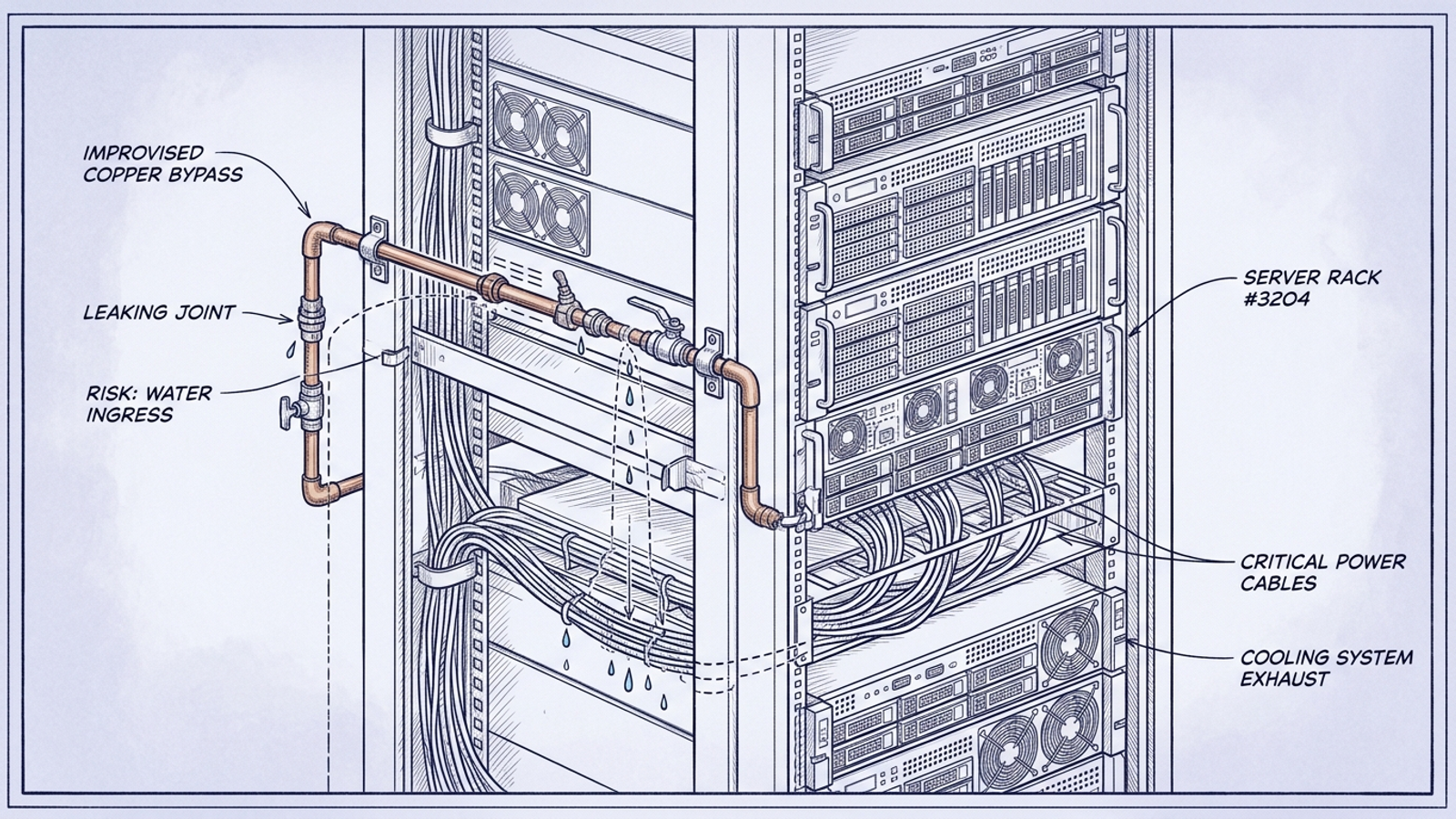
Even when the worker runs, ask what it serves. Pre-rendering content so a crawler can read what a visitor can read is one proposition. Feeding a bot an inflated, keyword-stuffed version that differs from the human-facing page is another. Stale prices, ghost URLs, and conflicting product claims do not become authoritative because they arrived from an edge server. The deck calls this AI-ready delivery. Engineering may use shorter words.
Presenter note: Before anyone touches DNS, establish which requests the proxy handles, who can roll it back, and whether the bot-facing content matches the site.
Finish the product tour with the pricing slide. “Agency Unlimited: $499/month for unlimited clients and uncapped tracking.” Add green checkmarks for white-label reports, custom domains, and weekly digests. With twelve retainers to serve, the agency owner can already see the margin. Fifteen accounts into a $499 bill looks better still.
Now open the terms. In this deck’s version of unlimited, the workspace has a shared pool of 250 prompt executions a month. Track ten queries on each of three surfaces for three clients, once a day, and you use 90 executions per run. The third daily run exceeds the monthly pool. The remaining clients have not made it into the calculation. At that point the platform either charges for additional checks or refreshes less often. Our fictional pricing table puts overages at $0.15 a check, discreetly placed beneath the large word unlimited.
As we discussed in our look at flat-rate multi-domain AEO pricing, the useful number is not just the headline fee. It is what the plan lets you do across the domains and prompts you actually need to monitor.

Presenter note: If a buyer asks how many checks their client roster requires, offer a custom quote. The slide has completed its assignment.
The sales rep now opens the floor. API webhooks are welcome. SSO integration is welcome. Agency partner discounts are especially welcome. The question not printed in the speaker notes is: Can this software guarantee that my client will be cited in an AI answer?
No. A dashboard can sample answers. A publishing tool can put pages online. A proxy can change how certain requests receive those pages. None of those actions gives a vendor control over every answer an engine returns. If the pitch has quietly moved from “we can improve the conditions for visibility” to “we can guarantee placement,” you are hearing the old first-page-ranking promise in new vocabulary.
There is still work worth doing. An engine needs to reach and understand the relevant pages. A client’s claims need to be accurate, consistent, and useful enough to appear beyond its own website. If core specifications hide behind a page a crawler cannot read, another violet line chart will not expose them. If outside sources do not support the story the client tells about itself, a private “knowledge graph” will not supply that support by decree.
Put that mechanism on slide one, and the guaranteed-citation claim has nowhere to sit.
Keep the deck open long enough to ask three operational questions. They are less glamorous than Multi-Modal Grounding, which is why they help.
Monitoring is comparatively easy to package: send prompts, record outputs, draw a line, add the agency logo. Execution is harder to fit into a screenshot. Someone has to identify what can be changed, make the change, and check whether the business got anything beyond another report. A $499 dashboard may help an agency observe the problem. It is not, by itself, a way to solve it.
That is why the alternative to this deck is not a prettier deck. An agency can put people on the technical and content work, or it can use an autonomous engine such as groas to execute search and content optimization continuously under defined guardrails, including work on earned search visibility. Either way, the useful promise concerns the work performed and how it is measured. It is not a reserved seat in ChatGPT’s next answer.
Next Sunday, another client may send another screenshot with another list that excludes them. You can reply with a PDF showing that Share of Model was up on Wednesday, then wait for the inevitable follow-up about what semantic clustering did for their pipeline. Or you can ask what the engine could reach, what the client actually published, which claims others support, and what your team can change.
Nobody selling AEO software can guarantee a citation, and the vendors worth buying from will tell you that before they show you slide two.