

 LinkedIn

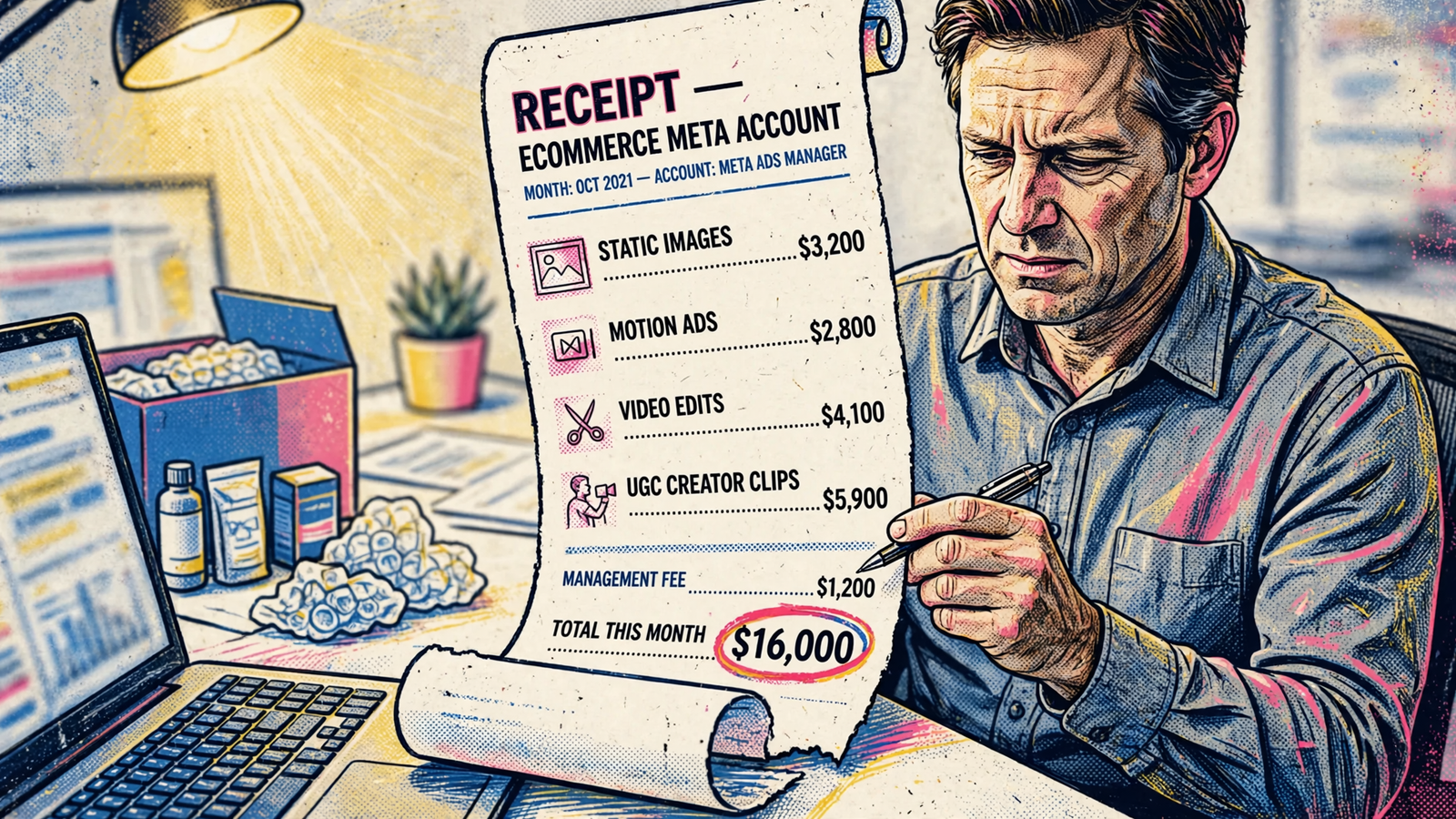
Most agencies won’t tell you this: the management quote is not the monthly bill. For an ecommerce brand making 12 new Meta ads a month, creative starts at $1,750 as a package or $3,100 for the itemized mix below, before management, test media or your own time. Those figures come from one published creative menu, not a promise that every vendor will deliver the same work at the same price. I used to tell clients the management fee was the decision. I was wrong. You have to price what feeds the account.
Fresh creative matters because an ad does not stay fresh just because it still has budget. Frequency can climb, CTR can slip and CPM can creep up before Meta flags an ad as Creative limited or Creative fatigue. An account that stops supplying new ideas keeps paying to show old ones. The agency still collects its fee.
Twelve ads is a working example, not a universal monthly minimum. Your spend, audience and existing winners determine the pace. The point is to put a price on a concrete production plan, then check whether the person quoting you for management actually makes any of it.
The recurring creative bill, line by line
Here is one monthly plan: 4 statics, 4 motion ads, 2 edits made from your footage and 2 UGC videos. At the listed per-asset rates, those 12 assets total $3,100. A package on the same menu starts at $1,750 a month; confirm its deliverables before treating that starting price as interchangeable with this exact mix.
| Line item | What is included in this example | Monthly cost | Source |
|---|---|---|---|
| 4 static image ads | Concept and design; feed and story sizes | $600 at $150 each | Per-asset menu |
| 4 motion ads | Animated versions with captions and end cards | $1,000 at $250 each | Per-asset menu |
| 2 video edits | Cutdowns from footage you supply | $600 at $300 each | Per-asset menu |
| 2 UGC videos | Creator videos with 12-month paid usage on this menu | $900 at $450 each | Per-asset menu |
| Itemized total | 12 finished assets | $3,100 | Sum of the four rows above |
| Bundled creative retainer | Package option; confirm the precise mix | From $1,750/month | Published package price |
An extra hook on an existing ad is $50 on that menu. It is not the same purchase as another finished UGC video. That distinction gets lost fast when a proposal promises a monthly number of “creatives” without saying whether it means concepts, edits, hooks or finished ads in every required size.
The plan also needs somewhere to run. Twelve files sitting in a folder are not twelve tests. Ask what gets launched, what is a variant of an existing idea and what has its own concept to evaluate. Buy a production plan and a testing plan together, or you may end up paying for assets nobody learns from.
UGC: the creator fee is not the whole fee
A UGC quote has two parts: the video and the permission to use it in paid ads. A mid-level creator’s base short-form video runs $300 to $800; beginners run $100 to $300, and experienced creators run $600 to $2,000-plus. Paid usage can add +30% to 50% for 30 to 90 days or +50% to 150% for 6 to 12 months. Whitelisting and perpetual buyouts carry their own additional charges.
That is why I want the license term beside the price, not buried in a follow-up email. The $450 UGC item on the menu above includes 12 months of paid usage. A quote for a $300 video that adds usage later is a different bill, even if both vendors call the deliverable “one UGC ad.” No stated usage term means no complete UGC price.
Revisions create another quiet gap. The same creative menu includes two revision rounds per asset; a new concept after the brief counts as a new asset. Some shops charge separately for different sizes, while others include the listed feed and story formats. If a vendor charges an illustrative $40 for an extra resize and $75 for an extra revision round on each of 12 ads, that is $1,380 more in a month. Those are example charges, not a published universal rate. The arithmetic is the warning: settle revisions, ratios and usage before the first brief.
Your time: the line the invoice leaves out
Say you spend $20,000 a month as an example and commission 12 ads. At 30 minutes to brief and approve each asset, you have spent 6 hours. Add an afternoon finding footage, gathering files and getting product to two creators, and you are at roughly 7 to 9 hours. At an illustrative $75 an hour, that is $525 to $675 of founder or operator time.
You may not write yourself a check for it. You still have to do the work. If “we handle everything” turns into a Monday request for your hooks, offers, angles and raw phone footage, the vendor did not remove the creative workload. It assigned you homework. Ask who writes the brief, who supplies the raw material and who makes the call when an ad needs a different angle.
Test media: spend already inside your ad budget
Creative also needs media to get an initial read. One testing framework suggests roughly $20 to $40 in total spend per concept before moving a promising one into a Challenger or Winners campaign, with 10% to 20% of daily spend reserved for testing. If all 12 ads represent separate concepts, that works out to $240 to $480 of test media. If some are hooks or cutdowns of the same concept, do not count them as 12 independent tests.
This is ad spend, not an extra management fee, and that initial spend is not a guarantee that you have found a winner. It is the budget that lets you start making decisions rather than declaring victory after a handful of impressions. If a proposal promises 12 ads but cannot tell you how they will be tested, you bought files, not learning.
Three management quotes, with creative added
Now put the feed bill beside the management bill. For comparison, assume $8,000 a month in Meta media spend. The figures below keep media spend separate: you pay that $8,000 under every model. They also leave your time outside the vendor totals, because the hours depend on what each vendor asks you to do.
Agency pricing varies. A market guide lists percentage-of-spend fees, flat monthly fees and hybrids, along with separate setup charges. Another lists creative production as an additional cost. That is the problem with comparing management proposals by their headline fee. One price buys account work. Another may buy account work and the ads that keep it useful.
Model 1: a percentage fee, then a creative invoice
At 20% of $8,000 spend, management costs $1,600 a month. Add the creative package starting at $1,750, and the combined vendor bill starts at $3,350. Buy the exact $3,100 itemized mix in the table instead, and it is $4,700. Neither total includes your time; test media remains part of your $8,000 spend.
At $20,000 in spend, the same 20% management fee becomes $4,000. Hold creative at the same package starting price or the same itemized mix, and the combined vendor bill becomes $5,750 to $7,100 a month. The creative requirement might change as spend rises, but it does not have to change for the percentage fee to go up. That is the part I object to: the manager’s invoice grows automatically, while production is still somebody else’s job.
A percentage quote without a creative line is half a quote. Ask for the monthly asset count, formats and production cost before you call it the cheap option.
Model 2: a media buyer and a separate creative shop
Use a $1,000 base plus 10% hybrid fee as the buying example. At $8,000 in spend, that is $1,800. Pair it with the $1,750 creative package, and the combined vendor bill starts at $3,550 a month. That is $200 more than the percentage-plus-package example, not less. A different fee or package might reverse the result; the point is to do the addition before declaring a bargain.
You also become the traffic controller between two vendors. The buyer says the hooks are stale. The designer says the buyer stopped the ads too early. You collect feedback, decide who is right and send another brief. If that adds 3 to 4 hours of coordination, put those hours on top of the briefing and approval time you already counted. Do not count the same work twice, but do not pretend the handoffs run themselves.
This model can work when you want direct control of each specialist. It is not a hands-off alternative, and the price needs to justify the extra coordination.
Model 3: one flat fee with creative included
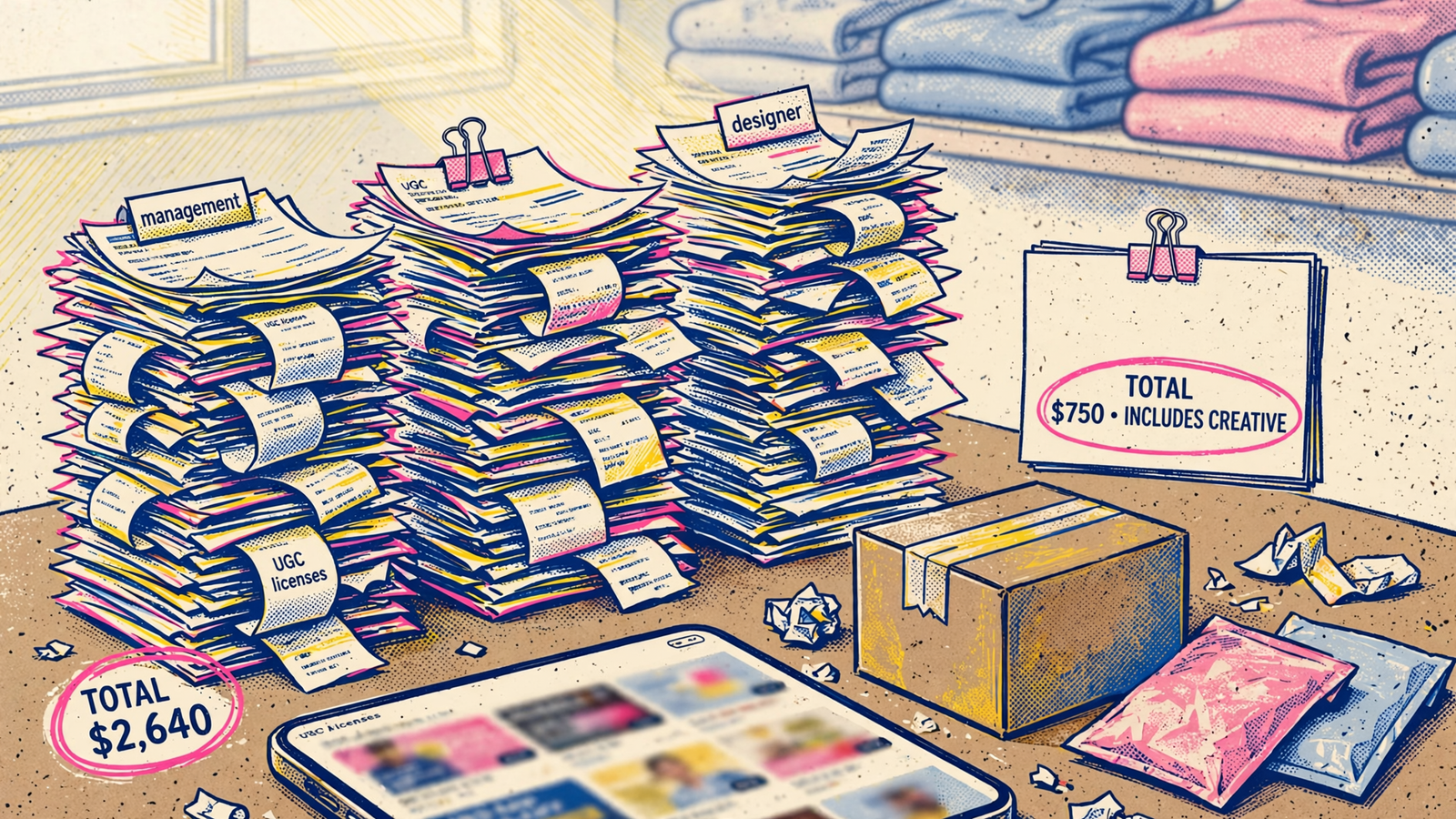
groas lists Meta Ads at a flat $1,499 a month, with new ads tested and winners scaled. The fee does not rise from $1,600 to $4,000 just because the illustrative account moves from $8,000 to $20,000 in spend. Creative is part of the operating model rather than an automatic second studio invoice. Against the vendor totals above, $1,499 is the lower monthly fee.
Do not mistake that comparison for a promise that every flat-fee service supplies the exact 4-static, 4-motion, 2-edit, 2-UGC mix in my table, or that every UGC license has the same term. Confirm those deliverables in writing with any vendor. The advantage of putting ads and management under one owner is operational, too: the team making the next variant also sees which ad needs replacing. There is no separate production queue to negotiate every time the account needs a new hook.
For a longer view of how fees accumulate, I have a year of Meta help itemized. For this monthly decision, the rule is simpler: compare what gets made and managed, not just what gets managed.
One-off setup versus costs that come back
Setup is a different kind of bill. Shops list $500 to $7,000 for onboarding work such as the pixel, catalog and initial account structure. It is one-off; creative production, management and your hours recur. Keep setup in the first-month total, then take it out of later months. Do not let a low setup quote distract you from a higher bill that returns twelve times.
UGC permissions need the same calendar check. A 12-month paid license does not become a surprise renewal in month four. It becomes a decision when the term ends, particularly if the ad is still useful. Longer paid-usage terms and whitelisting can add to the creator fee; the amount depends on the rights you buy. Get the term and renewal price before you need either.
Production pace can change as spend changes. Creative-fatigue guidance describes shorter useful lives for concepts at higher spend levels. That does not mean an $8,000 account automatically needs 16 ads when it reaches $20,000. It means the original 12-ad plan needs reviewing against frequency, performance and the size of the audience. A percentage manager’s fee rises with spend by formula. Your creative bill rises only if you buy more work, but you may need that work to keep the account supplied.
Before signing, make the vendor put these five lines on the quote:
- Finished ads by format. State how many statics, motion ads, edits and UGC videos you get, plus whether 1:1, 4:5 and 9:16 sizes are included. If you need a larger plan, compare it with the 20-ad monthly breakdown.
- UGC paid usage. List the license term in months, what it covers and the renewal price. “Creator sourcing included” does not answer any of those questions.
- Revisions and resizes. Count included rounds, price extra rounds and say when a changed brief becomes a new asset. The same quoting problem appears in the cost of a cheaper Meta lead.
- Test media and structure. Say which concepts run, how much of the existing ad budget funds the initial tests and what happens to a promising ad next.
- Your hours. Name who writes briefs, approves work, supplies footage and ships product. If it is you, include the time in your comparison.
The cheapest mistake is paying too much for a variant: try the $50 extra hook on an ad that already works before buying a $450 new face on a guess. The most expensive mistake is signing a percentage fee that excludes creative and finding, at $20,000 in spend, that you owe $4,000 for management and another $3,100 for the 12 ads that feed it. I would rather pay one flat fee where the team managing the account also has to make the next ad. On Meta, the feed always collects. Make the person cashing the management fee responsible for feeding it.