A campaign can hit its Target ROAS and still be in trouble. I used to hand clients reports full of official terms that sounded precise: Target ROAS, learning phase, Performance Max. The definitions were right. The decisions people made from them were not.
This glossary translates between Google’s product language and the account you have to run. Each term gets a plain-language definition, then the operator’s version: what people confuse it with, when it matters, and the trap that can cost you budget. Read it in order if you have inherited an automated account. It starts with the bid target and ends with the phrase I would retire.
Target ROAS
Official: Target ROAS is Smart Bidding that maximizes conversion value while aiming at an average return. A 300% target means roughly $3 in recorded value for every $1 spent across the period, not a guarantee on every auction.
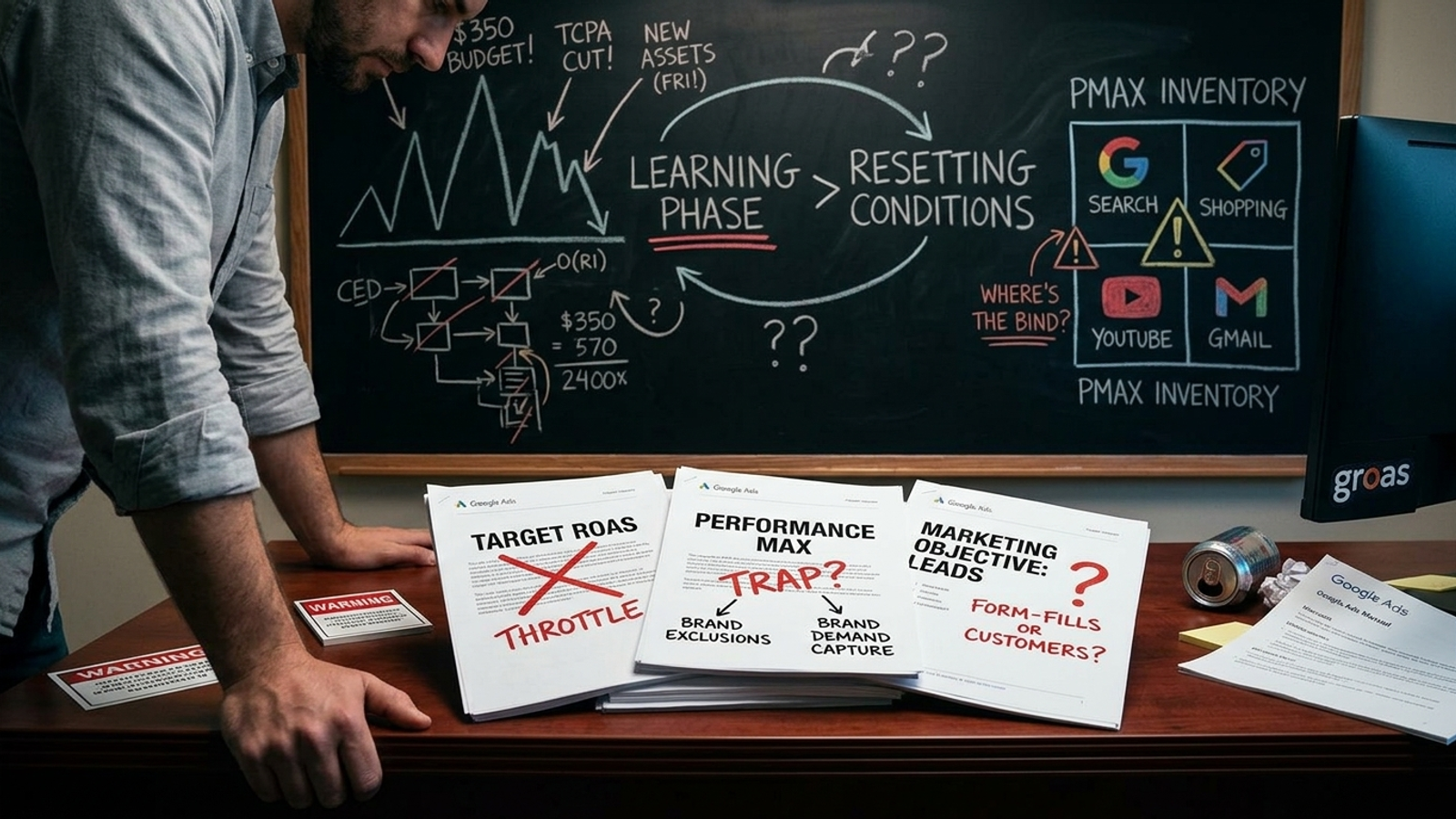
Operator meaning: It is a throttle, not a profit target. Google uses auction-time signals to pursue that average, and a target set above what the account can support can restrict spend. The campaign may look disciplined while it starves.
The trap: Starting with the finance team’s desired return instead of the account’s recent result. Start at or slightly below your last-30-day actual ROAS; check that you have 50 or more valued conversions in 30 days and that budget is not capping the campaign. I used to tell clients a high target forced efficiency. I was wrong. It can force inactivity.
Target CPA
Official: Target CPA tells Smart Bidding the average amount you want to pay for a conversion.
Operator meaning: It buys conversions at a price, without knowing what each one is worth. If every lead is worth roughly the same, that can be a simpler target than Target ROAS. If your leads range from tire-kickers to closed-won customers, the cheap ones can make the CPA look excellent.
The trap: Pointing Target CPA at form fills and calling the result cost per customer. A form-fill CPA is a form-fill CPA. Check what the conversion action represents before you congratulate anyone.
Conversion value
Official: Conversion value is the number attached to a conversion so value-based bidding has something to optimize toward.
Operator meaning: For lead generation, that number is often a score you assign rather than revenue. You might give a demo request from a 500-person company a value of 100 and an ebook download a value of 10. Google does not know which lead is closer to a sale until you pass it a distinction it can use.
The trap: Importing revenue for purchases, then treating every lead as though it has a meaningful value too. Without values to distinguish them, Target ROAS cannot do the job you expect; Target CPA or Maximize Conversions may be the more honest choice. Check the values before you set a value-based target.
Learning phase
Official: The learning phase is the period after a launch or major edit when Smart Bidding calibrates and the campaign may show a Learning badge.
Operator meaning: It can run from a week to a month, not a fixed seven days. Low budget, thin impressions, long sales cycles and frequent edits can stretch it. Manual CPC has no Smart Bidding learning phase because there is no automated bidding strategy to calibrate.
The trap: Treating the badge as the whole process. Learning continues after the label disappears, so a campaign does not become settled the instant its status changes. Look at the data and the changes you made, not just the label. For the longer version, see Smart Bidding strategies and learning period survival.
Performance Max
Official: Performance Max is a goal-driven campaign type that can run across Google inventory from one campaign.
Operator meaning: You provide a goal, feed, creative assets and guardrails; Google chooses where to show the ads. Search, Shopping, YouTube, Discover, Gmail, Maps. That reach is both the point and the problem. Clean ecommerce feed data can help it find volume a person misses. Weak lead-gen conversion values can send it after cheap form fills instead.
The trap: Running PMax beside Search without brand exclusions or a clear budget split, then calling a rise in blended ROAS new growth. Check whether it captured demand your brand Search campaign already had. I have seen that setup presented as a win.
AI Max for Search
Official: AI Max for Search adds broader search-term matching, text customization, final URL expansion and reporting to Search campaigns. Google says advertisers typically see 14% more conversions or conversion value at similar CPA or ROAS.
Operator meaning: It is Search with the fences lowered. Google has more room to match queries, adapt copy and choose landing pages. That can help when your keyword list is thin and your site has useful pages for different intents. It is less appealing when three service pages say nearly the same thing and the rest of the site is top-of-funnel blog posts.
The trap: Switching it on and leaving old negatives and brand rules untouched. Treat expanded reach as something to manage, not a free uplift. Check the queries, copy and destinations it chooses.
Demand Gen
Official: Demand Gen runs image, carousel, video and product-feed ads across YouTube, Discover, Gmail and video partners.
Operator meaning: It is audience-led, not keyword-triggered. You need a hook that gives someone a reason to stop scrolling. PMax, by contrast, follows a conversion goal across inventory that includes Search and Shopping. Those campaigns need different briefs.
The trap: Grading Demand Gen on last-click ROAS in week two and killing it because Search closed the sale. If you use it to start a conversation, do not judge it solely by who spoke last. For the fuller distinction, read Demand Gen vs Performance Max.
Marketing objective
Official: The marketing objective describes what you want a Google Ads campaign to achieve; for a business seeking form submissions, Leads is the relevant choice.
Operator meaning: The objective helps frame campaign setup. It does not, by itself, teach bidding which form submissions become customers. Your conversion actions and values carry that instruction.
The trap: Choosing Website Traffic because you want volume, or Sales because you eventually want revenue, while the immediate job is to collect leads. Pick Leads for that job. Then inspect which actions count as primary and, if lead quality varies, pass back information that separates the useful forms from the junk. The objective names the job; the conversion setup defines success.
Demand-led strategy
Official: Demand-led strategy is a phrase for giving automation signals grounded in the demand you want to reach.
Operator meaning: Search and AI Max respond to searches people make. Demand Gen can reach people before that search. PMax can pursue a goal across channels. None of those distinctions rescues a weak feed, thin creative or a generic form-fill goal that treats browsers like buyers.
The trap: Assuming automation will infer the business you meant to run from the cheapest conversion you gave it. Give it assets that fit different intents and values that distinguish useful outcomes. Better inputs come before better bidding.
Audience signals
Official: Audience signals suggest groups that may help PMax and Demand Gen find likely converters.
Operator meaning: They are starting hints, not hard targeting fences. I used to pile on in-market lists thinking I was narrowing reach. I was telling the system where to start, not where it had to stay.
The trap: Treating an audience signal as proof that only that audience saw the ad. Check who actually converted and what counted as a conversion. The signal is a suggestion; the outcome you reward is the stronger instruction.
Search themes
Operator meaning: They are the closest thing to keywords PMax gives you, without the control keywords provide. They add to predicted targeting rather than restrict reach, and exact-match Search keywords can still take priority.
The trap: Adding 25 themes and assuming you have covered intent. Start with five to ten that describe real buying topics, then inspect search term insights. A theme tells Google where to look; it does not show you what it bought.
Brand exclusions
Official: Brand exclusions are controls intended to keep eligible automated campaigns away from excluded brand queries.
Operator meaning: They are a guardrail against PMax reporting your existing brand demand as though it found a new audience. Without one, a strong blended ROAS can conceal where the conversions came from.
The trap: Assuming brand exclusions settle every overlap with Search. They address brand queries, not a PMax campaign pursuing the same generic query as an exact-match Search campaign. Check non-brand overlap too before you call the combined result incremental.
Primary vs. secondary conversions
Official: Primary actions appear in the Conversions column and generally feed bidding; secondary actions are ordinarily observed in All conversions.
Operator meaning: This setting tells the machine which actions to pursue. Make Purchase or Qualified Lead primary when those are the outcomes you want. Keep Add to Cart, View Product and Newsletter Signup secondary if you want to observe them without treating a signup like a sale.
The trap: Stopping your audit at the primary or secondary label. A secondary action included in a selected custom goal can still be used for bidding and reporting. Audit the goal as well as the action.
Enhanced conversions
Operator meaning: This is measurement repair, not a new audience to target. It can help recover conversions that ordinary tracking misses, giving Smart Bidding a fuller view of what happened.
The trap: Calling it a targeting upgrade, then changing bids before checking what it changed in reporting. Inspect your primary conversion count first. If measurement moves, you need to understand the new baseline before you judge the bidding.
Offline conversion import
Official: Offline conversion import connects later business outcomes to the ad interaction that began the lead journey.
Operator meaning: Capture the GCLID at the form or call, keep it in the CRM, and send back stages such as Qualified Lead, Opportunity and Closed-Won. That gives you a way to distinguish a customer from someone who merely filled in a form.
The trap: Importing every stage as primary and teaching the system to chase the earliest, easiest one. Import the stages you need to see; choose the downstream outcomes you want bidding to learn from. The form begins the measurement, not the sale.
Conversions
Official: Conversions are recorded actions you have designated as valuable, not necessarily customers.
Operator meaning: A report can count a form, a call and a download without telling you whether any of them became a buyer. The headline number is only as useful as the actions behind it.
The trap: Letting every action remain primary, then presenting the total as acquired customers. Before you accept a conversions chart, ask which actions it counts and whether one person can contribute more than one.
ROAS
Official: Return on ad spend is recorded revenue divided by ad spend.
Operator meaning: It describes a return on advertising cost, not profit. A 400% ROAS on low-margin products with returns can still disappoint while the chart climbs.
The trap: Using ROAS as the final answer to whether a campaign made money. Put margin and returns beside it. The ratio cannot do their job.
Impression share
Official: Impression share compares impressions received with the impressions you were eligible to receive.
Operator meaning: Eligibility is doing a lot of work in that sentence. Budget, rank and exclusions shape the pool before you read the percentage.
The trap: Telling a client a high impression share means you reached the whole market. Ask what limited eligibility before you treat the number as a measure of total demand.
Quality Score
Official: Quality Score is a 1-to-10 diagnostic of keyword-level ad relevance and landing-page experience.
Operator meaning: It is useful for finding a relevance problem. It is not a live bid multiplier or a substitute for looking at results. I have seen 5s make money and 9s sit on thin volume.
The trap: Rebuilding an account to improve the score while CPA gets worse. Use it to investigate, not to declare victory.
Learning Limited
Official: Learning Limited is a status indicating that a bidding strategy has limited data with which to learn.
Operator meaning: It is a prompt to inspect constraints, not a failure grade. A tight budget, small audience or too many goals splitting the signal may be part of the story.
The trap: Rebuilding the campaign because the label looks alarming. Find the constraint first. A fresh structure cannot manufacture the data the old one lacked.
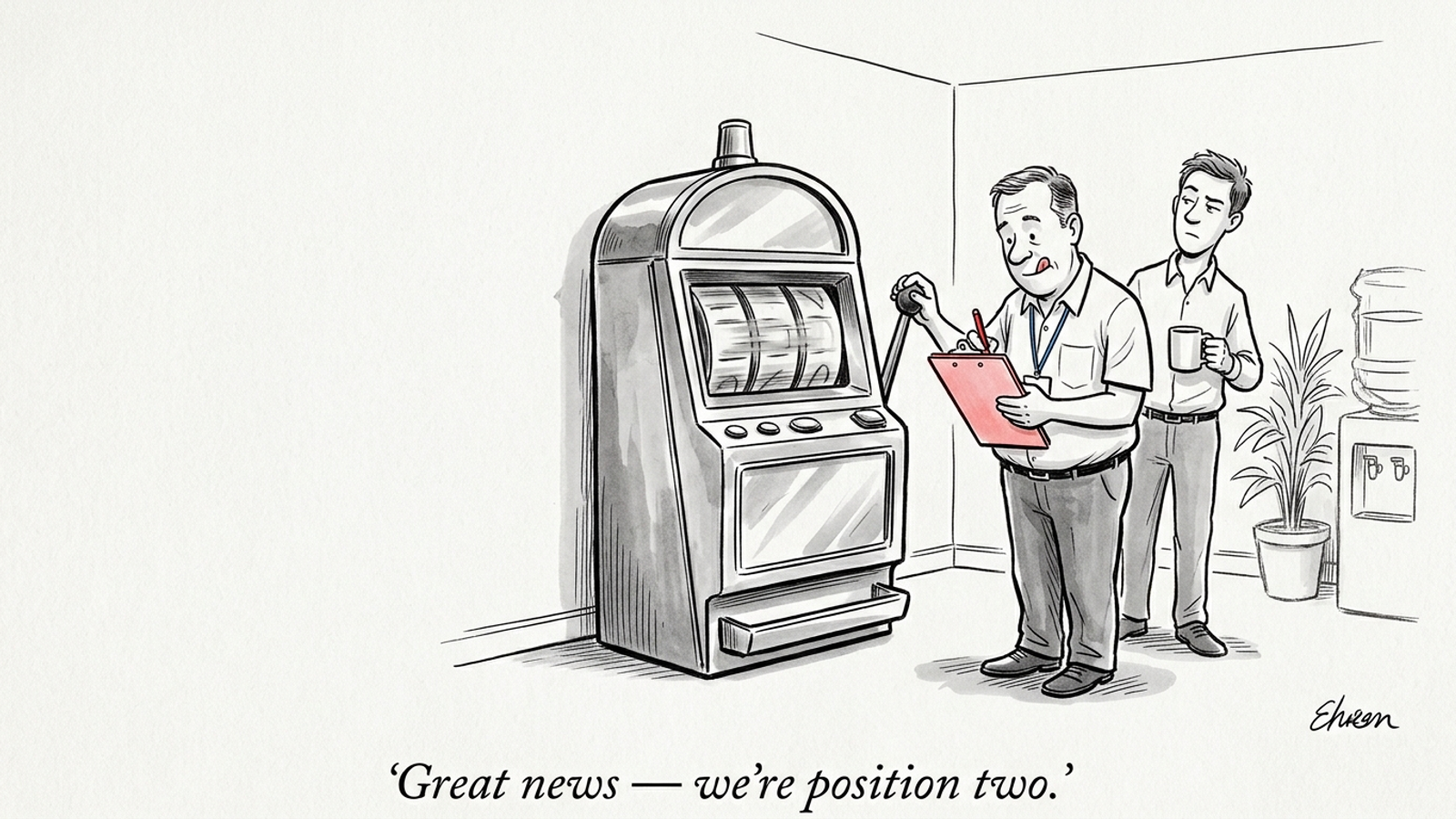
Set and forget
Official: There is no official Google Ads definition to memorize here. Set and forget is the promise that automation lets you choose a strategy and walk away.
Operator meaning: I hear the appeal, especially from people burned by monthly check-ins that produced reports instead of decisions. But automation still needs someone to decide which conversions are primary, what values they carry, which brand rules apply and whether offline revenue makes it back into the account.
The trap: Mistaking less manual work for less accountability. Clean inputs give the machine something worth learning; dirty inputs give it faster ways to buy the wrong outcome. If I could delete one phrase from every proposal deck, set and forget would go first. What the deck calls hands-free optimization, I call busywork running itself while judgment still needs an owner. That is the job I do now at groas, and it is the only part of this glossary that never needs a footnote.
Frequently asked questions
What Target ROAS should I start with in Google Ads?
Start at or slightly below your last-30-day actual ROAS rather than at a return your finance team would like. A target set above what the account can support can restrict spend and make the campaign look disciplined while it starves. Also confirm you have at least 50 valued conversions in 30 days and that budget is not capping the campaign.
Does a good Target CPA in Google Ads mean I am getting cheap customers?
No. Target CPA buys conversions at a price without knowing what each one is worth. If the conversion action is a form fill, the resulting CPA is a cost per form fill, not a cost per customer, so cheap leads can make the number look excellent. Check what the conversion action represents before judging the result.
What conversion value should I use for lead generation in Google Ads?
For lead generation, conversion value is usually a score you assign rather than revenue, such as 100 for a demo request from a large company and 10 for an ebook download. Without values that distinguish useful leads from cheap ones, Target ROAS cannot do the job you expect, and Target CPA or Maximize Conversions may be the more honest choice.
How long does the Google Ads learning phase last?
It can run from a week to a month rather than a fixed seven days, and low budget, thin impressions, long sales cycles and frequent edits can stretch it. Learning also continues after the Learning badge disappears, so a campaign does not become settled the instant its status changes. Judge it by the data and the changes you made, not just the label.
Should I run Performance Max alongside my Search campaign?
You can, but without brand exclusions or a clear budget split, a rise in blended ROAS may just reflect demand your brand Search campaign already had. Check whether Performance Max captured existing brand demand before calling the result new growth. Brand exclusions address brand queries, not overlap on the same generic query, so check non-brand overlap too.
What do I need to check before turning on AI Max for Search?
AI Max lowers the fences on Search campaigns, giving Google more room to match queries, adapt copy and choose landing pages. Before switching it on, review your old negatives and brand rules, and treat the expanded reach as something to manage rather than a free uplift. Check the queries, copy and destinations it chooses, especially if your site has few distinct service pages.
Do audience signals in Google Ads restrict who sees my ads?
No. Audience signals in Performance Max and Demand Gen are starting hints, not hard targeting fences. They tell the system where to begin, not where it has to stay, so do not assume only that audience saw the ad. Check who actually converted and what counted as a conversion; the outcome you reward is the stronger instruction.
Can I just set up Google Ads automation and leave it alone?
No. Automation still needs someone to decide which conversions are primary, what values they carry, which brand rules apply and whether offline revenue makes it back into the account. Clean inputs give the machine something worth learning, while dirty inputs give it faster ways to buy the wrong outcome. Less manual work does not mean less accountability.