

 LinkedIn

“Import successful. 14 campaigns, 62 ad groups, 418 keywords copied to Microsoft Advertising.” That screen proves a configuration transferred. It does not prove the resulting campaign deserves a dollar of spend.
I’m taking apart the direct-copy Google-to-Microsoft setup because it is the shortcut behind a lot of accounts described as “running on Bing.” The campaign names, keywords, ads and budgets arrive looking familiar. Familiar is not the same as tested. I’ll follow the setup in the order you encounter it and separate settings that need checking from decisions that need Microsoft-specific evidence.
The import screen: complete structure, incomplete case for spend
The setup under the microscope carries over campaign and ad group names, keywords with match types set on first import, responsive search ads with their pins, sitelinks, callouts, structured snippets, negatives and daily budgets. That visible structure transfers cleanly, which makes the success screen convincing. I used to point to that completeness as proof the second channel was live. I was wrong. It told me the structure was there, not whether the account was ready to spend.
Transfer completion and commercial readiness answer different questions. Microsoft’s import notes show why: Google Search plus partners maps to all Microsoft search networks, including syndicated partners; bids and budgets below Microsoft’s minimums get raised; and bid strategies do not arrive one-for-one (Microsoft import help mirror). The button is doing its job. It just cannot do the management job. For each piece that follows, I want to know whether we inherited evidence or merely inherited a setting.
1. The copied budget: a cap with no Microsoft case behind it
Say you spend $20k a month on Google and the import copies a $400-a-day campaign into Microsoft with the same cap. That number looks deliberate. It is a Google number wearing a Microsoft costume. The original budget reflects Google search volume, CPCs and competition for those keywords. Microsoft’s auction is different. Across 73 advertisers running search on both platforms, Microsoft CPC averaged $1.54 versus $2.93 on Google, about 47% cheaper, with 64 of 73 paying less on Microsoft.
A copied cap can sit mostly unused, or it can give poor traffic far too much room. Neither outcome tells you what the channel could earn with a budget set for its own demand. The imported number is a ceiling inherited from another auction, not a spending recommendation.
Verdict: adapt. Keep the campaign structure, but reset the budget to an amount you can afford to learn with. Increase it when Microsoft produces qualified volume, not because Google spends more. In an approval memo, I would put it plainly: the budget is guilty until proven innocent. This is where channel-specific management starts earning its keep. groas manages Search Ads across Google and Bing for a flat fee, rather than making the copied spend number the basis for a bigger management cut.
2. The bid strategy: check what the campaign now optimizes for
Your Google campaign bids toward enquiries. The import screen says the bid strategy copied. Look closer. If an imported campaign uses conversion-based bidding but Microsoft lacks conversion history, the strategy can become one that does not require conversions, such as Maximize Clicks. Unsupported strategies can fall back to Enhanced CPC with Microsoft-recommended bids. The label you expected is not enough; inspect the strategy that actually landed. Otherwise, a campaign built to find enquiries may start buying clicks instead.
There is a second trap if you put conversion-based bidding on a new account too soon. Imported campaigns using Maximize Conversions, Target CPA, Target ROAS or Maximize Conversion Value with zero history can get no impressions on generic terms; raising keyword bids does not help when the automated strategy ignores them. I used to treat a flatline like a keyword-bid problem. Sometimes the bidding setup was the problem.
Verdict: verify. Confirm the active strategy and make sure Microsoft UET records conversions before asking the platform to optimize for them. The cited note recommends Enhanced CPC or capped Maximize Clicks while you build evidence, then reconsidering conversion-based bidding at around 30 conversions. Start with a way to buy evidence. Automate against Microsoft evidence once it exists.
3. The keyword list: useful intent, still untested here
Your 418 imported keywords are a useful head start. Keep them. Just do not mistake them for proof of Microsoft demand. Google intent data comes from Google users, matched in Google’s auction. Microsoft users skew older and more desktop-heavy; they may phrase the same commercial need differently. Volume and close variants differ too. I used to call an import “instant coverage.” What it gives you is instant guesses formatted as coverage.

Verdict: retain, then review. Keep relevant intent and pause obvious Google-only baggage. For the first two to four weeks, use Microsoft’s search-term report to decide what you actually buy: add terms that convert as exact, negative queries that never will, and watch for LinkedIn-profile and partner-query creep that was not a problem on Google. I know the appeal of treating a familiar list as finished work. Resist it. A keyword spending on Microsoft queries you would never choose to buy does not earn a pass because it worked on Google.
4. The ads: finished-looking assets that still need an approval pass
Headlines and descriptions arrive intact, pins included. The preview looks finished. Before you approve it, check three things:
- Offer accuracy: Is the price, promo date or phone number still current?
- Destination behavior: Does the landing page work for Edge and desktop-heavy traffic, and does the form fire the Microsoft tag rather than only the Google one?
- Room to test: Has a single copied responsive ad left the ad group with nothing else to try for Microsoft’s audience and character limits?
I would keep the useful assets and rewrite around them. Verdict: preserve, do not assume. The import can carry an ad across. It cannot tell you whether its offer is current, its page tracks or its message fits this audience. Approve each ad only after those checks, and leave room to test a Microsoft-specific angle.
5. Conversion tracking: copied goals are not recorded leads
Microsoft cannot see your Google enquiries through Google’s tag. It needs its own UET tag site-wide and separate conversion goals before it can count them. The import helps less than its checkbox suggests. Where goal import is available, it brings across only certain online tag-based Google goals. GA-imported goals, Google call tracking and smart goals do not come across; even imported goals cannot count without UET. A tidy list of goals can therefore sit beside zero recorded conversions. The labels arrived. The measurement did not.
For a focused checklist of that failure, see Microsoft Ads Spending Without Converting? Audit the Google Import First. But a working tag is only the first test. A recorded form submission is not necessarily a qualified lead. Even a short-window comparison between platforms needs care: Microsoft attributes a conversion to the date it occurred, while Google attributes it to the date of the last click.
Verdict: reconcile. Confirm UET fires across the site, including the thank-you page, and that each goal shows it is recording. Then tie Microsoft reporting back to your CRM for 30 days before judging CPA. Closed-won revenue and cost per qualified opportunity decide whether the budget stays. Clicks and raw conversion counts do not.
6. The account after import: who actually owns the spend?
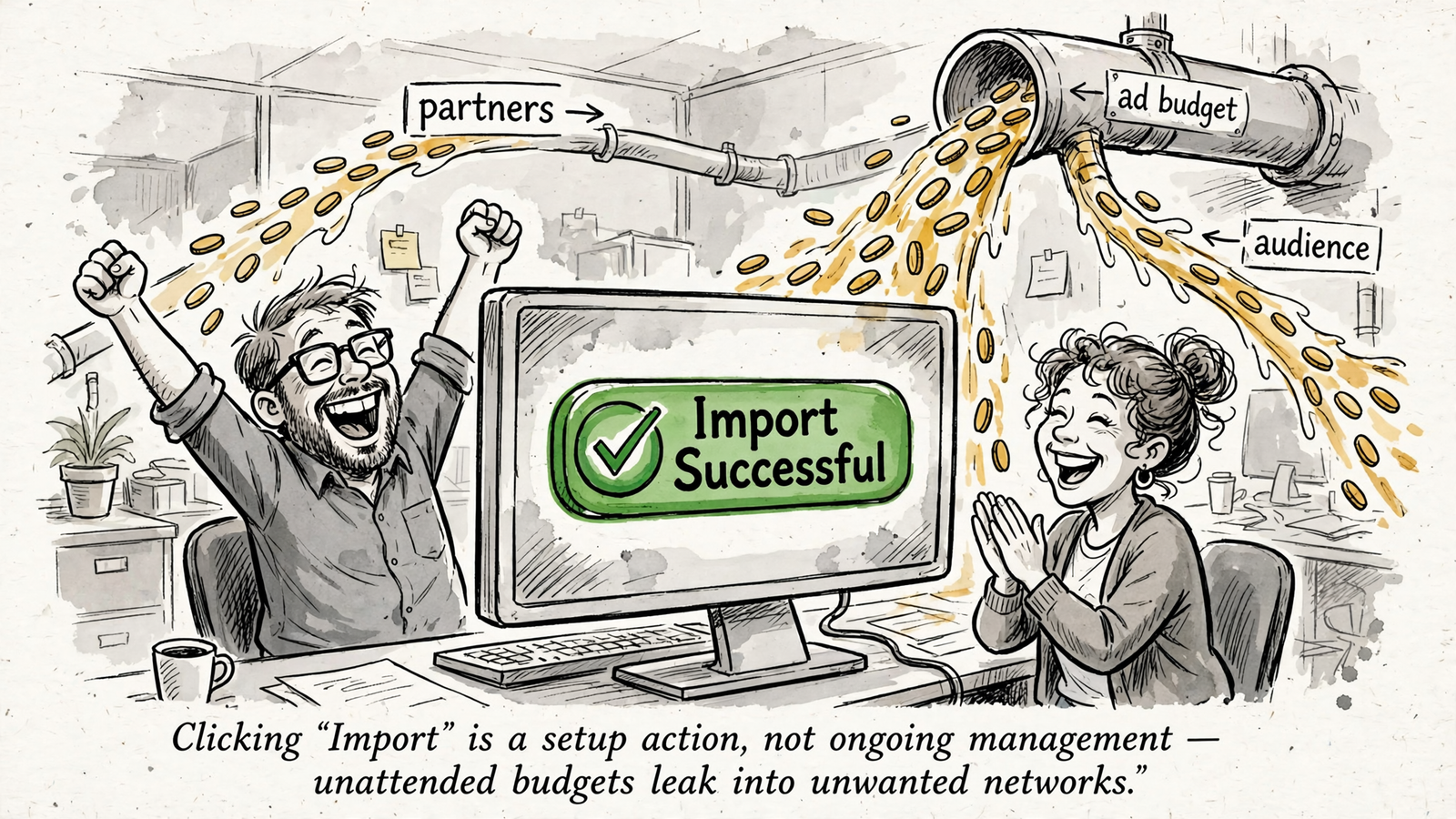
An import is a setup action. Management is what happens after it. When someone says Bing is now “covered,” I ask: who reviews Microsoft search terms, checks distribution, moves budget and explains each decision in writing? If the answer is nobody, the import has created a second account that inherits Google decisions and then sits.
That account can drift in a specifically Microsoft way. The import can put search campaigns into broader distribution, including syndicated partners and the Audience Network, even when the Google source was search-only. Low-quality partner traffic can then feed automated bidding a poor learning signal. The audit recommended there starts by restricting distribution to owned-and-operated only, then checking the publisher report before opening it wider.
Verdict: staff it or stop it. Without a named owner, scheduled search-term reviews, network checks and budget decisions, you do not have a managed second channel. You have a copy that may spend quietly. A generalist who imports and reports can preserve the settings. Someone has to prove the spend.
The approval memo: evidence I would ask for before scaling
If I had to defend this budget, I would ask for an adaptation log, not an import summary. In the first 14 days, the log should show what changed and why:
- A budget reset to a Microsoft-sized test amount.
- Search distribution restricted to owned-and-operated until the publisher report supports anything wider.
- UET installed site-wide, with goals showing they are recording.
- Bidding set to Enhanced CPC or capped clicks while Microsoft builds its own conversion history.
- The first Microsoft search terms reviewed, with relevant exact adds and unwanted queries made negative.
After that, I want a weekly record in plain language: which search terms were reviewed, which bids and budgets moved and why, which ads were tested, and what happened to qualified leads. No log, no management. A monthly PDF showing impressions and CTR tells me the copy job finished. The log tells me someone owns the budget.
Some teams should keep that work in-house. If Microsoft is a $500 test, you have one person with three to five hours a week for search terms and the publisher report, and your CRM already ties leads back to the channel, you do not need a specialist yet. Run the checks and review the account again in 30 days. Bring in a specialist when spend can hurt if it leaks into syndicated traffic, lead quality consumes sales time, or nobody owns Microsoft decisions.
That is also my test for an agency claiming to specialize in Bing Ads rather than bolting it onto Google. A tacked-on offer shows an import summary and a blended report. A Microsoft practice shows UET diagnostics, a separate budget and CPA to qualified opportunity, plus weekly search-term and network actions.
Overall verdict: keep the keyword list and usable ads; make everything else re-earn its place. The budget, bids, tracking and network settings arrive as guesses or checks still to be completed. I would put the work where it gets channel-specific attention, logged changes and a named person accountable for the result. That is the case for groas’s Search Ads management: Google and Bing treated as separate auctions with separate evidence, under one flat fee with no cut of spend. The import saves you typing. It never saves you deciding.