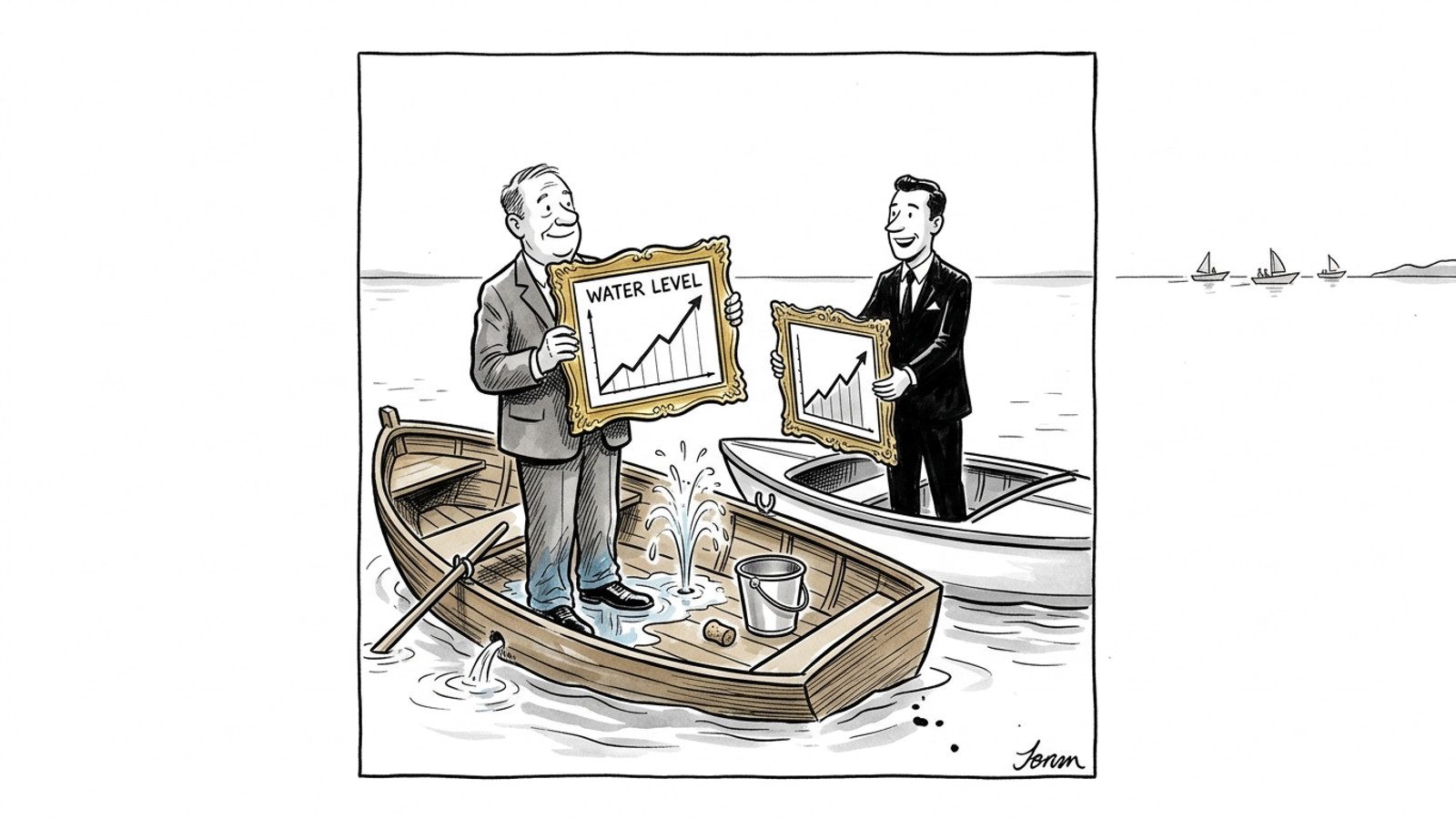

An agency changes your opening paragraph. Two weeks later, it emails a screenshot of your page cited in a Google AI Overview. The five comparable pages nobody touched might have gained citations too, but they are not in the screenshot.
That is the problem with most AI Overview optimization advice: a list of edits, followed by a before-and-after picture, with no control group. I would test it the way I used to test ad copy. Match pages, change one thing, check the same queries on a schedule, and agree on the win condition before anyone opens a CMS. Otherwise, “we got cited after the update” tells you when something happened, not why.
Citation turnover makes that distinction matter. Telemetry on commercial review and comparison pages found 15.3% AI Overview citation dropout, versus 12.1% for top-10 organic links. A citation can disappear or appear while you do nothing. The test needs a frozen holdout, not a prettier screenshot.
The question: did the edit earn citations, or did the sources rotate?
Why a before-and-after screenshot is not a result
An AI Overview citation is not a fixed prize a page wins once. The sources shown can change with the query and the check. An Ahrefs study of 863,000 keywords and 4 million AI Overview URLs found that 38% of cited pages came from Google’s top 10 organic results; 31.2% came from positions 11–100, and 31.0% from beyond the top 100. Organic position alone does not give you a predictable citation ladder.
So if you edit a headline on Tuesday and see your URL cited on Friday, write down the appearance. Do not call it a win. The useful question is whether edited pages improve more than comparable untouched pages over repeated checks.

Write the win condition before touching a page
For this protocol, a win is a sustained rise in citation frequency on the treatment pages relative to their own baseline and the holdout group’s movement. Do not pick a threshold after seeing the chart.
For example, if a page appears in two of twenty baseline checks, an appearance in one later check is not progress. You might decide in advance that twelve or fourteen appearances in twenty post-edit checks would merit a second test, provided the matched holdout stays near its baseline. Those are example thresholds for planning, not results I have observed or a universal standard for every site.
Record the rule in your sheet. If you cannot say what would make you keep, reject, or retest an edit, you are not ready to run it.
Setup: five matched pairs, then a two-week baseline
Pair ten pages before assigning treatment
Choose ten commercial or informational URLs targeting similar kinds of search intent. Do not pair a homepage with a deep comparison page, or an old pillar page with a guide published last month. Build five pairs using:
- Historical organic impressions in Google Search Console.
- Average monthly pageviews.
- Query intent, such as software comparisons, workflow guides, or service cost breakdowns.
Within each pair, assign one URL to the treatment group and freeze the other as the holdout. Matching will not make the pages identical. It gives you a more useful comparison than putting every URL you like in treatment and every awkward one in control.
Lock three to five buyer queries per page
Write down three to five real buyer queries for each URL before changing any copy. Use searches you actually care about, such as “b2b billing platform migration costs” or “target roas vs target cpa ecommerce.” Do not invent a phrase because it happens to produce your preferred citation.
Keep each page’s query list fixed for the whole test. The pages in a pair do not need to target identical wording, but their queries should reflect comparable intent. With ten pages and five queries each, you have fifty fixed queries. Changing the search terms every day until one shows your domain is not optimization. It is fishing with a spreadsheet.
Check the baseline for two weeks
Before editing, check every query on the same designated days at the same hour for two full weeks. Tuesday and Thursday mornings would give you four baseline runs. Use fresh incognito sessions with consistent location settings, or an automated browser without historical cookies. Keep the checking method the same afterward.
Log these fields for every check:
- Did an AI Overview appear?
- Did the page appear as an organic link?
- Did the page’s URL appear as a citation in the visible AI Overview source panel?
Five queries checked on four occasions produce twenty observations per page during the baseline. Record the URL, query, date, location setting, and result together. You will want the underlying checks when a chart later tries to tell a more confident story than the data supports.
SearchPilot’s account of SEO A/B testing describes the value of comparing changed pages with controls rather than treating a before-and-after movement as the effect of an edit. It is the same reason I would use an incrementality test for brand-search spend: first measure what happens without your intervention.
Intervention rounds: one change, then reset or start fresh
Run one round for fourteen days after the baseline. Keep the query set, check schedule, and holdout pages unchanged. Before testing another variable, restore the treatment pages to their baseline state or use a fresh matched cohort. If you leave the first change in place and add a second, you have tested a combination, not the second change alone.
Round 1: put the answer in the opening 60 words
On the five treatment pages, replace only the opening paragraph with a direct, declarative answer of roughly forty to sixty words. Answer the target query immediately. Cut throat-clearing such as “Choosing the right platform can be challenging,” along with promotional claims and context the reader does not yet need.
The proposed mechanism is simple: a clear opening gives a retrieval system a compact passage that directly addresses the query. Leave headings, images, schema, and layout alone. Freeze the holdouts. Check both groups for fourteen days before deciding whether the edited openings earned further testing.
Round 2: test a dated, sourced fact table
If you reset the openings, add only a structured fact table to the five treatment pages. Put it below the first subhead and give it four columns: feature or specification, verified figure or status, primary source, and verification date. Date and attribute every entry. Do not fill an empty cell with a number you cannot support just to make the table look complete.
Here the hypothesis is that aligning an entity, an attribute, and its source in one place makes the relevant information easier to extract than leaving it scattered across paragraphs. That is a hypothesis to test, not proof that a table will earn a link. Check the same fifty queries on the same schedule and compare the change in citation rate between groups.
Round 3: make schema defend its fee
Agencies like selling schema because adding JSON-LD looks tangible on an invoice. I would not treat tangibility as evidence. A controlled study comparing 1,885 pages that added JSON-LD with 4,000 matched control pages found no citation uplift across the AI platforms it tracked. It reported a 4.6% relative drop in Google AI Overviews; changes of +2.4% in AI Mode and +2.2% in ChatGPT were statistically indistinguishable from noise.
If schema is the variable you want to test, add appropriate TechArticle, Product, or FAQPage markup to the treatment pages without changing their visible copy or styling. Leave the holdouts untouched. If the groups do not separate after the scheduled checks, do not pay someone to describe the markup itself as an AI Overview win.
Round 4: expose content hidden behind interaction
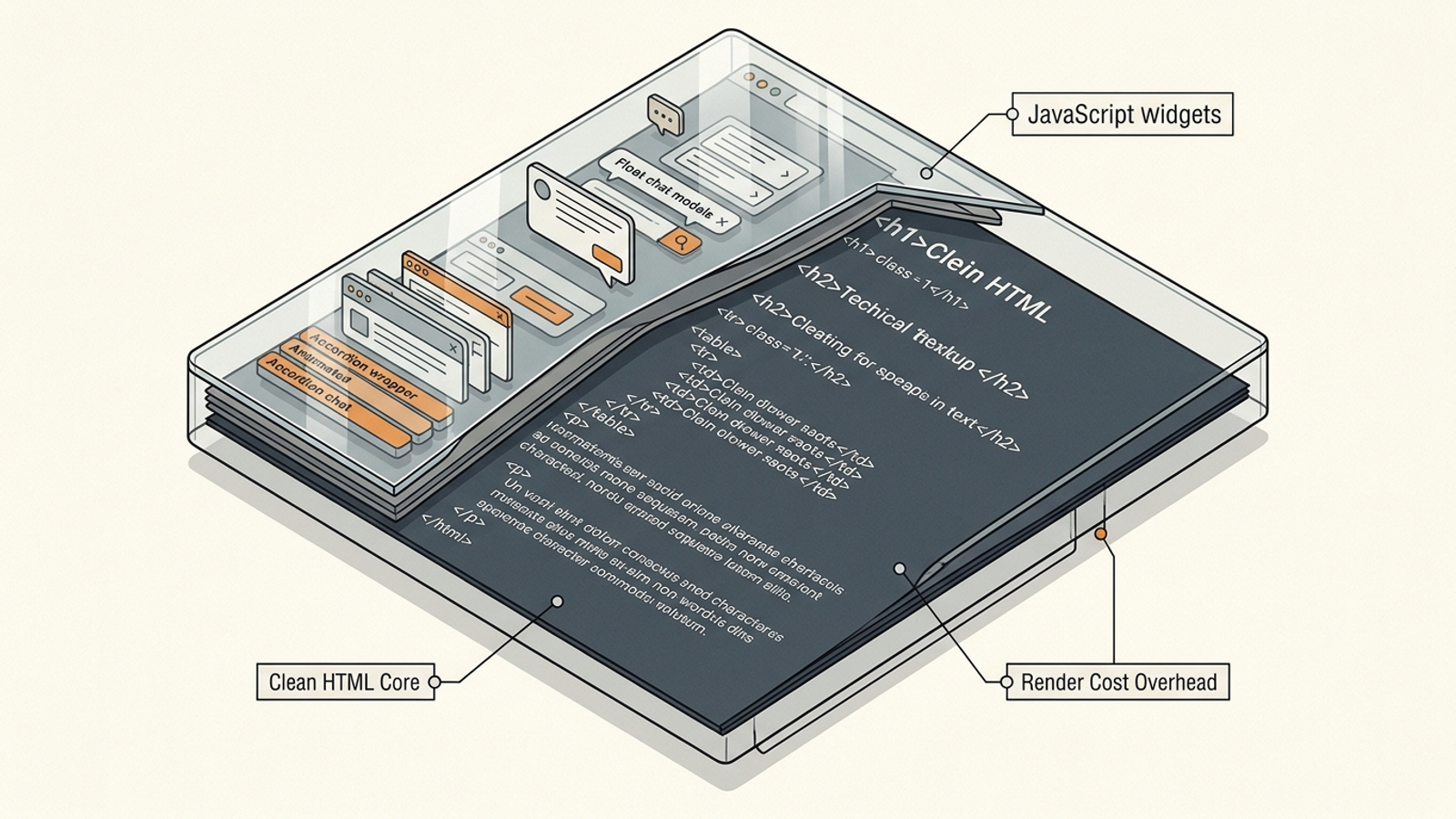
For this round, choose treatment pages where a critical answer sits inside a click-to-expand accordion. Change that one presentation pattern so the answer is visible as plain, static content in the page’s initial HTML. Leave other scripts, copy, and page elements alone. The holdouts keep their accordions.
The mechanism under test is whether making that answer available without an interaction improves its chance of being used. Do not also rewrite headings, remove scripts, and rearrange the page. Those may be useful changes, but together they make this round impossible to interpret. One round, one intervention.
Measurements: citation rate, search movement, and crawl timing
Count appearances across checks
For each group, calculate citation rate as total URL citation appearances divided by total scheduled checks across its fixed queries during the same window. Keep track of checks where no AI Overview appeared; coverage changes are part of what you need to see, not a reason to quietly discard rows.
If one page has five target queries checked four times a week, that is forty observations over fourteen days. Five appearances in forty checks is a 12.5% citation rate; twenty-four in forty is 60%. That would be a striking movement, but you still need to inspect what happened to its matched holdout and the other pairs. The group pattern matters more than one impressive URL.
Use Search Console as a diagnostic, not a citation counter
Check impressions and clicks for treatment and holdout pages over the same period. Search Console can help you spot broader search movement, but its search-performance reporting does not give you a clean, separate AI Overview citation series. Google’s reporting guidance explains how AI Overview links are counted within search performance data. Do not relabel an impression increase as citation growth.
If impressions rise across both groups while your scheduled citation checks do not separate, note the discrepancy. It is a reason to inspect the result, not to change your win condition.
Confirm when Googlebot fetched the edited URLs
A post-edit window is useful only if the edited pages have had a chance to be fetched. Inspect server logs for Googlebot requests to the treatment URLs and record when they occurred. To filter out spoofed user agents, verify Googlebot through reverse DNS and then forward DNS resolution.
If the first verified fetch of a treatment URL arrives on day eleven of a fourteen-day window, do not call fourteen days of flat citations a failed edit. Most of that window passed before the fetch you can verify. Flag the page and extend or rerun the observation period rather than giving the spreadsheet a false sense of precision.
Read the result without promoting a signal to proof
Treatment rises while holdout stays near baseline
Suppose the treatment group moves from a 15% citation rate to 55% across scheduled checks, while the holdout stays around 12% to 18%. That is the separation you were looking for. It supports the edit as a candidate cause more strongly than a before-and-after screenshot could.
Keep the change in your test notes, including which pairs moved and when the edited pages were fetched. Then test the same variable on another cohort before rolling it across the site. A small holdout gives you a reason to repeat a promising change, not a license to declare a universal rule.
Both groups rise together
Suppose treatment moves from 20% to 40%, while holdout moves from 18% to 42% over the same window. You have no clean evidence that the edit produced the lift. AI Overview coverage or source selection may have shifted across that query class. Do not credit your rewrite just because it happened first.
Mark the round inconclusive for that variable. This is exactly the result a screenshot-only report tends to hide.
Neither group moves
A flat result does not mean AI Overview citations cannot be influenced. It means this round did not show an effect for these pages, queries, and checks. If the edited pages were fetched and the opening rewrite produced no separation, stop polishing those openings as though another adjective will fix the chart. Try a different variable or a new cohort, and keep the null result in the notebook.
The vendor question: where are the untouched pages?
When an agency sells an Answer Engine Optimization retainer or a tool sells AI visibility tracking, ask: Where is your holdout test? Screenshots and citation histories can show what appeared. They cannot, by themselves, show what caused it.
If a vendor says its schema injection or content edits increase citations, ask for modified URLs alongside matched URLs left untouched, checked against fixed queries over a stated period. Ask what counted as a win before the results came in. If the answer is another screenshot, you are being shown monitoring dressed as incrementality.
At groas, we favor execution against explicit baselines and guardrails over paying for manual edits and a dashboard that merely watches what follows. Monitoring has a use. Calling every post-edit citation a result is an expensive spectator sport.
Run one round before buying the promise
Pick ten pages. Make five defensible pairs, lock the buyer queries, and spend two weeks measuring what happens without an edit. Then freeze five pages, change one thing on the other five, and keep checking on schedule. Decide in advance what separation would earn a second test.
If treatment pulls ahead while holdout stays put, you have a change worth repeating on another cohort. If they move together, do not buy a story about your edit. If neither moves, spend the next round on a different bottleneck. Either way, the result changes what you do next. A citation screenshot cannot do that.
Frequently asked questions
Why isn't a screenshot of my page cited in an AI Overview proof that my edit worked?
AI Overview citations can appear or disappear while you change nothing, so a screenshot shows timing, not cause. The article's telemetry found 15.3% citation dropout on commercial review pages versus 12.1% for top-10 organic links. Only comparing edited pages against matched untouched holdout pages over repeated checks tells you whether the edit earned the citations.
How should I decide in advance whether an edit counts as a win?
Define the win condition before touching a page: a sustained rise in citation frequency on treatment pages relative to their own baseline and the holdout group's movement. For example, a page appearing in two of twenty baseline checks would need something like twelve or fourteen appearances in twenty post-edit checks, with the holdout staying near baseline. Never pick the threshold after seeing the chart.
How do I set up a holdout test for AI Overview citations?
Pick ten commercial or informational URLs with similar search intent and build five matched pairs using historical Google Search Console impressions, average monthly pageviews, and query intent. Within each pair, assign one URL to the treatment group and freeze the other as the holdout. Then lock three to five real buyer queries per page and keep that query list fixed for the whole test.
What should I record during the baseline period before making any edits?
Check every query at the same times for two weeks, for example Tuesday and Thursday mornings, using fresh incognito sessions with consistent location settings. For each check, log whether an AI Overview appeared, whether the page appeared as an organic link, and whether its URL appeared as a citation in the AI Overview source panel. Five queries checked four times gives twenty observations per page.
What single-page changes are worth testing against a holdout group?
The article proposes four rounds: replace the opening paragraph with a direct forty-to-sixty-word answer to the query; add a dated, sourced fact table below the first subhead; add TechArticle, Product, or FAQPage schema without changing visible copy; and convert accordion-hidden answers into static content in the initial HTML. One round, one intervention, with a fourteen-day check window after each.
How do I calculate an AI Overview citation rate?
Divide total URL citation appearances by total scheduled checks across a group's fixed queries in the same window. If a page has five target queries checked four times a week, that is forty observations over fourteen days; five appearances is a 12.5% citation rate. Always compare the treatment group's pattern against its matched holdout rather than judging one impressive page in isolation.
Can Search Console show me whether I'm gaining or losing AI Overview citations?
No. Search Console impressions and clicks can help you spot broader search movement, but its search-performance reporting does not give a clean, separate AI Overview citation series. Also verify when Googlebot actually fetched your edited URLs, filtering out spoofed user agents through reverse DNS and forward DNS verification, since a flat result before the first verified fetch is not a failed edit.
What does it mean if both the edited pages and the untouched pages gain citations together?
It means you have no clean evidence that the edit produced the lift, because AI Overview coverage or source selection may have shifted across that query class. Mark the round inconclusive for that variable. This is exactly the result a screenshot-only report tends to hide, which is why the holdout group exists.