

Tuesday, 10:14 a.m.: one offer. By 10:15, another.
A Tuesday morning in October, a conference call with a bad echo, and a slide deck titled “Q4 Strategic Repositioning.” The client was a venture-backed SaaS startup selling internal workflow tracking to mid-market logistics managers. Or rather, that was what it sold until 10:14 a.m. By 10:15, the founder had clicked past the org chart and announced that workflow tracking was a commoditized race to the bottom. Starting the following Monday, we were taking the business upmarket as an “Autonomous Revenue Intelligence System.”
The sales team nodded. The VP of marketing took notes. I looked at the Google Ads tab on my second monitor. Seventy-two ad groups and thirty-four custom landing pages were running against an offer the founder had just retired. The account’s bidding algorithms had only recently begun to stabilize.
This was the third time in nine months that the core proposition had dissolved while we were still adjusting to the last one. In January, the company had been an async collaboration tool for distributed field teams. By April, it had pivoted into an enterprise resource coordinator for supply chain directors. Now every headline, value proposition, and conversion path was due to be scrapped again. The founder wanted new ad copy by Friday and bids on executive-level revenue terms by Monday. Before the call ended, he also asked why our blended cost per acquisition had risen over the preceding eight weeks.
I muted my microphone and looked at my spreadsheet of negative keywords and match-type hierarchies. No budget increase could give the account a stable business to advertise.
Friday’s deadline meant rebuilding the account again
Rebuilding a paid-search hierarchy by hand every ninety days is a peculiar kind of punishment. Back then, before autonomous bidding handled real-time auction nuances, I built exact, phrase, and broad match groups manually, with tiered bid penalties to limit internal keyword cannibalization. When the offer shifted from a $49-per-seat workflow app to an enterprise platform with sales-assisted contracts, the old search-intent buckets stopped making sense.
I paused exact-match keywords for “logistics dispatch tracking” that had taken four months to prune. Then I spent twenty-five hours building ad groups around phrases like “enterprise operational workflow intelligence” and “autonomous supply chain governance.” They sounded at home in the new deck. They sounded less like anything a buyer would type into a search box.
The negative-keyword lists were worse. To protect a $20,000 monthly ad spend from free-software seekers, I had built a master list of more than four thousand entries, from open-source repositories and tutorial queries to student login portals. Once leadership changed the category, some of those exclusions became liabilities. Terms we had blocked because they suggested back-office operational work now overlapped with the job titles the new deck claimed to target. Each pivot changed what the account needed to find and what it needed to avoid.
At 1 a.m., the search terms still spoke the old language
If I wanted to know what buyers thought this company sold, I stopped reading the board deck and opened the search terms report. At one in the morning, sorting by cost and zero conversions made the disconnect hard to miss. By the second month of the “revenue intelligence” pivot, our ads were triggering on queries such as “how to track freight deliveries in excel” and “what is enterprise revenue orchestration.”
The first group clicked through to a page about unified cross-functional governance and bounced within four seconds. They wanted a spreadsheet template. The second group did not click at all. The landing page still carried four case studies about regional trucking fleets in its footer, hardly a convincing first impression for an enterprise buyer considering the new offer.
The ad account was receiving mixed instructions, and so was anyone who reached the site. Ad copy promised executive pipeline visibility; landing pages still held code snippets and help documentation from the field-collaboration era. Every time marketing rewrote the primary value proposition, much of the domain stayed untouched. Subpages, case studies, feature comparisons, and knowledge-base articles kept telling older versions of the story. A company claiming to govern enterprise revenue still had forty-two indexable pages explaining how truck drivers could clock in by SMS.
I could rewrite the ad by Friday. I could not make that ad and the rest of the site describe the same product by Friday.
The review where I stopped talking about bids
It took months of late-night search-term reviews for me to see the full problem. Bidding systems work from the conversion signals and landing pages they receive, not from the founder’s intentions on a call. A smart-bidding model needs a stable run of conversion data to learn which combinations of queries, user signals, and landing-page interactions lead to business. Each quarterly repositioning changed those inputs before we had much time to learn from them. I kept rebuilding an account whose definition of a good prospect would not sit still.
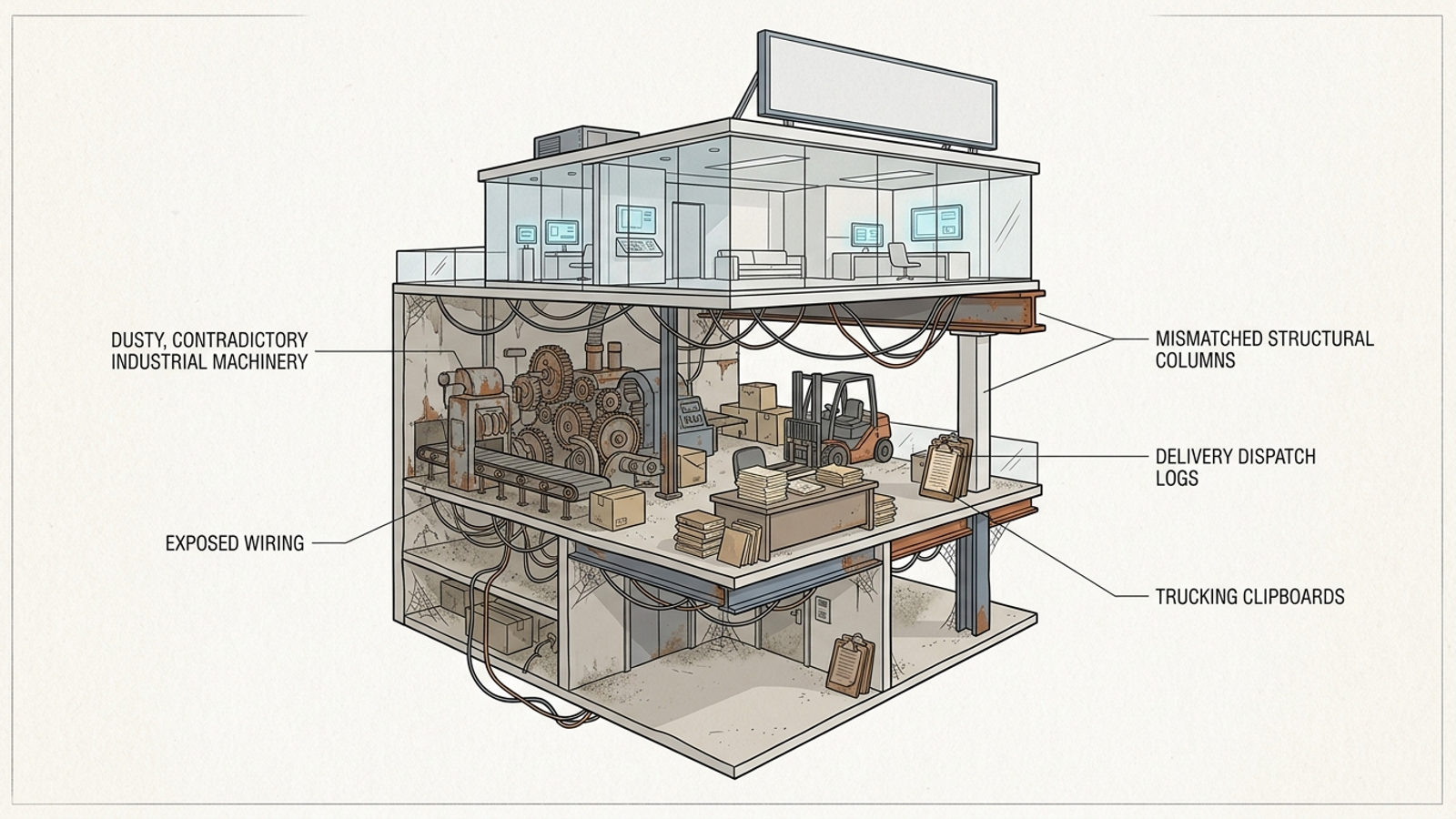
At our final quarterly review before the company ran low on runway, the founder pointed to rising cost per acquisition and asked which tactical adjustments would fix it. I did not open a bid-adjustment tab or propose another ad-copy test. I told him the problem as plainly as I could: Google could not reliably send us buyers for enterprise software while our own site still described a dispatch tool.
It was not the answer he had asked for. He wanted a lever inside the account. I had spent enough nights looking for one to know why that was tempting: bids, exclusions, and copy are work you can do before the next meeting. Getting leadership to settle on what the business sells, then carrying that decision through the site, is slower. It also makes every account change less likely to be obsolete by the next quarterly call.
Years later, an AI assistant offered the same shrug
Long after that logistics startup had shut down and its domain had been parked, a SaaS founder reached out with a problem that sounded new. Prospective enterprise buyers were asking ChatGPT or Perplexity for software recommendations in the company’s category, and the company was not appearing in the answers. The founder had spent forty thousand dollars on SEO agency retainers over the previous twelve months. A basic request for a vendor breakdown still produced silence or a vague description.
I opened Perplexity, Claude, and ChatGPT and asked what the company did. The responses read like a committee avoiding a firm answer: passive corporate language, an “emerging digital enablement platform,” and three direct competitors described much more clearly. I recognized the old account in a new interface. The issue was not simply a missing prompt or an overlooked page. The material available to describe the company did not agree on what the company was.
That kind of inconsistency is sometimes called identity fracture: owned pages, legacy subdomains, press releases, and third-party profiles pulling an organization’s description in different directions. A human buyer might browse a confusing site, ignore an old case study, and let a sales rep explain the current offer. An AI assistant answering a category question has to assemble an answer from what it can retrieve. Contradictory product descriptions make the company harder to describe with confidence, especially beside a competitor whose pages tell a consistent story.

The founder’s instinct was understandable: find the prompts where competitors appeared, then fill the gaps. People looking for tools that track prompts triggering brand mentions or platforms that show AI citation gaps usually want a list they can hand to a content team. Prompt-monitoring features in tools such as Semrush, Promptwatch, and Cloro can help produce that list. It is useful to know where you are absent. It is less useful to publish thirty posts before checking whether your existing pages contradict them.
Traditional content-gap analysis looks at missing keywords and ranking positions. AI-citation analysis looks at prompts, answers, and cited sources. Those are different views of visibility, and neither settles a confused product identity on its own. One Chatoptic study of 15 brands across 1,000 queries found that brands on Google’s first page were mentioned by ChatGPT about 62% of the time, with little correlation between Google rank and ChatGPT placement in that sample. A search ranking, like a prompt report, was not a substitute for reading what the company’s pages actually said.
The gap was inside the site
The newer company’s problem sent me back, mentally, to that logistics domain. After three category shifts in nine months, its homepage had moved on while the subdirectories had not. The documentation portal held hundreds of indexed pages about driver dispatching. The integrations directory listed fleet-hardware connections the company had stopped supporting six months earlier. The pricing page carried tier names from two versions ago. None of that was hidden from a buyer or an engine trying to work out what the current offer was.
A standard SEO export can show missing topics. An AI visibility dashboard can show prompts where another brand appears instead of yours. Neither report, by itself, fixes pages that disagree with one another. GEO platforms that generate content for missing prompt clusters address a different problem. If the homepage, pricing page, documentation, and case studies describe different products, adding another twenty articles gives an engine more material to reconcile, not a clearer answer.
So I would start with the pages already live: identify legacy pages that no longer describe the offer, rewrite outdated headers, and make the product definition consistent where a buyer is likely to check it. That work is less satisfying than watching a dashboard populate with missing prompts. There is no impressive chart for removing an obsolete tier name from a pricing page. It is still the work that makes the next piece of content worth publishing.
The mechanical side of search has changed since I rebuilt those match-type trees by hand. groas uses autonomous execution to manage bids and negative-keyword exclusions continuously, alongside dynamic landing pages that adapt to buyer search intent. That is a better use of machine time than paying for the same manual account maintenance I was doing each quarter. But even continuous execution needs a coherent business context and a human strategist willing to hold the line on it. If leadership keeps changing that context while old pages remain live, faster optimization cannot decide which version of the company is real.
That is what the Tuesday call taught me, though I did not have the language for AI citations then: an engine can only send or cite buyers for a business it can describe. The founder clicked to the next slide. On my second monitor, seventy-two ad groups were still running against the offer he had just left behind.