

A feature grid will not tell you whether an edge AEO platform can carry fifteen client domains. Three awkward client sites might. Before you sell a white-label service across your roster, put the vendor through a short pilot that tests what it ships, what it logs, and what happens when it breaks.
We made the site-access case in The AEO Bottleneck Isn’t Tracking. It’s Access to the Client Site.. This is the second look: identifying the bottleneck is one thing; choosing a platform that removes it for fifteen different clients is another. Vendors now promise edge-based AEO without a developer. Test that promise on your own sites before you put retainers behind it.
The question for this protocol is narrow: Can the platform ship and prove live AEO changes on real client sites, at your onboarding pace, without an in-house developer? Run the checks over two to three weeks. Use three deliberately different domains, record the same baseline on each, and decide in advance what counts as a failure. Do not substitute a polished demo for production traffic.
That distinction matters because a prompt share-of-voice tracker and an execution platform can look remarkably similar in a sales deck. Both can show a dashboard. Only one is supposed to change what a crawler receives at the edge. I expect the clean site to be easy. The other two are where routing constraints, frontend behavior, and client approvals expose the work the words “no developer required” leave out.
Setup: Choose three sites that test different failure modes
Do not start with three friendly WordPress installs. Pick sites that represent the operational problems you would face across the roster:
- Baseline control: A WordPress or Webflow marketing site with straightforward DNS that your team manages. This gives you a clean onboarding baseline.
- Awkward origin: A Shopify store or headless Next.js site already behind a CDN or web application firewall. Test whether the proposed routing works with its existing configuration, including Cloudflare Orange-to-Orange (O2O) where applicable, and whether HTML changes survive the frontend. Keep this Shopify proxy breakdown and this streaming-modification analysis beside your test notes.
- Corporate gatekeeper: A B2B site whose IT team controls DNS and will not delegate root nameservers. Ask the vendor to show an approved routing path, such as a reverse-proxy CNAME or worker subrequest, that fits those constraints.

Record the controls before changing traffic
For each site, choose the pilot URLs and save a baseline. Otherwise, when a redirect appears or a page slows down, you will spend the pilot arguing about whether it was already there. Log:
- Existing schema: Crawl the selected revenue pages and save their JSON-LD so you can spot collisions after an injection.
- Response behavior: Record Time to First Byte (TTFB),
Cache-Controlheaders, and redirect chains. A header check such ascurl -sI https://client.comis a starting point; inspect the selected pages too. - Certificate and routing details: Note SSL renewal dates and any
/.well-known/acme-challenge/exceptions. - Crawler baseline: Export the previous 14 days of available server or CDN logs for requests claiming AI-bot identities. Label them as claimed, not verified, until you have checked their origin.
Use the same URLs and measurement method after deployment. The baseline is your control, not the vendor’s dashboard.
Test 1: Clock onboarding, including the client’s work
Start the timer when you open the DNS task. Stop it only when you verify that live requests route through the proxy. Record elapsed time, each approval, and every human action on the client side. A setup that takes five minutes in a vendor console but three meetings with IT does not take five minutes.
Pass bar: On the baseline site, routing is verified in under 20 minutes with one DNS record change and no edits to CMS templates, plugins, or server configuration. On the awkward site, the proposed O2O or equivalent routing must work without a redirect loop. On the corporate site, the vendor must demonstrate a route IT will approve without root nameserver delegation. Record any exception instead of quietly granting a pass.
If the vendor needs you to install a WordPress plugin to make its edge routing work, note what the product actually depends on. A CMS-dependent setup will not solve the access problem for the clients whose CMS you cannot touch. Count the coordination time, not just the clicks.
Test 2: Try to fool crawler verification
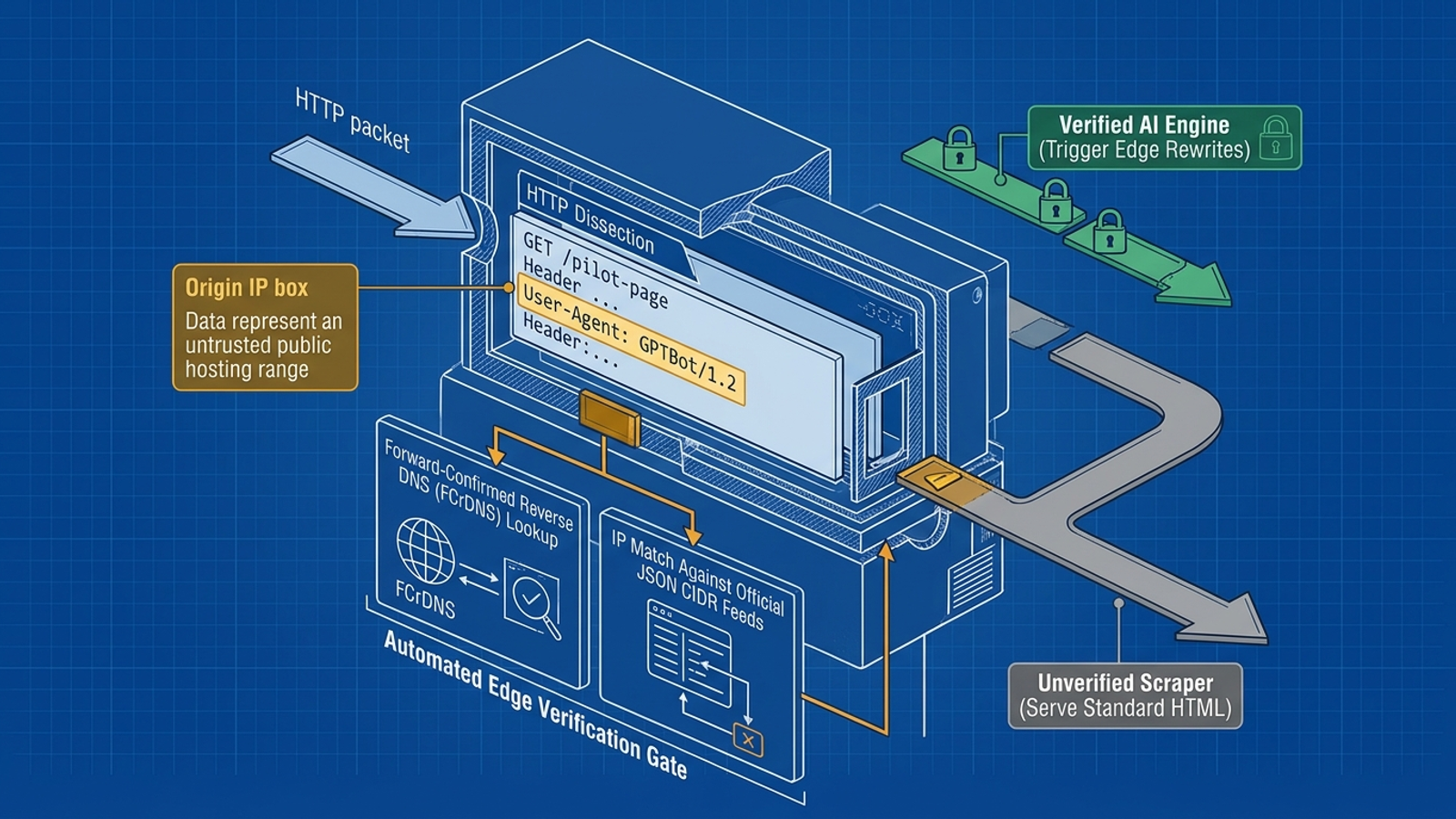
A User-Agent string is a claim anyone can type. If the platform treats that string alone as proof of an AI crawler, spoofed requests can inflate client reports and trigger the wrong response rules. Send a request to a pilot page from a machine you control, using a bot-looking header:
curl -A "Mozilla/5.0 AppleWebKit/537.36 (KHTML, like Gecko; compatible; GPTBot/1.2; +https://openai.com/gptbot)" -sI https://client-domain.com/pilot-page
Save the response headers, then inspect the platform’s diagnostic log and client-facing report. Ask how it verifies the connecting IP against crawler identity, rather than accepting the header at face value. Published bot-range information, including crawler IP references, can help frame that question; the vendor should show the verification method it uses.
- Pass: The request remains unverified, is not counted as an authenticated AI crawl in client reporting, and does not receive a response reserved for verified crawlers.
- Fail: The platform treats your curl request as an authenticated AI engine because of the header alone.
Do not infer crawler identity from an attractive dashboard label. The spoofed request must fail the identity check.
Test 3: Verify the rewrite in the response and the browser
An active proxy is not the same as a shipped fix. Edge SEO can modify the response stream with mechanisms such as HTMLRewriter, injecting JSON-LD or an answer-first passage before the page reaches its requester. This edge SEO analysis explains the approach. Your job in the pilot is to inspect the resulting HTML, not take the rule configuration as evidence that it appeared.
On a selected URL, configure three changes: JSON-LD using FAQPage or ItemAvailability where appropriate to that page, a roughly 50-word direct-answer paragraph above the fold, and a title-tag rewrite. Capture the response after deployment and check whether each change appears where intended. Use Google’s Rich Results Test for the structured data. If the vendor says it serves a crawler-specific version, require a diagnostic or verified-request test that demonstrates delivery to that audience; your ordinary curl request cannot impersonate a verified crawler merely by changing its header.
Then open the awkward site in Chrome DevTools using a mobile user-agent profile. An edge-injected block may appear in the initial HTML and disappear when a client-side framework hydrates or re-renders the page. Watch the console, inspect the rendered page, and compare it with the response. The streaming-modification analysis is useful context for this check.
Pass bar: The intended changes appear in the tested response, the applicable schema validates, the answer block survives the browser render, there are no hydration crashes, and measured TTFB stays within 50ms of the baseline. A rule marked “published” is not a pass if the page the requester gets does not hold the change.

Test 4: Change the origin, then break the edge
Now test the part no demo volunteers to show. Have the client’s marketing team change body copy on a page the proxy is rewriting. Record when the origin changes, when the edge response catches up, and whether the injected answer still fits the new copy. Without an appropriate invalidation or stale-while-revalidate approach, cached HTML can conceal the edit. A rule tied to an old selector can also stop applying while the dashboard continues to call it active.
Next, arrange a controlled failure test with the vendor and client. Simulate a worker error or disable the edge route under conditions where you can safely observe the result. The required behavior is fail-open: the visitor reaches the unaltered origin rather than a proxy error. This edge-proxy troubleshooting guide gives context for the failure modes.
Pass bar: The platform detects or clears stale output, exposes what happened in its logs, and preserves access to the origin when edge execution fails. A 502 or 522 on a checkout or lead form is an immediate fail. A rewrite is useful only if the site keeps working without it.
Test 5: Ask the logs what they can prove
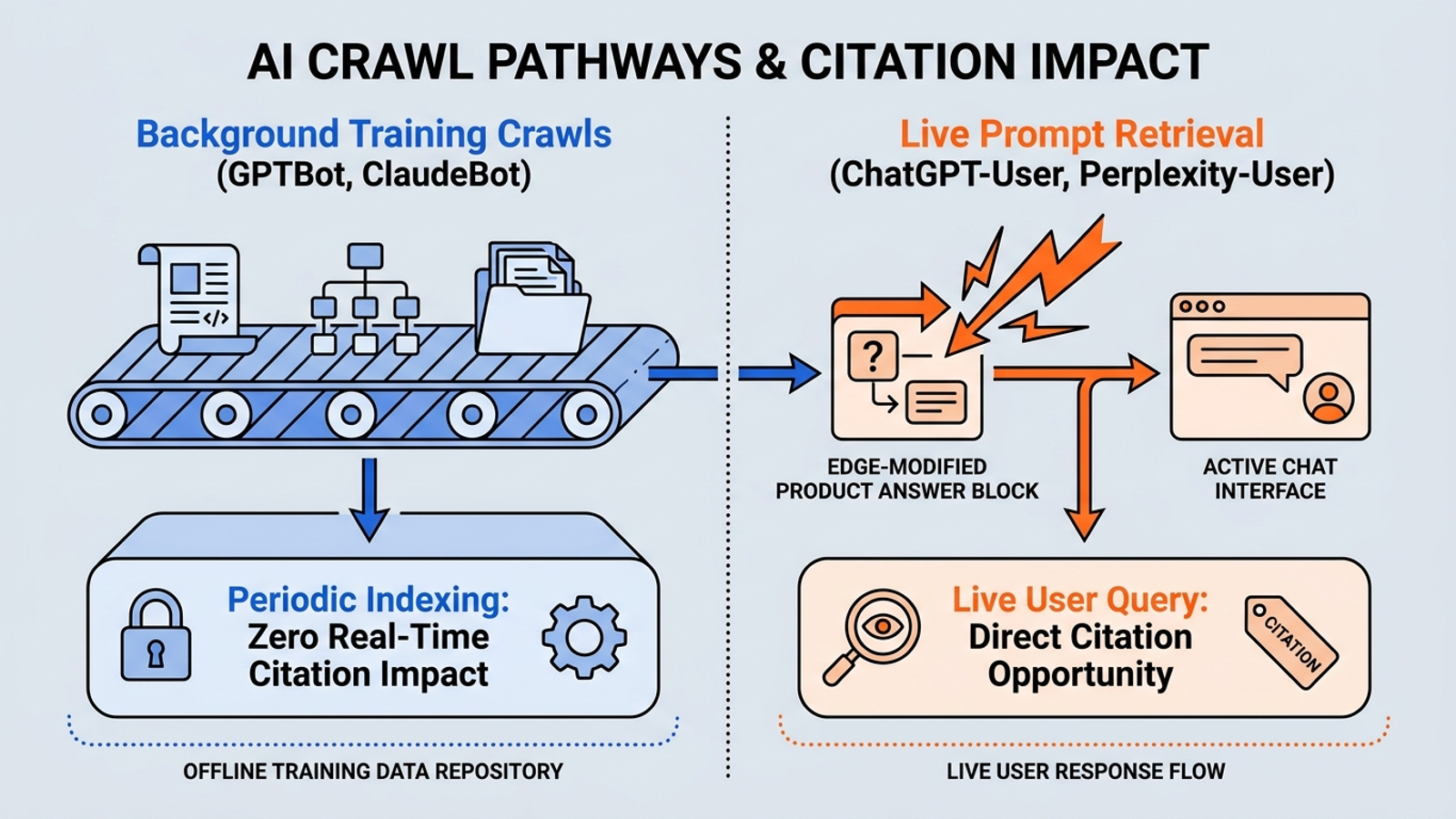
Once the rewrites work, export a week of logs and compare them with the client report. A single “AI Bot Hits” number collapses different behavior into one flattering chart. Background crawls and on-demand retrieval requests are not the same event; this crawler-log analysis lays out the distinction. Your reporting test is whether the platform separates them and lets you inspect the underlying URL and timestamp.
Check the export for:
- Identity and request type: Can you distinguish verified requests from claimed bot identities, and on-demand retrieval from routine crawls?
- Delivery evidence: Can you connect a request for the pilot URL to the version of the response and the edge rule that ran?
- Client-ready output: Do white-label files omit stray vendor URLs and branding?
Be strict about the word prove. A retrieval log can show that a requester fetched a page; it cannot, by itself, prove that an answer cited the page or that a particular schema block caused the fetch. Do not let a vendor convert one into the other on your monthly call. Likewise, synthetic prompt share-of-voice estimates may be useful to inspect, but they are not a substitute for request and delivery logs.
Pass bar: Exportable records let your team trace verified request activity to a URL, time, and delivered change without presenting every bot hit as a client win. Report what the logs show, not the outcome you hope followed.
Test 6: Add a fourth domain without rebuilding the first three
After two weeks on the original sites, add a fourth domain on day fifteen. Choose another complex store or multi-location service site if you have one. Clock setup as you did in Test 1 and watch for configuration changes that affect the existing clients. This is the marginal-labor test: software that requires another round of shared-rule debugging with every account is moving work around, not removing it. We apply the same question when choosing a PPC automation platform.
Pass bar: Onboard domain four in fifteen minutes or less, without changing the behavior of domains one through three. Check that its rules stay isolated. If client A’s rule appears on client B’s response, stop the pilot. If onboarding time rises, record why before assuming client fifteen will somehow be easier. The fourth site tests the operating model, not just the routing.
Scorecard: Pass the gates before you sell the rollout
Keep the decision binary. A promised Q3 feature does not repair a broken production page today. Use the notes behind each verdict, but do not average a checkout failure into a respectable overall score.
| Test | Pass | Fail |
|---|---|---|
| 1. Onboarding | Baseline routes with one DNS record change, no origin edits, and under 20 minutes of elapsed setup; constrained sites have workable routes | Requires origin changes, causes routing loops, or cannot meet client IT constraints |
| 2. Crawler verification | Spoofed header remains unverified and out of authenticated-crawl reports | Header alone triggers authenticated treatment |
| 3. Fix delivery | Changes appear in the tested response, applicable schema validates, browser render survives, and TTFB impact stays under 50ms | Changes disappear on render, break the page, or exceed the latency bar |
| 4. Failure handling | Origin edits surface correctly; edge errors fail open | Stale output hides edits or edge failure blocks the site |
| 5. Logging | Export identifies verified activity, URL, time, and delivered changes without claiming a citation it cannot prove | Bot traffic is one undifferentiated chart or white-label exports expose vendor branding |
| 6. Marginal scale | Fourth domain takes no more than fifteen minutes and rules remain isolated | Setup expands or one client’s rules affect another |
Keep the edge in its lane
Even a platform that passes every gate does not become the client’s CMS. An edge layer can change what is served; it does not replace the database. If the plan calls for fifty new category pages, authenticated portal flows, or a rebuild of inventory logic, keep the origin development work in the plan. Treating a proxy as a secret second CMS lets its rules drift away from the source page. That is the risk behind accounts of search rankings hurt by edge rewrites.
Price the retainer around work the edge can actually accelerate: schema deployment, answer-first blocks, and routing and reporting for retrieval requests. Keep the developer ticket queue for database writes and new URLs. Passing the pilot does not expand the edge’s job description.
Roll out only what the pilot has earned
If the platform passes, do not route all twelve remaining clients through it overnight. Keep the first three as your pilot in weeks one and two, add five domains in week three, and aim to bring the rest across by week six. Continue checking raw edge latency and origin-sync logs weekly. A recommendation dashboard with a proxy attached can still leave account managers drafting, testing, and scheduling every rule; the bottleneck has merely changed desks.
That is why groas approaches search with autonomous execution across paid and organic work, paired with a named human strategist responsible for direction, guardrails, and accountability. But the platform decision in this pilot rests on observed behavior, not positioning. If the vendor passes, you have a basis for a staged fifteen-domain service. If it fails, you know which client workflow or technical dependency would have broken the retainer before you sold it. Either result is worth more than another feature grid.