

 LinkedIn

Two-thirds of one merchant’s reported ChatGPT purchases were view-through conversions. The remaining click-through purchase was still unmatched to a Shopify order, leaving approximately $332 in spend without a reconciled acquisition cost.
That is not evidence that ChatGPT Ads failed. It is evidence that an agency cannot turn a platform conversion column into client revenue by copying it into a nicer template.
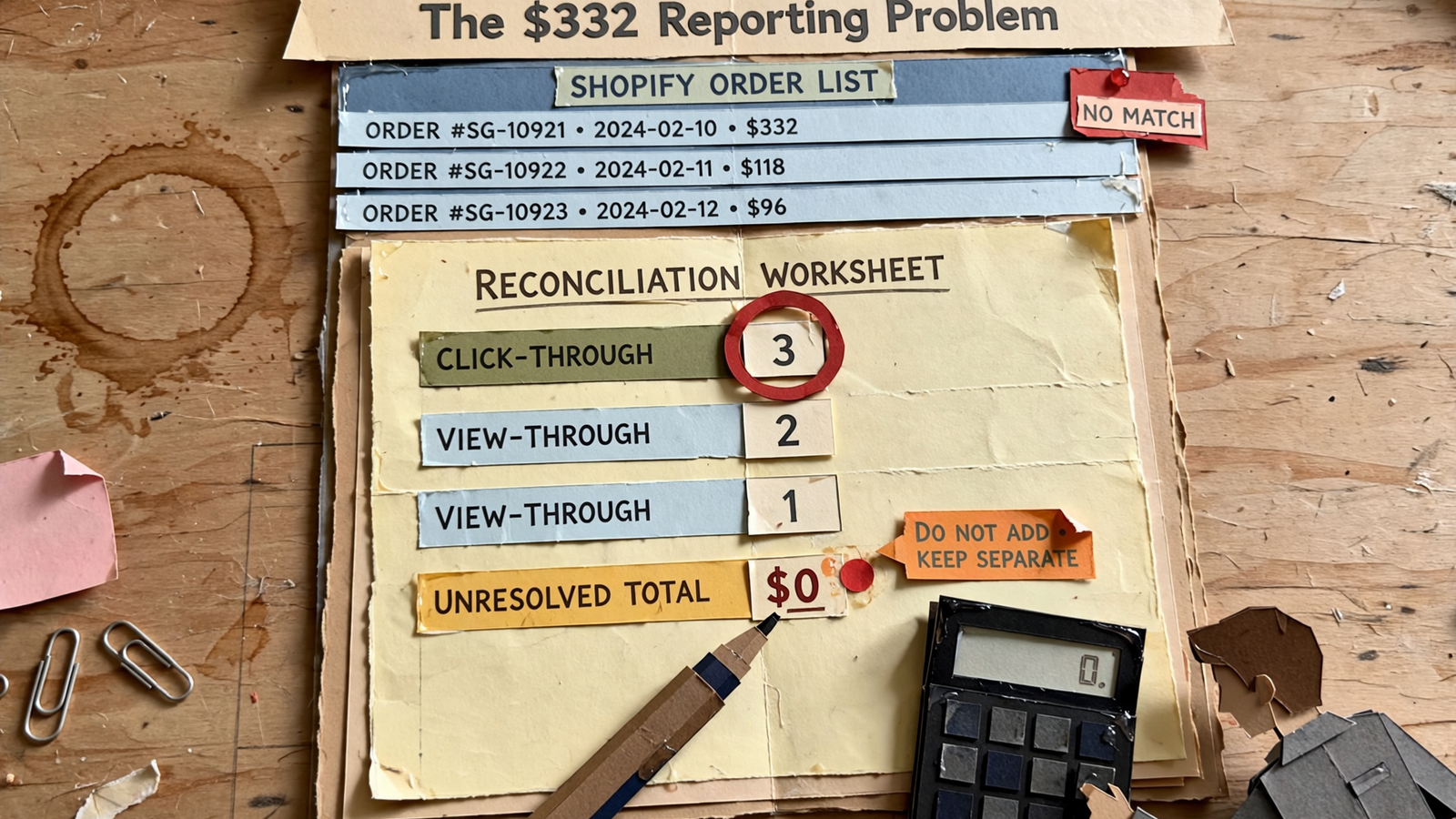
I am working from one merchant report posted October 12, not an audit. The merchant described approximately $332 in spend, three purchase conversions in Ads Manager, and no Shopify orders attributed to ChatGPT. Two conversions were acknowledged as view-through; the remaining click-through purchase was unresolved against store records.
I have not seen the account, pixel logs, or order export. Every case figure below is reported, and the arithmetic is mine. That limited evidence still exposes a useful problem: the same spend produces three different reporting statements. Only the statement that preserves the unresolved reconciliation belongs in front of a client.
The case shows a mismatch, not a channel verdict
Here is the merchant’s report stripped of the implied success story:
| Reported item | What the merchant described | What remains unresolved |
|---|---|---|
| ChatGPT ad spend | Approximately $332 | No account export reviewed |
| Platform purchase conversions | Three | No underlying event log reviewed |
| View-through purchases | Two | No matched store orders supplied |
| Click-through purchases | One | Could not be matched to a store order |
| Shopify attribution | No orders attributed to ChatGPT | Whether any actual order corresponds to the platform events |
No ChatGPT-attributed Shopify orders does not prove that no orders happened. It tells me the reporting systems did not agree when the merchant checked them. It does not identify the cause.
Platform attribution, store attribution, and verified orders answer different questions. A platform assigns credit under its attribution rules. Shopify assigns credit under its own rules. An order record establishes that a transaction exists. Those are related checks, not interchangeable ones.
Timing adds another complication. A conversion that has not appeared yet cannot be reconciled from a screenshot taken now. But a reporting delay is only a possible explanation, not permission to assume that missing orders will eventually turn up.
The practical starting point is narrow: preserve the discrepancy. Do not call it a failed channel test, and do not call it three acquired customers.
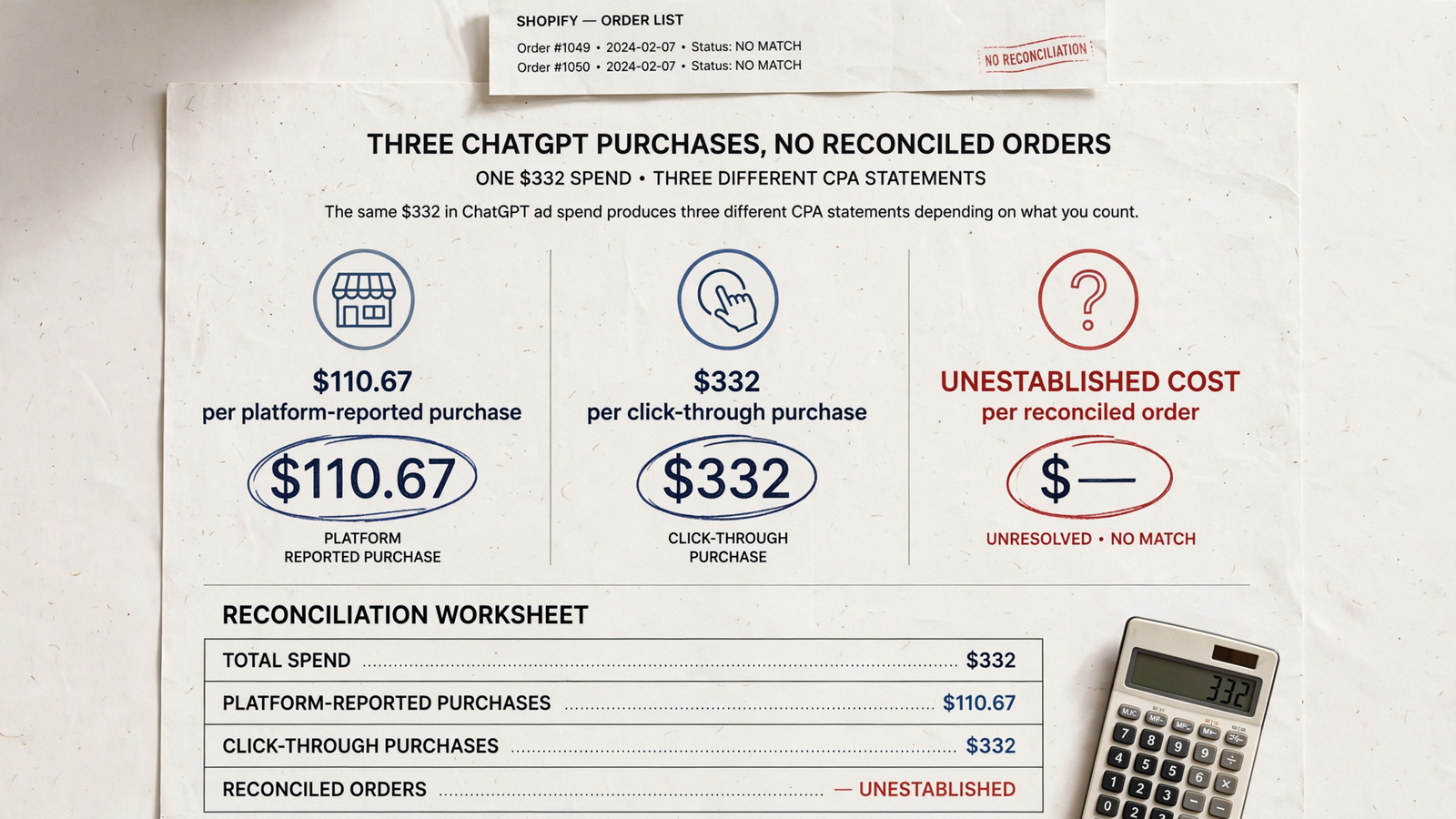
The same spend produces three different reporting statements
I get the following calculations from the merchant’s reported figures, without assuming that any purchase event corresponds to a verified order:
| What I count | Calculation | Defensible label |
|---|---|---|
| All platform-reported purchases | $332 ÷ 3 | $110.67 per reported purchase |
| Reported click-through purchase only | $332 ÷ 1 | $332 per reported click-through purchase |
| Reconciled ChatGPT orders | No matched order IDs supplied | Cost per reconciled order: unestablished |
The spend is approximate, so the first calculation’s decimal places are arithmetic, not evidence of precise measurement.
The first row includes view-through credit. The second removes it. The third asks whether the platform events can be connected to actual store orders. That is where the evidence runs out.
Neither calculated ratio is a verified acquisition cost. Both can appear in a report if their labels survive the trip from Ads Manager to the client deck. Neither can responsibly become “we acquired customers at this CPA.”
Reporting latency makes premature comparisons especially weak. Reach describes a default attribution window of 30-day click and 1-day view, with conversions appearing 24 to 48 hours after they happen. The same guide describes spend lagging clicks by 7 to 8 hours.
Those timings explain why early snapshots can disagree. They do not establish why this merchant’s records disagreed, or guarantee that waiting will resolve them. I would let the reporting delay clear, then match records rather than compare headline columns.
Until that work is done, cost per reconciled order is not zero. It is unknown.
View-through credit accounts for most of the reported result
Two of the three reported purchases, or approximately 66.7%, were view-through. That percentage describes this report alone. It is not a ChatGPT Ads benchmark.
The attribution settings matter because they define which events receive credit. The available reporting windows are described as 7-, 14-, or 30-day click, with view-through off or set to one day. Changing those windows changes reporting, not optimization, bidding, or billing.
Under the described last-touch rules, click attribution takes priority. A view-through receives credit when someone converts within the eligible view window without a qualifying click. The useful distinction is therefore:
- Click-through: a reported purchase credited to a qualifying ad click.
- View-through: a reported purchase credited to an eligible ad view without a qualifying click.
- Reconciled order: an actual store order matched to the relevant records.
The first two describe attribution. The third describes reconciliation.
I can summarize the merchant’s platform total as three reported purchases. I cannot summarize it as three confirmed store orders. Nor does removing view-through credit magically verify the remaining click-through.
Browser-pixel tracking can lose visibility when ad blockers, Safari protections, or cross-device journeys interrupt the tracking chain, as Reach’s tracking guide explains. That is a reason to investigate the instrumentation. It is not proof of what happened in this account.
There is another limit: reported totals may include modeled conversions. Some credit can therefore reflect statistical estimation rather than a directly tracked buyer. The report does not establish whether that applies here, so I would not invent a modeled share.
A qualifying click makes the attribution claim narrower, not automatically verified. Until the reported click-through is matched to an order ID and supporting event records, $332 divided by one remains a reporting ratio.
What the deck calls full-funnel visibility, I call two systems grading different tests.
The client report needs separate lines, not a blended win
A client needs a reconciliation that the finance team can repeat, not just an Ads Manager screenshot. Reporting that places platform figures alongside analytics and store orders makes the disagreement visible instead of burying it. It also leaves room for profit and MER rather than platform ROAS alone, an approach reflected in this agency reporting guidance.
For this case, I would keep the following fields separate:
| Report field | What belongs in it |
|---|---|
| Spend and dates | Approximately $332, with the reporting period and known reporting lag |
| Attribution settings | The click window and whether view-through reporting is enabled |
| Click-through purchases | One reported; none reconciled to an order ID in the supplied account |
| View-through purchases | Two reported, clearly labeled as view-through credit |
| Reconciled store orders | None established from the supplied evidence |
| Open discrepancy | The click-through purchase remains unmatched |
The unresolved row belongs in the client report, not just the agency’s internal notes. Otherwise the agency knows something material that the client cannot see.
My client-facing wording would be:
The platform reports one click-through purchase and two view-through purchases on approximately $332 in spend. No ChatGPT orders have been reconciled to store order IDs in the supplied report, so acquisition cost and attributed revenue remain unestablished.
That is not a refusal to report results. It is the result available so far.
I would also label any modeled share if Ads Manager discloses it. Where it does not, I would not present the whole column as an observed list of buyers.
The same discipline applies across reporting systems. A platform claim and a Shopify claim may describe the same sale; they are not additional revenue just because they occupy different columns. That is the attribution overlap behind the familiar problem of multiple platforms claiming the same sale.
Separate credit types. Reconcile orders. Do not turn overlapping claims into extra customers.
Reconciliation starts with the tracking chain
To investigate the unmatched purchase, I would start with the click identifier and event records, not a broader collection of personal data.
The documented flow begins with an oppref parameter on the landing URL. The pixel stores it in a first-party __oppref cookie and attaches it to later events, with server events sent through OpenAI’s Conversions API. Kukie describes that pixel and cookie flow here.
A redirect, consent step, or checkout transition can interrupt that chain. A real sale can then lack the attribution evidence needed to connect it to the ad. Again, that is a failure mode to check, not a diagnosis of this merchant’s account.
My reconciliation sequence would be:
- Check the landing path. Confirm that
opprefsurvives the relevant redirects and checkout journey. - Inspect the purchase event. Look for the order ID, timestamp, and evidence that the event carried the click identifier.
- Check browser and server delivery. Confirm that pixel and Conversions API events use shared event IDs so the same purchase is not counted twice.
- Match against store records. Keep any unmatched event unresolved rather than filling the gap with an attribution assumption.
Reach’s guide recommends pixel plus server-side tracking rather than pixel-only measurement. That gives the investigation more than a single browser event to work with. It does not remove the need to check deduplication or order records.
Better instrumentation supports reconciliation; it does not substitute for it. A purchase event is still something to match, not a receipt to take on faith.
A white-label partner must own the mismatch
When an agency delegates execution, it does not delegate the client’s expectation that the numbers mean what the report says they mean.
I would start partner selection with a sample report, not creative samples or a promised CPA. The sample should show spend, attribution settings, click-through purchases, view-through purchases, and reconciled store orders separately. A single blended conversion total tells me very little about how the partner handles an unresolved account.
Then I would put responsibility into the scope of work:
- Who checks that the click identifier survives the landing and checkout path?
- Who owns pixel and Conversions API implementation and shared event IDs?
- Who investigates disagreements between Ads Manager and Shopify?
- Who keeps unresolved purchases labeled unresolved in the client-facing report?
- Who approves any acquisition or revenue claim before it reaches the client?
Billing and attribution also need separate treatment. The cited account of platform settings distinguishes impression billing, which optimizes toward view and click conversions, from click billing, which optimizes toward post-click conversions. The attribution window itself changes reporting only. A partner should be able to explain that distinction without using the report setting as a catch-all explanation for performance.
Reconciliation responsibility belongs in the SOW, not in Slack after the mismatch. If nobody owns the investigation, the agency still owns the client call.
That is where groas’s done-for-you model has an advantage over fulfillment that stops at a dashboard: senior strategists own the result, and actions are logged with their reasoning. Execution has an accountable owner rather than becoming another set of recommendations for the agency to interpret.
That operating model does not change the arithmetic. I would apply the same reporting discipline used for white-label Shopify ads: separate credit types, inspect tracking, match order IDs, and leave unresolved rows visible. Accountability means answering for the discrepancy, not making it disappear from the presentation.
A good fulfillment partner welcomes that inspection. A weak one calls it unnecessary.

The numbers support reconciliation, not scaling
For this merchant, the evidence stops at a precise boundary:
- $110.67 per reported purchase includes view-through credit.
- $332 per reported click-through purchase excludes that credit but remains unreconciled.
- Cost per reconciled ChatGPT order is unknown.
Even a matched order would not, by itself, prove that the ad caused a sale that would otherwise not have happened. Attribution assigns credit. Reconciliation establishes a connection to an actual order. Incrementality asks a different question: what changed because the advertising ran?
Geo-lift tests, audience holdouts, and third-party lift studies address that last question. The available discussion describes ChatGPT incrementality work as early-stage, with partners including Haus, Measured, and WorkMagic named as options in this account of lift testing and attribution. This merchant report contains no such test, so it supports no causal conclusion.
The decision is narrower, and useful enough: do not scale this test on three reported conversions. Let reporting delays clear, investigate the tracking chain, and reconcile the purchase events against order IDs. Then judge what the evidence actually establishes.
That is how an agency keeps a $332 reporting question from becoming a client refund conversation.


