
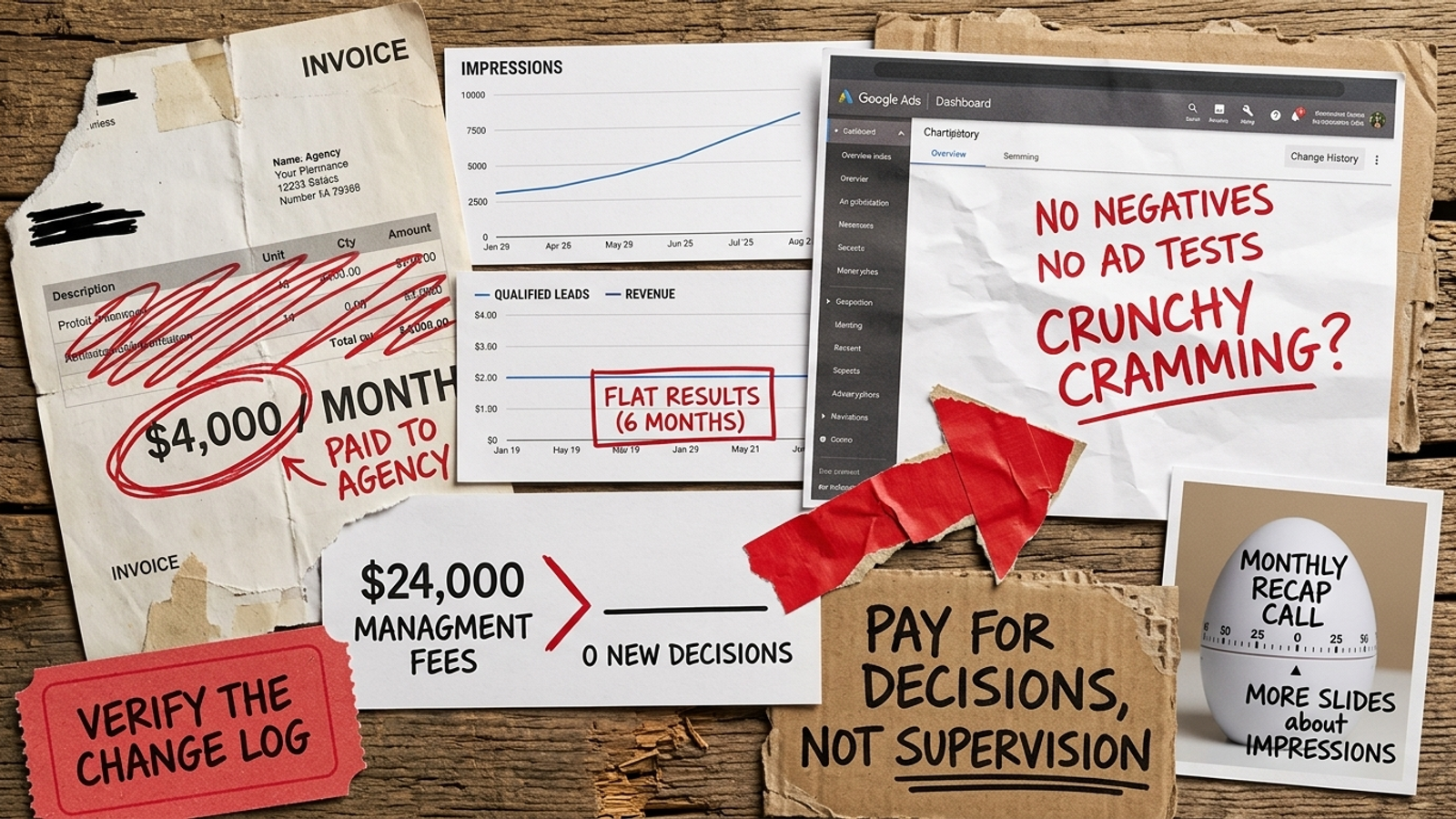
If you are the owner paying an agency $4,000 a month while your Google Ads results sit where they were six months ago, you do not need another slide about impressions. You need to know whether anyone has been doing the work.
You have paid $24,000 in management fees, plus perhaps $60,000 to $120,000 sent directly to Google. Your customer acquisition cost is still within two percentage points of where it started. Yet every thirty-minute recap call brings another deck: impressions up 14%, click-through rate steady, search impression share holding. Qualified pipeline and attributable revenue? Flat.
You ask why. First it was the Google Ads learning phase. Then seasonal drag. Now it is auction competition, the economy, or Smart Bidding needing a few more weeks. You leave wondering whether you expect too much, and whether replacing the agency with AI would finally fix it.
I have managed accounts by hand, and I would not switch anything on that evidence alone. AI is not the first question. The first question is whether the work you are paying for still happens. A flat result can have several causes. Six months of flat results and an empty change log tell a much narrower story.
Your retainer should buy decisions you can inspect
At $4,000 a month, you are not paying someone to keep an eye on a dashboard. You should see ad tests, search-term reviews, negative keyword additions, landing page alignment work, audience decisions, and budget changes tied to a commercial goal. Not every week needs a dramatic campaign rebuild. Every month should contain a defensible answer to: what did you try, what happened, and what will you do next?
That answer should be understandable without a tour of every Google Ads menu. If the team says a search-term review found waste, ask which queries it found and what changed. If an ad test did not improve the result, ask what it ruled out. An unsuccessful test can still earn its place in your retainer. An unexplained month cannot. You are looking for decisions that respond to what the account is telling you, not a quota of edits.
I know how an account can drift away from that standard. Onboarding gets attention. A senior buyer audits the setup, writes ads, and checks tracking. Then the account settles into a routine, the senior person moves on, and a junior manager has too many accounts and too little time. Automation handles more of the routine maintenance, but the retainer does not shrink. What was sold as active management becomes monitoring with a monthly presentation attached.
That is the part worth challenging. Automated bidding has reduced some manual campaign work. Fine. If a task no longer needs a person, I am not asking the agency to perform it ceremonially so the timesheet looks busy. I am asking where that saved attention went. Did it go into better tests, cleaner conversion signals, sharper search queries, and decisions about qualified pipeline? Or did it leave the account altogether?
Take the $4,000 invoice and divide it by the hours of actual attention your account received. If the answer is two hours, that is $2,000 an hour. Those hours might be worth it if they produce consequential decisions. They are hard to defend if they cover little more than checking rejected ads and daily budget caps. Pay for the decisions, not the appearance of supervision.
Check the work before you accept the excuse
An agency can do useful analysis without making a platform edit every day. I would not fire someone because Tuesday’s change log is blank. But if performance has been flat for two quarters, the team should be able to show the tests, findings, and decisions behind its claim that it is managing the account. “We monitored the algorithm” is not an explanation by itself.
Google Ads Change History gives you a place to start. Open your account, set the date range to the last ninety days, and look at changes made by your agency’s users separately from automated actions. Find the ad revisions, keyword changes, negative keywords, budget reallocations, and campaign adjustments. Then put their dates beside your review calls and the results the agency reported.
Look for a sequence, not just a total. A budget change may follow a finding about which campaign brings qualified enquiries. A new negative keyword may answer a search-term problem the team raised on a call. If you cannot connect an edit to a diagnosis, ask what prompted it. If the team described a problem but made no visible change, ask whether it took action elsewhere or decided to wait. Either can be reasonable. Neither should be a mystery.
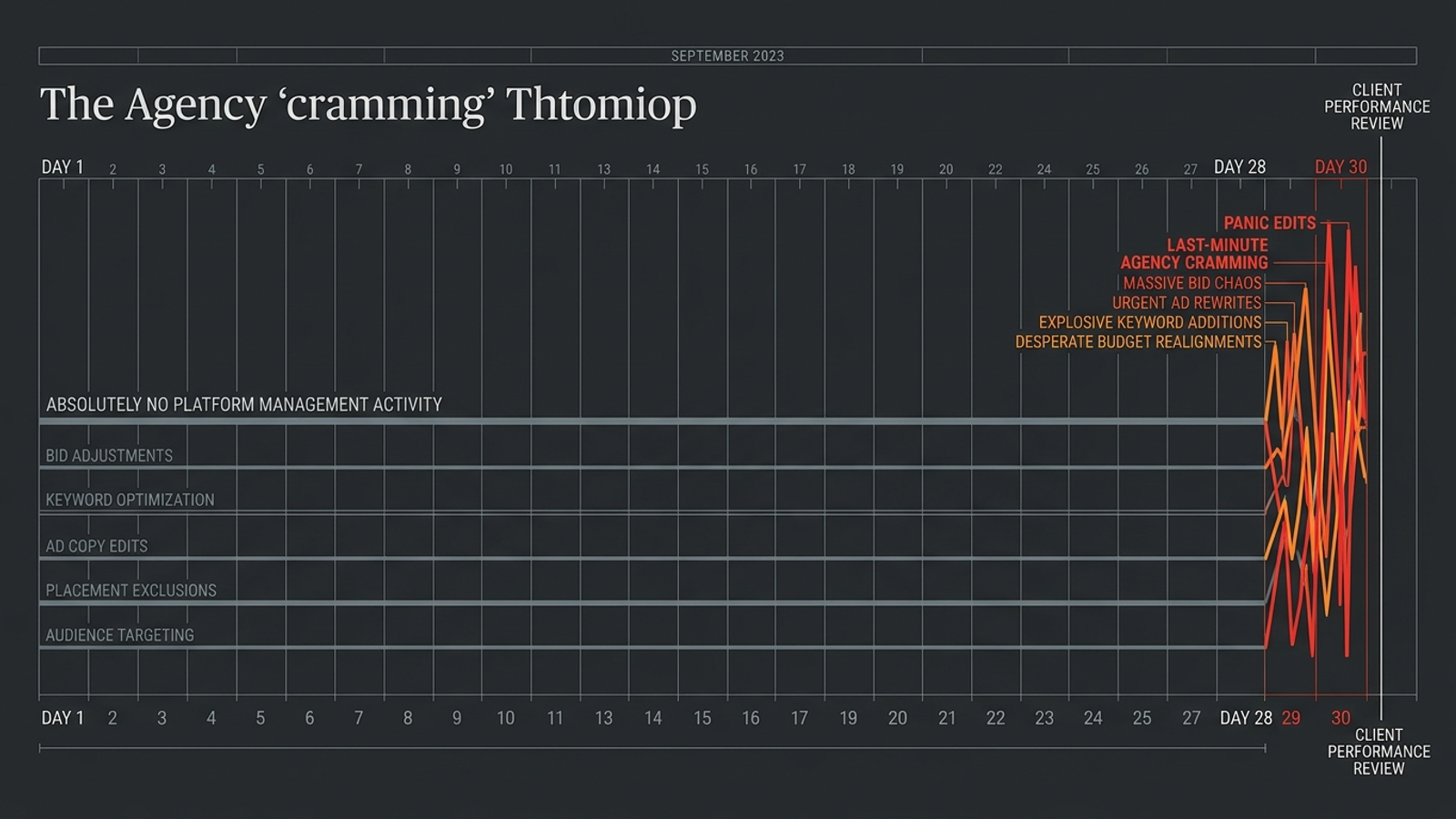
Some neglected accounts show long stretches of silence followed by a burst of edits just before a meeting. Operators call that cramming: a few hurried changes made in time to have something to discuss. A pre-call cluster of edits does not prove every earlier hour was wasted, but it is a fair reason to ask what happened during the quieter weeks. If the only answer is a graph of impressions, keep asking.
Do not mistake the log for a complete record of strategy, either. An agency may have reviewed a landing page, investigated a tracking problem, or recommended an offer change outside Google Ads. Ask to see that work. Compare its dates and conclusions with what you were told on the monthly calls. The point is not to count clicks in a change log as though activity were performance. The point is to see whether there was a continuous line from diagnosis to action to result.
That line may end with a disappointing result. You can live with that if the agency tells you what it learned and what it will try next. What you cannot evaluate is a vague claim that conditions were difficult, followed by another month of the same plan. You hired someone to make decisions under imperfect conditions. Ask to see those decisions, including the ones that did not work.
Our 10-point account audit goes deeper. For now, three months without new negatives, ad tests, or budget decisions deserves a direct explanation. Patience is sometimes the right strategy. It still has to be a strategy someone can articulate, not the name given to an untouched account after the fact.
AI helps when execution is the bottleneck, not the data
Once you find thin activity, the tempting move is to fire the agency and buy an AI bidding tool that afternoon. I understand the impulse. I also know how quickly a faster system can spend money on the wrong thing.
AI cannot fix broken unit economics or corrupt tracking signals. If your primary conversion is an unqualified form fill, a bot submission, or a thirty-second visit, autonomous management will optimize toward those signals. It will not infer that your sales team hates the leads. Give a bidding system bad conversion data and it can pursue bad conversions with impressive efficiency. That is not a rescue plan.

Before you blame the operator or replace it, compare what the account calls a conversion with what you call a customer worth acquiring. If those are different things, improving the campaign’s reported numbers may leave your pipeline exactly where it is. This is why the agency’s answer about qualified pipeline matters more than its answer about clicks: it tells you whether the people managing your spend understand the outcome they are meant to pursue.
With clean tracking, the comparison changes. A human manager checks an account between other work. Search terms, bids, and budget opportunities do not wait for that manager’s calendar. An autonomous growth engine such as groas can make bid adjustments, filter wasteful queries, and reallocate spend continuously, while a named strategist sets direction and guardrails. The advantage is not that a machine has better taste than every media buyer. It is that sound decisions can be executed without waiting for the next account check-in.
That distinction matters if your account’s problem is neglected execution. It matters less if nobody knows which conversions lead to revenue. Before you replace the operator, make sure the system has a useful definition of success.
When a human diagnosis comes first
If you spend $800 a month and see three conversions per quarter, an autonomous bidding model has little data to work with. If your offer has not shown product-market fit, or your sales cycle takes nine months and no offline conversions reach your CRM, an algorithm cannot invent demand or see the sales outcome it needs to learn from. You need help with the offer, customer understanding, and conversion infrastructure first.
That does not mean you need to keep paying $4,000 a month for static ad groups and a PDF chart. It means you should buy the human work the problem actually calls for. Fix the signal before you accelerate the spend.
Before you leave, protect the account you paid to build
If the evidence points to an exit, do not send the cancellation email before you check access and preserve what you can. A difficult handoff gets harder when you discover that the agency controls permissions, billing, or tracking. Work through these steps before the conversation, in this order:
- Confirm access and billing ownership. Check your administrative access to Google Ads, GA4, Google Tag Manager, and Google Merchant Center, and confirm who controls the billing profile; check access directly rather than relying on a contract description.
- Review the last ninety days of Change History. Separate agency-user edits from automated actions so you have a factual record for the discussion.
- Export search terms and negative keyword lists. Keep the queries, spend, and conversion history you will need to avoid repeating obvious waste.
- Audit primary conversion actions and post-click tracking. Check whether the account optimizes for qualified pipeline, closed-won revenue, or validated customer actions rather than spam forms or unverified page views.
- Save an offline account copy in Google Ads Editor before giving notice. Synchronize the account and export a backup of the campaign setup; skipping this leaves you more dependent on the agency if the handoff becomes difficult.
That last item is the one I would not leave until tomorrow. An Editor backup is not a substitute for access to every connected platform, and it will not make a damaged handoff painless. It does give you a record of campaign settings before anyone starts changing permissions or assets. Losing that record can turn a straightforward switch into avoidable reconstruction work.
Ask for the work on your next call
On your next status call, share your screen and open Change History for the past sixty days, filtered to the agency’s users. Ask: “Walk me through the campaign tests and negative keyword work your team completed over the last eight weeks. What happened to qualified pipeline?” Then give them room to answer.
A good answer may include work outside the platform. It should still have dates, decisions, and a connection to the outcome you hired the agency to improve. You do not need the manager to pretend every test won. You need to hear what the team noticed, what it chose to do, and why the next move follows from the result. If you get another tour of impression share instead, you have learned something important without making a blind switch.
If tracking is sound and your spend gives an autonomous system enough signal to act on, consider replacing intermittent maintenance with continuous execution and a named strategist accountable for the business goal. If tracking is broken or the offer still needs validation, address that first. Neither problem improves because you keep paying the same retainer out of habit.
I wrote to an owner ready to fire an agency that walking away from sunk fees hurts. So does paying another quarter for work you cannot find. Check the account, protect it, and make the next payment a decision rather than a reflex.
Alexander