

 LinkedIn

A repeatable monitor lets you see exactly where ChatGPT stopped recommending you: which buyer question flipped, in which market, and what the new answer cited. Most people ask once, screenshot the answer for Slack, and call that visibility. I used to tell clients to do that. I was wrong.
One ChatGPT answer is a spot check, not a monitoring system. In one test of 434 answers across seven software categories, only 9 of 32 ChatGPT brand appearances repeated across all four runs. If the answer flips the week you edit a page, the timing makes a good story. It doesn’t tell you whether the edit did anything.
I’ll show you how to build a monitor around 24 real buyer questions and use Claude to review the results. Whether you use a spreadsheet, a standalone tracker, or Claude with groas, my test is the same: can you pull up the exact question, the market, the full answer, and the cited sources when a result changes? If all you get is a visibility score, you’re decorating the dashboard.
1. What counts as a recommendation?
I’ve seen clients spot their name in an answer and celebrate while the sentence telling the buyer what to choose points to a rival. That’s why I log three things separately:
- Mention: The answer names your brand, even if it’s buried in a list.
- Citation: The answer links to your domain or to a page about you as evidence.
- Explicit recommendation: The answer tells the buyer to pick you for their situation.
One answer can do all three. It can also cite your page and recommend somebody else. I make explicit recommendations the headline rate and keep mentions and citations alongside it so I can see the difference. For a worked example, see Track ChatGPT Recommendations in Claude: Prove the Pick, Not the Mention.
Before writing prompts, pin down the product, the buyer situation, the market, and the rivals that matter. Say you’re spending $20k a month advertising a CRM for 10-person law firms in the US, and buyers are weighing Clio and PracticePanther. That gives you a buyer to write for, a market to record, and a rival list to check. Keep prompts that name your own brand out of the headline rate. Use them to check whether ChatGPT gets the facts about you right, not whether it would bring you up on its own.
2. Which setup should I use this week?
I pick the setup based on what I need to do after I read an answer. There are three routes worth considering.
Manual checks are where I’d start. Ask a real buyer question three times in clean ChatGPT sessions with web search on. Keep the answers in a sheet. It costs nothing and shows you what you’d actually want to log before you pay someone else to log it. The problem is week two, when the novelty wears off and somebody still has to run the panel. Spreadsheet, Script or Tracker? The Small-Business AI Mention Test lays out the cost tradeoff.
Standalone trackers save you the reruns, but check what you can inspect. Ask how many runs sit behind each number, whether the headline rate excludes prompts that name your brand, and whether you can read the full answers and open the cited URLs. If a score goes down and the tool won’t show you the rows behind it, you’ve automated the part that makes the chart, not the part that explains it.

I prefer Claude with groas when the next step is fixing a page. Connect Claude to groas over MCP and it can work with the AI search answers and citations groas collects, alongside your site and research data. That includes competitor landing pages and funnels, Reddit research, and SEO data from Semrush and Ahrefs. Instead of stopping at “the answer changed,” I can compare what the answer cites with what my page says, then have Claude draft an edit for approval in the same chat.
groas Unlimited is $19 a month, flat, for the whole team, with unlimited teammates, ad accounts, and websites, plus every feature and all the data. It’s not a free tracker. If all you need is a free snapshot, start with a manual check or a free checker that uses its own prompts. And don’t substitute Google’s Generative AI performance report in Search Console for this job. Google impressions don’t tell you whether ChatGPT recommended you. Pay for the setup when you’re ready to keep the evidence and act on it. Skip it if you only need the screenshot.
3. How do I build a panel I can rerun?
The repeatable manual method starts with 20 to 30 real buyer questions and three runs per question. I use 24. Here’s how I’d set up the panel in Claude:
- Collect questions buyers already ask. Start with sales call transcripts, support tickets, and the comparison pages rivals rank for. Use the phrasing prospects use before they know your name.
- Group the questions by intent. Start with eight discovery questions (
best CRM for 10-person law firm), eight comparison questions (Clio vs PracticePanther for small firm billing), and eight problem questions (clients not paying on time law firm fix). Rivals can appear in a comparison question if that’s how buyers ask it. Your own brand stays out of the fixed panel. - Freeze the wording and market. Give Claude the exact text and label each question by intent. If you’re monitoring the US, record that market with every observation. Don’t tidy up the prompts between weeks. The point is to ask the same question, not a slightly better one.
- Collect three ChatGPT answers per question. Use clean sessions with web search on. Keep the full text and cited URLs from each run. Use groas data where you’ve got the matching observations; otherwise, run the prompts in ChatGPT and bring the results into Claude. Don’t count an answer to a similar question as a run of the frozen one.
I’d skip vendor-generated prompts for the fixed panel. They tend to sound like the vendor describing a buyer, not the buyer describing a problem. I’d also skip the fourth and fifth runs as a default: repeats can correlate, so I’d rather use that effort to explore another buyer question. Keep one-off questions on an exploratory list. If a question graduates to the fixed panel, its history starts that day. It doesn’t rewrite last week.
4. What should Claude give me instead of a score?
I want one row per answer. If I can’t get from a rate back to the answer it came from, I can’t tell whether we were the first pick, the eighth name in a list, or just a link under somebody else’s recommendation.
Have Claude record the engine, exact prompt, market, date, and full answer. Give mentions, citations, and explicit recommendations their own fields. Keep the rivals named and every cited URL. Record position only when the answer actually presents an ordered list. Add fields for context available and evidence missing: if there’s no citation to record, write citations unavailable; if the run didn’t record location or model tier, write unknown. Don’t let Claude fill the blanks from memory.
After the weekly run, I’d give Claude this instruction:
Build the evidence table from the observations provided. Report mentions, citations, and explicit recommendations separately. Keep discovery, comparison, and problem prompts separate, and report any branded accuracy checks outside the headline rate. Show the count and denominator behind every rate. For ordered lists, report median position and the middle 50%. Flag missing answers, citations, and context. Do not give me a blended visibility score.
The denominator keeps a tidy percentage from doing too much work. Nine mentions in 30 answers is 30%, with a Wilson 95% range of 16.7% to 47.9%. That’s an illustration of how much uncertainty a small sample can hide, not a reason to treat correlated reruns as independent. Read the counts before you read the trend. Then open the rows that moved it.
5. What changed, and how do I avoid guessing why?
When a recommendation flips, I ask Claude to put the full answers side by side for the same frozen prompt. First, find the sentence that changed the verdict. Then list which citations appeared, disappeared, or moved. Finally, check whether the recorded context changed: market, model tier, or date. If you don’t have the context, leave it unknown. A changed answer is an observation. The cause still needs a test.
Two tools can run the same question seconds apart and get different draws. That’s another reason to ask how many runs sit behind a number and insist on the raw answers. If you want to test whether a page edit moved the answer, use a fixed prompt, a control group, and a change log. I lay out that protocol in The 30-Day Citation Test: Does Your AI Search Tool Change Answers or Just Track Them?.
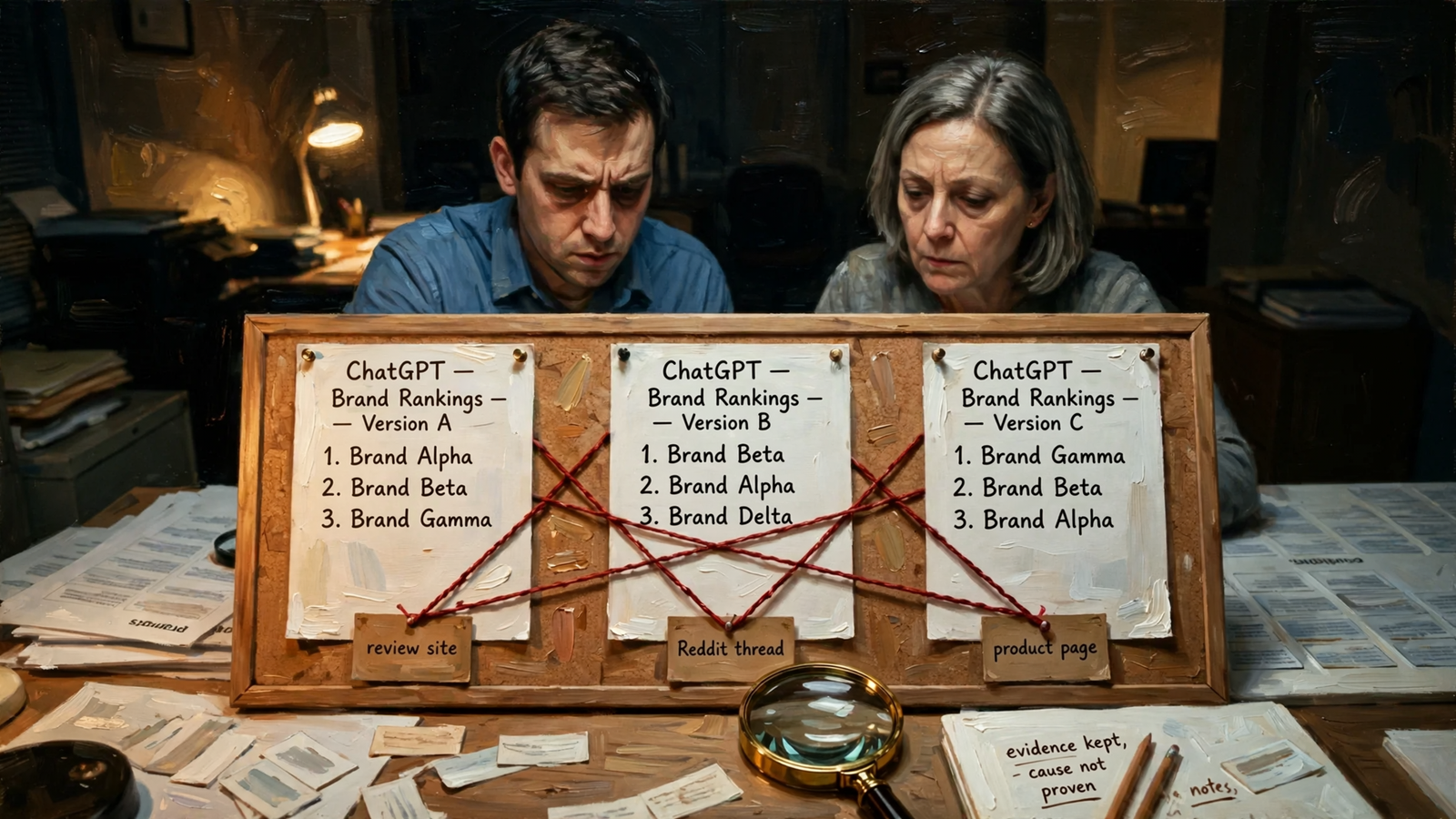
Use the citations to decide what to inspect. In the same test, ChatGPT averaged 5.8 sources per answer, compared with 10.1 for Perplexity and 3.4 for Google AI Mode. Keep those source patterns separate by engine. For the ChatGPT panel, have Claude sort cited domains by frequency, then read the pages that keep turning up. Is a review site answering the billing question your page dodges? Is a profile claim stale? Does a Reddit thread explain the buyer’s problem more plainly than your landing page does?
If the answer gives you no sources, log the gap. You can still check whether your page answers the buyer’s question, but you can’t point to a missing citation and claim you know why ChatGPT picked someone else.
6. Which page should I change first?
Pick one group of questions where you get mentioned but never picked. I once watched a team rewrite twelve pages because a tracker score dipped. They did plenty of work and learned nothing about which edit mattered.
I’d give Claude a narrower brief:
For this group of prompts, identify the buyer question my site doesn’t answer directly. Quote the cited passage that does answer it, if one is available. Draft a 150-word section for the closest existing page and an FAQ entry for the same question.
Read the draft and approve the edit before it goes live. With groas, autopilot stays off until you turn it on, and changes are logged with their rationale and can be undone in one step. Keep the date, the page version, and the before-and-after rows from the frozen panel. Then rerun the same questions. One edit with a paper trail gives you something to investigate. Twelve edits and a rising score give you a slide.
7. What should I check before I pay, and what do I do today?
My acceptance test is whether someone else can retrace the result without asking support. Open one reported recommendation and follow it back to the evidence. Can you see the frozen prompt, market, full answer, and every cited URL? Can you tell how many runs went into the rate? If a tool advertises per-prompt mentions and citations, competitor share of voice, or sentiment, can you get from those reports to the actual answers? Skip the tool if the trail ends at a score. No dashboard can promise what ChatGPT recommends next week.
Today, freeze your 24 buyer questions. Run each one three times in clean ChatGPT sessions and keep the full answers and citations in a table. That sheet is your monitor. Buy the automation once the sheet proves you’ll actually read it.


