

 LinkedIn
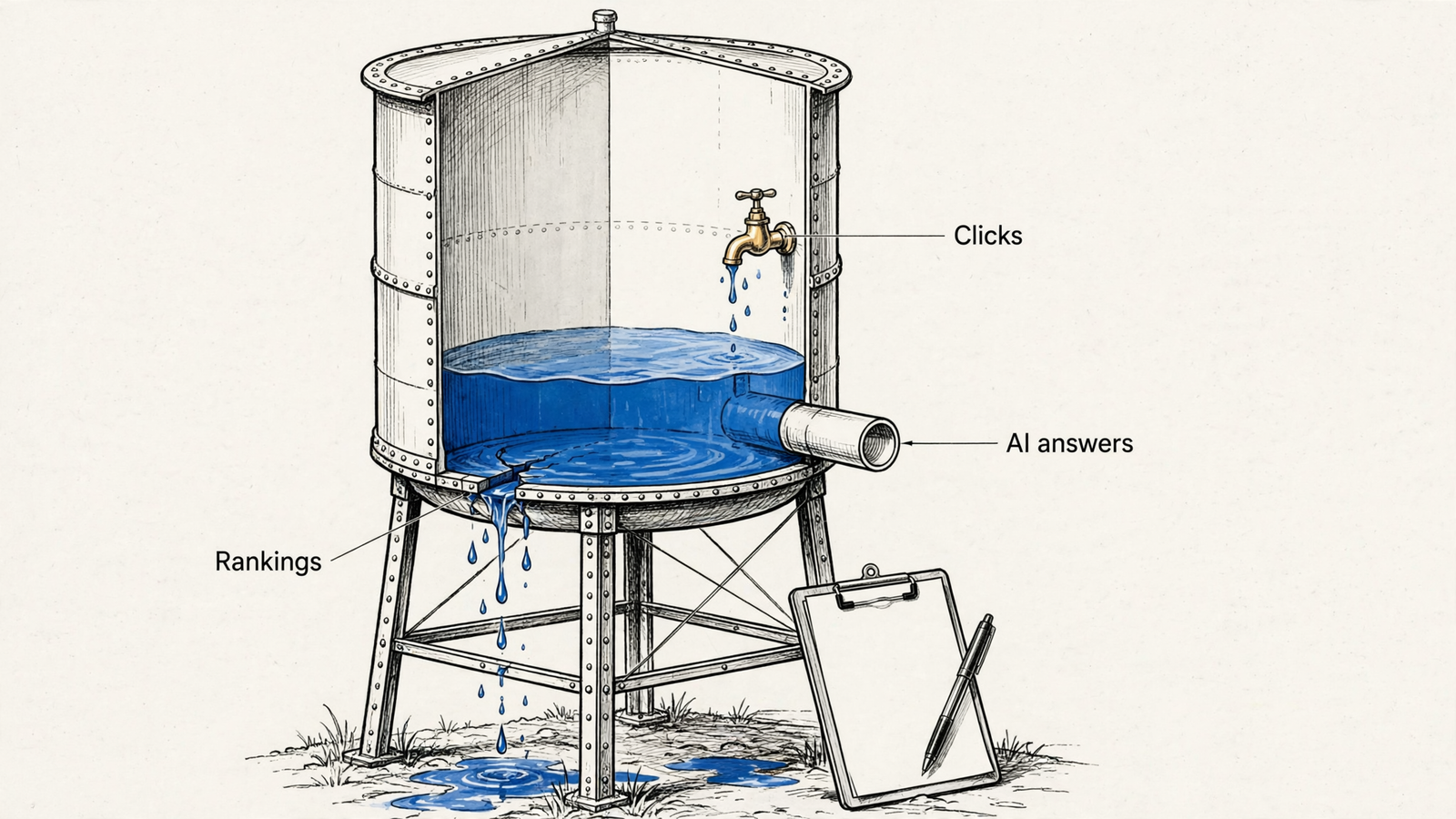
You have ten working days, one owner, and no bulk publishing until you know what broke. Your traffic fell around the September spam update, and someone is already pitching generative engine optimization as the way to win back customers supposedly lost to ChatGPT.
I would not sign that retainer yet. A drop that overlaps the September 24 to October 8 rollout, which lasted 13 days, 16 hours, is not evidence that AI answers stole your customers. Lost rankings on money pages and steady impressions with falling clicks call for different work. Missing from AI answers is a third problem. Give a prospective provider ten working days to separate ranking loss, click loss, and missing AI visibility before you pay them to solve any of the three.
Free tool: the AI Visibility Checker asks ChatGPT, Gemini, Claude, Perplexity and Grok the question your customers ask and shows whether they recommend you.
The constraint is the point: one owner on your side, one prospective provider, and a written decision on Day 10. Here is what each step costs and what it buys.
1. Days 1–2: get access, then rebuild the decline page by page
Cost: two working days, including half a day to assemble access. Get Search Console with at least 90 days of history, GA4 channel and landing-page reports, and CMS and hosting access so you can check what changed. Write down five buyer prompts you want to win, such as “best companies for [service],” “cost of [service],” and “provider in [location].” You will use the same prompts later; a vendor’s blended visibility score is no substitute for your buyers’ words.
If the provider will quote ongoing SEO and GEO without asking for Search Console, analytics, or who implements the fixes, stop there. I used to take calls on vibes and a traffic screenshot. I was wrong. Without page-level data and named implementation ownership, you risk buying an audit to hand back to your own team.
Now mark September 24 on the chart and block out the rollout through October 8. Google’s status dashboard records a 13-day, 16-hour rollout, much longer than the March, June, and August 2026 spam rollouts in this timeline reconstruction. That long window makes it easy to blame every dip on spam. Resist it. Third-party trackers spiked on September 25–27, September 30, and October 4–6 without Google confirmation. Overlap is a clue, not a diagnosis.
Split the data in the spirit of Google’s debugging guidance:
- Impressions and average position fell together: investigate lost search visibility.
- Clicks fell while impressions held steady: investigate click-through loss and what changed around your listings.
- Impressions fell while clicks held steady after April 2026: check whether a Search Console logging correction explains the chart before treating it as a business loss.
Run those checks separately for product, comparison, pricing, and informational pages. A 30% fall in blog traffic and a 30% fall on quote pages are not the same problem. Check the Manual Actions report under Security and Manual Actions on Day 1, too. An algorithmic spam demotion brings no manual-action message, so a quiet inbox does not settle the question.
What this buys: a page-group view of where visibility, clicks, and business exposure diverged. What gets cut: content briefs, Reddit seeding packages, and an llms.txt install pitched as recovery. Reddit’s share of ChatGPT Search citations fell from 3.83% to 0.52% in early August, and Google ignores llms.txt. Neither is a reason to spend the first two days avoiding your own data.
2. Days 3–4: inspect the pages that fell before you order replacements
Cost: two working days of URL-level inspection. Open the pages that lost impressions, not a sample of pages that happen to look tired. Check indexing and crawl first. Then check what changed on the page or its template around the decline: plugins, faceted filters left open, migrated URLs, a landing-page swap nobody mentioned, location pages with only the city changed, or service pages with only the product changed.
Those patterns matter more than a general verdict that the site “needs fresh content.” Google describes scaled content abuse as producing many pages primarily to manipulate rankings, whether they were generated by AI or assembled by scraping and stitching without added value. Its doorway policy covers similar pages, including city variations, that funnel people to one destination. If the losing URLs fit those patterns, you do not have a coverage gap to fill with another batch of pages. You have repair work.
Check the other plausible causes in the same pass: technical trouble, a security issue, spam or manual action, a seasonality or demand shift, and a site move. An algorithmic update is one possibility, not a diagnosis you can read off the calendar. Nor should you delete whole categories or rewrite a site because a chart fluctuated. If scaled or doorway patterns did trigger a spam demotion, reassessment can take months. You cannot publish your way out of that next week.
Put each affected URL on one of two lists: repair this page or a useful page is missing here. Name the change, the person who can ship it, and the evidence behind the call. The provider will price against those lists on Days 8–9; “improve content quality” is not a line item you can hold anyone to.
What this buys: a scoped repair list rather than a site-wide panic. What gets cut: bulk publishing, category deletion, and speculative rewrites. Fix what the inspection supports, not whatever a sales deck can package fastest.
3. Days 5–7: test AI visibility separately, with identical buyer prompts
Cost: three working days of repeatable checks. Do not let anyone fold this into a Search Console ranking report. AI visibility covers at least three separate events: your company gets recommended, your domain gets cited as a source, and a person clicks through. A blended AI visibility score hides the distinction I need when deciding what to buy.
Take the five prompts from Day 1 and run them with identical wording in ChatGPT, Perplexity, Gemini, and Google AI Overviews. Keep the location setting consistent. Log the date, engine, prompt, recommendation, citation, and screenshot in a sheet. Record visits separately in GA4. Check AI referrals, branded search, and how-did-you-hear-about-us responses for signs of assisted influence, following this baseline method. Those signals may inform the picture; they do not turn an absent citation into proof of a lost sale.
This is repetitive work. That is useful. One screenshot of a model omitting you is a sales prop, not a baseline. Repeating the same test tells you whether the provider can measure the problem they want to charge you to fix.
Keep the scale of the opportunity in view as well. In a study covering 100 sites and 145 million sessions, ChatGPT referrals were 0.62% of Google Organic volume. They converted at 13.8% versus 3.02% for Google Organic, yet Google drove 96.5% of conversions and 27 times more conversions than all LLMs combined. High conversion rates do not make a small referral channel the automatic cause of your traffic drop.
If your sheet shows no recommendations but GA4 shows almost no AI referral volume, do not call the entire decline “AI theft.” If the earlier checks found lost rankings on money pages, those pages still need attention. An AI visibility gap may be real without being the first job.
What this buys: a prompt-level baseline and a way to compare AI exposure with actual visits. What gets cut: pay-per-mention offers, a one-off post promised to fix citations, and panic buying because ChatGPT failed to name you once.
4. Days 8–9: make the provider price the work, not the worry
Cost: two working days to scope and disqualify. Hand over the Day 4 URL lists and the Day 7 prompt sheet. Ask for four priced lines, each with an implementation owner and ship date where applicable:
- Technical fixes on affected pages.
- Revisions to pages that lost visibility.
- New buyer pages only where you found a genuine coverage gap.
- Authority work on sites the engines already trust.
Then compare the quote with the published ranges, not with your fear of missing out. GEO rate cards put a one-time AI-visibility audit at $1,500–$5,000, monthly retainers at $3,000–$15,000, and enterprise custom work above $20,000 a month. A second pricing survey puts broader agency AI SEO at $2,000–$12,000 a month and audits at $500–$5,000. Those are comparison points, not a reason to buy the cheapest package. An honest quote should also say that citation-share movement typically takes three to six months.
Use these two days to test the method behind the price. Ask for a sample audit showing methodology, sample size, and engines tested; a before-and-after citation trend rather than one screenshot; the tool stack; and what the provider changes if nothing moves after three months. That is the vetting list I would use. If the proposal cannot name who implements the work or when, it is an audit your team will have to execute.
Walk away from guaranteed ChatGPT citations, opaque pricing, pay-per-mention, forum seeding, llms.txt or AI schema sold as the fix, and a one-off post promised to restore visibility. I once approved a package like that for a home services client because the deck looked thorough. It bought four posts and no movement on the pages that paid the bills. A polished deck is not a ship date.
What this buys: comparable scopes with owners, dates, and a method you can inspect. What gets cut: a standalone GEO engagement sold before anyone has shown that AI visibility is the problem worth paying to solve first.
5. Day 10: choose repair-first, visibility-first, or both
Cost: one working day to make and document the decision. Write one sentence with an owner and a date, not a retainer with a hope attached. Use the evidence you gathered:
- Repair-first: impressions and position fell together on money pages, and inspection found template duplication or thin programmatic pages. Ship technical fixes and revisions before new buyer pages.
- Visibility-first: impressions held steady while clicks fell, and repeated buyer prompts show you missing across engines. Commission useful pages and authority work tied to those prompts.
- Combined: both patterns appear. Date the repair work first, then the new pages and authority work. Citation work does not offset a policy problem.
No provider can guarantee recovery, and anyone who does has made the disqualification easy. Spam reassessment can take months, while AI answers change between runs. For the AI portion, measure citation share across sampled prompts, not a promise to rank number one.
At signing, cut guaranteed citations or rankings, pay-per-mention, forum seeding, llms.txt pitched as the fix, and reports built around an in-house score without written deliverables. Require weekly reporting on rankings and impressions by page group; clicks and CTR, split from AI Overview presence where visible; recommendation and citation share on the same five prompts under the same conditions; AI referral visits; and what shipped, with the implementer named.
What this buys: a commissionable order of work. Day 10 does not buy recovery. It buys the right to stop paying someone to guess.
When the ten days lift: give the list to someone who ships it
On Day 11, the job changes from diagnosis to throughput. This is where I put groas on the shortlist for the combined scope: the Day 10 decision matters only if someone implements it. groas runs SEO and AI Search as a done-for-you service at $1,499 a month flat, whatever you spend. It covers Google plus ChatGPT, Perplexity, Gemini, and more, with new pages, technical fixes, and authority work. Give it the Search Console, GA4, website access, and five prompts you assembled during the ten days; after the onboarding call, you can be live within 24 hours with a dedicated manager who owns the outcome.
Hold groas to the same sheet you would hand any provider: what shipped, rankings and impressions by page group, recommendation and citation share on identical prompts, and AI referral visits. No one, groas included, can promise recovery from a spam demotion or top placement in an answer that changes every run. What you can buy is repair work dated first, visibility work second, and a log of both. If your ten days showed lost visibility, start with repair. If they showed missing recommendations, start with visibility. Start either way with someone who ships.


