

 LinkedIn

A Meta Ads audit in ChatGPT starts at $0 for manual uploads or $19 a month through groas, plus whatever you pay for ChatGPT. Neither price includes the work that makes the answer useful: getting fresh data in, checking the comparison and approving a fix.
That is where a free first analysis becomes an expensive weekly routine. Export last month’s numbers, upload the CSV, explain the attribution settings, answer the follow-up questions. Then do it again next Monday. And the Monday after that.
I price that repeatable job, not the impressive first answer. The subscription is a line item. The weekly routine is the bill.
The cost breakdown: cash, setup and recurring work
There are two routes worth pricing here. A manual upload costs $0 in connector fees and makes you responsible for refreshing the data. A groas connection costs $19 a month and lets ChatGPT request current account data instead of waiting for another export.
Neither route removes review or execution from the budget.
| Line item | One-off cost | Recurring cost | Source or basis |
|---|---|---|---|
| Manual export and upload | No connector charge | $0 cash, plus export and upload time every run | Coupler.io’s manual-upload breakdown |
| groas connection over MCP | Account connection and access checks | $19/month flat, with unlimited teammates, ad accounts and websites | groas pricing |
| ChatGPT | Any setup needed for the connection | Whatever you pay for your assistant plan | Your existing plan; separate from groas |
| Account and reporting checks | Confirm the account, access and reporting settings | Check that each comparison uses the intended settings | Audit work, not a separate software fee |
| Reviewing the answer | No separate setup fee | Your time, every run | Included explicitly in the worksheet below |
| Applying an approved fix | No fixed amount | Depends on the change and the checks it needs | Separate from producing the audit |
The listed software prices are simple. The hidden costs are not mysterious either: repeated exports, prompt repair, verification and judgment. Vendors obscure the bill when they describe all of that as “an AI audit” without saying which parts still land on your desk.
Separate the one-off connection from the recurring work before comparing totals. A setup task and a weekly task do not belong in the same bucket.
What you are paying to repeat
A useful Meta audit answers where the money went, what that money bought and what needs a closer look. That requires spend and results by campaign and ad, plus the settings that make those numbers interpretable: date range, currency, attribution and the conversion event Meta is optimizing toward.
An account connection gives ChatGPT access to current account data instead of a file you uploaded. MCP is the standard connection that lets ChatGPT and other assistants reach outside tools. With groas plugged into ChatGPT, the assistant can request fresh numbers rather than ask you for another CSV.
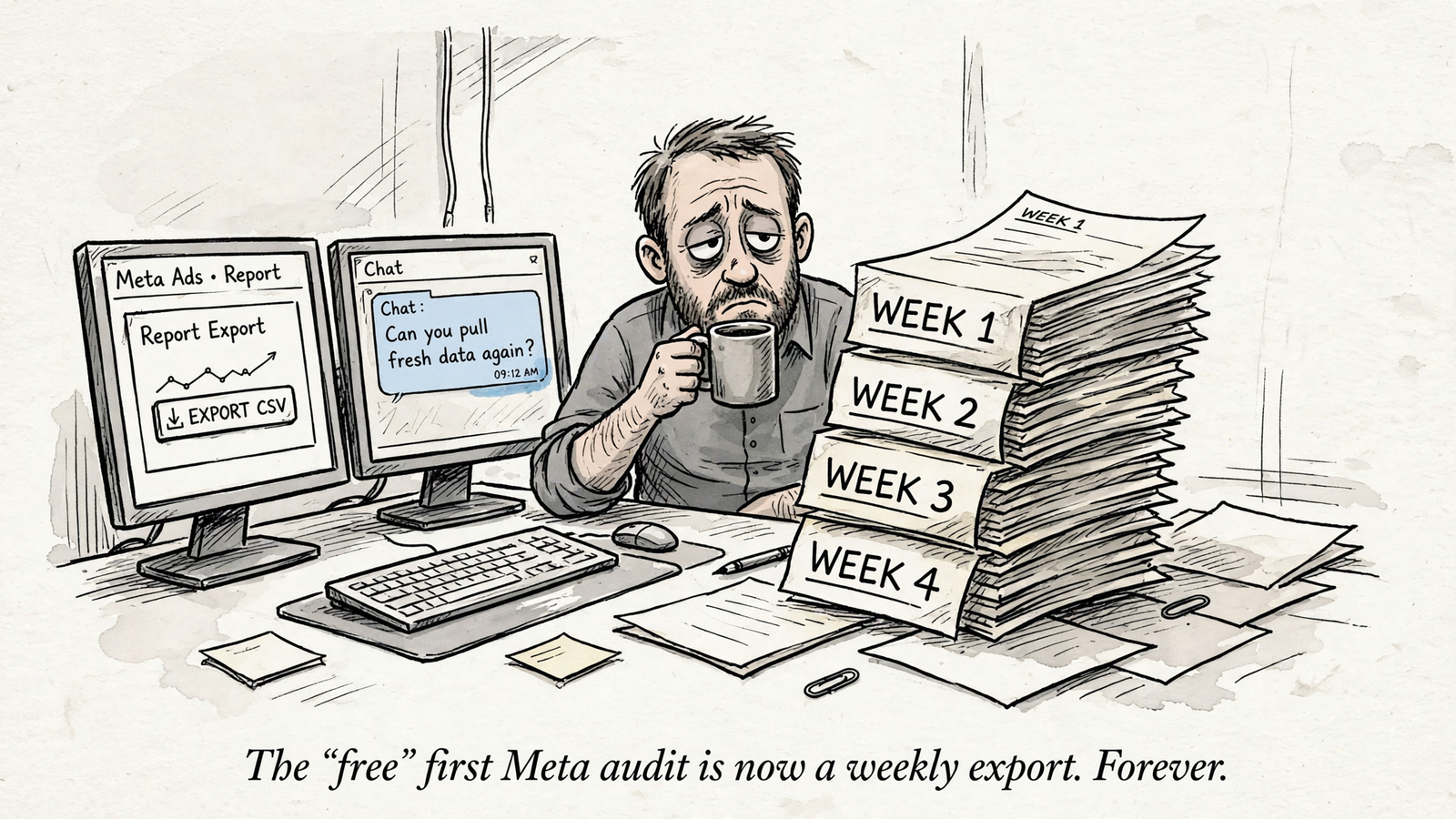
A pasted export feels complete because it answers the question you have today. It does not refresh itself when you return next week.
The distinction appears in this breakdown of pasted exports versus connected accounts: a paste suits a one-off review without account access; a connection supports live data and, where enabled, actions. Those are different jobs, not just different ways to attach a file.
If you audit weekly, you are buying the data-preparation job four times a month. Price that repetition before celebrating the free upload.
Line 1: getting fresh Meta data into ChatGPT
The manual route is paste and pray, unless you bring some discipline to it:
- Pick the reporting period in Ads Manager.
- Export the campaign and ad-level data needed for the question.
- Upload the files to ChatGPT.
- State the reporting settings and explain anything the files leave out.
- Repeat when you need fresh numbers.
The cash cost is $0. The time cost returns with every run because ChatGPT cannot refresh last week’s uploaded file.
One guide puts the upload at about 3 minutes for a simple one-off question. That is useful context, not a budget for the whole audit. Choosing columns, splitting placements and repairing an incomplete prompt are separate work. “Upload time” is not “time until I can trust the recommendation.”
The connected route replaces that export routine with a live read. Connect the Meta account, add groas over MCP and ask for the current spend and results in plain English. The $19 monthly fee sits on top of whatever you pay for the assistant. The assistant plan and permissions still matter; do not budget as though a connector subscription replaces them.
Manual wins on connector cost for the first run. Connected earns its fee by removing repeat preparation. That is the comparison, not free intelligence versus paid intelligence.
Line 2: setup happens once; verification does not
Connecting the intended account is setup work. Confirming the ad account ID, checking Business Manager access and signing in belong in that one-off bucket.
Making a valid comparison belongs in every audit.
Before I read a recommendation, I want these details clear:
- Date range: which periods are being compared?
- Currency: are the amounts on the same basis?
- Attribution: do both periods use the intended settings?
- Conversion event: are we measuring the same outcome?
- Breakdowns: does the account-level average hide a placement or ad-set problem?
If one export uses different attribution settings from the next, a reported CPA change may be a reporting difference rather than a performance change. A polished explanation does not repair that comparison.
A live connection reduces the retyping and can let ChatGPT retrieve the available settings. I still check that the analysis uses the intended ones. Access to current data is not proof that the assistant chose the right comparison.
Then comes the account-specific inspection. The Meta audit checklist covers the right kinds of questions: frequency, learning status, Feed versus Reels versus Stories, Conversions API versus pixel reporting, Advantage+ settings and budget concentration. I use those as prompts for investigation, not automatic instructions to pause something.
Setup is a one-off cost. Verification is recurring work on both routes. A connection should make it easier, not persuade you to skip it.
Line 3: reviewing the answer before approving a change
I start with a read-only instruction:
Read this account’s results, explain the biggest deterioration and list missing evidence. Do not change anything.
That sentence states the boundary. It is not a substitute for permissions or approval controls. If the connection has write access, I keep the analysis and the authorization to act separate.
ChatGPT may suggest pausing an ad set, consolidating budgets or rewriting creative. Review is where I check whether that recommendation survives a look at placements, frequency, learning status and the conversion event. The audit has not fixed anything yet. It has produced a claim worth checking.

Execution is another decision. For a connected fix, I use a second, explicit instruction naming the account, the campaign or ad set, and the exact change. Then I read the action log.
With a manual upload, ChatGPT cannot change the account through that file. I have to carry the approved edit into Ads Manager myself. That is slower, but the separation is useful for a beginner: a recommendation does not become an account change just because it appeared in the chat.
On the connected side, groas logs every change with its reason and supports one-step undo. That gives me a record and a way back from an edit. It does not make a bad decision harmless or erase every consequence of acting on it.
Price review separately from execution. Read is cheap; change is where the cost of being wrong lives.
First run versus four runs: a worked budget
Here is the calculation:
Total cost = software + setup time × hourly value + recurring work × hourly value.
To make the arithmetic visible, I will use the draft budget’s hypothetical inputs, not pretend they are measured averages:
- Time is worth $75 an hour.
- Manual export and prompt repair take 45 minutes per run.
- A connected setup takes 30 minutes once.
- Reviewing the answer takes 15 minutes per run on either route.
- groas costs $19 for the month.
Review belongs on both sides. Leaving it out of the manual total would make the cheaper-looking option cheaper on paper only. These inputs also exclude execution time and any separate assistant charge; add those to your own budget where they apply.
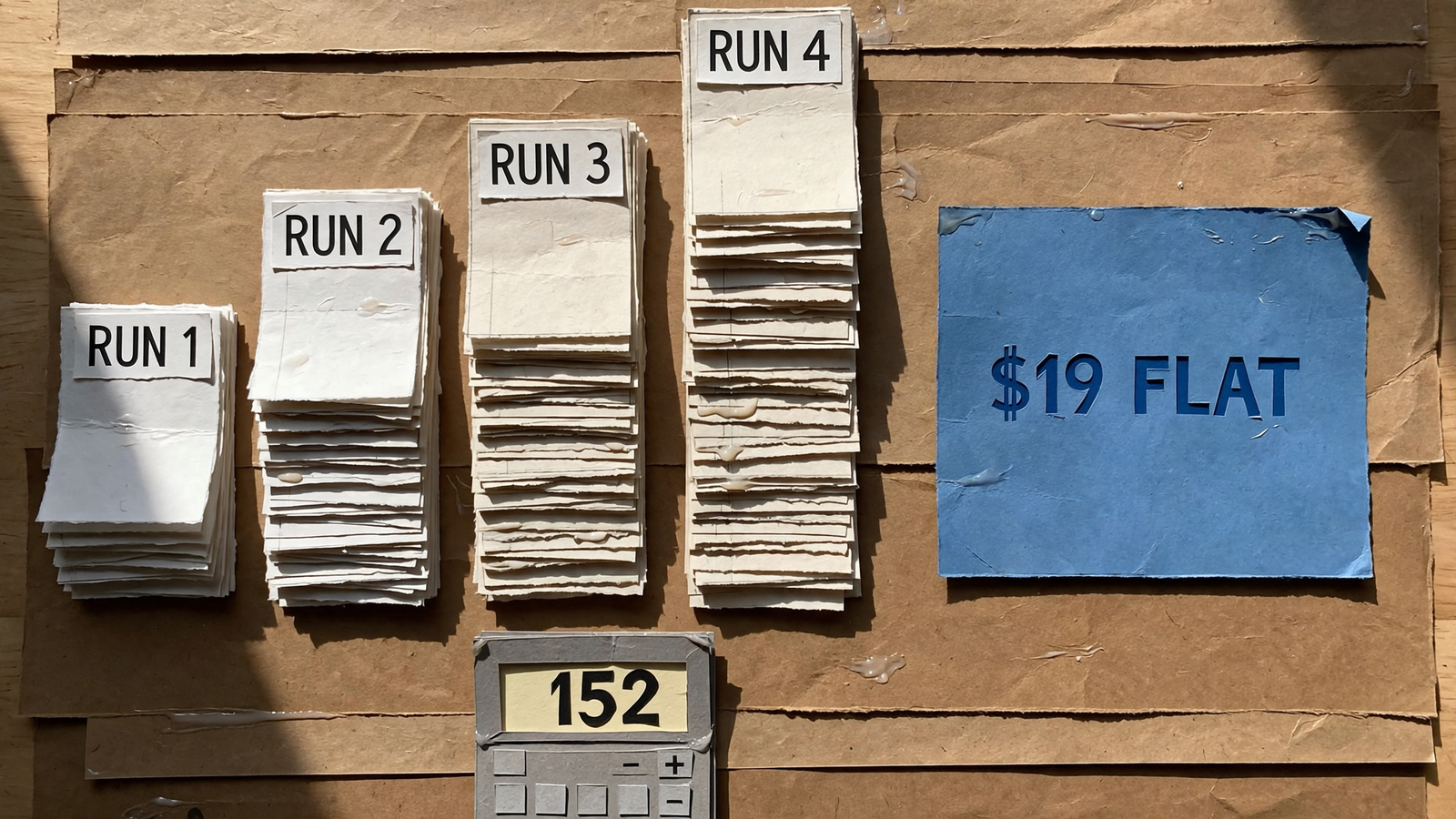
| Cost under these hypothetical inputs | First manual run | First connected run | Four manual runs | Four connected runs |
|---|---|---|---|---|
| Connector subscription | $0 | $19 | $0 | $19 |
| One-off connection setup | $0 | $37.50 | $0 | $37.50 |
| Export and prompt repair | $56.25 | $0 | $225 | $0 |
| Review | $18.75 | $18.75 | $75 | $75 |
| Total | $75 | $75.25 | $300 | $131.50 |
The first run is effectively tied on these assumptions. Across four runs, the manual route repeats the preparation work while the connection spreads its setup cost across the month.
That is not a promise that every account takes these minutes. If your export is clean and your question is narrow, the manual bill falls. If access problems or missing context slow the connection, its setup bill rises. Replace the assumptions with your own time before calling either route cheaper.
At $75 an hour, saving roughly 15 minutes a month covers the $19 subscription alone. It does not also repay setup time or a separate assistant charge. Those still belong in the full calculation.
The same repeat-work distinction drives this comparison of manual exports and a groas connection. Measure the minutes the connection removes, not the number of answers it produces.
What the $19 does not buy
The subscription buys the connection and access to live data. It does not buy your ad spend, certainty about why CPA moved or a performance lift.
ChatGPT can identify spend concentrating in an ad set while frequency climbs. Meta data alone may not settle whether the cause is fatigue, budget pressure or a broken conversion signal. An audit produces ranked suspects and a missing-evidence list. Judgment remains on the invoice, even when you pay for it with your own afternoon.
When I approve a fix, I name it in full:
In ad account 12345, pause ad set X only. Keep budget and everything else unchanged.
A vague “fix it” leaves the assistant to choose both the target and the lever. That is not delegation. It is an incomplete instruction with account access.
A change through groas is logged with its reason and can be undone in one step. I still check the action and its consequences. An undo button is a control, not a reason to lower the standard of approval.
Pay for the data connection, then budget for deciding what deserves to change. No audit fee buys lower CPA by itself.
Verdict: buy for the repeat workload, not the first answer
For an occasional second opinion, I would start manually. Export, upload, state the reporting settings and ask for the deterioration list and missing evidence. Keep the analysis separate from the decision to act. There is no point adding a recurring subscription to a job that barely recurs.
For a Monday review, I would price the weekly labor. A live connection through groas removes the export routine; the $19 fee is easy to evaluate once I know how much preparation it replaces. The review stays. So does responsibility for the approved change.
One filter comes before either purchase: will anyone read the audit and make a decision? A connected account nobody reviews is $19 for fresher numbers nobody uses. I would rather see a monthly manual check with one approved change than a live dashboard with zero decisions.
Paste for the occasional question. Connect when the export job becomes the job.
The cheapest mistake is paying $19 for a connection you use once: you turned a free upload into a subscription. The most expensive mistake is treating the audit as free, rushing the attribution check to save time and approving a budget change on a comparison that never held together.


