

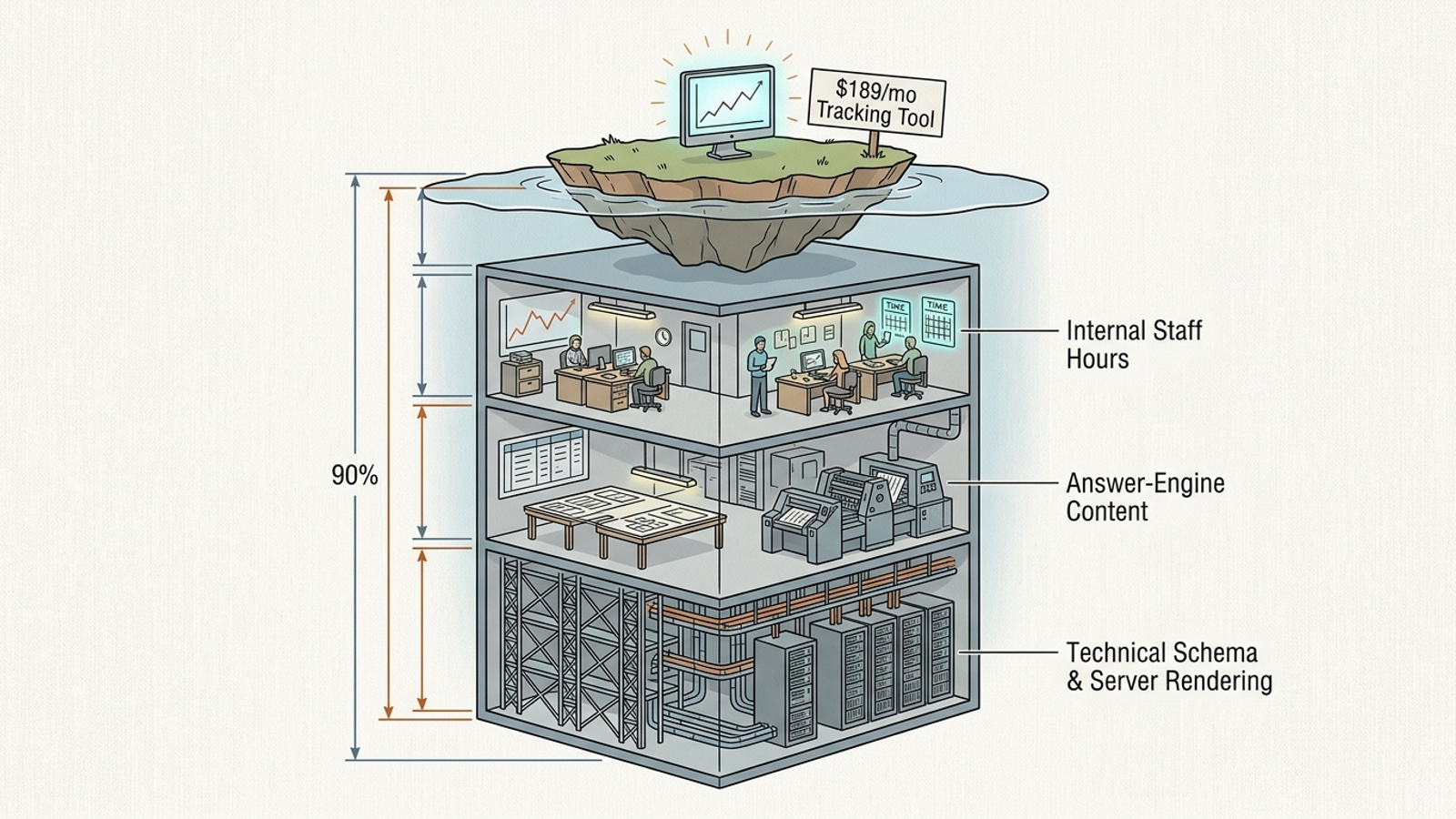
A $29 tracking subscription will tell you whether ChatGPT mentions your brand. It will not give ChatGPT a reason to cite you. Across the illustrative setups below, the monthly bill runs from $1,080 for a small DIY operation to $9,500 for a larger agency engagement, before any separate technical setup or audit fee. The sticker price of software is often the smallest line.
I watched performance marketing make this mistake with rank trackers: buy the dashboard, watch the lines wobble, call it a strategy. AI visibility adds more moving parts. Queries cost money to run. Someone has to interpret the results. Then someone has to fix crawl barriers, publish useful answer-targeted content and keep it current. Cheap monitoring can become an expensive way to stay invisible when it pays for observation but not execution.
The invoice: listed fees, hidden work and one-off costs
Separate what a vendor quotes from what your team must still do. These are cost categories, not six charges every business should add together. A full-service retainer, for example, may cover work you would otherwise buy separately.
| Cost category | One-off cost | Monthly recurring cost | What drives it and where the figure comes from |
|---|---|---|---|
| Monitoring software | $0 | $29–$439 | Prompt limits and engine add-ons; Otterly.AI tier comparison |
| Raw API and scraping calls | Up to $500 setup | $30–$520 in the cited model | Prompts × engines × regions × daily runs; Dageno pricing model |
| Technical site work | $2,000–$5,000 | Around $750 maintenance | Schema, rendering and crawl accessibility; Fuel Online benchmark |
| Answer-targeted content | $0 | $1,500–$4,500 | Publishing and technical writing; Austin Heaton pricing study |
| Internal analysis and upkeep | $0 | Roughly $750–$1,360 for 15–20 hours | Hours at $50–$68 loaded rates; MyVirtualMate staffing analysis |
| Full-service agency | $2,500–$5,000 audit | $3,500–$8,000 | Scope and manual execution; Fuel Online pricing guide |
The first distinction is one-off versus recurring. A rendering fix or initial audit can make month one expensive without becoming a permanent monthly charge. The second is listed versus hidden: a tool may quote you $189 a month while the employees and freelancers needed to act on its findings cost several times more.
Path 1: Build the monitor yourself, then pay to keep it running
The query formula that turns a script into a bill
The DIY pitch is familiar: write a Python script, connect an API, put it on a schedule and send the output to a dashboard. I understand the appeal. Nobody sends you a software contract, so the project feels free.
It is not. The Dageno operational formula is prompts × engines × regions × daily runs × 30 days. Track 50 buyer-intent prompts across four engines in one region once a day, and you make 6,000 checks a month: 1,500 per engine. At 200 prompts, the total is 24,000 checks, or 6,000 per engine. Add regions or more frequent runs and the count rises again.
Here are the cited rates behind three of those engine lines. The 6,000-check examples below are per engine, not the cost of the entire four-engine program:
- ChatGPT with web search: The OpenAI Responses API pricing includes a $10 fee per 1,000 web-search calls, plus applicable token charges. The draft’s model puts 6,000 monthly checks at roughly $67–$90 and 24,000 at $270–$360.
- Perplexity Sonar: Live search adds a per-request charge of $5–$12 per 1,000 lookups, depending on context tier. That fee alone is $30–$72 for 6,000 runs, or $120–$288 for 24,000, before token charges.
- Google AI Overviews: A SERP endpoint such as DataForSEO’s Google Organic Search API runs from $0.0006 per standard-batch SERP to $0.002 per live request. That is roughly $4–$12 at 6,000 runs or $14–$48 at 24,000, before storage or other infrastructure.
Those lines do not price a fourth engine or every implementation choice. That is precisely why “we’ll just use the APIs” is not a budget. Decide which prompts, engines, regions and run frequency you need first; then calculate the calls.

Maintenance is the larger DIY line
Raw calls are the electric bill. Upkeep is where DIY starts eating staff time. Response formats change, parsers fail and a clean-looking dashboard can quietly fill with bad data. Someone must spot the failure, repair the pipeline and check whether yesterday’s results are still usable.
The staffing analysis used here puts a loaded internal rate at $50–$68 an hour. At 15–20 hours a month, that is $750–$1,360 before you publish a page or fix a crawl problem. I would not assume every small script needs 20 hours of attention. I would budget for the time rather than pretend it is free because the employee already has a salary.
And the output still describes the problem. Your script does not draft a citable answer page or repair a site that hides product facts from crawlers. You have built a speedometer. Budget for the engine separately.
Path 2: Buy visibility software, then staff the work behind it
The $29 tier is a starting point, not the operating cost
A low subscription price is easy to approve. It is also easy to outgrow. The Otterly.AI tier comparison lists a $29 Lite plan capped at 15 prompts across four default engines in one workspace. Its 100-prompt Standard tier is $189 a month; additional engine coverage can increase the bill, with the cited configuration reaching $439.
The Okara comparison shows why you have to inspect the unit you are buying. Peec AI starts at $95 a month for 50 prompts across three engines. Qwairy lists €79 for up to 100 prompts subject to a 1,300-credit ceiling. Some enterprise vendors, including Profound, put pricing behind a sales conversation. Vendors are happy to display the entry price; you need the prompt, engine and credit limits beside it.
A 15-prompt cap may be enough for a narrow product. If you need to follow several services, competitors and commercial questions, it can disappear fast. Count the questions you actually intend to track before you compare subscriptions.
A citation-gap report is not a fix
A dashboard can show that a competitor appears for “best inventory management software for manufacturing” while you do not. It cannot, by itself, make your product specifications crawlable, improve the page that answers that question or publish the missing comparison. As Klarivo’s discussion of generative search agencies notes, tracking is only one part of the work.
Then comes the human cost. Ten hours a month spent reviewing prompt losses, checking citations, briefing a writer or developer and reporting progress costs $500–$680 at the loaded rates above. Add the draft’s $1,500–$3,000 allowance for freelance copy and schema work, and this example looks different from the advertised subscription:
| Recurring item | Monthly cost |
|---|---|
| Software and engine add-ons | $189–$439 |
| Internal review and reporting, 10 hours | $500–$680 |
| Freelance content and schema execution | $1,500–$3,000 |
| Illustrative monthly total | $2,189–$4,119 |
You may already have writers and developers. Fine: their time belongs in the calculation instead of the freelance line. If you leave execution out altogether, you are paying to document your absence, not change it.
Path 3: Hand off execution—and inspect what the retainer includes
An agency invoice can still buy you reports instead of work
The Austin Heaton agency pricing study puts the median monthly retainer at $4,500. The Fuel Online benchmark places active service retainers around $3,500–$8,000 a month, with an initial audit often priced at $2,500–$5,000. That audit is a one-off charge; do not quietly treat it as part of the recurring retainer, or pretend it vanishes from your first invoice.
At those prices, I want deliverables, not a polished account of what the team noticed. Ask what gets published, what technical changes get made, who makes them and how often the work happens. A monthly screenshot deck may describe a citation gap accurately. It does not close it.
This is the limit of the traditional agency cycle: people review findings, assign work and wait for the next round. I respect good human judgment. I do not see a reason to pay senior rates for routine monitoring and report assembly when those tasks can run continuously. Pay for decisions and execution, not the ceremony around them.
That is the distinction groas makes. Its autonomous growth engine handles ongoing search execution across paid and organic work, while a named human strategist sets direction, guardrails and accountability. It uses a flat monthly fee with no setup fee, rather than making the client manage dashboards or pay a percentage of spend. The supplied pricing does not give a dollar figure for that fee, so I am not going to invent one to make a comparison table look tidy. The question to put to any provider, groas included, is what work actually happens after a visibility problem appears.

Two hidden costs that do not fit neatly on an invoice
The first is time before a fix goes live. If a DIY build occupies months of developer time, or an agency spends its early weeks preparing an audit rather than changing a page, you continue paying while the underlying visibility problem stays in place. I would track the date of the first useful change, not just the date the dashboard starts collecting data.
The second is reporting without an owner. Automated PDFs are easy to produce. Reading them, checking whether a citation gap matters and turning the finding into a live change is the work. A $189 monthly tool that flags missing product information but never prompts anyone to update that information has bought you a recurring reminder, not a result.
Neither cost means monitoring is pointless. It means monitoring needs a path to action. Every alert should have someone—or something—responsible for the next step.
Side by side: what three operating setups can cost each month
These are illustrative operating budgets, not quoted prices for every business. They show how tracking, labor and execution stack up at different levels of complexity. One-off technical fixes and agency audits sit outside the monthly figures unless expressly included.
| Operating setup | DIY in-house | SaaS tracker plus execution | Traditional agency | groas |
|---|---|---|---|---|
| Small business: 25 prompts, 2 engines | $1,080/mo: $30 calls, $300 upkeep, $750 content and schema | $1,579/mo: $29 tool, $550 analysis, $1,000 fixes | From $3,500/mo for an active-service retainer in the cited benchmark; check scope and audit fee | Flat monthly fee: request the price and scope; no setup fee |
| Mid-market: 100 prompts, 4 engines | $2,320/mo: $320 calls, $1,000 upkeep, $1,000 content | $3,189/mo: $189 tool, $1,000 analysis, $2,000 developer and copy work | $5,500/mo example: $4,500 retainer plus $1,000 technical work | Flat monthly fee: autonomous execution with human strategic ownership |
| Scaling enterprise: 300 prompts, 4 engines | $4,800/mo: $800 calls and scraping, $2,000 data engineering, $2,000 editorial work | $6,239/mo: $439 tool, $1,800 reporting labor, $4,000 development work | $9,500/mo example: $8,000 retainer plus $1,500 citation work | Flat monthly fee: compare the quoted scope with the full operating budget |
Do not read the lowest number in each row as the winner. A lean DIY setup is cheap only if its owner can keep it working and ship the content or technical fixes. Likewise, an agency retainer earns its price only when its deliverables extend past diagnosis. Compare completed work against total cost, not dashboards against retainers.
Where each option stops making sense
- Stay DIY if you have a narrow set of questions, the technical ability to maintain a monitor and time to act on its findings. A simple scheduled script can be enough to tell you whether your brand appears. Add products, regions and engines, and you should recalculate both call volume and upkeep before declaring the savings permanent.
- Buy software if you already have people who can turn alerts into shipped work: someone to assess the finding, someone to write, and someone to make technical changes. The dashboard then serves a team with execution capacity. Without that team, its attractive entry price tells you little.
- Hand off execution if you do not want to manage the monitoring-to-fix chain yourself. Demand clarity on what changes, who owns the outcome, the monthly fee and any initial charge. A traditional agency can charge thousands and still leave you waiting on the next report; groas offers continuous autonomous execution with a named strategist accountable for direction instead.
The cheapest mistake is paying $29 a month for a tracker and assuming that measuring your absence will fix it. The most expensive mistake is paying a traditional agency $5,000 a month for six months of diagnostic decks while nobody makes your site more useful or accessible to the engines you want to cite it. One wastes a little cash. The other spends $30,000 to stand still.
Frequently asked questions
Does a cheap AI visibility tracking tool actually get my brand cited in ChatGPT?
No. A subscription around $29 a month can tell you whether ChatGPT mentions your brand, but it does not give ChatGPT a reason to cite you. Getting cited requires fixing crawl barriers, publishing answer-targeted content and keeping it current, which the tracker does not do.
How much does AI search visibility cost per month overall?
The illustrative setups in the comparison run from about $1,080 a month for a small DIY operation to $9,500 a month for a larger agency engagement, before any separate technical setup or audit fee. Software prices are often the smallest line item.
How many API checks does a DIY AI visibility setup generate per month?
Using the formula prompts × engines × regions × daily runs × 30 days, tracking 50 buyer-intent prompts across four engines once a day produces 6,000 checks a month, or 1,500 per engine. At 200 prompts the total rises to 24,000 checks, or 6,000 per engine.
What do the API calls for AI visibility tracking cost per month?
Per engine, the cited model puts 6,000 monthly checks at roughly $67–$90 for ChatGPT with web search, $30–$72 for Perplexity Sonar and $4–$12 for Google AI Overviews via a SERP endpoint, before token charges or a fourth engine. At 24,000 checks the figures rise to $270–$360, $120–$288 and $14–$48 respectively.
How much staff time does maintaining a DIY AI visibility monitor take?
The cited staffing analysis assumes 15 to 20 hours a month at a loaded rate of $50–$68 an hour, which works out to roughly $750–$1,360 before any content or technical work. Upkeep covers fixing parsers, spotting bad data and repairing the pipeline when response formats change.
What does Otterly.AI cost and what are its limits?
The Otterly.AI tier comparison lists a $29 Lite plan capped at 15 prompts across four default engines in one workspace, and a 100-prompt Standard tier at $189 a month. Additional engine coverage can push the bill to $439 in the cited configuration, so you should check prompt, engine and credit limits before comparing subscriptions.
What is the real monthly cost of running a visibility tracker plus the work behind it?
One illustrative breakdown totals $2,189–$4,119 a month: $189–$439 for software and engine add-ons, $500–$680 for 10 hours of internal review and reporting, and $1,500–$3,000 for freelance content and schema work. The software price alone is only the starting point.
How much does an AI SEO or GEO agency retainer cost?
The Fuel Online benchmark places active-service retainers around $3,500–$8,000 a month, with an initial audit typically priced at $2,500–$5,000. The audit is a one-off charge and should not be treated as part of the recurring retainer.