

The $29 tracker is the cheapest line on an AI Overview visibility bill. For an illustrative small-business job involving 20 buyer questions, 10 page rewrites and six new answer pages, I get about $6,850 to $21,800 in one-off work if you commission the audit, fixes, content and starter off-site work separately. Keep tracking those questions and publishing four articles a month, and the recurring bill is roughly $1,389 to $5,389 a month, depending on whether you also keep building outside authority. Neither total includes your staff’s time.
That is why a $2,000 to $5,000-a-month agency retainer can look expensive next to a tool subscription but less startling next to the whole job. A dashboard tells you whether an answer names you. It cannot make a page render, rewrite an evasive introduction or publish the missing comparison page. Price the work that changes the answer, not just the chart that records it.
The bill: one-off work versus the monthly meter
These are alternative buying paths, not charges to stack indiscriminately. The one-off total above uses the small-site budget ranges discussed below, including six new pages at the draft’s illustrative $400 to $800 each. The recurring range combines $189 tracking, four articles at $1,200 to $3,200 a month, and $0 to $2,000 for continuing off-site work. Your page count, site condition and publishing pace decide what you actually buy.
| Cost line | One-off | Recurring | Source and price driver |
|---|---|---|---|
| Prompt tracking | No setup cost in this example | $29/mo for 15 prompts; $189/mo for 100 | One check covers one prompt on one engine; 20 questions across four engines means 80 tracked combinations. |
| Audit | Under $500 for an automated export; $1,000–$5,000 for an SMB audit | None unless repeated | The difference is manual review and a buildable backlog, not the crawler’s logo. |
| Technical fixes | $500–$5,000 for a one-off project | None unless new problems arise | Crawl, rendering, robots, schema and speed work; consultant rates run $75–$200/hr. |
| Rewrites and new pages | $150–$800 per article; 10 rewrites alone are $1,500–$8,000 | $1,200–$3,200/mo for four articles | Count missing pages separately from pages you can edit. Publishing may cost extra. |
| Off-site authority | $150 for a guest post to about $800 for a hero-content link | Freelancer contracts average $4,200/mo; agency contracts $6,357/mo | Tactic and volume drive the quote; a continuing campaign is not the same purchase as a few starter placements. |
| Agency to manage the program | Scope-dependent | $2,000–$5,000/mo for SMB work; $2,000–$8,000/mo for a focused program | An alternative to assembling the lines above. Check whether developer work, publishing and outreach are included. |
I used to tell clients tracking was step one. I was wrong. Tracking is the receipt, not the work.
Line 1: Tracking is cheap until you count what you track
Twenty buyer questions are not necessarily 20 tracked prompts. If one check means one prompt on one engine, watching those questions across ChatGPT, AI Overviews, Perplexity and Copilot gives you 80 combinations. That makes Otterly Lite’s $29 a month for 15 prompts a narrow view of the job. Standard is $189 a month for 100 prompts; Premium is $489 for 400. Gemini, Claude and Google AI Mode add-ons run from $9 to $439 a month, depending on tier. Vendors lead with $29. Your question list determines the invoice.
Then someone has to read the report. An hour a week scanning citation movement is manageable. Four hours a month debating why an answer changed when your page did not is still four hours. AI answers move without waiting for your approval.
Buy enough tracking to see your buyer questions, but do not mistake coverage for progress. If you are comparing tools, ask which AEO tools do the fixing rather than merely report the result. A scoreboard needs a team.
Line 2: An audit should end in tickets, not a score
A $400 audit and an $8,500 audit can run the same crawler and deliver very different value. Automated exports sit under $500; small-business audits run $1,000 to $5,000; mid-market and ecommerce audits run $5,000 to $15,000. The useful part is manual template and rendering review, prioritisation, and a backlog your developer can build from. A cheap export says 340 things are wrong. A useful audit tells you which 12 to fix first.
I have bought both kinds with client money, back when I billed hours and told myself thoroughness was strategy. A findings list never shipped a page. Pay for an audit that identifies which templates block extraction, which sections bury the answer, and which buyer questions have no page at all. If the deliverable is only a PDF with a score, you bought the receipt again.
For a small site, set aside $1,000 to $3,000 one-off for a build list, or establish that the audit is included in an agency retainer before you sign.
Line 3: Technical fixes decide whether the answer can be read
This is where a tidy DIY budget meets the CMS. Crawlability, rendering, robots rules, schema and speed can all become developer tickets. Consultants charge $75 to $200 an hour, with $100 to $150 most common; technical specialists run $100 to $200 an hour. One-off projects run $500 to $5,000. For a small site, the draft’s working scope is five to 20 hours, not an unlimited rebuild.
Say you spend $20k a month on ads and your service-page reviews load client-side where a crawler cannot see them. Five hours at $150 an hour is $750 if the fix is simple. Twenty hours with QA and a stalled CMS queue is $3,000, plus the wait. Schema might take a few developer hours once; a template problem can touch every page you meant to improve.
Budget $750 to $3,000 one-off for a small-site fix list, more if the CMS fights you. Skip an extraction problem and the cleaner answer you write next may never be available to quote.
Line 4: Count rewrites and missing pages separately
Rewriting 10 existing pages costs $1,500 to $8,000 in writing alone at reported research, writing and editing rates of $150 to $800 per article. Publishing, internal linking and indexing can cost extra. The work is not sprinkling AI-friendly over the copy. It is putting a direct answer near the top, giving questions their own headings, and making a table or passage clear enough to extract without guessing what you mean. Answer-first introductions, question headings, tables and sourced statistics give a page material an answer can use. Google says no special AI Overview markup is required.
Now count the pages you do not have. If six buyer questions need new comparison, pricing or answer pages, six pages at the draft’s illustrative $400 each add $2,400; at $800 each, $4,800. That is on top of the 10 rewrites, not tucked inside their quote. Missing buyer-question pages are easy to recommend in an audit and considerably harder to commission, approve and publish.
For the illustrated job, rewrites plus six new pages total $3,900 to $12,800 before any separately billed publishing. Continue with four articles a month and the writing line runs $1,200 to $3,200 monthly. Count pages before comparing proposals. “Content included” means little until the quote says how much.
Line 5: Off-site authority is not in the audit PDF
An audit can point to missing outside corroboration. It cannot produce it. A page may give a direct answer and still struggle to be named when other sources provide the proof an answer leans on. That is the part of the job most neatly formatted tool reports leave outside the frame.
The quoted market rates vary by tactic: guest posts around $150 a link, journalist requests around $400, and hero content around $800. The same pricing report puts the average at $597 per link on a $5,458-a-month contract, with freelancer contracts averaging $4,200 and agency contracts $6,357 monthly. Those contract averages are not the price of buying three links once. Do not let a vendor slide between the two when presenting a budget.
For this small-business example, allow $1,200 to $3,000 one-off for three to five starter placements, then $0 to $2,000 a month if you keep building. I used to tell clients outside authority could wait until after content. For AI answers, leaving it out of the price can make an otherwise complete plan look cheaper than the work you intend to do.
The hidden line: the person who gets it shipped
Staff hours are where the clean spreadsheet turns into a ticket queue. You pick the 20 questions. A writer rewrites two pages. A developer quotes five hours but has a full CMS queue. Legal or the owner then holds the copy for approval. Each person has done a little work; the page is still not live.
Price even a few of those hours at the draft’s illustrative $100 an hour and internal labor can add $500 to $1,000 in a month before another vendor invoice arrives. I watched the same pattern with PPC landing-page tickets: an urgent change sat behind checkout bugs and holiday promotions until the quarter ended.
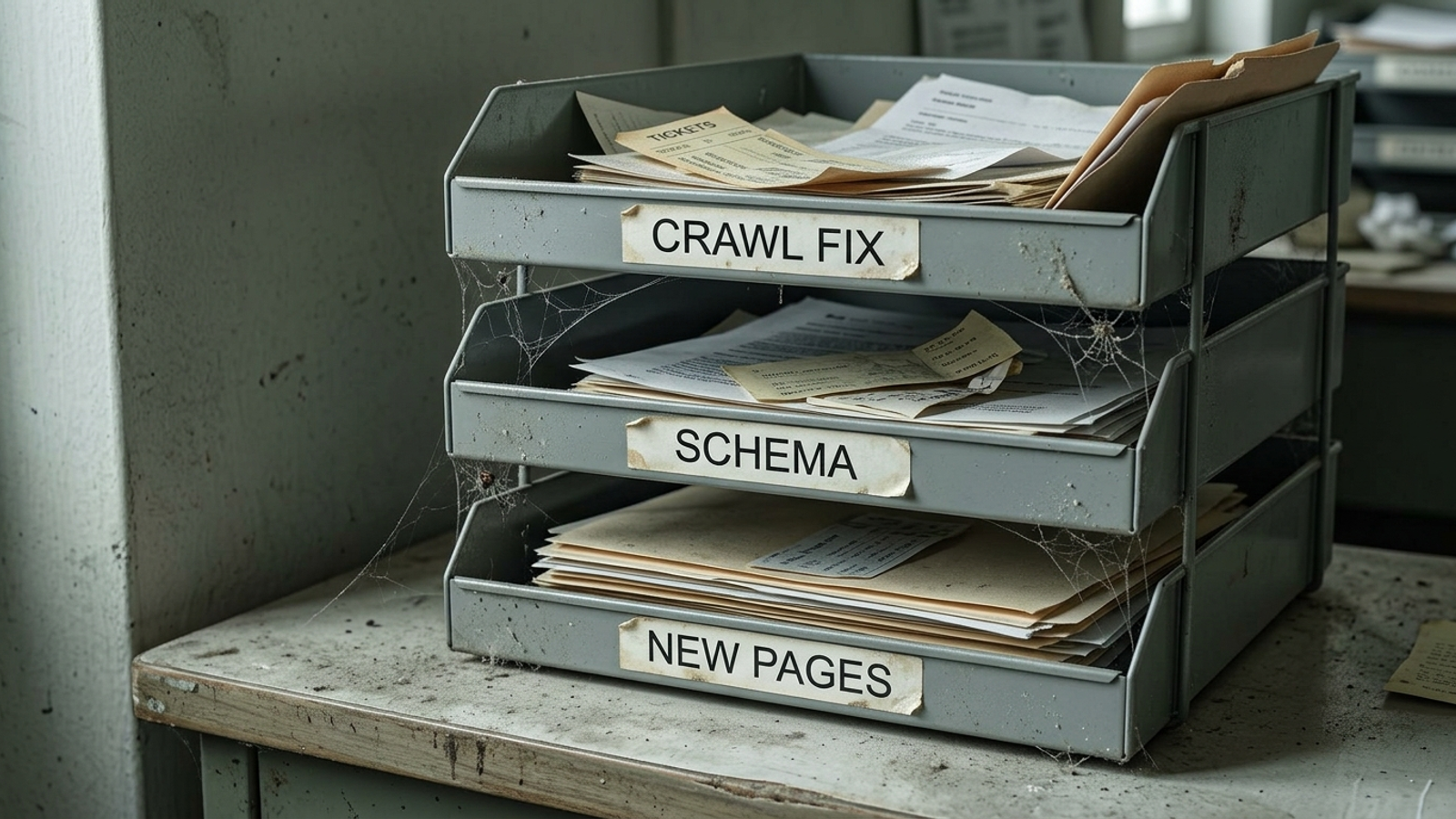
Meanwhile, monitoring keeps billing. The report arrives, the citation has not moved, and the audit’s best recommendation still lives in a backlog. Put one person in charge of the ship date. If nobody can get a page live in under two weeks, fix that bottleneck before buying another report.
Three ways to buy the job
The table prices tasks. These paths show who owns them. Compare scope and delivery, not just the smallest monthly number:
- DIY with a tool: Pay for tracking and assemble the audit, fixes, writing and outside work yourself. For the illustrated 10-rewrite, six-new-page job, the one-off lines total about $6,850 to $21,800, plus your time. Tracking the 80 combinations adds $189 a month on the cited 100-prompt plan. You can choose a smaller scope, but every ticket then waits on your ability to assign and approve it.
- Agency retainer plus your developer: A small-business retainer runs $2,000 to $5,000 a month if the site already works; a broader mid-market program runs $8,000 to $15,000. Three months of the smaller retainer is $6,000 to $15,000 before any separately billed developer tickets or outreach. Ask who writes, publishes and builds links. Below $2,000 a month, the scope is more likely to be audits, tools or a few rewrites.
- Done-for-you flat fee: A flat-fee model is attractive when one provider takes responsibility for execution instead of selling you a dashboard and leaving you to coordinate the work. groas pairs autonomous search execution with a named human strategist, rather than charging for human hours whether performance moves or not. Confirm the scope of technical work, content and off-site work before treating any flat fee as the price of every line in this table.
DIY is cheap only when you can do or ship the work yourself. An agency can consolidate it, but a retainer is not proof that every line is included. A flat fee can simplify ownership; its scope still has to match the job.
Pick a path, or skip the bill
Pick DIY with a tool if you can ship pages weekly without asking permission, your site already ranks on page one or two for the buyer terms, and the question list stays under 20. Pick an agency if templates need real engineering, you need five to 10 new answer pages plus outside work, and someone in-house can approve copy in days rather than months. Pick a done-for-you flat fee if you want one owner for execution inside guardrails you set instead of coordinating vendors and a developer queue.
Skip the visibility project for now if AI Overviews rarely appear for your money terms, if your pages sit beyond page three and need a full rebuild first, or if the informational clicks you want never turned into pipeline anyway. I used to say everyone should chase every new surface. I was wrong. If a citation cannot plausibly produce a call, demo or sale, it is a vanity metric with an invoice attached.
The cheapest mistake is the $29 tracker that tells you each month you are still invisible. The most expensive is paying for monitoring, an audit and content while the fix tickets sit unbuilt. Price the whole job before you buy its first line, and do not start until someone owns the ship date.
Häufig gestellte Fragen
Is a $29 AI visibility tracker enough to get cited in Google AI Overviews?
No. A tracker only records whether an answer names you; it cannot fix rendering problems, rewrite pages, publish missing comparison pages or build outside authority. For the illustrated small-business job, the one-off work costs about $6,850 to $21,800, with tracking as just one line on that bill.
How much does it cost to optimize for Google AI Overviews?
The article's illustrative small-business example involves 20 buyer questions, 10 page rewrites and six new answer pages. The one-off work totals about $6,850 to $21,800, and ongoing tracking plus four articles a month runs roughly $1,389 to $5,389 monthly. Staff time is not included in either figure.
Why does prompt tracking cost more than the advertised $29 a month?
One check covers one prompt on one engine. Twenty buyer questions tracked across ChatGPT, AI Overviews, Perplexity and Copilot mean 80 combinations, which points to the $189-a-month 100-prompt plan rather than the $29 entry tier. Your question list, not the vendor's headline price, determines the invoice.
What should a good technical SEO audit deliver for AI Overview visibility?
A useful audit identifies which templates block extraction, which sections bury the answer, and which buyer questions have no page at all, so your developer gets a buildable backlog. Automated exports under $500 list everything that is wrong; an SMB audit at $1,000 to $5,000 tells you which fixes to do first. For a small site, budget $1,000 to $3,000 one-off for that build list.
How much do technical fixes cost so AI crawlers can read my pages?
For a small site, plan on $750 to $3,000 one-off, assuming five to 20 hours of work. Consultants charge $75 to $200 an hour, with technical specialists at $100 to $200. Costs rise if a template problem touches every page or the CMS queue delays the fix.
Do rewriting pages and creating new answer pages count as one content cost?
No. Rewriting 10 existing pages costs $1,500 to $8,000 at rates of $150 to $800 per article, while six new pages at an illustrative $400 to $800 each add $2,400 to $4,800 on top of that. Count the pages you can edit separately from the pages you do not have before comparing proposals.
How much should I budget for link building to appear in AI Overviews?
For the article's small-business example, allow $1,200 to $3,000 one-off for three to five starter placements, using market rates of about $150 for a guest post up to $800 for hero content. Continuing campaigns average $4,200 a month with freelancers or $6,357 with agencies, so do not confuse a one-off purchase with an ongoing contract.
What hidden costs come with running an AI visibility project in-house?
Staff hours for picking questions, approving copy, and waiting on developer queues can add $500 to $1,000 a month at an illustrative $100 an hour, on top of vendor invoices. The article recommends putting one person in charge of the ship date and fixing any bottleneck that keeps a page from going live in under two weeks before buying more reports.