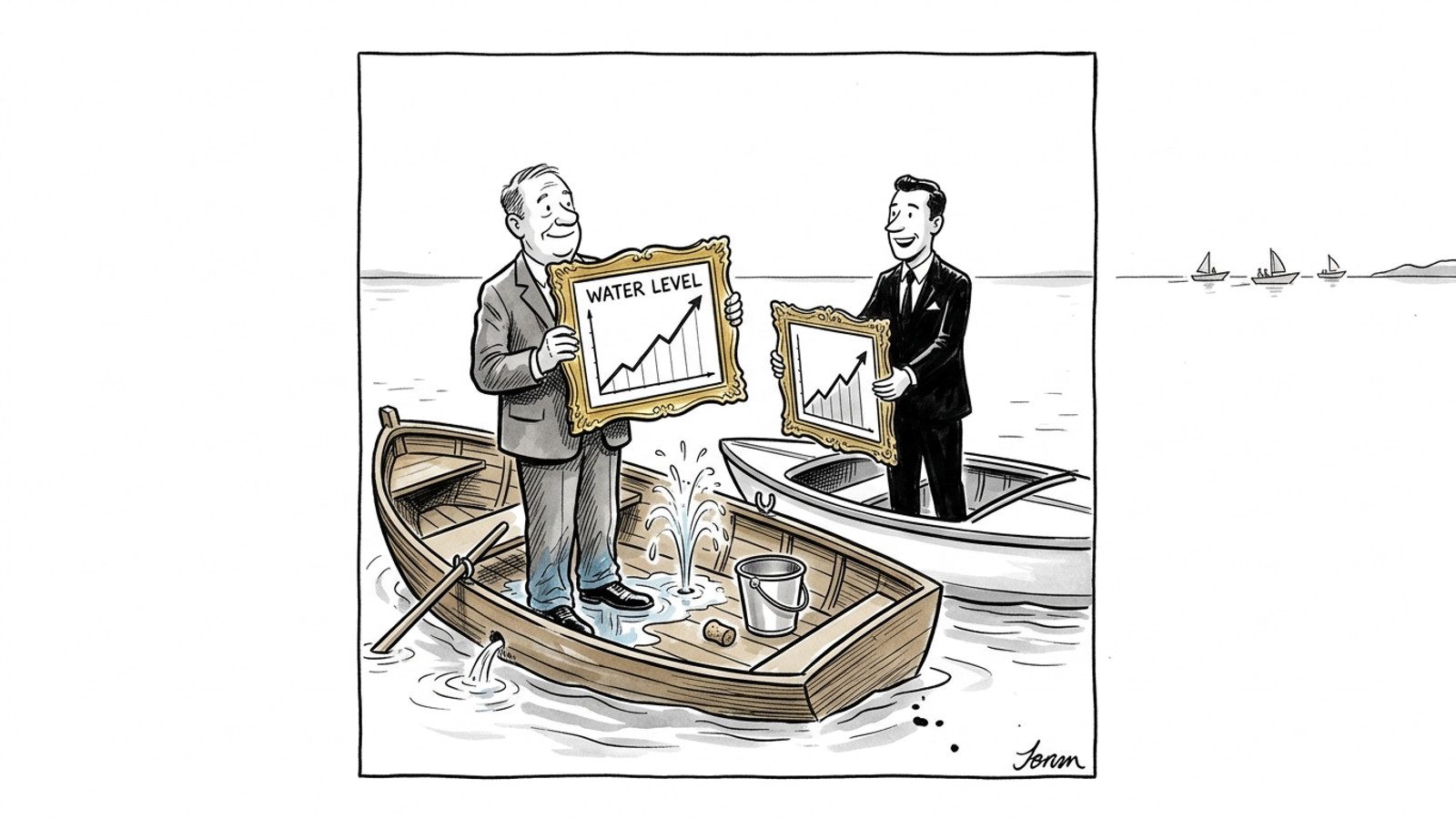

On a $20,000-a-month ad account, a reported LocaliQ starting quote of $500–$1,000 a month is only the first number to examine. Add an illustrative $750 for your own review time and $333 for one delayed response to wasted spend, and the monthly load becomes about $1,583–$2,083 before media spend. Neither extra cost is guaranteed. Both are worth putting beside the quote before you sign.
WordStream no longer gives you a public self-serve tier to plug into that calculation. Its old software prices were $199–$399 a month across the published spend bands below; today, the path leads to a sales consultation and a custom LocaliQ managed-services quote. I managed accounts on the old recommendation-led model, and I can tell you where the pricing-page math stopped: someone still had to do the work. The subscription could be the smallest line on the bill. Here are the lines I would count.
Line 1: the listed price, then and now
| Cost | Published or reported figure | What the figure covers | Source |
|---|---|---|---|
| Historic tier: up to $2,500 in ad spend | $199/month | Self-serve software and weekly fixes to review and approve | Historic tier listing |
| Historic tier: $2,500–$5,000 in ad spend | $319/month | The same tool at a higher spend band | Historic tier listing |
| Historic tier: $5,000–$10,000 in ad spend | $399/month | The same tool; pricing above $10,000 moved to a custom quote | Historic tier listing |
| LocaliQ managed bundle | Roughly $500–$1,000/month to start, scaling with spend | A custom managed-services quote rather than a public self-serve tier | Pricing review |
| Managed-service buyer example | $1,600/month | What one reviewer reported paying for managed services, not a current rate card | Buyer review |
The first three rows are historic software prices, not offers you can buy today. That matters if you find an old article that calls WordStream a $199 tool and compare it with a current managed-services quote. Those are different purchases. The current pricing path is a consultation rather than a public table of tiers and costs, so ask what the quote includes before treating it as a software price.
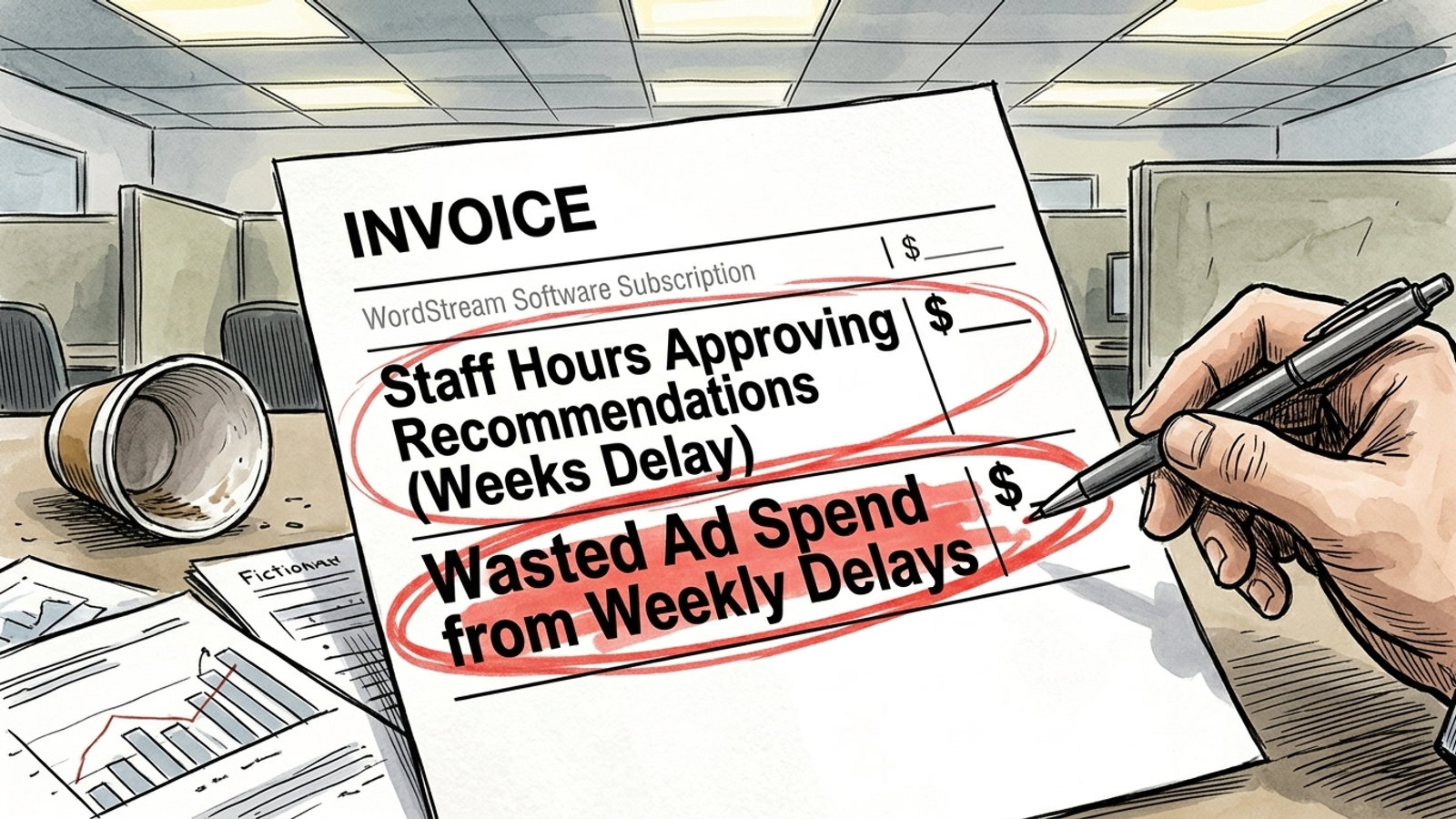
I used to tell clients that the $199 tier was cheap coverage. I was wrong. It was cheap triage. The 20 Minute Work Week gave you a queue of recommended fixes, and the Performance Grader remains free, but a recommendation was not an implemented change. The price rose with spend; the approval work stayed on someone’s desk. Price the person as well as the tool.
Line 2: a monthly quote is not a monthly commitment
The shift from self-serve software to a managed bundle changes the contract question. LocaliQ bundles are often described as carrying a minimum six-month term. If your quote is $750 a month and your term is six months, you are committing $4,500, not testing a $750 purchase. That is a commitment calculation, not an extra fee to add to each month.
Cancellation deserves its own line in the decision, even when you cannot assign it a sensible monthly number. One LocaliQ reviewer reported two additional months of billing after cancellation, costing almost $1,000. That account does not establish what will happen to you. It does show why a verbal assurance about cancellation is not enough.
Before you sign, get these terms in writing:
- Initial term: how many months are you buying?
- Renewal: does the agreement renew, and on what schedule?
- Cancellation: where must notice go, and when must it arrive?
- Scope: what work does the managed fee cover, and what stays with your team?
For a six-month term, a reminder around day 150 gives you time to check the agreement before the end approaches. The practical point is simpler than the paperwork: multiply the quote by the term before you compare vendors.
Line 3: managed service is a different bill, not a cheaper software tier
The second time you pay is when a tool does not do enough and someone offers to run the account for you. A LocaliQ quote can bundle search with listings, social, and display, which makes its price harder to compare line by line with the old WordStream subscription. The reported starting range is $500–$1,000 a month, with cost scaling with spend. Your quote and scope are the figures that matter; the range is a reason to ask questions, not a promised price.
One buyer reported paying $1,600 a month for managed services. Against $5,000 a month in media spend, that fee alone would equal 32% of spend. It is an example of how heavy a management charge can feel on a smaller account, not evidence that every LocaliQ customer pays that rate.
What you receive for the fee matters more than the label managed. The same $1,600-a-month reviewer said conversion tracking went unfixed over nine months, with duplicate code producing more reported leads than clicks while CPA and spend rose and leads fell. Another reviewer reported a $3,000 cost per lead against an approximately $100 industry average, with months remaining on the contract.
Those are individual complaints, not an average outcome. The mechanism is still worth understanding: bad conversion signals can steer bidding toward the wrong result. Paying someone to manage an account does not make that risk disappear. Before buying managed service, ask who checks tracking, how they check it, and who fixes it when the numbers stop making sense. Get that responsibility in writing.
Line 4: recommendations leave hours on your side
A work queue is not completed work
The historic 20 Minute Work Week surfaced prioritized fixes for weekly approval. That can be useful. I would rather review a sensible queue than hunt through the Google Ads interface with no idea where to start. But I know that queue from managing accounts: a flagged search term still needs judgment, an approved change still needs checking, and a broken landing page will not repair itself because an alert found it.
A TrustRadius comparison describes one sales director cutting account work from 20 hours a week to two or three. Another buyer in that comparison cites at least five hours a week saved on junk keywords and groups. Those are meaningful savings. They also make the distinction clear: saving hours is not the same as removing the job.
Put a rate against the hours that remain. For a $20,000-a-month account, suppose someone spends 10 hours a month reviewing recommendations and checking changes, at an illustrative loaded cost of $75 an hour. That is $750 a month in internal labor. If the time belongs to a founder and you value it at $150 an hour, the same 10 hours cost $1,500. These are scenario assumptions, not WordStream fees or measured averages.
Do not automatically add that entire amount to every managed-service quote. First find out what the service actually does. If your team still handles approvals, tracking checks, and follow-up, count that time. If the provider genuinely takes those tasks over, do not charge for them twice on your spreadsheet. The question for every quote is who owns the next action.
Line 5: a weekly response can have a cost, too
A weekly review creates a gap between a problem starting and someone acting on it. Search terms can shift, bids can move, or a landing page can break inside that gap. A queue may surface the problem at the next review; a team or system watching continuously has a chance to catch it sooner. Neither schedule guarantees a particular saving, so I would not sell the difference as one.
I would still stress-test it. Suppose 10% of a $20,000 monthly account’s spend goes soft for five days before the next review. Using a 30-day month, that is about $333 of spend exposed: $20,000 ÷ 30 × 5 × 10%. On a $5,000 account, the same assumption yields about $83. These are examples of spend at risk, not proven waste or a recurring vendor charge. If the problem never occurs, the line is zero. If it does, the software price is not the only cost you felt that month.
Ask how often changes are made, not just how often reports arrive. The response schedule belongs in the cost breakdown because delay can spend money even when the dashboard is working exactly as sold.
The totals: separate recurring fees from hypothetical leakage
Here is the math without stacking the old subscription on top of a current managed bundle. Both examples exclude media spend. The labor rate, hours, and delayed-response amounts are illustrative assumptions; the managed-service range is a reported starting range, not a quote for either account.
| Monthly account | Managed-service starting range | Assumed internal review | One assumed soft-spend episode | Illustrative monthly load before media |
|---|---|---|---|---|
| $5,000 in ad spend | $500–$1,000 | 8 hours × $75 = $600 | About $83 | About $1,183–$1,683 |
| $20,000 in ad spend | $500–$1,000 | 10 hours × $75 = $750 | About $333 | About $1,583–$2,083 |
The table’s $500–$1,000 input comes from the reported LocaliQ starting range; the labor and soft-spend inputs come from the scenarios above. Since managed pricing scales with spend, do not assume a $20,000 account will receive the starting quote. If it instead paid the reviewer’s $1,600 monthly fee, the second row would become about $2,683 under the same labor and delay assumptions. That example is a sensitivity check, not a current offer.
For comparison, a 15%-of-spend agency fee would be $750 on $5,000 or $3,000 on $20,000, before any setup fees. That arithmetic does not settle which service does better work. It shows why a low-looking subscription or management quote is a poor comparison if your own hours and the contract stay out of view.
There are two different totals to keep on your notepad. The recurring cost is the quoted fee plus the work your team still performs. The one-off or occasional exposure includes a tracking problem or delayed fix; it may be zero in a good month. Separately, the contract tells you how much of the quoted fee you have committed to pay. Mixing all three into one certain-sounding monthly price would be another kind of sales math. I have seen enough of that already.
The flat-fee comparison: pay for execution or pay to approve
WordStream’s old model charged for the list of work. groas charges a flat monthly fee, month to month, with no percentage of spend or setup fee for execution inside your guardrails. Specialized models handle bids, budgets, keywords, ads, and landing pages continuously; a named human owns direction, and actions are logged with their reasoning. That is the distinction I would test in a sales conversation: what changed, who changed it, and when?
I cannot give groas a dollar-for-dollar win against a LocaliQ custom quote that is not on the page. I can tell you which model I would rather investigate for an account where weekly approvals eat real time: one that does the work and lets you inspect it, instead of handing you another queue. For parallel $20,000-account math, read the $20,000-spend breakdown. Take the hidden-fee checklist into any vendor call, not just this one.
For more on the old tiers and the shift to LocaliQ, see the WordStream pricing and review assessment. Whatever a vendor calls the product, ask for the price, the term, and evidence of what it actually changed last week. If the answer stops at recommendations, you still need an operator.
Who should buy the queue, and who should skip it
If you are small, patient, and staffed to review recommendations, the old WordStream-style workflow has an appeal. Say you spend under $2,500 a month and can give the queue three honest hours a week. You may save time versus working raw in Google Ads, learn from the search term recommendations, and use the free Grader as a starting point. That is an argument for a review workflow, not a claim that the historic $199 tier is still for sale. Ask what today’s managed quote actually provides before buying on the strength of an old product description.
Skip a recommendation-led workflow if you spend $10,000 or more and have nobody assigned to act on recommendations. Be wary of a managed bundle if your tracking is already suspect or a six-month commitment makes you flinch. If you need a fix applied when waste starts rather than at the next weekly review, a suggestion list is the wrong purchase. Buy the discipline of review only if someone will do the reviewing.
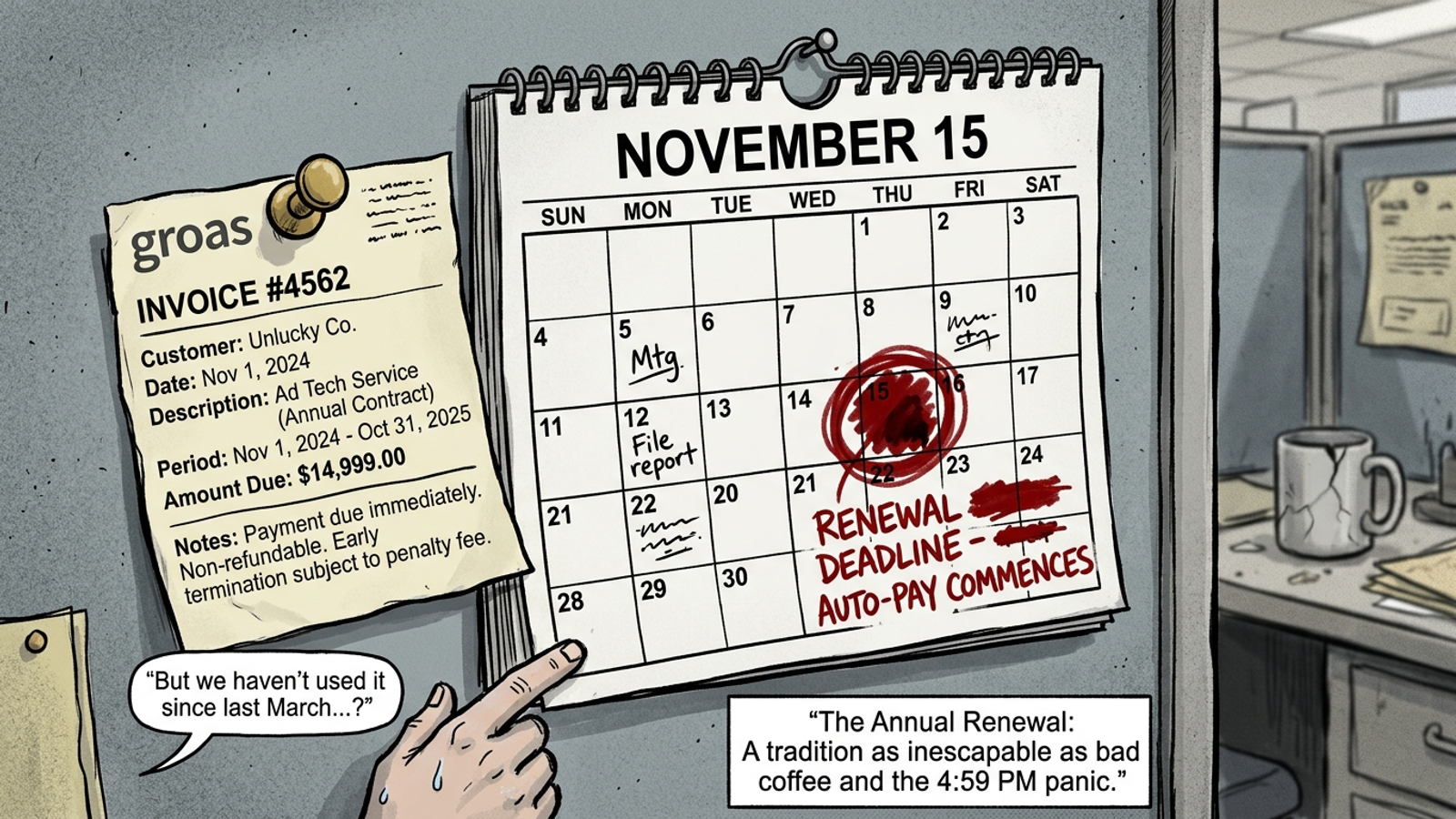
The cheapest mistake is paying for a month and ignoring the queue. You lose the fee and learn that you did not have the hours. The most expensive mistake is committing to a six-month managed bundle on a $20,000 account while broken tracking feeds the bidding system bad conversion signals. The fee keeps coming, the media keeps running, and the contract limits how quickly you can walk away. I used to tell clients software plus a little effort was enough. I was wrong. Count the term, count the hours, count the delay. Then decide whether the sticker price was ever the number you needed.
Frequently asked questions
How much does WordStream cost per month?
WordStream's old public tiers cost $199–$399 a month depending on ad spend, but those prices are no longer available. Today the path leads to a sales consultation and a custom LocaliQ managed-services quote, with a reported starting range of roughly $500–$1,000 a month that scales with spend.
Is WordStream really a $199-a-month tool?
The $199 figure is a historic price for self-serve software in the up-to-$2,500 ad-spend band, not an offer you can buy today. WordStream's current pricing is a custom LocaliQ managed-services quote obtained through a consultation, which is a different purchase from the old subscription.
What contract terms should I check before signing up for LocaliQ managed services?
LocaliQ bundles are often described as carrying a minimum six-month term, so a $750-a-month quote is a $4,500 commitment. Get the initial term, renewal schedule, cancellation notice requirements, and covered scope in writing. One reviewer reported two additional months of billing after cancellation, costing almost $1,000.
Does managed service remove the risk of bad conversion tracking?
No. Bad conversion signals can steer bidding toward the wrong result, and paying someone to manage an account does not make that risk disappear. One reviewer said conversion tracking went unfixed over nine months, and another reported a $3,000 cost per lead. Ask who checks tracking, how, and who fixes it, and get that responsibility in writing.
Does the subscription fee cover all the work, or do I still need to spend time on it?
The old model surfaced weekly recommended fixes that still needed your approval and follow-up, and saving hours is not the same as removing the job. For a $20,000-a-month account, the article's illustrative scenario assumes 10 hours a month of internal review at $75 an hour, or $750. If your team still handles approvals and checks, count that time alongside the fee.
Can a weekly review schedule cost me money through delays?
Yes. A gap between a problem starting and someone acting on it can expose spend. For example, if 10% of a $20,000 monthly account's spend goes soft for five days, that is about $333 of spend at risk, using a 30-day month. Ask how often changes are actually made, not just how often reports arrive.
What should the total monthly cost include besides the vendor's quote?
Keep two totals: the recurring cost, which is the quoted fee plus the work your team still performs, and one-off or occasional exposure such as a tracking problem or delayed fix, which may be zero in a good month. Separately, the contract determines how much of the quoted fee you have committed to pay.