

 LinkedIn

A contractor told me his Instagram leads cost $40 each and asked whether better interest targeting would get him to $20. I told him to look at the ad and the lead signal first: a $40 lead is not one price Meta chose. It comes from what he pays for impressions, how often people click, and how often those clicks become leads. Meta’s auction also uses its own prediction of outcomes when it decides which ads to deliver.
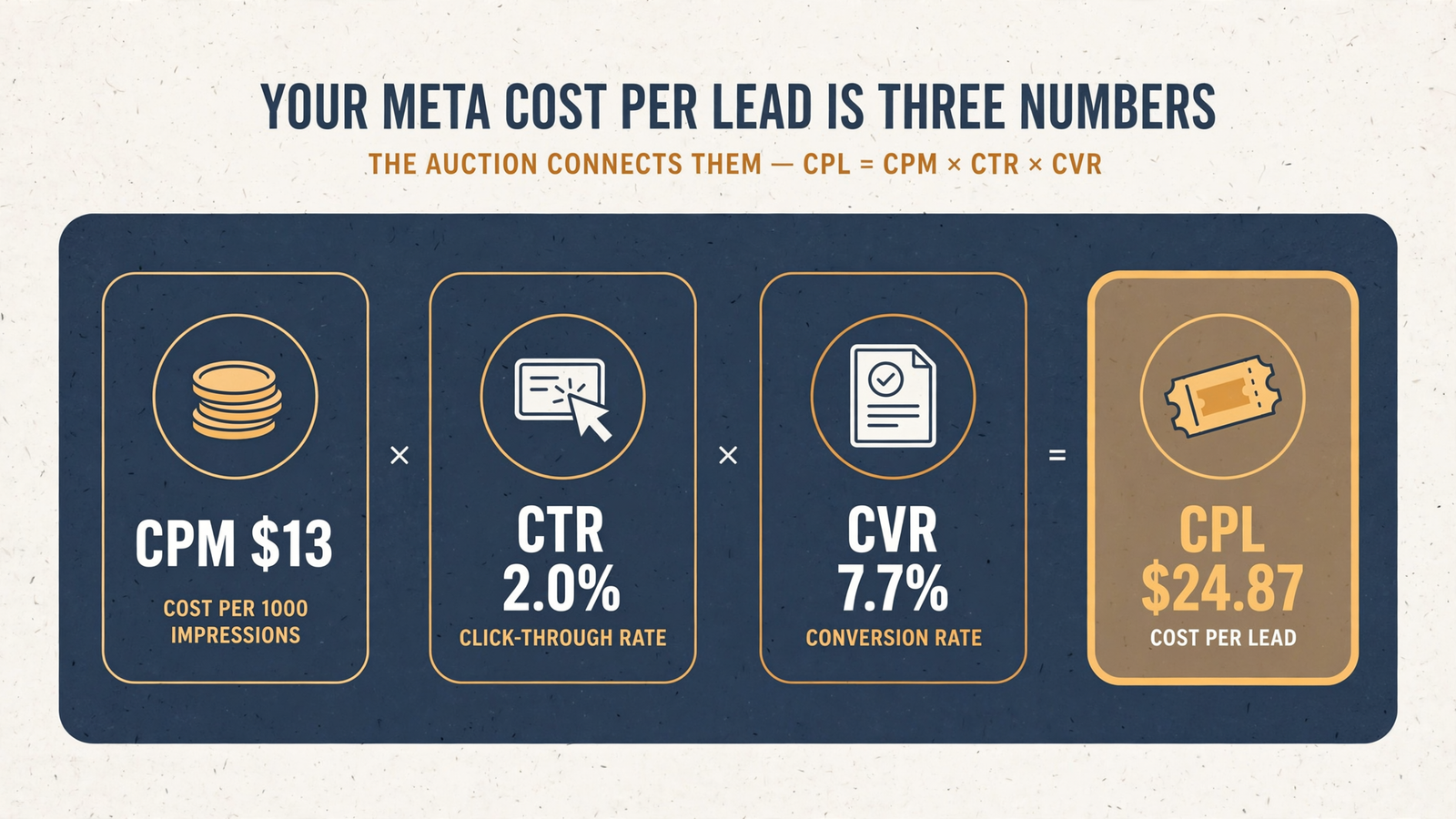
The arithmetic is straightforward. With rates written as decimals, CPL = CPM / (1,000 × click-through rate × conversion rate). Say you pay $13 per thousand impressions, 2% of those impressions produce clicks, and 7.7% of clicks become leads. That is 20 clicks, about 1.54 leads, and roughly $8.44 per lead. Change any input and CPL changes. The harder part is that the inputs do not operate independently: the ad and the conversion data that shape clicks and leads also help shape Meta’s prediction in the auction. That is why I start there, not with another interest stack. This auction breakdown explains the pricing model.
CPM is an auction outcome, not a fixed price for your audience
Meta does not sell you leads. It sells impressions through an auction, and the highest bid does not automatically win. Meta ranks ads by total value: the bid, multiplied by its estimated action rate, plus ad quality as this auction breakdown explains. Your bid expresses what a result is worth to you. The estimated action rate is Meta’s prediction that this person will take the action you optimized for. Ad quality is a separate assessment of the experience people have with the ad.
Those terms explain why a bid tweak is not the whole job. Imagine a $5 bid paired with a 3% predicted conversion rate and strong creative, against a $15 bid paired with a 0.8% predicted rate and weak relevance. The lower bidder can still win. The higher bidder has offered more money, but Meta expects less from showing that ad to that person. I used to talk about a bid as though it were a price tag. I was wrong. It is one part of a score, and a weak prediction can make an expensive bid do surprisingly little.
That matters for the contractor’s $40 lead. If he raises his bid before checking whether people want to click or whether Meta can recognize a good lead, he has not diagnosed the cost. He has only offered to pay more for the same setup. First find out what the auction has to work with.
The auction predicts actions from the signals you give it
Meta does not show you its estimated action rate directly. It recalculates that probability for each user and auction, informed by the creative, audience setup, and conversion data from Pixel and Conversions API described in this tracking guide. Ads Manager gives you clues instead: Quality Ranking, Engagement Rate Ranking, and Conversion Rate Ranking. If all three read Below Average, I treat that as a reason to investigate the ad and its signal, not as a prompt to open the bid-cap menu.
Conversion tracking matters because Meta needs to see the outcomes it is trying to predict. Pixel-only setups capture roughly 70 to 80% of true conversions, while Pixel plus Conversions API with hashed customer data captures 90 to 98%. Meta reported in April 2026 that using both cut cost per result by 17.8% versus Pixel alone according to the same Pixel and CAPI guide. Fewer recorded outcomes, especially when they arrive late or cannot be matched well, leave the system with a poorer picture of what happened after the impression.
This does not mean installing CAPI magically cuts every account’s CPM. It means the prediction has better material to learn from. If the contractor’s best leads are invisible to Meta, the system cannot reliably distinguish the people who book work from the people who merely open a form. Send back the outcome you actually want it to find.
A cheap form submit can teach Meta the wrong lesson
Here is where lead accounts often break their own model. Optimize for the raw Lead event and Meta learns to find people who submit forms. That is useful only if form submits reliably become customers. Instant forms can convert 3 to 5 times more often than landing pages because they prefill contact details, while producing 40 to 60% lower qualified rates. The easy submit can make raw CPL look excellent while cost per booked job gets worse.
For the contractor, the distinction is practical. A name and phone number are not a booked job. If many of his cheapest submits never make it past qualification, feeding Meta only those submits tells it to find more people like them. The next round of delivery can improve the number on the dashboard while making the business result harder to buy. A low CPL is not a win if it prices the wrong event.
The better target is a downstream event sent through Conversions API: Qualified Lead, Schedule, or an offline Customer Won event from the CRM rather than the initial form submit. Meta reports that lead ads using CAPI for CRM with a qualified-leads goal saw 21% lower cost per quality lead. Since April 2026, new campaigns need a CAPI integration to use that Maximize number of qualified leads goal, with existing campaigns following from August 2026. The setup also depends on a CRM updated at least daily and a target stage reached within 28 days. If the sales team never records which leads qualified, there is no qualified outcome to send back. Start with the record, then the integration.
Creative tells Meta whom the ad is for
I used to spend hours stacking interests and exclusions like they were load-bearing walls. They are not walls anymore. Under Advantage+ Audience, interests act as suggestions, and Meta can deliver outside them when it predicts someone else is more likely to convert as this breakdown of creative-led delivery describes. An owner can ask for a targeting rebuild when those settings are not the constraint they think they are.
Creative gives the system a different kind of information. A video that opens with a price, a neighborhood, and a specific problem tells viewers what the offer is and gives Meta reactions to that offer. Different angles can draw responses from different pockets of people. That does not make a neighborhood mention a targeting control; someone outside it can still see the ad. It makes the message more specific, which is the part the advertiser can test.
For the contractor, one angle might lead with the problem and another with the price. Their job is to show which message gets attention from people who may actually book, not simply which one produces the cheapest click. Three ad sets carrying the same tired image give the auction little new to learn from. One broad ad set carrying six distinct angles gives it six different messages to price. Test the message before rebuilding the audience around it.
Diagnose CPL by finding the term that moved
Before changing anything, pull the last 30 days and write down CPM, link CTR, and click-to-lead conversion rate. Keep the click and conversion definitions consistent: if you use link clicks for CTR, use those clicks as the denominator for the conversion rate too. Then compare the numbers with the account’s own history and an appropriate category reference.
Across 726 US lead campaigns from April 2024 to June 2025, the medians were 2.59% CTR, $1.92 CPC, 7.72% conversion rate, and $27.66 CPL, with CPL up 20.94% from $22.87 the prior year. But restaurants sat near $3.16 CPL and dental near $76.71, roughly a 24-fold gap. A general median can tell you where to investigate; it cannot tell a dental clinic what its leads should cost. Use the three terms to locate the leak, then judge it in context.
High CPM, normal CTR: inspect the auction inputs
Suppose link CTR is near 2.5%, but CPM is $28 against a relevant $14 baseline. The expensive part is getting impressions, not persuading people to click once the ad appears. Look at Quality Ranking, Engagement Rate Ranking, and Conversion Rate Ranking. If all three read Below Average, weak creative or conversion signal deserves attention before the bid does.
The rankings are clues, not a receipt showing the exact cause of every dollar of CPM. But the mechanism is worth checking: Meta weighs predicted action rate and ad quality alongside the bid. Stronger creative and cleaner outcome data can improve the inputs it uses to evaluate the ad. Do not pay more before checking why the ad is an expensive bet.
Normal CPM, low CTR: fix the ad people see
Suppose CPM looks normal, but link CTR is 0.6% against a category reference near 2.59%. The impressions are not the obvious problem. People see the ad and keep scrolling, leaving fewer clicks to carry the cost of those impressions. Through the middle term of the equation, CPL rises.
I check the hook first, format second, and audience last. For a local offer, a user-generated-style opening that names the problem and trade area is worth testing against another polished stock clip. The point is not that one format wins every account. It is that a different message gives you a real test, while another audience carrying the same ad may not. Keep one broad ad set and give it six distinct angles to price, not six audiences to chase.
Good CTR, weak form conversion: follow the click
Suppose CTR is near 2.5% and CPM looks normal, but only 2% of clicks become leads against the 7.72% overall median conversion rate. The ad earned attention. The form or page did not turn much of that attention into a lead, so CPL rises through the last term. That comparison does not prove the form is broken; it tells you where to look.
I see the tradeoff most clearly with instant forms left on default settings. Prefilled contact details make submitting easy, which can lift form conversion and invite low-intent leads at the same time. If qualification is the problem, two changes are worth testing:
- Add useful friction: a Higher Intent form with a review screen and two to four qualifying questions, or a landing page instead of a native form for a high-ticket offer.
- Check placements: Advantage+ includes Audience Network by default, including rewarded in-game slots. Cited Adalytics research puts invalid traffic there as high as 67%. Turning the placement off can raise raw CPL by 20 to 40% while lowering cost per qualified lead.
Neither change is a promise of a prettier raw CPL. That is the point. If a little friction or a narrower placement mix removes cheap submits that never become work, judge the test by qualified leads and booked jobs, not by how inexpensive the form looks.
Ask an agency what it will change in the equation
Most agency pitches I read promise to fix CPL with bid tweaks and audience rebuilds. Those can change delivery, but they do not answer the useful question: which term is broken, and what work will change it? Better creative can earn more clicks and give the auction stronger evidence about the ad. Pixel plus Conversions API can give Meta a clearer record of outcomes. A better form and follow-up can turn more of the right clicks into qualified leads. Each piece has a mechanism you can inspect.
This is the work behind how creative and conversion signal move CPL inside the auction. I would ask an agency to show its plan for creative tests and qualified-lead tracking before listening to an elaborate account-structure pitch. A weekly interest reshuffle is easy to put in a report. It is not a substitute for finding out whether the ad gets clicked or the lead gets booked.
Put the model to work on a $68 dental lead
Now take a different case: a dental clinic pays about $68 per lead. Its CPM is $22, link CTR is 1.4%, and 2.3% of clicks become leads. For every thousand impressions, that is about 14 clicks and 0.32 leads. Divide the $22 impression cost by those leads and you get roughly $68. The arithmetic accounts for the price; it also points to the work.
The CPM is not the obvious outlier in this example. CTR sits below the 2.59% overall median, and click-to-lead conversion sits below the 7.72% overall median. Those broad figures are not dental targets, but they give me two places to investigate. A pitch built around lower bids or a rebuilt interest stack addresses neither one directly.
I would test hooks that name the treatment, price range, and suburb to see whether a clearer message earns more clicks. Then I would test a Higher Intent form with two qualifying questions and send an offline booked-visit signal back through Conversions API. The form test addresses what happens after the click. The booked-visit signal tells Meta which leads mattered, giving its auction prediction better material over time. Those are separate jobs, and the three-number model keeps them separate.
Before signing an agency, I would ask: which number will you change in the first 30 days, and what work will prove it? If the answer is only audiences and bid caps, keep looking. The work that moves Meta CPL’s three inputs is creative testing that gives the auction new messages to price, paired with tracking that feeds qualified outcomes back so it stops hunting cheap form-fillers. That is what groas runs for Meta Ads at a flat $1,499 a month: audiences, budgets, and ads worked around the clock, new ads tested and winners scaled, with a strategist accountable for the result. No percentage of spend. No report that tells you to do the work yourself.


