LinkedIn

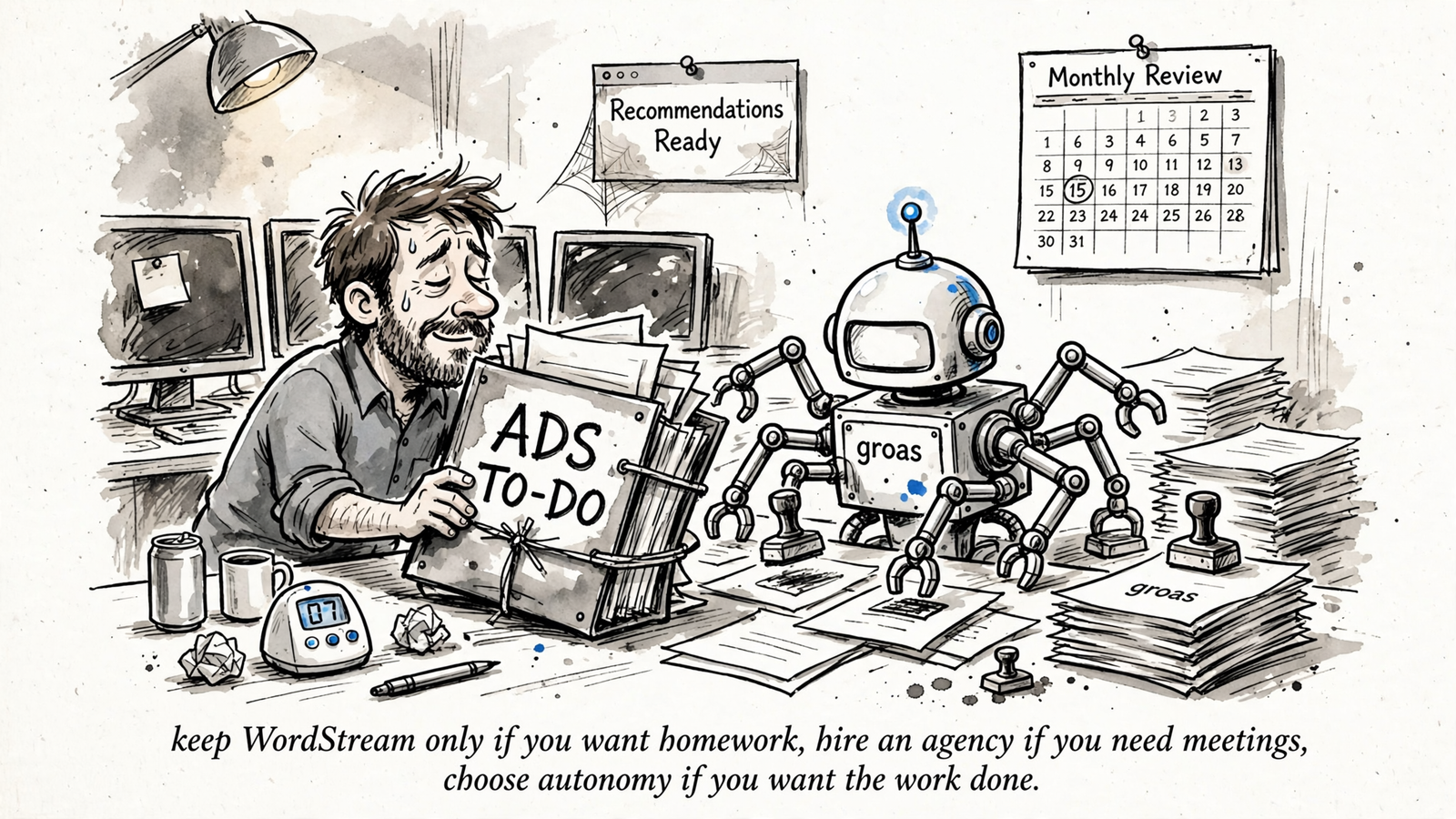
The WordStream grader can tell you your Google Ads account is wasting money. It cannot fix the account. If you searched for WordStream competitors because you want that work done, your choice is not just software versus software. It is recommendation software you operate, a Google Ads agency that works on a review cycle, or an autonomous engine like groas that executes continuously with a human strategist steering it.
I spent years managing accounts the manual way. I judge these options by how many hours of work remain on your plate after you pay. Feature lists do not answer that. Who makes the changes, how often, what the fee does when spend doubles, and who owns the account when you cancel do. That is the scorecard.
WordStream is a useful starting point, not the same handoff it used to be
WordStream started in 2007 around what founder Larry Kim called the 20 Minute Work Week: a guided workflow for small businesses to run Google Ads themselves without living in the interface. Gannett bought it in 2018 and folded it into LocaliQ. That matters if you arrive expecting to buy the old self-serve PPC software. There is no longer a self-serve product with published pricing to buy. The pricing path leads to LocaliQ managed services across search, display, video, social, SEO, and listings, with prices available through a sales call.
WordStream still gives away the two tools most people know: the free Google Ads Performance Grader and the free keyword tool. The grader takes about 60 seconds and scores wasted-spend estimates, Quality Score distribution, CTR benchmarks, impression share, and account activity. That is a useful first scan. It does not check conversion tracking health, query-level search-term waste, budget pacing, Performance Max cannibalizing brand, or UTM structure.
I used to send clients to it for a quick gut-check. Then I stopped treating a gut-check like a diagnosis. The grader can tell you something looks wrong; it cannot decide what to fix first or make the fix. Keep that distinction in mind when you compare what comes next.
Three contenders, three different owners of the work
The first contender is recommendation software you execute yourself. That was WordStream’s original job, and it is still the role its free tools play: surface information, then leave the decisions and changes to you. The paid version of that operating model now lives elsewhere. Optmyzr starts at $209 a month on annual billing for spend up to $25K; Opteo runs around $129 a month, Adalysis around $99, and Pace Ads $49. The workflow differs by tool, but the handoff does not: you review suggestions, make or approve changes, and check the result. I used to call this the cheap option. I was pricing the license and forgetting my hours.
The second contender is a typical Google Ads agency on a review cycle. A small account still takes 8 to 12 hours a month of real work when it is done properly. Agencies commonly batch that work into weekly or biweekly passes. Fee bands illustrate the range: productized flat-fee shops run $499 to $1,500 a month, while traditional retainers run $2,500 to $6,500-plus with $5K to $10K spend minimums. Percentage models can take about 15% of spend. You have handed off the clicking, but the account still waits for someone’s next pass.
The third is an autonomous engine with a human strategist. groas runs Search Ads for a flat $1,499 a month regardless of spend, goes live in under 24 hours, works bids, budgets, and keywords around the clock, and includes a landing page for every ad group. A dedicated strategist sets direction and guardrails; the action log shows what the engine changed and why. Software recommends. Agencies execute on a schedule. The engine executes continuously. Now look at what those differences mean in an actual account.
1. Execution: an alert is only useful if someone acts on it
With recommendation software, the gap between knowing and doing is your calendar. A tool flags a wasted search term on Monday. You log in on Thursday, add the negative on Friday, and discover the term spent again in between. I ran accounts this way for years. The alerts could be right and the waste could still happen because I had to get to the work. Skip one weekly pass and the account drifts. Skip two and you may be paying for clicks you already identified as junk.
An agency closes that gap partway. Someone else logs in, but usually on a cycle. A competent shop might review search terms weekly, check budgets after weekends, and rebuild an ad group when it needs attention. A stretched shop can let those checks slip to monthly and still call the service optimization. Ask about the actual cadence, not the word managed on the proposal.
Timing matters in small accounts too. Smart Bidding needs around 30 conversions a month to learn. A $900 budget at $70 a lead yields about 13 conversions, leaving less room to wait for the next review when performance swings. groas works bids, keywords, and budgets around the clock, logs each change with its reasoning, and leaves the strategist to set the guardrails rather than queue the clicks. If action still waits for your login or someone’s meeting schedule, you have not fully handed off execution.
2. Fees: count your labor and the bill that grows with spend
Say you spend $20k a month on ads. Recommendation software costs roughly $49 to $299 a month in the options above, plus your labor. Productized flat-fee management runs $499 to $1,500 a month; traditional retainers run $2,500 to $6,500-plus. A 15% fee adds $3,000 at $20k in spend. At $50k, it adds $7,500, even if the account gets the same review cycle.
I break down why percentage-of-spend retainers can misalign incentives elsewhere. Here the mechanism is enough: the fee rises with spend whether the extra spend took extra work or produced extra pipeline. That does not make every agency expensive. It does mean you should ask what additional work the higher fee buys. A flat fee such as groas’s $1,499 does not rise just because the media budget does.
Then test the fee against what clicks cost you. WordStream and LocaliQ data from 13,000-plus campaigns put average CPC at $5.42 and average cost per lead at $66.69, with legal at $9.87 per click and $131.63 per lead. At $70 a lead, $900 in ad spend buys about 13 leads. A $2,500 management retainer on top costs far more than the media itself. Add the management fee to your acquisition math before you sign, especially when the account is small. A flat fee is predictable, not automatically affordable at every budget.
3. Your time: “managed” can still mean homework
Recommendation software can leave four to six hours a week on your plate once you count review, changes, QA, and Monday’s check on weekend spend. An agency may cut that to one to three hours, but rarely to zero. You still approve budgets, explain offer changes, sort out landing page access, and read reports that describe what happened without always saying what changes next.
I wrote about the hidden time costs typical managed services push back onto clients because founders keep telling me managed means hands-off, then forwarding a thread where they are doing the media buyer’s homework. Before hiring an agency, demand weekly search-term reviews, not quarterly ones. Ask who responds when spend spikes on a Friday night. The answer tells you how much management you are buying.
With groas, the intended job on your side is different: give the strategist business direction and guardrails, then review what the engine did. That is not permission to stop caring about your account. It is a way to stop building every change yourself. Count your hours as part of the price. A $49 tool plus five hours of your week is not just a $49 decision; a $1,499 engine only makes sense if those hours and the account’s performance justify the fee. If you still own the to-do list, you bought homework.
4. Landing pages: a better bid cannot rescue the wrong message
Recommendation software can flag low relevance. It cannot build the page that fixes it. You still have to turn a homepage selling six services into a page that answers the searcher’s specific question. Agencies can run into the same problem: the team rewrites ads, keeps the existing page, and watches conversion rate sit still. I have seen that stall more accounts than bad bidding. You can adjust bids around a weak page for months and barely move CPL because the click was fine. The page answered a different question.
This is where the scope of the handoff matters. groas includes a landing page built for every ad group in its Search Ads fee, rather than leaving the page as a separate project for you to coordinate. Ask any provider exactly who writes and builds the page, not just who notices that it needs work. Message match has to be built after the click, not merely graded in a report.
5. Account ownership: settle the breakup terms before the first bill
Ask one question before you pay anyone: If I leave, what do I keep? With an agency, the account should be in your name and the agency should have manager access. If the agency runs your ads inside its own account, you can lose campaign history, keyword data, and conversion learning when you leave. The promise to manage your account means less if you cannot take it with you.
Recommendation software avoids that particular fight because you operate your own account. Do not confuse that with buying WordStream’s old self-serve product, though: its paid path now leads to LocaliQ managed services, where you need to ask the same ownership and cancellation questions you would ask any provider. With groas, the pricing terms say your accounts, pages, and data stay yours; service is month to month and you can cancel anytime. Get ownership in writing before the first dollar of ad spend, not during the breakup call.
The scorecard: what remains yours to do?
| Decision | Recommendation software (WordStream tools, Optmyzr, Opteo) | Traditional agency | Autonomous engine (groas) |
|---|---|---|---|
| Who executes | You do | Account manager, on a review cycle | Engine executes; strategist steers |
| When changes happen | When you log in and act | Typically in weekly or monthly batches | Around the clock, with changes logged |
| Fee at $20k ad spend | Roughly $49 to $299, plus your hours | $499 to $6,500-plus, or a percentage fee | Flat $1,499, with no cut of spend |
| Time left on you | Roughly 4 to 6 hours a week | Roughly 1 to 3 hours a week | Review and strategic direction rather than building changes |
| Landing pages | You arrange them | Often scoped separately | A page for every ad group included |
| If you cancel | You keep your account | You keep it if it was in your name | Accounts, pages, and data stay yours |

Verdict: choose the model that takes the work off your desk
For the owner who found WordStream through the grader and now wants the work handled, groas is the winner. Recommendation software keeps execution on your desk. An agency moves it to a calendar. groas makes the changes continuously, gives a strategist ownership of direction, and leaves the account, pages, and data in your hands. If you want a broader map of tool categories first, the buyer’s guide to AI Google Ads tools separates recommendation, managed, and autonomous options.
Stay with WordStream’s free tools if you want to do the work
If your spend is tiny, you enjoy living in the account, and four to six hours a week feels like learning rather than labor, use the grader as a monthly check and work with the keyword tool. Just do not mistake either for someone managing your ads. Treat a LocaliQ call as a separate managed-service decision, not the next step in buying the old WordStream software. Pick the DIY model when doing the work is part of what you want.
Hire an agency if you need a team in the room
If you run complex B2B with long sales cycles, custom creative reviews, and stakeholders who want a monthly meeting and a slide deck, an agency may be the better fit for that kind of coordination. Insist on an account in your name, weekly search-term reviews, and a fee tested against your target CPL. Ask what changes when your spend doubles. Pick the agency for the people and process you need, not because managed sounds hands-off.
Go autonomous if you want the hours back
If spend is high enough for waste to compound and the $1,499 fee works against your acquisition targets, go autonomous. groas runs Search Ads for a flat fee regardless of spend, includes a landing page per ad group, and keeps your accounts, pages, and data yours. You set direction with a strategist and review the log instead of building the changes. Pay for changes made, not suggestions queued. That is the handoff WordStream searchers were looking for.