

 LinkedIn
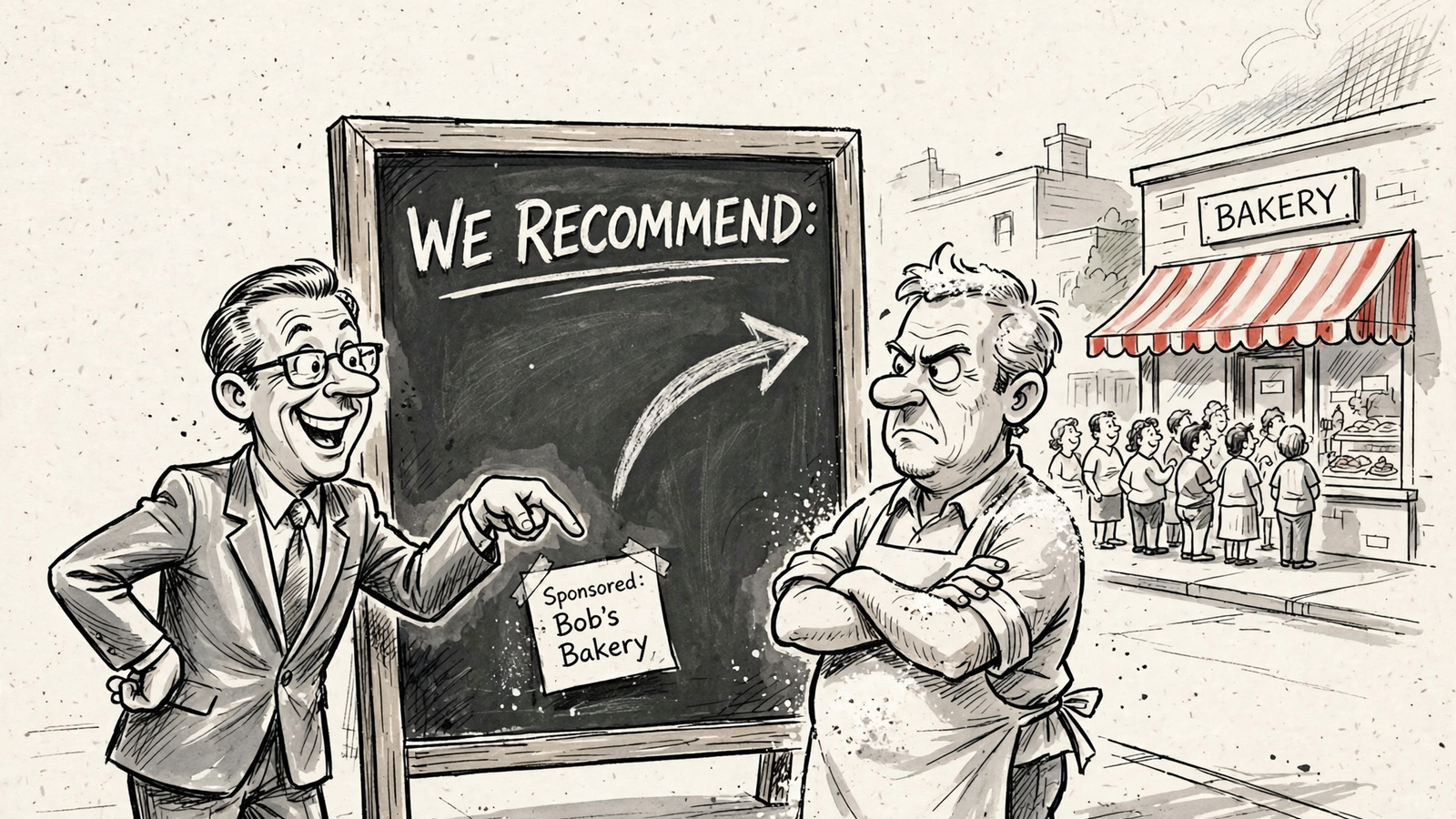
“You’re in ChatGPT” can mean you paid to sit below an answer that recommends a competitor. Before I accept that screenshot as a result, I want to know which part of the screen I’m looking at.
I keep four buckets separate: a paid ad, a source citation, a brand mention and a recommendation. They run on different systems, appear in different places and need different measurements. Blend them together and a visibility score can climb while the pipeline stays flat.
This is my glossary for reading those reports without buying the sales pitch. Your own AI can read all four from groas’s ads and AI-answer data. The useful question is what to ask it for: the answer, the ad, the buyer question and the denominator behind that impressive percentage.
ChatGPT ad
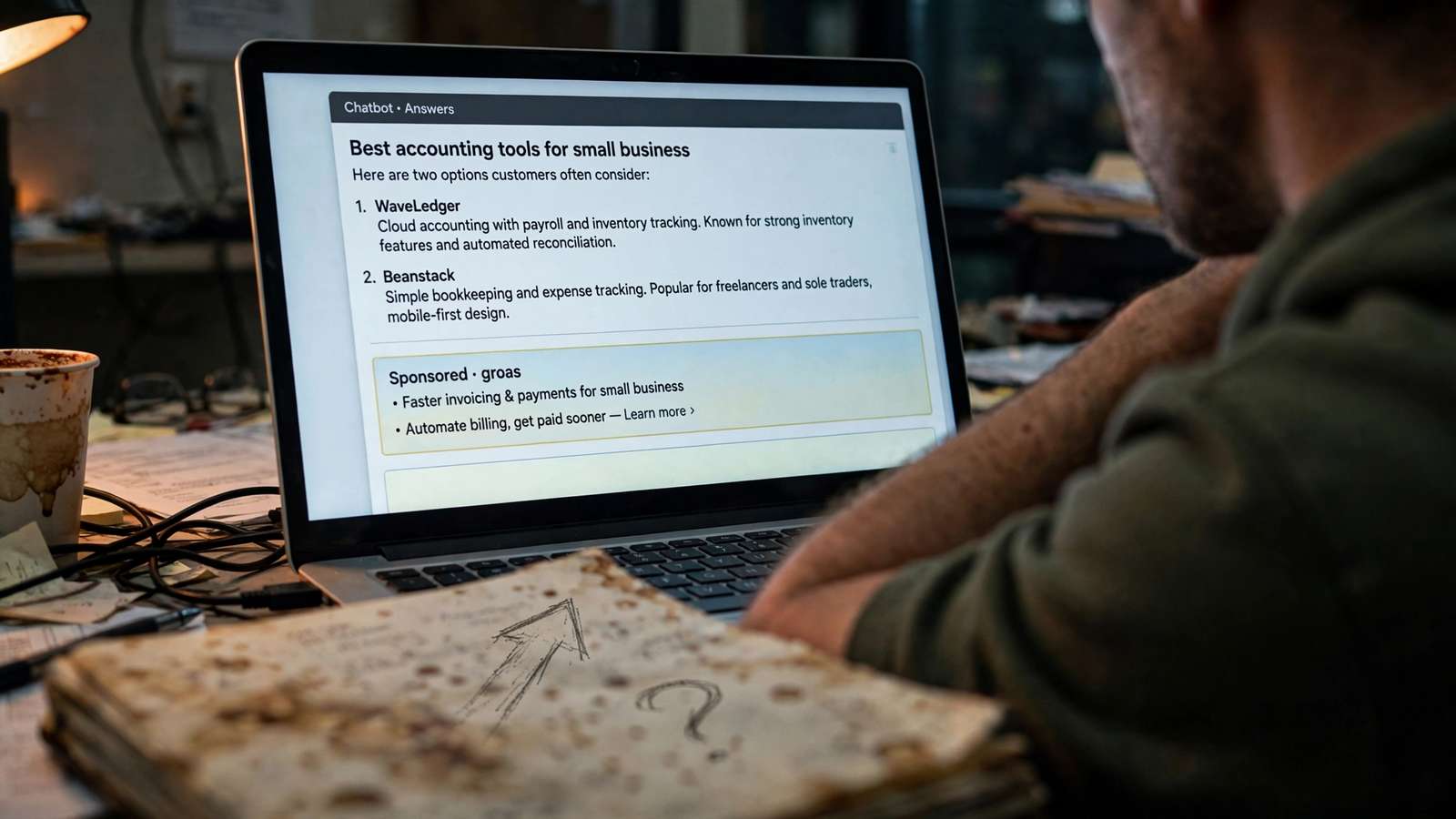
A ChatGPT ad is a paid sponsored unit that sits below the answer, not inside it.
Buying the ad does not buy the recommendation above it. OpenAI keeps the answer system and ad system separate, and its stated principle is that ads do not influence the answers. That separation is the first thing I would explain to anyone paying for “ChatGPT visibility.”
In one 100-question logged-out test, 66 answers carried an ad, but in only 11 cases was the advertiser also named in the answer above its own ad. In the other 55, the advertiser appeared below an answer that recommended someone else.
That is the reporting trick to watch for: a screenshot of your ad presented as proof you were chosen. The screenshot may be perfectly genuine. The interpretation is doing the dishonest work.
I would ask my AI to pull two captures side by side from groas data:
- The answer text, including the businesses it recommends.
- The sponsored slot below it, including the advertiser.
Then I can judge the placement I bought without confusing it with an endorsement I did not.
Source citation
A source citation means a specific page was linked as a source for the answer.
A mention puts a name on screen. A citation puts a URL under the reader’s cursor. That makes citations worth tracking separately from unlinked mentions and recommendations: the link creates a route to a referral visit.
A citation is evidence of sourcing, not necessarily endorsement. Your page can supply a background statistic while the answer recommends three competitors. There are also documented ghost citations: one domain was cited 182 times with zero brand-name mentions.
That is why I want the capture, not just the citation count. For each one, I want to see:
- Which prompt produced the answer.
- Which page received the link.
- Where the citation appeared.
- Whether the business was the subject or just the footnote.
A footnote can still be useful. I just would not pay someone to report it as a shortlist spot.
Brand mention
A brand mention means the business’s name appeared in the answer text; the name alone proves neither a link nor an endorsement.
Practitioners separate this out because it is a name on screen, not a vote. Context does the rest of the work. “Avoid these providers” and “shortlist these three” can both increase a raw mention count. One is not the result I would put on the celebratory slide.
Never accept a mention count without the sentence it came from. I would ask my AI to pull the full answer captures for the mentions groas tracked, then start by reading five.
If three are neutral directory lists and one repeats a Reddit complaint, rising share of voice tells a different story from the one in the headline. The business is being discussed. Whether that discussion helps is a separate question.
For the longer version, I keep the distinctions together in this mention, citation and recommendation breakdown.
Recommendation
A recommendation means the business appears among the answer’s suggested options for a particular buyer question.
The question matters. An evaluation prompt such as best X for Y asks the assistant to help build a shortlist. A branded pricing question asks it to discuss a business already in the conversation. Those are not interchangeable wins.
Of the four outcomes here, a recommendation is the one that puts the business on the answer’s shortlist. It can also happen without a click: an active recommendation can influence shortlist inclusion without producing a visit. A referral report alone therefore cannot establish how often the assistant recommended the business.
I would judge recommendations by the prompts behind them, not the total. A vendor can show 40 appearances for “what is [your brand] pricing” and none for “best CRM for a 20-person agency.” The first count does not answer the second question.
My instruction to the AI would be simple: read recommendation captures from groas against buyer questions, and keep branded questions separate. Show where the business was picked, for whom and in what company.
SEO, AEO and GEO
SEO, AEO and GEO are labels for work aimed at traditional search results, direct answers and generated responses—not three guaranteed outcomes.
The common distinction is that SEO targets traditional rankings and clicks, AEO targets selection as a direct answer, and GEO targets visibility in generated responses. The surfaces differ. Much of the underlying work overlaps: pages, technical delivery and outside references that help establish what the business offers.
A new acronym is not, by itself, a separate deliverable. What the deck calls a GEO stack can turn out to be familiar SEO work with a new invoice attached.
That does not make the work worthless. It makes the work more important than its label. Before I buy any of the three acronyms, I want three answers:
- Which pages will change?
- Which technical fixes will ship?
- Which outside mentions will be pursued, and by when?
I unpack that buying conversation further in this glossary for owners being pitched AEO. If the proposal cannot name the work, the acronym is not helping.
Indexing and retrieval
Indexing concerns whether a page is available to the system; retrieval concerns fetching it, neither of which proves it appeared in an answer.
Availability is not selection. A server log can show a verified fetch, but it cannot prove use or citation. For that, I need the captured answer.
This is where bot-traffic screenshots mislead. The bot names describe different activity:
- GPTBot: a training crawl.
- OAI-SearchBot: an index crawl for ChatGPT search.
- ChatGPT-User: a fetch associated with a user’s live question.
Even that last fetch does not guarantee a citation. A page can be fetched without the answer naming the business, linking to the page or recommending anything it sells.
I would ask which bot visited, on which dates, and what happened next. If the evidence stops at a crawl log, report a crawl. Do not promote it to a recommendation on the way into the client deck.
Prompt set and visibility rate
A prompt set is the list of questions being tested, and visibility rate measures how often the brand appears across runs of those questions.
The denominator is part of the result. Before I accept a percentage, I need to know what was counted as an appearance and how many answers were tested.
Share of voice is a different calculation: the brand’s mentions divided by all tracked brand mentions, multiplied by 100. That measure also depends on the competitor list. Calling both numbers “visibility” hides a useful distinction.
This is where reports become easy to flatter:
- Friendly branded prompts inflate apparent presence.
- Changing the questions breaks the comparison.
- Adding a rival changes the share-of-voice denominator.
- A single run can look different from the next run of the same prompt.
I want multiple runs per prompt and week-over-week comparisons on identical questions before calling movement a trend. I also want the engine-by-engine split, dates and repeat count, not one blended percentage.
That is what a mention rate measured against a defined prompt scope should force into the open. Freeze the question set before celebrating the answer.
Referral traffic and qualified pipeline
Referral traffic records visits from AI answers, while qualified pipeline records the qualified inquiries and opportunities those visits help produce.
A human AI referral begins with a click from an assistant to the site. A citation without a click creates no session. That is why visible presence can coexist with near-zero referral traffic: the answer appeared, but nobody followed the link.
A visit is not an opportunity, and an opportunity is not closed-won revenue. I keep those stages separate rather than letting “AI performance” do duty for all of them.
The useful reporting chain follows exposure, referral, behavior, conversion and revenue without pretending every stage is visible in one dashboard. An assisted path might look like this:
- ChatGPT sends someone to a comparison article.
- They visit pricing and request a demo.
- The inquiry becomes an opportunity.
- The opportunity eventually closes.
A later branded search or direct return can hide the original AI source in last-click reporting, which is why assisted paths matter alongside referrals.
Clicks are observed. Inquiries are counted. Revenue is attributed. Any report that calls the first one the third one is selling the funnel without the bottom.

Managed AI visibility service
A managed AI visibility service is ongoing work on pages, technical accessibility, outside corroboration and measurement across assistants such as ChatGPT, Gemini and Perplexity.
The work is unglamorous. Specific product data and category pages come first, then clean technical delivery so assistants can fetch and parse them, then outside corroboration, then repeated answer captures against a fixed prompt list.
When a provider sells ongoing SEO and generative engine work, that list is what I expect the words to mean. I want pages, fixes, outreach and dates. “Improving your AI presence” is not a work log.
Buy the work log and the captures, not a blended score. I hold groas to the same standard. Content and technical changes concern fetch and citation eligibility. Mention captures show where the name appeared. Recommendation captures show where the answer suggested the business. None should be substituted for another.
My AI can query groas ads and AI-answer data alongside the competitor ads, funnels, Reddit quotes and SEO data it collects around the clock. That puts the evidence in one place without making the four outcomes the same thing.
The buying distinction matters here, too:
- groas Unlimited is the infrastructure my own AI runs on: $19 a month flat for unlimited teammates, ad accounts and websites.
- Done For You is the senior-team service for businesses that want to hand the work over, starting at $5,000 a month.
One gives my AI the hands and data. The other puts a team on the work. I would choose based on who is going to operate it, then ask for evidence across the engines being tracked.
Visibility guarantee
A visibility guarantee is a promise that a provider will get the business ranked, cited or recommended in AI answers.
This is the term I would retire. No vendor controls whether an assistant recommends a business for a given buyer question, what its next answer says or which third-party source it trusts that week.
A service can commit to work and observation: pages shipped, technical barriers removed, mentions pursued and prompts tested on fixed dates with repeat runs. Rankings, citations and recommendations stay outside the guarantee column because they are outputs of systems the provider does not own.
So the next time someone says “you’re in ChatGPT,” I would ask which of the four they mean. An ad below the answer? A link? A name? A shortlist spot—and for which exact question?
My AI can read all four from groas data. I still want the questions, engines, dates and captures behind the claim. Everything else is a screenshot sold as a strategy.


