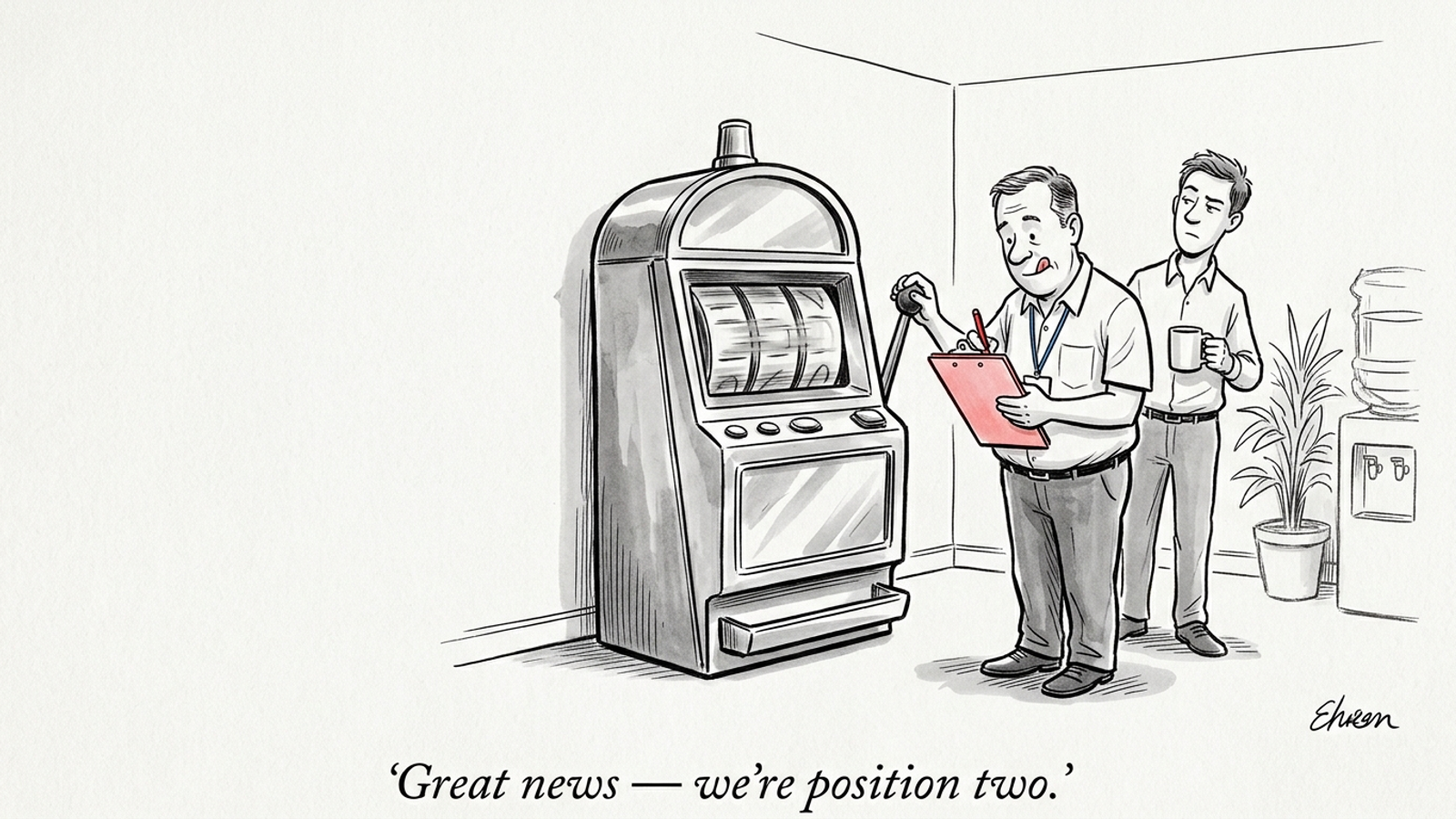

The ‘AI Google Ads agency’ changed its homepage, not its work. The account manager still checks your account on Tuesday, and the invoice still rises with your spend.
At 3am on Sunday, that manager is asleep, the chatbot tab is closed, and your auctions keep running.
I spent nearly a decade managing Google Ads accounts the slow way: mining search terms late at night, fixing broken tracking tags, and watching budgets leak while an approval call sat on the calendar. I respect the work. I also know which parts are repetitive, and I don’t think using a language model to do them faster entitles an agency to hide the time savings.
Look at a fairly ordinary workweek. An account manager copies search terms into a chatbot, asks for headline ideas, pastes a few suggestions into Google Ads Editor, and marks the task complete in Asana. The deck calls it algorithmic asset deployment. I call it a copy-paste job with an expensive middleman. The fake-AI-agency problem isn’t that a shop uses an LLM. It’s that the shop changes its pitch without changing how it runs your campaigns.
The homepage changed. The Tuesday review didn’t.
Ad auctions run 24 hours a day, 168 hours a week. A product feed can break on Sunday morning. A broad-match query can eat budget before anyone opens their laptop on Monday. Yet the standard agency contract still offers a ‘weekly optimization cadence’ and a monthly Zoom call. If a vendor says it runs an autonomous operation but changes your account only during business hours, you are not buying continuous execution. You are buying a human with faster homework.
There is a less glamorous way to test the pitch. Open your Google Ads account, go to Change History, set the filter to the last 90 days, and separate agency actions from changes made by ‘Google system.’ Look for intentional changes to bids, budgets, negatives, and assets. When did they happen? How often? Who made them? An account audit is more useful than a slide about ‘always-on intelligence’ if you want to know who is actually operating the account. Even WordStream suggests an automated rule to flag an empty change history. That is a low bar, but some accounts need it.
Don’t confuse a login with an edit, or an edit with a good decision. The point of checking the log is to give the agency something specific to explain. ‘We optimized the account’ is hard to challenge. ‘Why did this budget change on Thursday, but nothing happened after Friday’s query spike?’ is a conversation about the account you actually paid it to manage.
A quiet log does not, by itself, prove neglect. Sometimes the right decision is to leave a campaign alone. It does mean the agency should be able to explain what it monitored, why it held back, and what would have triggered action. A weekly check-in is not a 24-hour operating model. Ask to see the difference in your account, not in the pitch deck.

Translate ‘AI-powered insights’ into actual account work
Every cycle of ad tech gives manual routines a fresh vocabulary. Basic bid scheduling becomes ‘machine-learning optimization.’ A coordinator exports a CSV, asks a chatbot to summarize the biggest keywords, and pastes the answer into a branded PDF: ‘AI-powered performance insights.’ Someone prompts an LLM for responsive search ad headlines, uploads them, and leaves them alone: ‘generative creative testing.’ The phrases sound like work happening all the time. Often, they describe work that happened once.
When a client asks why the log is empty, an agency might say its third-party tools make changes outside Google Ads Change History. Don’t accept that as an explanation for an absent record of account edits. Ask which changes the tool made, when it made them, and where you can verify them. An insight and an execution are different products.
Suppose cost per acquisition rises after phrase-match queries start matching irrelevant software terms. An insight reports the problem in next week’s deck. Execution identifies the drift and adds an appropriate negative keyword while the waste is occurring. The first can be useful; the second is account management. If the agency sells you the second and delivers only the first, you’re paying to read yesterday’s news.
And if the agency says the insight was ‘real time,’ ask when anyone acted on it. A warning delivered on Saturday is not continuous management if it sits in a queue until Tuesday. The clock matters because the spending doesn’t pause while the recommendation waits for a meeting.
Why the old fee looks worse with an AI label on it
Agency pricing often runs at 10% to 20% of ad spend, sometimes with monthly minimums. There was a straightforward labor argument for that model. If you raised your budget from $15,000 to $60,000 a month in 2015, a manager might have had to build more account structure, write more variations, and adjust bids across devices. More spend could mean more hands-on work.
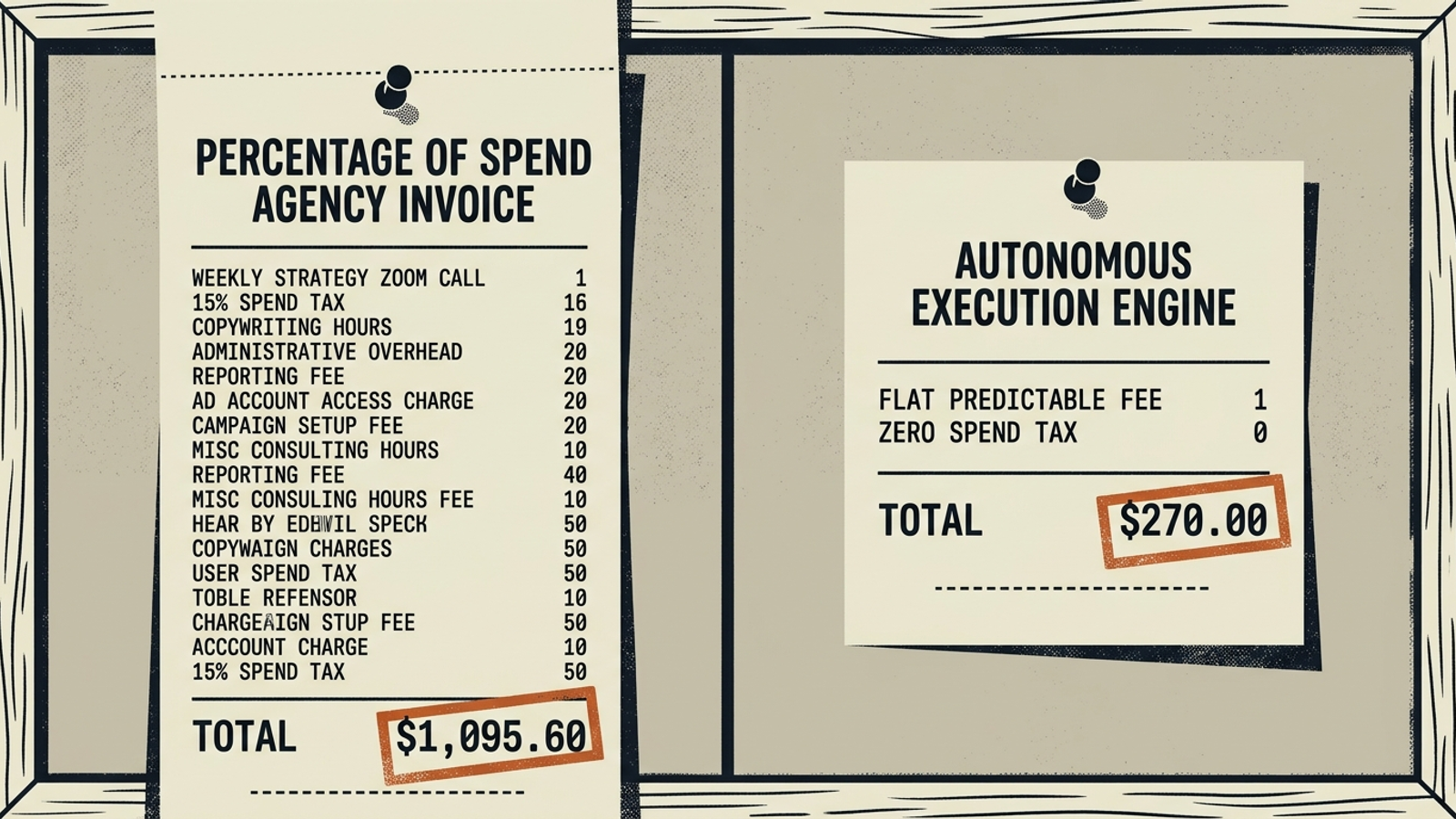
Now picture an agency claiming its own autonomous system handles bids, budgets, and targeting, then charging the same 15% of media spend. A model does not ask for overtime because a daily budget moves from $200 to $2,000. The account may become more complex as it grows; spend alone does not tell you how much additional work the agency did. That’s the hidden-margin problem with the AI agency retainer: the sales pitch says automation reduced the labor, while the invoice still treats every extra dollar of spend as extra labor.
The agency cannot have this both ways without explaining the work. If its software now handles the repetitive changes, what does the higher fee buy when spend rises? More strategic attention might be worth paying for. A bigger percentage-based invoice, with no change in the service you can see, is not an answer. It’s arithmetic.
The incentive is awkward, too. A percentage-of-spend fee rises when you spend more, whether or not the additional spend produces attributable revenue. If cutting $5,000 of wasteful broad-match spend improves the account, that recommendation also trims the agency’s fee. I’m not saying every manager chooses the invoice over the client. I am saying the contract rewards one direction more than the other.
If the agency’s case is that software does the routine execution and a human owns strategy, ask for a fee that reflects that model. Don’t pay a manual-work markup merely because your budget grew.
‘Does it use AI?’ is the wrong question
Buyers ask whether an agency or tool ‘really uses AI.’ That tells you very little. Asking whether your accountant uses a calculator wouldn’t tell you who prepares the return. An LLM can draft ad copy or explain a chart without ever touching a live campaign.
That is the gap I care about when comparing advisory tools with execution. A chatbot can tell you to improve ad copy after click-through rate drops. You still have to decide what to change, make the change, check the result, and reverse it if it goes badly. As I wrote in my review of tools like Ryze AI and Mai.co, an advisory experience leaves the operating work on your plate. A practitioner account of AI marketing tools describes that familiar frustration: generic suggestions where a campaign decision should be.
The dividing line is execution authority. Ask what can change in your account when nobody is sitting at a keyboard. An alert that cost per lead spiked on mobile is not a budget adjustment. A recommendation queue is not management. If every bid cap, negative keyword, and budget move waits for a human to click ‘apply,’ the operating speed still depends on when that human logs in.
I don’t object to a human approving important decisions. I object to selling that approval queue as autonomous execution. Call it advisory software, staff it properly, and charge for what it does. The argument starts when the sales deck promises one operating model and the account gets another.
That does not mean handing a model the keys and hoping it behaves. An autonomous setup needs commercial guardrails and a person accountable for the direction. With groas, specialized models execute across bidding, budgets, targeting, and search intent while a named human strategist sets goals and guardrails. That is a better division of work than a chatbot handing an overloaded manager another list of suggestions. The machine handles routine execution; the strategist owns the decisions it serves.
Run the 3am Sunday test
Here’s the question I’d put to any agency selling ‘always-on’ management: What changed in my account between Friday afternoon and Monday morning, and why? Don’t ask for a promise about what the system could do. Ask for timestamps and a reason for each action.
Imagine an inventory sync breaks on Sunday morning and paid traffic heads toward a broken landing page. Or a cluster of junk queries starts consuming a broad-match budget on Saturday night. A weekly review can discover either problem. It cannot go back and unspend the money. If the agency’s answer is that an account coordinator will check an alert on Monday or Tuesday, at least you know what you’re buying. It is not 24-hour execution.

Now look beyond the timestamp. Change History shows what happened, but you also need to know why. What signal triggered the action? Which guardrail limited it? When would the system reverse it? Audit-ready change rationales matter because a long list of edits is not proof of good management. A machine can make bad changes quickly, too.
That is why ‘look how many changes we made’ doesn’t settle anything. A pile of edits may show that software had access to the account. It doesn’t show that those edits served your target CPA or protected your budget. The useful record ties an action to a reason and gives you a way to question both.
Nor should you demand activity for its own sake. If nothing changed over the weekend, ask what the system observed and why no intervention was warranted. If something did change, ask to see the rationale beside the mutation. The test is not ‘did a robot click a button at 3am?’ It’s whether the account can be monitored, acted on, and explained while the office is empty.
Seven questions before you sign
Skip the tour of the dashboard. Before signing a contract with an agency promising AI-driven growth, ask for evidence from the account and terms from the contract. I made the same point in my letter to the owner who wants hands-off Google Ads: hands-off should mean transparent execution, not blind trust. Work through these in order:
- Show me the unedited Change History for last weekend. A slide about activity is not a timestamped record of it.
- Which actions can the software execute on its own, and which wait for human approval?
- How often do bids, budgets, and negative keywords change without a client meeting?
- What happens to your fee if our monthly ad spend doubles from $20,000 to $40,000? Ask what additional work justifies any increase.
- What triggered your last ten bid changes, and what limits governed them?
- What happens if target CPA breaks its guardrails at midnight on Saturday?
- Show me the rollback criteria for an underperforming automated change. Skip this and a bad change can keep spending until somebody notices.
That last question is the one I’d ask twice. ‘The system optimizes continuously’ sounds comforting until you need to know how it stops. If the agency cannot tell you when an experiment gets reversed, you haven’t been shown a safety mechanism. You’ve been shown a slogan.
The fix is not another slide explaining that the agency uses AI. Make it prove what the software executes, show you the log, name the human who owns the guardrails, and price the work accordingly. If it can’t do that, keep the retainer and choose a setup whose actions you can see.
Paying human prices for a chatbot tab is voluntary waste.
Frequently asked questions
Does calling itself an AI Google Ads agency actually change how the agency runs my account?
Often it does not. Many agencies that market themselves as AI-driven still rely on a manager who checks the account during business hours, with a weekly optimization cadence and a monthly call. The homepage changes, but the operating model stays the same.
How can I check whether an agency is actually making changes to my Google Ads account?
Open Google Ads, go to Change History, filter to the last 90 days, and separate agency actions from changes made by 'Google system.' Look for intentional changes to bids, budgets, negatives, and assets, and note when they happened, how often, and who made them. A quiet log does not prove neglect, but the agency should be able to explain what it monitored and why it held back.
What if my agency says its third-party tools make changes outside Google Ads Change History?
Don't accept that as an explanation for an absent record of account edits. Ask which changes the tool made, when it made them, and where you can verify them. An insight and an execution are different products, and you should be able to see the executions you are paying for.
What is the difference between an AI insight and actual account management?
An insight reports a problem, such as rising cost per acquisition, in next week's deck. Execution identifies the drift and adds an appropriate negative keyword while the waste is occurring. If an agency sells you execution and delivers only insights, you are paying to read yesterday's news.
Why does my agency fee keep rising with ad spend if software does the work?
Traditional agency fees run at roughly 10% to 20% of ad spend because more spend used to mean more manual work. If an agency claims its software autonomously handles bids, budgets, and targeting, a budget increase no longer means proportionally more labor, and the agency should explain what the higher fee actually buys.
Does a percentage-of-spend fee give an agency an incentive to keep wasteful ad spend?
The contract rewards one direction more than the other. Cutting $5,000 of wasteful broad-match spend would improve the account, but that same recommendation also trims the agency's fee. Not every manager chooses the invoice over the client, but the pricing structure favors higher spend regardless of attributable revenue.
What should I ask an agency instead of whether it really uses AI?
Ask what can change in your account when nobody is sitting at a keyboard. An alert about a cost per lead spike is not a budget adjustment, and a recommendation queue is not management. If every bid cap, negative keyword, and budget move waits for a human to click apply, the operating speed still depends on when that human logs in.
What is the 3am Sunday test for an always-on Google Ads agency?
Ask what changed in your account between Friday afternoon and Monday morning, and why, and ask for timestamps and a reason for each action. A weekly review can discover a problem that occurred over the weekend, but it cannot unspend the money already lost. The test is whether the account can be monitored, acted on, and explained while the office is empty.