

 LinkedIn

That screenshot where ChatGPT named your competitor and skipped you is not proof your SEO failed. I would not spend a dollar on an emergency rescue package based on it.
I keep seeing the same sequence. An owner asks ChatGPT for a recommendation, a competitor appears, they do not, and within 48 hours an agency pitches a monthly GEO retainer to “restore visibility” across ChatGPT, Gemini and Perplexity. The panic is real. The diagnosis is not.
A missing recommendation is a reason to investigate, not proof your SEO failed. Anyone asking you to buy before they have measured anything has the order backwards.
One missing recommendation is not a diagnosis
ChatGPT answers can change between runs. Its responses involve sampling, and its models are non-deterministic by default, with even the seed parameter described as best effort. The same buyer question can name different brands in a different order on Tuesday than it did on Monday, with no change to your site, reviews or so-called authority in between.
A brand can appear second in one answer, disappear in the next, then return as a passing reference in the third. One screenshot cannot tell you whether you caught a persistent absence or an unsettled edge case.
Before treating that absence as a pattern, I want the same prompt run at least three times, with the full text, cited sources and date saved, and appearances counted as named-in-N-of-N. Three runs do not explain the whole market. They do give you something better than one alarming answer.
Repeat the observation before buying the diagnosis. Otherwise, you have an anecdote with a logo on it.
A mention, a citation and a customer are three different things
A model can recommend your brand while linking to someone else. Semrush’s 2026 AI Visibility Index, covering 22 categories and four platforms, found fewer than half of the top-100 mentioned brands also appeared in the matching top-100 cited domains in every month measured.
The gaps are not subtle. In the study’s US July data, Ford appeared in all four top-100 mention lists yet ranked 1,055th on ChatGPT and 1,146th on Gemini as a cited domain. Tesco and Asda both ranked among the top-100 mentioned brands, but Tesco ranked 25th among cited domains on ChatGPT and Asda ranked 606th.
A place in the conversation is not the same as a place among the sources. If the answer names you but links elsewhere, the recommendation and the opportunity to click have split.
Then comes the distinction rescue decks tend to skip: neither a mention nor a citation is a customer. Ahrefs tracking across 115,254 sites put AI referrals at 0.43% of traffic in September 2026. That is a traffic measure, not a verdict on every recommendation those systems make.
Buyers can learn a name in an answer and type it directly later. Counting only referral clicks can miss that path; counting every mention as a business win makes the opposite mistake.
I want reporting that keeps those outcomes separate:
- Mentions: whether the answer names the business.
- Citations: whether the answer links to its domain.
- Business outcomes: whether the work connects to qualified pipeline and customers.
Do not let a provider slide between those three whenever one number looks better than another.
Measure buyer coverage before ordering more content
Most rescue pitches start with content. I would start with coverage.
ChatGPT, Gemini and Perplexity do not retrieve and present sources in the same way. One comparison puts cited-source overlap as low as 12–17% across engines. That matters because an improvement in one engine does not establish an improvement in the others. Pineprompt found only 12.9% of 8,269 brands appeared in every engine, while 46.2% appeared in just one.
If a provider grades the whole job on one ChatGPT prompt, they are measuring a sliver of the buying journey and calling it the funnel.
So no, I would not buy 10 new FAQ pages yet. First, establish which buyer questions, locations and engines matter for revenue. Then repeat the observation under documented conditions.
A useful starting panel covers 15–30 buyer prompts across discovery, comparison, use-case, brand and objection queries. I would organize the work in this order:
- Fix the prompt set. Choose the buyer questions and locations before looking for flattering answers.
- Run it repeatedly. Use clean sessions across the selected engines and record the dates.
- Save what happened. Capture mentions, accuracy, sentiment, position and cited sources, not just a score.
- Repeat monthly. Keep the questions consistent so the next observation has a useful baseline.
I lay out a larger panel in Build an AI Visibility Baseline: 40 Prompts, 4 Engines, 3 Runs Each.
Either the absence repeats and you know where it repeats, or it does not and you have avoided a retainer built around noise. Repeatability first, writing second.
Check whether machines can reach what you already publish
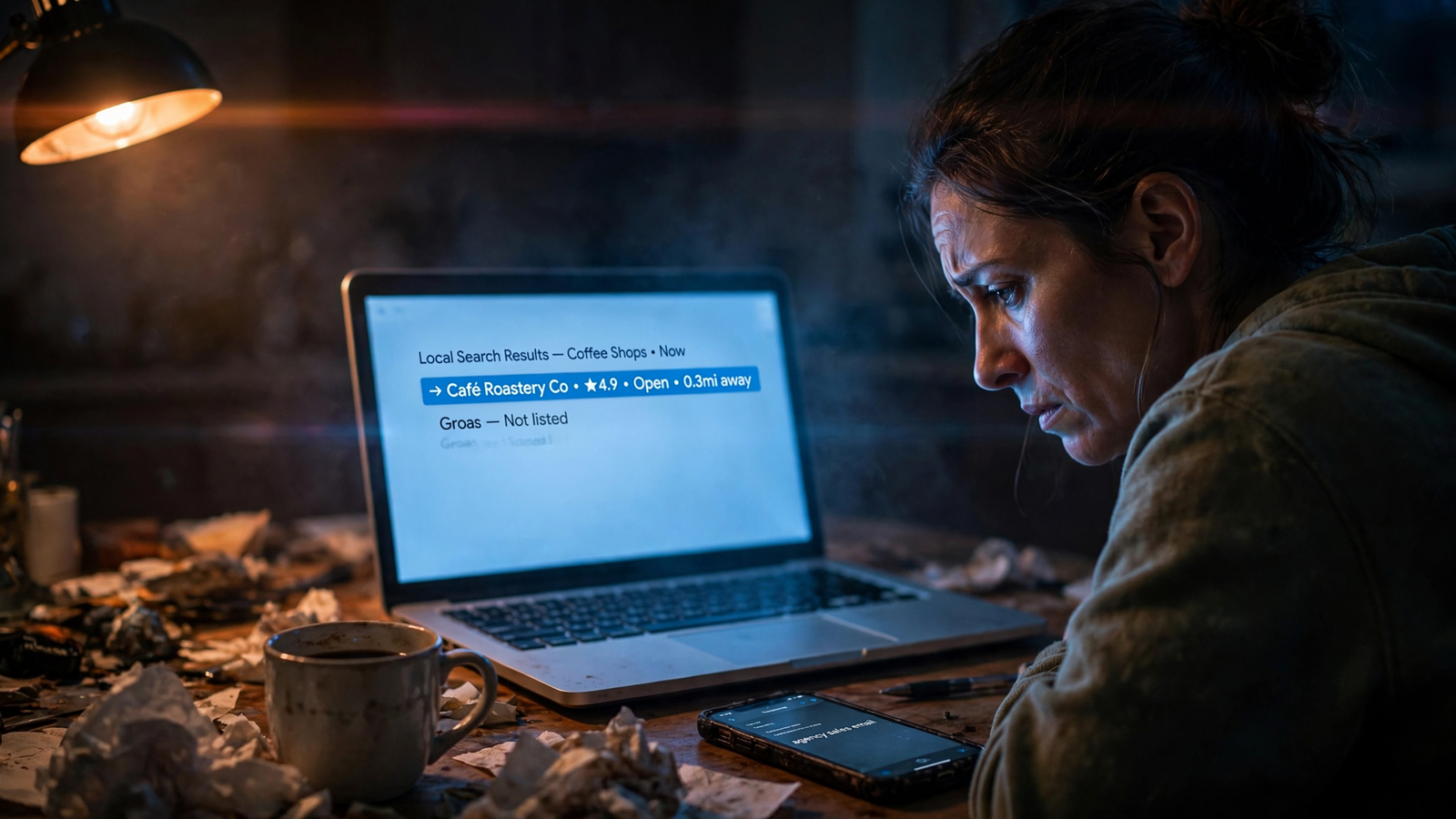
Picture the kitchen-table moment. Laptop glow, competitor named in a tidy bullet list, your business nowhere. It feels like a verdict. It is one sample, and the work that determines whether you have a fixable problem is considerably less glamorous than an emergency content package.
Before prescribing more content, a competent provider checks whether machines can reach the content you already have. I want that inspection to cover:
- Crawler access: robots.txt rules, checked bot by bot.
- Firewall access: Cloudflare or other defaults that block AI crawlers.
- Rendering: pages whose useful content appears only after JavaScript loads.
- Indexing: whether key commercial pages are indexed at all.
I walk through that order in How to Get Cited in ChatGPT and Perplexity: Fix Access Before Content.
Then comes third-party corroboration: reviews, directories, comparison pages and local listings that models can use when evaluating a business. Are those sources saying the same thing about what the business does? Is there evidence behind the claims on its own website?
If a competitor has that corroboration and you do not, ten new FAQs will not close the gap. Diagnose access and evidence before adding another page to the pile.
Pay for a fix list, not a publishing quota
I would pay for pages that answer commercial questions buyers actually ask, not posts built to chase a visibility score.
If the missing answers concern “best installer for clay soil in Austin” or “who services commercial freezers on weekends,” I want a service page that states coverage area, response time, pricing logic and proof in clear sentences a machine can quote without guessing. It should answer the question, not circle it for 1,500 words.
That page needs to load fast, render without JavaScript tricks and carry the boring business facts: consistent name, address and phone details, opening hours and service list. Content without that foundation is decoration.
I would also pay for the access fixes and third-party evidence that rescue packages tend to bury beneath a content calendar. Can the relevant crawlers fetch the site today? Do review profiles and local listings describe the same services as the website? Which comparison pages need correcting?
This is the cost of the alternative: someone has to implement the fixes and keep measuring them. A baseline is not the work. Neither is a report recommending the work. Pages need editing, blocks need clearing and profiles need correcting.
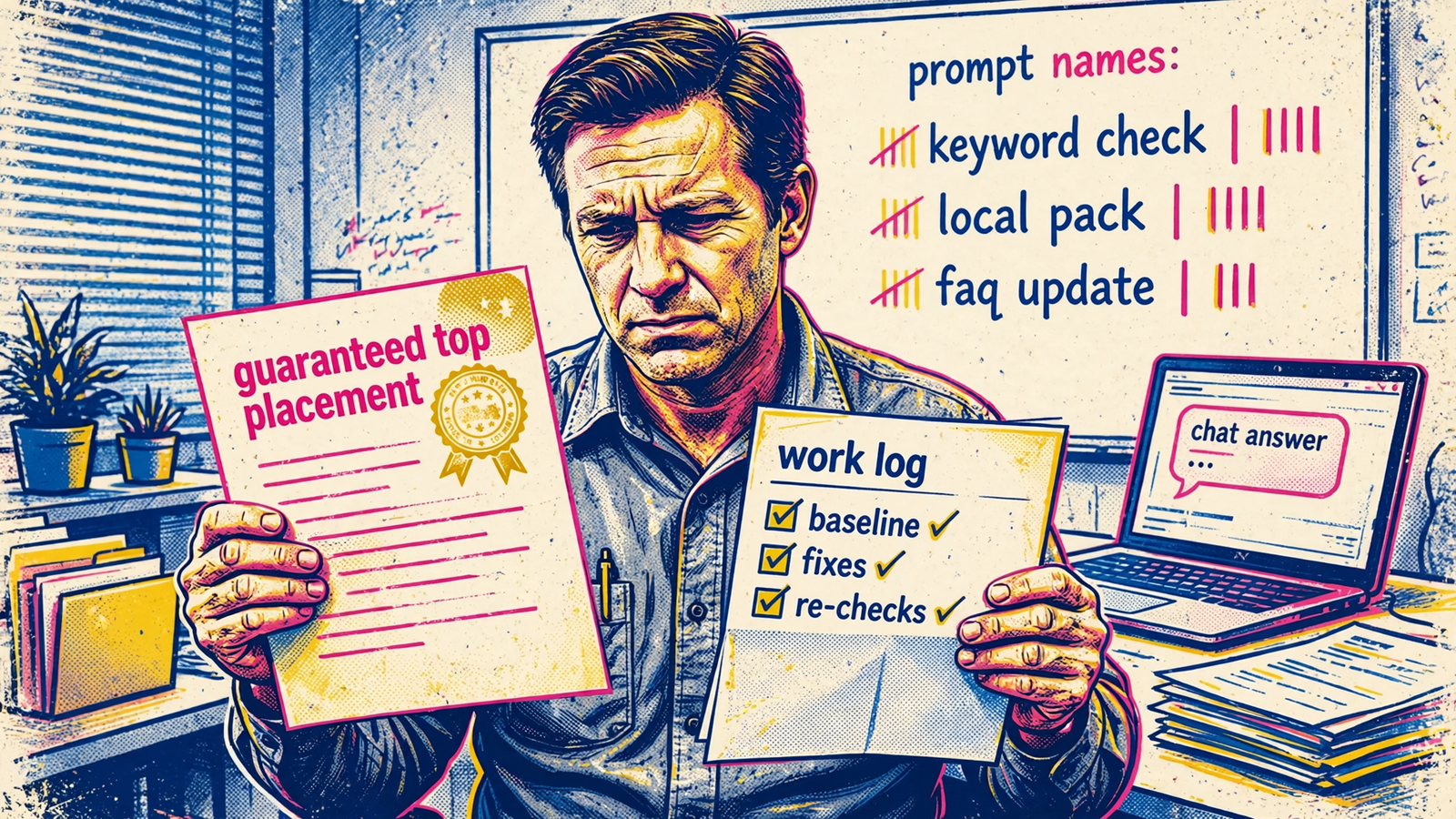
I also demand a change log. Every edit, every fix and every new mention earned should be dated beside the subsequent observation on the same fixed prompt set. The log does not prove that one edit caused one answer to change. It does make the provider’s work inspectable.
No log, no renewal. I am paying for operations, not theater.
Buy managed work, not a guaranteed answer
The useful question is not which provider promises to “get you into ChatGPT.” It is which provider will establish coverage, identify the gaps and ship the work.
Outputs vary by prompt, geography, context and time. A pitch guaranteeing first place, a citation by a certain date or a recommendation promises control the provider does not have.
I make an agency define mention rate, citation rate, share of voice and average position, show an actual recommendation, and connect reporting to pipeline. An unexplained “visibility score up 40%” does not answer any of those questions. If the provider cannot separate the measures, I have no reason to trust the diagnosis.
That is why I run this as one managed workstream at groas rather than splitting Google SEO and AI search across two vendors. The team runs paid ads, SEO and visibility in ChatGPT and Google answers directly, with a weekly report of every action. It also tracks how often the business is named in AI answers across engines and appears on Google, against its starting point.
The work and the observation sit together. No vendor blaming the other vendor when the mention moves and the citation does not.
No honest provider controls the final answer. No one outside those systems decides when ChatGPT searches live, which sources Gemini uses or how Perplexity orders its citations. Pay for the work you can audit, not the answer no one can promise.
When I would pay—and what I would demand first
There is a case where I would pay promptly. Imagine a fixed panel showing the business missing from 18 of 20 buyer prompts across two engines, three runs each, while one competitor appears in 14. Branded search is flat, review profiles are thin, and key service pages block AI crawlers or return soft 404s in a fetch test.
That is not one screenshot. It is a repeated absence alongside identifiable problems. It does not make every problem the proven cause of every missing recommendation. It gives the provider a concrete fix list instead of a fear to sell.
My buying rule fits on an index card:
- A dated baseline before work starts. Fixed prompts, documented conditions and saved answers.
- A written implementation plan. The pages to fix, access blocks to clear and third-party profiles to correct.
- A named owner who ships. Someone accountable for changes, not just recommendations.
- A dated change log and monthly reruns. The same questions, measured the same way, with the work visible beside them.
On the sales call, I would ask what changes in week one and how those changes appear against the next observation. If the answer is a guaranteed recommendation by next month, I would walk away. A guarantee is not a substitute for showing the work.
A missing recommendation deserves an investigation. It never deserves a blank check. Skip the baseline and buy the rescue on one screenshot, and you will pay every month to chase an answer that can change on the next run, with no way to tell what the money did. That is not a visibility strategy. It is a screenshot with an invoice attached.


