

 LinkedIn

A first ChatGPT ads campaign should buy you an answer: did this channel produce customers or qualified enquiries at a cost you can live with? Most first-time advertisers buy something harder to judge instead: an open-ended promise to “manage” a new channel.
I have managed enough launches to be blunt about the difference. Buy a controlled launch. You need an account you own, a landing page that matches the ad, tracking tested before money moves, a written spend cap and a named person who approves changes. If you and the agency cannot explain those terms on one page, do not fund the test. Here is what to put on that page.
What are you buying from the agency?
A done-for-you setup should leave you with things you can point to: an ad account in your business name, a live ad matched to a specific landing page, conversion tracking that fired correctly in a test, a spend cap and a date for the first review. If a proposal cannot name those deliverables, it is selling activity. I used to tell clients activity was progress. I was wrong. Progress is a test you can read.
Clear up one confusion before you pay anyone: paid placement is separate from organic recommendation. Paid units are labeled sponsored and visually separated, and advertisers cannot pay to shape or rank organic answers. A product-feed upload is paid-campaign only, too: inclusion in the advertising feed does not make you eligible for organic ChatGPT mentions. If you want paid placement and organic visibility, buy them as two jobs. Do not let anyone imply that ad spend buys the answer.
The first purchase, then, is not “ChatGPT growth.” It is a bounded test with deliverables you can inspect and an outcome you have agreed to measure.
Can the agency launch your account now?
ChatGPT ads are new enough that availability still matters. Ads expanded to 89 countries on October 21, 2026, after US testing that began in February 2026 drew more than 100,000 advertisers. Self-serve access still requires the legal entity paying for the ads to sit in a supported market, and new accounts can be limited to domestic targeting until identity checks and qualifying home-market spend clear.
Ask the agency to answer three questions before it quotes a launch date:
- Which country is your billing entity in?
- Is the targeting you want cleared for this account?
- Who holds the Ads Manager login?
A vague “we have access” does not answer any of them. You need to know whether your account can run your test, not whether someone at the agency has seen the interface.
Then separate what the agency runs today from what it hopes to run soon. A live Ads Manager screen, a named contact who approves copy and an active client placement demonstrate current capability. Roadmaps, beta waitlists and “we will support catalog feeds next quarter” are proposals. Write the two lists down. If they cannot show a launch they control right now, you are funding their learning curve.
What counts as a win?
Skip the deck language. Write one sentence that says what you will pay to learn. For example: “A useful enquiry is a homeowner in our service area who submits a phone number and picks a time slot.” Or: “A qualified lead is a demo booked with a company over 50 staff.” For a shop, it may simply be: “A sale is a paid checkout.”
Clicks, CTR and raw chats are diagnostic numbers. They do not pay invoices. I learned this running lead gen where the form fills looked great and the sales team heard nothing but students and vendors. Name the qualified outcome before launch, because the agency will optimize toward whatever you named. Put the definition in the launch sheet, not in a conversation everyone remembers differently.
Account for the lag as well. An enquiry on Tuesday rarely becomes revenue by Friday, especially in B2B and home services, where quotes, callbacks and approvals stretch for weeks. Agree on two measures:
- The early signal: what you review in week two, such as cost per qualified enquiry.
- The later result: what you judge the test on, such as cost per booked job or cost per closed deal.
Write down who marks a lead qualified and how fast. Otherwise, you will argue about quality in week three with no record to settle it. The point is not to pretend a short test reveals every eventual sale. It is to know which early evidence matters while you wait for the later result.
How much can the test cost, and who can raise the cap?
Put the fee and the media on separate lines. The management fee goes to the agency. Ad spend goes to the platform, from billing you control, in an account and analytics property held in your business name with the agency on linked access. That arrangement protects something basic: you keep the account, billing and analytics in your business name from day one.
ChatGPT pricing is auction-based. The stated entry point is modest: no account minimum on self-serve, a $25/day US minimum, a recommended $3–5 max CPC bid, and reported CPMs around $25–45 depending on topic. Say you spend $20,000 a month on Google. A $50/day ChatGPT test is $1,500 over 30 days. Put the proposed test spend beside your existing spend so neither the agency fee nor the media budget disappears into one reassuring number.
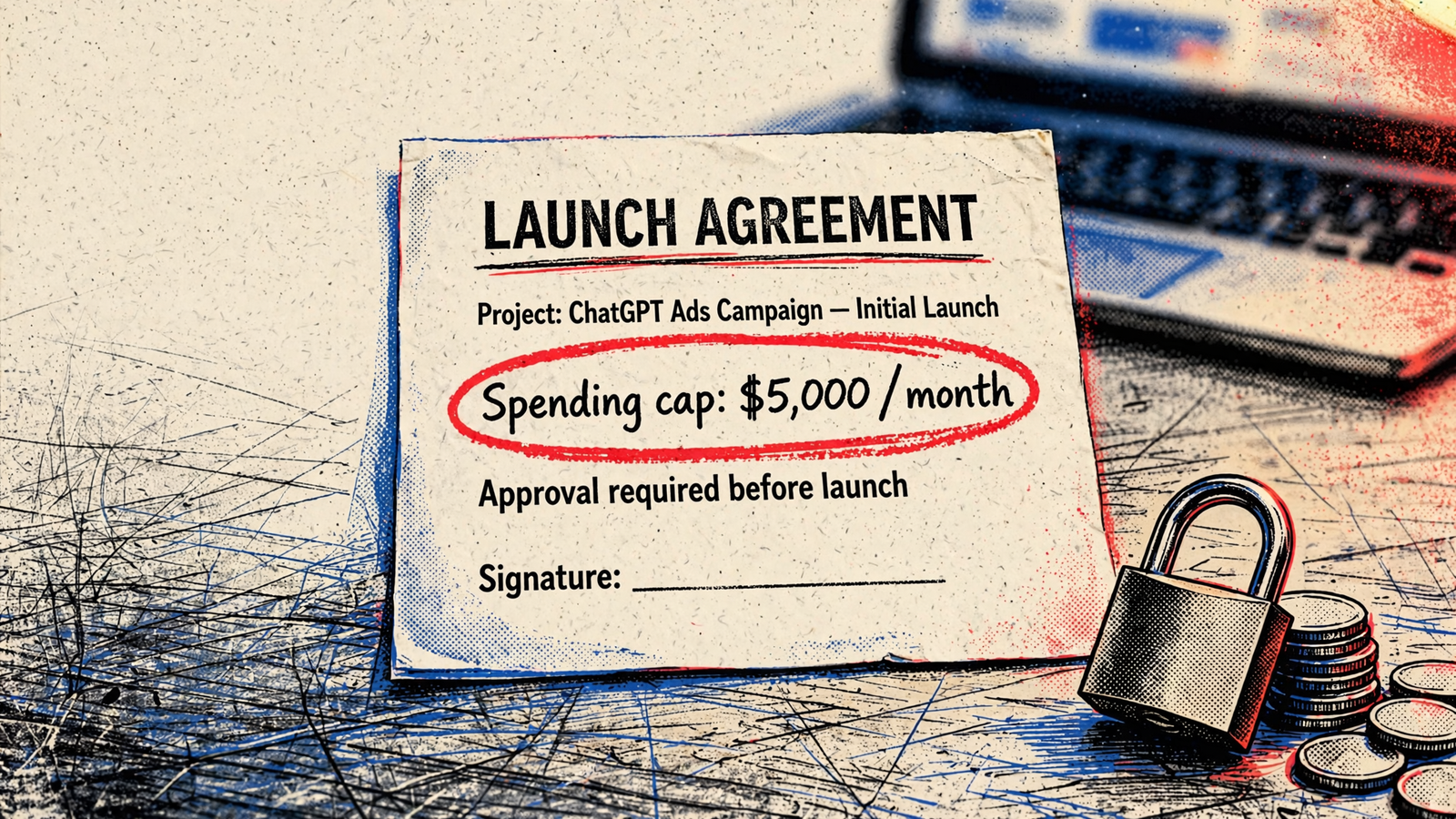
Then write the cap and the approver. A ChatGPT daily budget is a seven-day average, not a hard daily ceiling: one day can spend up to twice the daily budget as long as the week stays under seven times that budget. A $100/day budget can therefore exceed $100 on Tuesday, even though the week cannot exceed $700. Your agreement needs three lines:
- The starting daily budget.
- The total test cap.
- The single named person who approves any increase in writing.
No cap increase by chat message. No automatic escalation because early clicks looked cheap. If spend can move without your written approval, your cap is not much of a cap.
What must work before the first ad runs?
Start with ownership. If you part ways, the ad account, billing profile, pixel and landing pages stay with you. The agency gets linked access you can revoke, not ownership you have to negotiate back. Write down what it hands over within seven days: account admin transfer, audience and creative files, and a change log of what it altered. I have inherited accounts where the old agency owned the pixel and the new test started blind. That single line in the agreement is worth more than a month of “insights.”
Next, put the ad beside its destination. A ChatGPT click needs a short path to an outcome: someone asks a buying question, sees a sponsored unit, clicks and lands on a page that answers that question with one clear next step. Not your homepage. Not a blog post with three popups. One question, one page, one action: call, book or buy. If the agency cannot show you the draft ad next to the draft landing page and explain why they match, there is no matching page and there should be no launch.
Finally, test measurement before the budget goes live. Submit the forms and test the calls so an enquiry actually records as a conversion. For ChatGPT, the tracking setup can include the oaiq pixel, server Conversions API and image-tag fallback feeding one Pixel ID; shared event_id values deduplicate events, clicks carry an oppref value in a cookie, the default windows are 30 days for clicks and one day for views, and reporting can lag 24 to 48 hours. Have the agency explain its setup in plain English. Run a test enquiry yourself and check that it appears.
Tracking also has limits. It will not tell you which chats influenced someone who never clicked, or which leads close weeks later without a callback import. Agree how you will fill that gap. A working conversion event is the start of measurement, not proof that every eventual customer will appear neatly in the report.
When do you review the test, and what happens next?
Name the first review date before launch. I ask for the same four lines every week:
- Spend against the cap.
- Qualified enquiries and cost per qualified enquiry.
- What changed in the account.
- What happens next.
No 20-page PDF. No CTR victory lap. This matters more on ChatGPT than on Google because there is no stable baseline to lean on: OpenAI publishes no cross-advertiser benchmarks and labels Ads Manager beta, with delivery that can fluctuate. One public test makes the point: $2,319 in spend at $3.14 CPC and 1.06% CTR, against 5.2% CTR on Google for the same advertiser, produced zero MQLs. That does not mean the channel fails. It means you judge your own cost per qualified outcome, not somebody else’s average or a click-through rate taken out of context.
Agree on three possible decisions in writing. Skip the promise of a magic sample size:
- Continue: qualified enquiries arrive under your target cost, and your CRM verifies them. The named approver can decide whether to raise the cap.
- Investigate: clicks arrive but qualified enquiries do not. The agency checks the match between question, ad and page, or changes targeting, before asking for more spend. The cap stays put.
- Stop: spend reaches the cap without a qualified enquiry, or cost per sale exceeds margin. The test ends, and you keep the account and its history.
Skip any agency that guarantees a result from 100 clicks or 30 days. ChatGPT volume is too thin and too new for that promise. The review date forces a decision; the economics justify it. If the report cannot connect the agreed outcome to spend and a specific next action, ask for that work instead of another slide.
Where does groas fit, and when should you wait?
If you want the launch handled for you, groas offers a done-for-you service. Its Search Ads offering covers Google Ads, Bing Ads and ChatGPT Ads together for $1,499 a month flat, with the same fee at any ad spend, no cut of spend, no setup fees and month-to-month terms. Media stays separate. You agree goals with a dedicated manager on an onboarding call, with work live within 24 hours of that call. If you are still weighing formats, its comparison of a course, consultant and done-for-you service lays out who actually runs the test.
The reason I point to that structure for a first ChatGPT test is control. You set the goals and budget, every action comes with the reasoning behind it, and increases do not move without your approval. That fits the agreement this guide is built around: your account, your cap, your approver, your review date. A flat fee keeps the agency on your side of the spend decision. It does not replace the launch sheet. Get the terms in writing whoever runs the campaign.
Wait if any of three things remain unresolved:
- Access: your billing entity is not in a supported market, or targeting is still domestic-only when your test needs more.
- Tracking: a test enquiry does not show in the pixel or your CRM.
- Economics: even a good conversion rate leaves you losing money after fulfillment.
I have paused launches for all three reasons. Each pause saved the client more than any optimization would have earned. A good agency will agree to wait. A hungry one will push to spend anyway. That tells you who to keep.
What should you send the agency today?
Take 20 minutes and draft the one-page launch sheet. Write the exact enquiry or sale you will pay to learn about, the starting daily budget and total cap, the person who can approve increases, who owns the account and pixel, and the first review date. Add the continue, investigate and stop rules. Send it to the agency and ask for a signed copy before any login is shared.
If they sign it without edits, you found an operator. If they argue with the cap, you just saved yourself a bad test.


