

 LinkedIn

Your Google Ads grade does not know which fix pays. I picked WordStream’s Performance Grader for this teardown because so many advertisers encounter it first, and its overall score makes a set of diagnostic signals feel like a repair order.
It scores an account against 10 key metrics and promises deep insights. Useful, provided the score starts an investigation rather than ends one. I treat the report as a set of claims: Claude should use groas to check each actionable finding against live conversion data and business constraints before anyone changes the account.
Open your actual report next to Claude, connected through groas. Start with: “Read the connected account. What evidence supports or contradicts this finding? Make no changes.”
Use your own numbers. A sample score describes someone else’s structure, budget and tracking. The grade tells me where to look. The account, checked against the business, tells me whether to act.
The score at the top: a pointer, not a priority list
The overall score is the first thing that asks for attention. It is also the easiest thing to overread. A single number makes wasted spend, Quality Score, impression share and account activity look like parts of one problem with one solution: improve the grade.
They are not. Each points toward a different question, and none establishes how much money a fix would make or save.
I start with the first actionable finding in the report, often wasted spend or Quality Score because those sound expensive. The grader defines wasted spend around negative keyword use and Quality Score around rank and CPC effects. That gives me configuration signals. It does not establish whether the flagged issue cost a single qualified lead last month.
My verdict on the score: use it to choose what to inspect, not what to change. Ask Claude to separate three things:
- Observation: What setting, metric or account pattern triggered the finding?
- Evidence: What spend, search terms, conversion actions or revenue support it?
- Decision: Does that evidence justify a change, and within what limits?
A missing negative keyword list is an observation. Money spent on queries that cannot buy from the business is a problem. Those are not interchangeable.
The distinction is not new. An early grader critique warned that the account activity grade ignored bids, so deliberate tests left alone could hurt the grade. It also challenged the landing page count advice for small catalogs. A more recent audit triage guide makes the practical point: treat grades as pointers and confirm wasted spend in the search terms report.
For a wasted-spend finding, I want Claude to identify the queries, their cost and their outcomes. If it cannot establish waste, the red flag stays a question.
The conversion numbers: check what the report is counting
Before I accept a recommendation based on performance, I want to know what “performance” means in that account. Recorded conversions are not automatically real business outcomes. A report can summarize bad measurement perfectly.
I ask Claude to inspect the connected account’s conversion actions and explain what each records. Then I work through the measurement questions before touching bids, budgets or keywords:
- What event fires each conversion action? A purchase, qualified lead or booked call is different from a page view or scroll.
- Which actions are Primary? Keep real outcomes as the optimization goal rather than letting lighter interactions stand in for them.
- How are conversions counted? The conversion audit checklist uses One per click for leads and Every for purchases.
- Is the same outcome counted twice? Check whether a Google Ads tag and a GA4 import both count the same lead.
- Has the data had time to arrive? Yesterday’s cost and yesterday’s conversions do not necessarily become available together.
Google’s data freshness timetable says clicks and cost refresh hourly, while last-click conversions take about 3 hours and default data-driven conversions take up to 15 hours. GA4 imports can take 12 to 24 hours. Judge too soon and the apparent shortfall may be reporting delay.
Zero recorded conversions deserves a measurement check. It does not, by itself, prove broken tracking or bad media. I want Claude to state what it can verify from the account and what still needs confirmation.
The same restraint applies to Quality Score. Google says Quality Score is not a KPI and is not used directly in the auction. It is a 1-to-10 diagnostic covering expected CTR, ad relevance and landing page experience.
My verdict on the conversion section: verify the measurement before trusting the recommendation. A grade built on bad conversions is a confident answer to the wrong question.
The proposed fix: make it name the cost
The next persuasive move is the recommendation. Add negatives. Raise Quality Score. Recover impression share. Each sounds like tidying up. Each can change what the account buys.
A broad negative can block searches that bring in good leads. Chasing Quality Score can lead to rewriting ads that already convert. Recovering impression share can mean raising budgets or bids. That is a spending decision dressed as hygiene.
I paste the proposed fix into Claude and ask:
Which campaigns would this affect, what could it cost, and what evidence would make you reject it? Use the connected account through groas. Make no changes.
The answer needs to address the actual finding, not recite best practice:
- For wasted spend: identify the search terms, their spend and the evidence that they are not returning value.
- For impression share: separate budget limits from rank limits, then compare them with CPA and lead quality. Low impression share alone does not say which constraint deserves money.
- For asset coverage or ad strength: show whether the weak-rated assets sit in revenue-producing campaigns or campaigns that barely spend.
- For Quality Score: identify the diagnostic weakness without treating a higher score as the business outcome.
My verdict on the recommendation: no named scope, no approval. A missing asset, setting or recommendation is not an automatic spending decision. I want the campaign, the evidence, the proposed change and the limit.
This check runs inside Claude through groas. groas costs $19 a month; it is not a free audit. The point is to let the assistant inspect the live account before a checklist becomes an instruction. One scoped change I can undo beats five best practices I cannot explain.

The action list: keep one change that earns its place
By this point, the report may have produced five or six suggestions. That does not mean the account needs five or six interventions. A list makes everything look equally urgent. Spend and outcomes usually tell a less tidy story.
Take an illustrative account spending $20k a month. A search-term cluster that spent $340 without a qualified lead in 30 days deserves investigation. A Quality Score of 5 on a keyword that drove 42 calls at a $61 CPA may not deserve the same urgency. The cheaper-looking fix is not necessarily the more valuable one.
I rank the findings by cash at risk, not by the color of the warning. Keep the finding supported by business evidence. Park the rest until they earn a change.
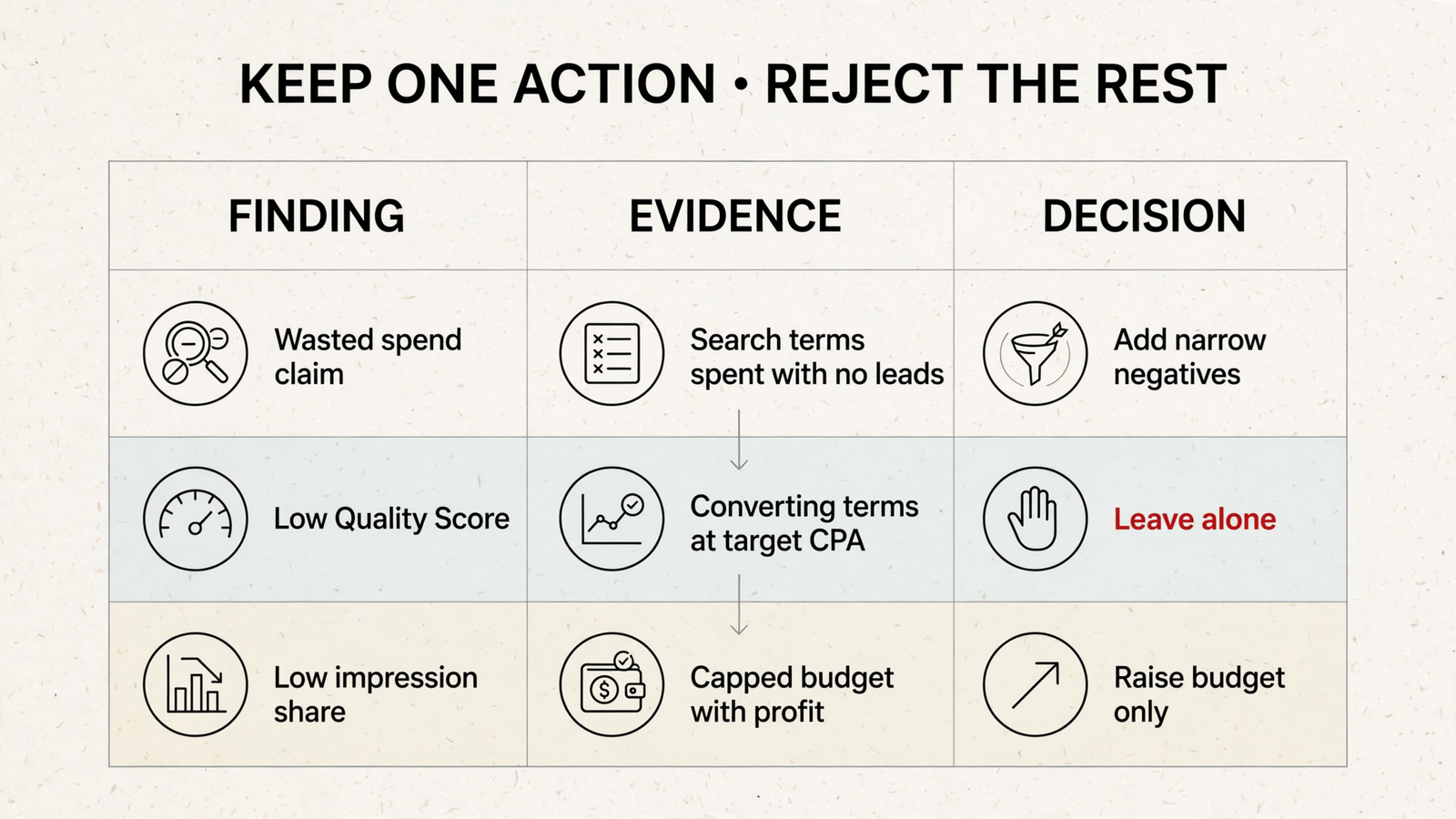
Here is what that decision process could look like. These are illustrative alternatives, not findings from a tested account or instructions to make all three changes.
| Finding | What Claude must establish | Possible decision |
|---|---|---|
| Wasted spend flag | The search terms spent $340 with zero qualified leads, and the queries are unsuitable | Add narrowly scoped exact-match negatives |
| Low Quality Score | The flagged keyword converts at $61 CPA against a $75 target | Leave it alone and recheck in 30 days |
| Low impression share | Budget is the constraint, and the last 50 orders were profitable | Consider a $20/day increase on one campaign |
The qualification matters. Zero qualified leads tells me where to investigate; it does not automatically tell me which negative keyword to add. Recorded orders do not establish profit unless the business supplies that evidence. If Claude lacks the information, the decision stays open.
Once one change earns approval, approve that change inside groas and read what comes back. Autopilot stays off until switched on, every change is logged with its reason, and any change can be undone in one step.
The log is what I check the next morning. I want the reason to name the campaign, evidence and limit. A reason that merely repeats the grader has not passed the test.
For a worked example of this approach, see WordStream’s Google Ads Grader Read by Claude. The useful output is not a prettier score. It is one defensible decision with a paper trail.
The missing column: what the business must supply
Even after that account-level check, there is a boundary I do not let Claude talk past. It can read spend, search terms and recorded conversions. It cannot infer the business’s actual close rates, margins, returns or lead quality from those numbers alone.
That gap is where an apparently sensible audit recommendation can fall apart. A cheaper lead is not necessarily a cheaper customer. A recorded sale is not necessarily a profitable order.
Consider an illustrative home services comparison. One campaign generates leads at $62 and books 41% of them. Another generates leads at $34 and books 9%. The lower cost per lead does not settle which campaign deserves the next dollar. The booking rate changes the decision.
I ask Claude to state the limit explicitly:
Using only ad account data, what can you not conclude about profit or lead quality? What business evidence would change your answer?
Then I supply the missing evidence rather than asking the model to sound more certain:
- For ecommerce: orders and refunds by campaign.
- For calls and leads: qualified calls and closes by campaign.
- For the spending decision: the margin or contribution that makes an acquisition worthwhile.
Say the business closes 1 in 4 qualified calls and each job is worth $900 in contribution. A $75 cost per qualified call leaves room on those numbers. Without the close rate and contribution, $75 is just a number wearing a performance label.
My verdict on efficiency claims: no order or CRM match, no verdict on business efficiency. Claude should mark the missing evidence, not fill the gap with confidence. The account can support a narrower conclusion while the business supplies the rest.
The free-tool promise: where the report stops
There is a reasonable question underneath this teardown: does the free grader read the actual account?
Yes. The Performance Grader is free to run and connects to inspect the account. My objection is not that it sees nothing. It is that a standardized score does not finish the work of deciding what this business should change.
The report flags configuration patterns against its thresholds. It does not settle what a lead is worth, whether recorded conversions reflect real outcomes or whether a proposed fix fits the business’s constraints. Nor does it act on the finding.
That is where I use Claude through groas. Connect the ad account once, paste in the finding, and have Claude query the live account rather than improvise advice from the wording of a warning. Campaigns, search terms, conversion actions and change history give the assistant something concrete to check. Business evidence supplies the part the account cannot.
The distinction is a free score versus a paid verification-and-action workflow. groas costs $19 monthly. What I want from that connection is not another grade: it is evidence tied to spend, a scoped fix I approve and a change log with an undo option.
The grader supplies the prompt. Claude through groas does the account-level follow-through. Skipping that second step is how a useful warning becomes an expensive instruction.
Verdict: keep the triage, reject the repair order
I would keep the Performance Grader’s pointers. Wasted spend sends me to search terms. Quality Score sends me to expected CTR, ad relevance and landing page experience on high-spend terms. Impression share sends me to the split between budget and rank constraints.
I would not let the activity grade decide whether a deliberate test should keep running. Nor would I let the overall score rank the account’s business priorities. The report is useful for deciding where to look, not sufficient for deciding what to do.
Every proposed change still has to earn its place: verified tracking, spend tied to outcomes, business constraints accounted for, and a fix scoped to named campaigns with a cost attached. Run that check in Claude through groas. Keep one supported action, park the rest for review, and read the log the morning after.
A report card is a set of claims. Your ledger decides which claim gets paid.


