

 LinkedIn

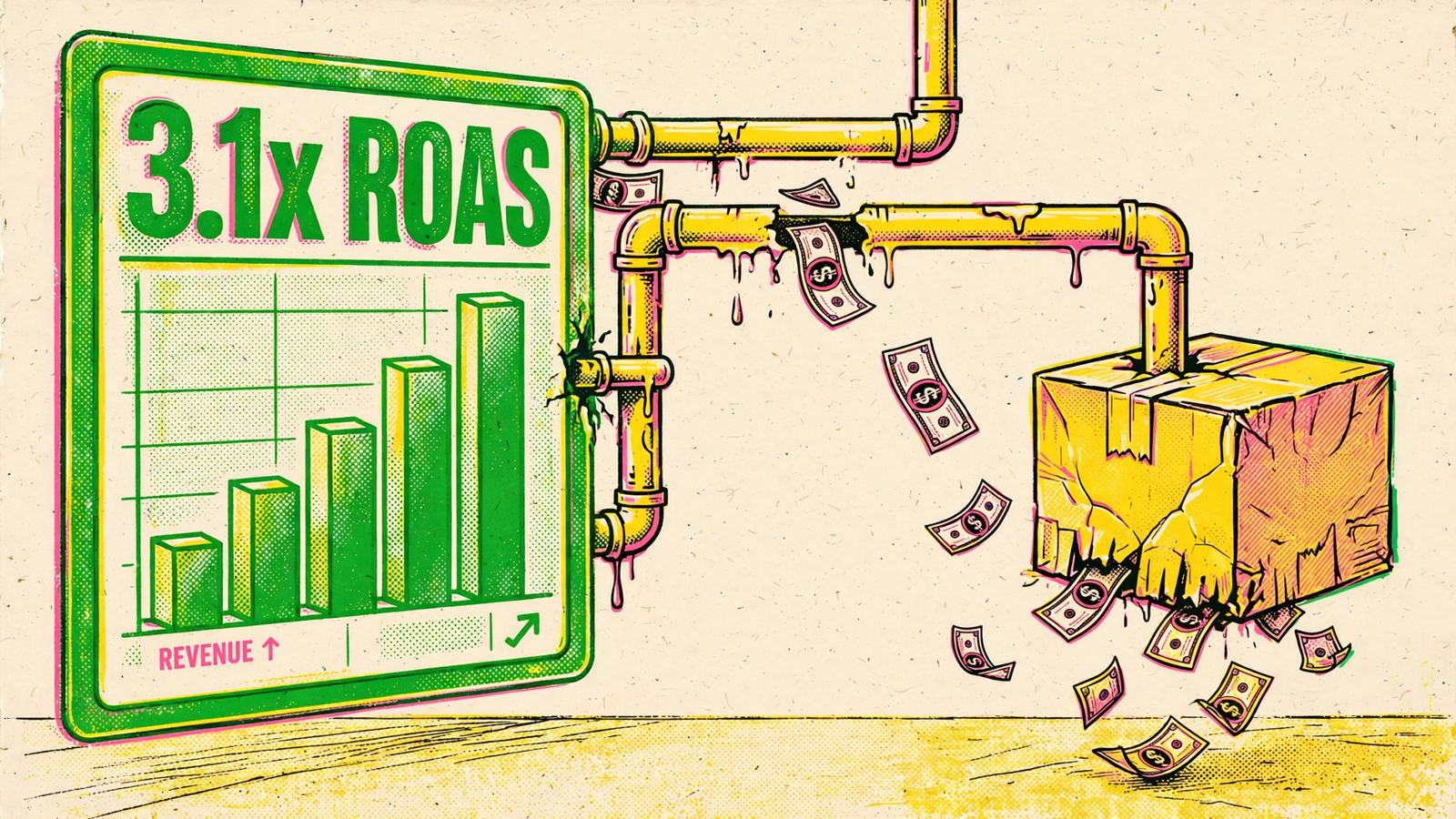
Your Meta report still says 3.1x ROAS. Your payouts say you kept a lot less on every order it drove. I have watched that gap eat into ecommerce margins for months while the report stayed green: product costs rose, discounts deepened, and returns took a bigger cut.
The first mistake is asking the agency for more creative or a lower budget. Neither fixes a target built on old costs. Yesterday’s ROAS target cannot defend today’s margins. When contribution per order falls, the amount you can pay to acquire that order falls with it. Rebuild that limit before you change bids, budgets, or ads.
Free tool: the ROAS Calculator works out your return on ad spend, your break-even ROAS and the budget a revenue goal takes.
I’ll show you how to calculate a contribution number you can defend, turn it into a ROAS floor, and hand your Meta management company guardrails it can actually use. If you are spending $20k a month, do this before you approve another test.
Why does Meta show 3x ROAS while I keep less each month?
Two things can be true at once: Meta reports the purchase value it attributes to ads, and your store keeps less of each purchase than it used to. Meta and Shopify also do not necessarily count revenue the same way. Meta counts purchase value inside its attribution setting, including view and engage-through credit. Shopify credits orders by referrer and defines sales using discounts, reversals, taxes, and shipping. A green dashboard is not a profit statement.
On your side, the usual suspects are less mysterious. Your supplier raised COGS or inbound freight got more expensive. You ran 20% off to hold volume but left the old ROAS target in place. Or your return rate rose from 8% to 14% without anyone updating the allowance per order. Online return rates sit near 1 in 5 orders, with apparel at 20 to 40% and electronics at 8 to 15%. Your own SKU baseline matters more than the category average: a change in your return rate is a change in your costs, not dashboard noise.
Before you open Ads Manager, write down which costs or sales terms changed and when. Name the margin leak before you ask a campaign to fix it.
How much can one order actually pay for acquisition?
Start with the price the customer pays after discounts, not the list price. Then account for everything the order costs before advertising: product, landed freight, shipping, fulfillment, payment processing, and an allowance for expected returns and support. What remains is contribution before ads. I used to tell clients to use gross margin for this. I was wrong. Gross margin skips costs that still leave the business, and the shortcut makes an unaffordable acquisition look fine.
Here is the calculation, in order:
- Take the order value after discounts. Decide whether you are modeling expected refunds as a separate allowance or using revenue after refunds; do not subtract the same refund twice.
- Subtract COGS, including the order’s share of inbound freight.
- Subtract outbound shipping, fulfillment, payment and pick-pack fees, plus your allowance for returns and support where those costs are not already reflected.
- The remainder is contribution before ads. Divide the order value you used in step 1 by that contribution to get break-even ROAS.
Say an order is worth $80 after discounts and before expected returns. Product plus inbound freight costs $28. Outbound shipping and fulfillment cost $11; payment and pick-pack fees cost $4. You set aside another $7 for expected returns and support. That leaves $30 before ads, or a 37.5% pre-ad margin. Divide $80 by $30 and the break-even floor is 2.67x. Below that, acquisition costs more than the order contributes.
The same calculation explains why a $50 order keeping $22.20 needs 2.25x, and why a 60% gross margin can still need 2.25x once shipping and fees are included. The reported revenue is not the amount available to spend on ads. Contribution is.
Break-even is not a profit target. If you want to keep some contribution after acquisition, reserve it before setting the spending limit. Target ROAS for profit uses the pre-ad margin minus the profit you want to keep. At a 40% pre-ad margin, keeping 10% calls for 3.33x; keeping 20% calls for 5.0x. Less contribution leaves less room to buy the order, so the target rises. Keep repeat purchases out of this first-order calculation until your 90- and 180-day cohorts prove payback.
Finally, check the denominator you are using. The store calculation and Meta report need a comparable revenue definition, or you will apply the right floor to the wrong number. Reconcile the same dates, timezone, and currency, and compare Meta results under one attribution setting. Its default blends click, view, and engage-through attribution. If the revenue going in differs, the ROAS coming out differs. Write your chosen definition beside the floor so nobody silently changes it next month.
Is the problem tracking, customer mix, or the offer?
I check these in that order. A tracking mismatch can make an offer look worse or better than it is. A shift toward returning buyers can make blended ROAS look healthy while acquisition of new buyers loses money. Only after those two checks can you tell how much of the change comes from the offer itself.
- Check tracking. Compare the pixel and Conversions API values with Shopify for value, date, and currency. Keep the Meta attribution setting consistent while you compare periods. If the numbers do not line up, do not use the reported ROAS to make a fine-grained budget decision. First establish what each number includes.
- Split new from returning customers. Blended platform ROAS can sit above break-even while new-customer orders lose money. Treat first-order profitability as the default. Repeats can become part of the acquisition case when your 90- and 180-day cohorts show that they arrive with enough margin to pay back the spend.
- Reprice the offer. Recalculate contribution with today’s COGS, discounts, and returns. A higher refund rate, including a $30 to $65 cost per return in electronics, can move the floor even when reported purchase value barely moves.

Skip any plan that changes all three at once. If you rewrite tracking, audiences, and discounts in the same pass, the next report cannot tell you which change mattered. Fix measurement, split new versus returning, then reprice the offer math. That is how you find the lever that broke.
What guardrails do I hand the agency this week?
Give the agency a spending limit, not a vague request to “protect ROAS.” I put four things on one page: maximum allowable acquisition cost per new order, the ROAS floor calculated from it, the budget authority the manager has without asking, and the discounts that need approval. Include the revenue definition and the costs behind the calculation. Otherwise, two people can agree on “3x” while measuring two different things.
Use the $80 order again. It contributes $30 before ads. If you need to keep $9 per order, you can spend at most $21 to acquire it. Divide $80 by $21 and the target floor is 3.81x, using that same order-value definition. At 3.0x, the agency may see a result worth celebrating; your $9 goal still does not survive. The target is a spending limit, not a trophy.

Set the other rules in the same note. Budgets move only inside the authority you grant. Discounts need your sign-off because a 20% code changes order value and can break the calculation overnight. If your catalog has real margin spread, separate the targets. A hero SKU at 45% pre-ad margin can tolerate a lower ROAS floor than an accessory at 25%. Force both through one blended target and you risk starving the winner while feeding the loser.
Skip a management pitch that promises better ROAS without asking for those numbers. Retainers commonly run $1,500 to $3,000 flat or 10 to 15% of spend, with creative fees separate. The fee model does not repair a target based on old costs. Make the manager show how the account will stay inside your new limit.
How do I change campaigns without breaking what works?
Once you know the floor, resist the urge to edit everything before lunch. Work through the customer journey in order:
- Confirm the offer. Check that the order still clears the new floor after current discounts and expected returns. If it does not, a clever bid cannot make the underlying order more profitable.
- Check the landing and product pages. Make sure the traffic you already buy has a clear path to the offer you priced. Do this before blaming creative for every weak result.
- Refresh creative. Now you can test whether a different message brings in orders that meet the limit, rather than asking new ads to conceal a margin problem.
- Move budgets last. Scale what clears the floor; do not move more spend toward a result merely because its platform ROAS looks green.
I learned this after killing a working ad set with three edits in one afternoon and spending two weeks figuring out which one broke it. An ad set needs about 50 optimization events in 7 days to exit learning, and changes to targeting, creative, or bid strategy can restart it. Respect conversion lag, compare ad sets under the same attribution setting, and give a material change a full buying cycle before judging it. One change, one buying cycle, one verdict. Daily volatility is not a verdict.
What should the weekly report actually decide?
Stop accepting a ROAS screenshot as proof. I want one page every week with four lines:
- What changed: the offer, page, creative, audience, or budget decision under review.
- What it cost: spend and the order contribution behind the result, not just attributed revenue.
- What has matured: results old enough to judge past the conversion-lag window, under the agreed attribution setting.
- What happens next: keep, cut, or change one thing, with a reason tied to the floor.
Suppose new creative spends $1,800 and drives $5,200 in net-revenue value at a 37.5% pre-ad margin. That is about $1,950 in contribution before ads and $150 left after spend. The platform screenshot shows 2.89x ROAS. The decision sheet shows that the test clears break-even, but leaves little after acquisition; whether it meets your profit target is the decision to make. Calling it a loss would be bad math. Calling it a win without checking the target would be bad management.
That is also how I judge a Meta management company for ecommerce. Fresh creative every two to three weeks and a lower reported CPA are not substitutes for rebuilding the floor from landed costs. groas runs Meta Ads for $1,499 a month, flat whatever you spend, with media spend separate and no guaranteed outcome. It works audiences, budgets, and ads around the clock and scales winners. That is a better operating model than paying for periodic activity dressed up as strategy, but you still need to hand it the guardrails above. No weekly profit decision, no retainer.
What do I do today?
Pull your last 60 days from Shopify. Get order value after discounts, COGS with inbound freight, shipping and fulfillment, payment and pick-pack fees, and refunds and support costs. Decide how you will handle refunds in the calculation so they are counted once. Calculate contribution before ads, reserve the profit you need to keep, and write down the maximum allowable acquisition cost and matching ROAS floor. Put the revenue definition and Meta attribution setting on the same page.
Send that page to whoever runs Meta before you approve another dollar of test budget. Ask which current campaigns clear the floor, which do not, and what single change comes next. If the manager argues with the math instead of working inside it, you have your answer about the manager.
Skip the broad-versus-interest test, the Advantage+-versus-manual debate, and the creative sprint until that sheet exists. They are second-order moves. So is the promise that future orders will rescue a losing first order. Count repeats only when your 90- and 180-day cohorts show that they arrive with margin; Shopify cohort revenue includes tax, shipping, and refunds, and is not contribution. Until then, price acquisition to work on order one and let repeats be upside.
Returns belong on that sheet too. The return rate alone does not tell you how much cash leaves; how customers resolve those returns matters. An exchange-first flow can keep more value in the business, which is why return policy sits inside the ROAS conversation, not outside it.
Rebuild the floor today and hand it over in writing. Then let campaigns earn their way back inside it. Contribution first, target second, tactics third.


