

 LinkedIn

This is a 30-day Meta playbook for a made-to-order shop that can fulfill 20 orders a week, no more. If an agency hears that number and starts pitching scale, do not let it touch your ad account.
I used to tell clients to chase attributed ROAS and let fulfillment catch up. I was wrong. A good week of prospecting can leave a small shop with weeks of late orders, cancellations, and chargebacks. The order of operations has to change: give the agency a weekly capacity ceiling, a contribution-margin floor, and explicit pause authority before you give it a scaling target.
Free tool: the ROAS Calculator works out your return on ad spend, your break-even ROAS and the budget a revenue goal takes.
1. Day 0: Price the 20 slots before you price the ads
Cost against the constraint: an hour with your own order and cost numbers. What it buys: a limit on what you can afford to acquire, alongside the limit on what you can build.
Write down four things before interviewing anyone:
- Your current backlog in units and how much of this week’s build capacity is already committed.
- The number of new orders you can actually finish each week. For this playbook, that ceiling is 20.
- Your cancellation and refund terms.
- Contribution per order after product cost, shipping, payment fees, and expected refunds, but before media and management costs.
Those last two costs still have to come out of the contribution. Break-even ROAS is order value divided by contribution per order: at a 50% contribution margin, that is 2.0x before a management fee; at 25%, it is 4.0x. If a $60 order keeps $30.16 before ads, break-even media ROAS is about 1.99x. At 3x, you spend $20 on media and keep $10.16 before paying the agency. A dashboard can call that a win while the fee eats the rest.
Refunds make the gap harder to see. Online returns ran to 19.3% of online sales in 2025, and a refund hits margin after a sale appears in the ad report. Meta can book Tuesday’s purchase long before you know what the order kept. Set an all-in allowable acquisition cost per fulfilled order, including media and management, and decide what contribution you need left over. That is your margin floor. An agency does not get to negotiate it away with a prettier ROAS chart.

2. Days 1–3: Hire the person who will stop the campaign
Cost against the constraint: three interviews and a fee calculation. What it buys: a manager whose instructions still make sense when the ads work.
Ask every candidate the same question: “Who pauses Meta when we fill the 20th slot?” I want a named person, a check-in time, a response time, and a restart rule in writing. No named owner, no hire. Cut the candidate who answers with a ROAS slide. ROAS without a capacity rule is how you sell week four’s production time in week two.
Then put the fee through the same margin test as media. Meta agencies commonly charge 10–20% of spend or $500–$5,000+ a month flat, with setup and creative potentially extra. A percentage fee rises when spend rises, even if your workshop cannot build another order. A flat fee still has to earn its place inside the acquisition limit.
groas lists Meta Ads management at $1,499 a month, with media separate, month-to-month terms, and no setup fee. That gives you a known management cost to put into the calculation rather than an incentive to spend past your slots. It does not make the fee free. Say each fulfilled order contributes $45 before ads and management, and you can take 20 a week. That is $900 in weekly contribution available to cover those costs and leave a profit. If the numbers do not fit, do not launch at a loss and hope volume fixes it. You have a volume ceiling.
3. Days 1–3: Assign tracking, creative, and order reconciliation
Cost against the constraint: one awkward conversation about who owns the unglamorous work. What it buys: fewer ways for a false purchase number to override a real production limit.
Get three assignments in writing, in this order:
- Tracking: name who checks Purchase events before spend starts. If Pixel and Conversions API both send a Purchase, Meta counts it once only when the event name and
event_idmatch and the second copy arrives within 48 hours. Without shared IDs, duplicates can inflate conversions and ROAS. Check Event Deduplication and Freshness in Events Manager before launch (tracking detail). - Creative: name who pauses ads that promise something you can no longer supply. A feed can stop shopping an out-of-stock item, but static and UGC ads showing an unavailable size still need a human pause. There is no honest one-click answer for every variant in a learning ad set.
- Reconciliation: name who matches booked purchases to fulfilled orders, cancellations, and refunds each week. That person needs your order-system numbers, not just Ads Manager access.
If the manager will not own or explicitly assign those jobs, the 20-order ceiling exists only in your head. That is not an operating plan.
4. Days 1–3: Put pause authority on one page
Cost against the constraint: a written brief and a signature before launch. What it buys: a rule the agency can act on without asking whether a good ROAS week deserves an exception.
I have seen too many verbal promises to “keep an eye on capacity.” Paper forces the trade. Give the manager these four lines:
- Ceiling: 20 new orders per week, counted from your order system. Track existing commitments and every source of new orders, not just Meta-attributed purchases.
- Floor: the allowable all-in cost per fulfilled order and the contribution you require after media and management. Show the break-even ROAS as a reference, not as permission to ignore fees or refunds.
- Cadence: booked orders beside fulfilled orders every Monday; cancellations, refunds, backlog, and spend shown separately. Check remaining slots again on Thursday.
- Ownership: one named person checks capacity, handles creative pauses and tracking fixes, and logs each change with its reason. When available slots fill, campaigns pause within two hours. Only you approve a restart in writing.
A manager can object to the two-hour rule before signing. That is useful information. What they cannot do is accept the account, run past the ceiling, and explain afterward that the ROAS looked promising. If a candidate will not sign the pause rule, they have told you how they sell.
This is why I favor a flat-fee operator like groas for this brief over a percentage manager. A percentage manager earns more as spend rises; groas’s stated fee does not rise with media spend. The named owner still has to follow the brief, and the action log has to show what paused and why. A pricing model is an incentive. The written pause rule is the control.
5. Days 4–7: Make every purchase promise fit the build calendar
Cost against the constraint: a rewrite of the promises in your ads and shop. What it buys: orders customers are less likely to cancel because the delivery date surprised them.
Made-to-order capacity is not shelf stock. For a made-to-order shop, lead time can live in a numeric metafield that renders a date, with production updating the number weekly. Do not use inventory numbers in a way that misstates the build calendar; the approach described there keeps selling on untracked inventory while the lead-time date carries the schedule.
Put the same realistic date in the ad, the landing-page headline, and checkout. Hide an Express 1–2 day option if the build takes 4–6 weeks. Then look at the creative again: a product photo and an “in stock” line can make a promise the checkout quietly takes back. If the ad says “in stock” and the shop needs three weeks, you are buying cancellations.
Cut the faster claim, not the explanation. A clear lead time may make the ad less tempting to someone who needs the order tomorrow. Good. That person could not have bought a slot you could serve.
6. Week 2: Buy available slots, not the full 20
Cost against the constraint: a smaller test than Meta might happily spend. What it buys: room for existing commitments and orders that never came through the ad.
Start with open slots. If eight orders already claim this week’s build time, 12 remain; you do not have 20 to buy. Then leave a buffer for delayed reporting, organic orders, and repeat buyers. I hold back 20% of the open capacity in this first test. With 12 slots open, brief the manager to pursue nine or ten, then pause.
Work backward from those nine or ten orders. Multiply the target by your allowable all-in acquisition cost, then subtract the management fee allocated to the period. What remains is the media ceiling for the test. Do not multiply by 12, spend it all on ads, and remember the fee afterward.
Set a lifetime account spending limit so delivery pauses across campaigns when that media limit is reached; daily budgets are averages and can run 75% over on a given day. But do not confuse a spend limit with an order limit. It cannot see an organic sale, a repeat buyer, or an order that appears late in reporting. The named person still checks the order system and pauses when the slots are gone.
A paused winner beats a scaled apology. Spend to fill the slots you have, not the week you wish you had.
7. Week 3: Pause the winner when the slots fill
Cost against the constraint: the attractive performance number you could have bragged about. What it buys: protection for the orders already in production and the capacity you need next week.
This is the uncomfortable week. The ad works, cost per purchase falls, and somebody wants to increase the budget. Do not let platform performance make the capacity decision. Your named owner checks remaining slots Monday and Thursday, pauses within two hours when they fill, and waits for your written approval to restart. If orders come in between checks, the order-system ceiling still governs the pause.
Cut three tempting workarounds:
- No waitlist or backorder campaign without your sign-off. It may look like demand capture; it can also turn an unavailable build slot into a cancellation and a support ticket.
- No audience expansion or budget increase just because cost per purchase dropped. A cheap order beyond your capacity is not cheap to fulfill.
- No low-margin substitute for a sold-out hero product just to protect ROAS. It changes the margin calculation and muddies the creative test you meant to run.
Each workaround keeps the platform number moving while dodging the business constraint. The instruction is plainer: capacity checks decide spend, not performance. A manager who knows when to stop selling is worth more here than one with another scaling slide.
8. Week 4: Judge fulfilled contribution, not booked ROAS
Cost against the constraint: the easy win in the dashboard. What it buys: a decision about whether the campaign paid for itself on orders you actually served.
Meta can report a booked purchase before cancellation, fulfillment, and the refund window tell you what happened to it. Reconcile what you know in Week 4, and mark any orders whose refund outcome is still open as provisional. Do not call an unsettled order kept cash.
For fulfilled orders, start with revenue. Subtract product cost, shipping, payment fees, and known refunds. Then subtract media spend and the management fee. Divide what remains by fulfilled orders if you want a per-order figure. Keep booked purchases alongside that calculation so you can see the gap rather than quietly rewriting the campaign history.
Say Meta shows 22 booked orders at 3.1x ROAS, but five cancel or return. You fulfilled 17. At $45 contribution each before ads and management, those orders provide $765 to cover both. If media cost $500 and the week’s prorated management fee was $375, the campaign lost $110. The dashboard still calls it a win. That is the whole problem in one subtraction.
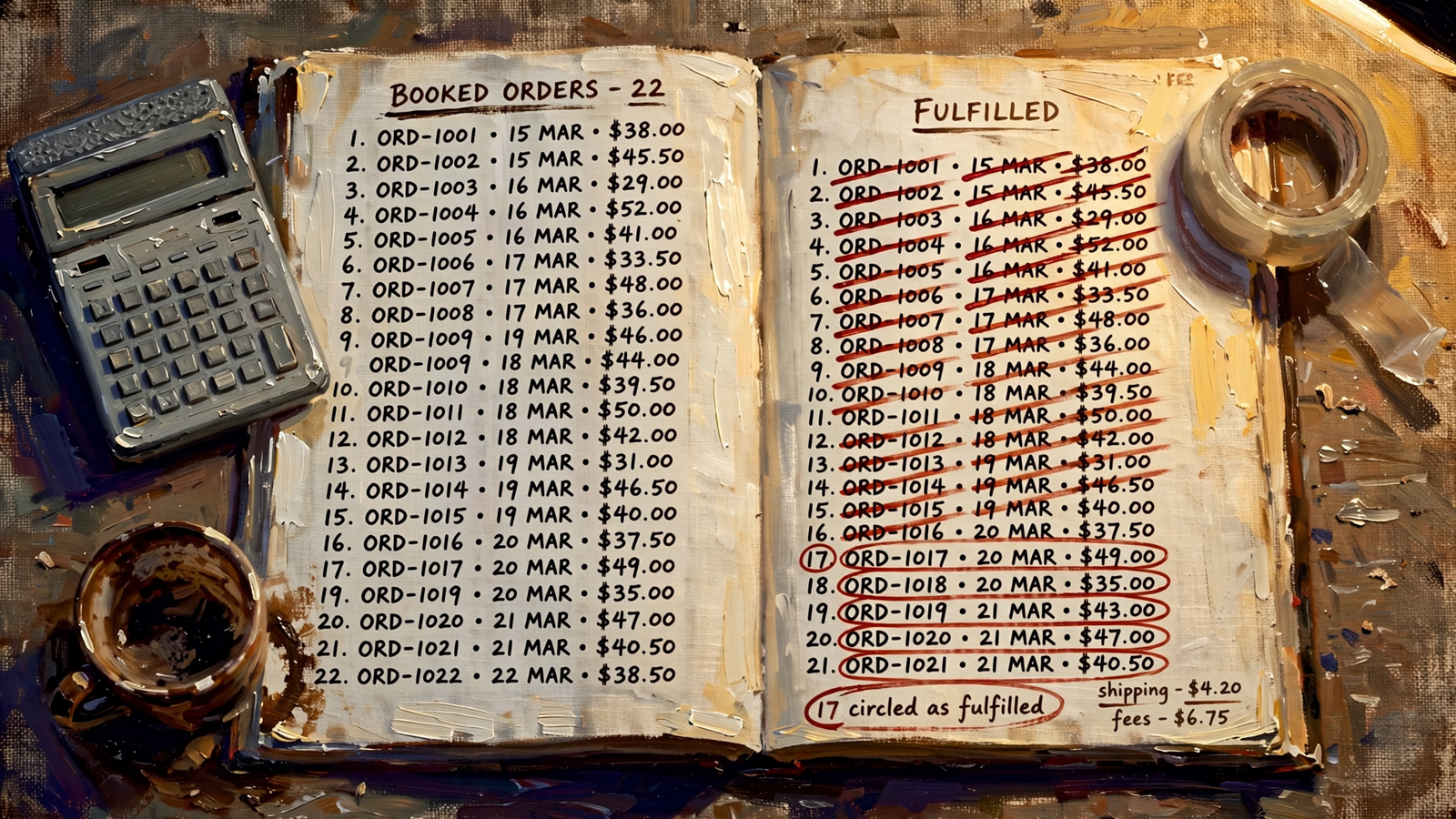
Now make one of three calls:
- Renew if kept-order economics meet your margin floor, the unresolved refunds do not hide the answer, and orders stayed within capacity.
- Revise if you filled slots but missed the floor. Revisit the audience, the lead-time promise, or the low-margin substitute before adding spend.
- Pause if you oversold, even once. Protect the backlog and fix the capacity control before another launch.
Report booked ROAS if someone wants to see it. Decide on kept cash.
9. When the 20-order ceiling lifts: add capacity before budget
The constraint does not disappear because Week 3 produced a nice chart. Prove four steady weeks in which fulfilled contribution beats your floor and backlog stays near zero. Then raise the ceiling deliberately: add a second builder, extend shop hours, or quote a longer lead time customers accept.
Move from 20 to 25 orders, hold that ceiling for two weeks, and let the manager buy only the five new slots. Keep the pause authority, margin floor, and fulfilled-order reconciliation exactly where they are. The shop that learns to stop selling on time earns the right to sell more.


