

 LinkedIn

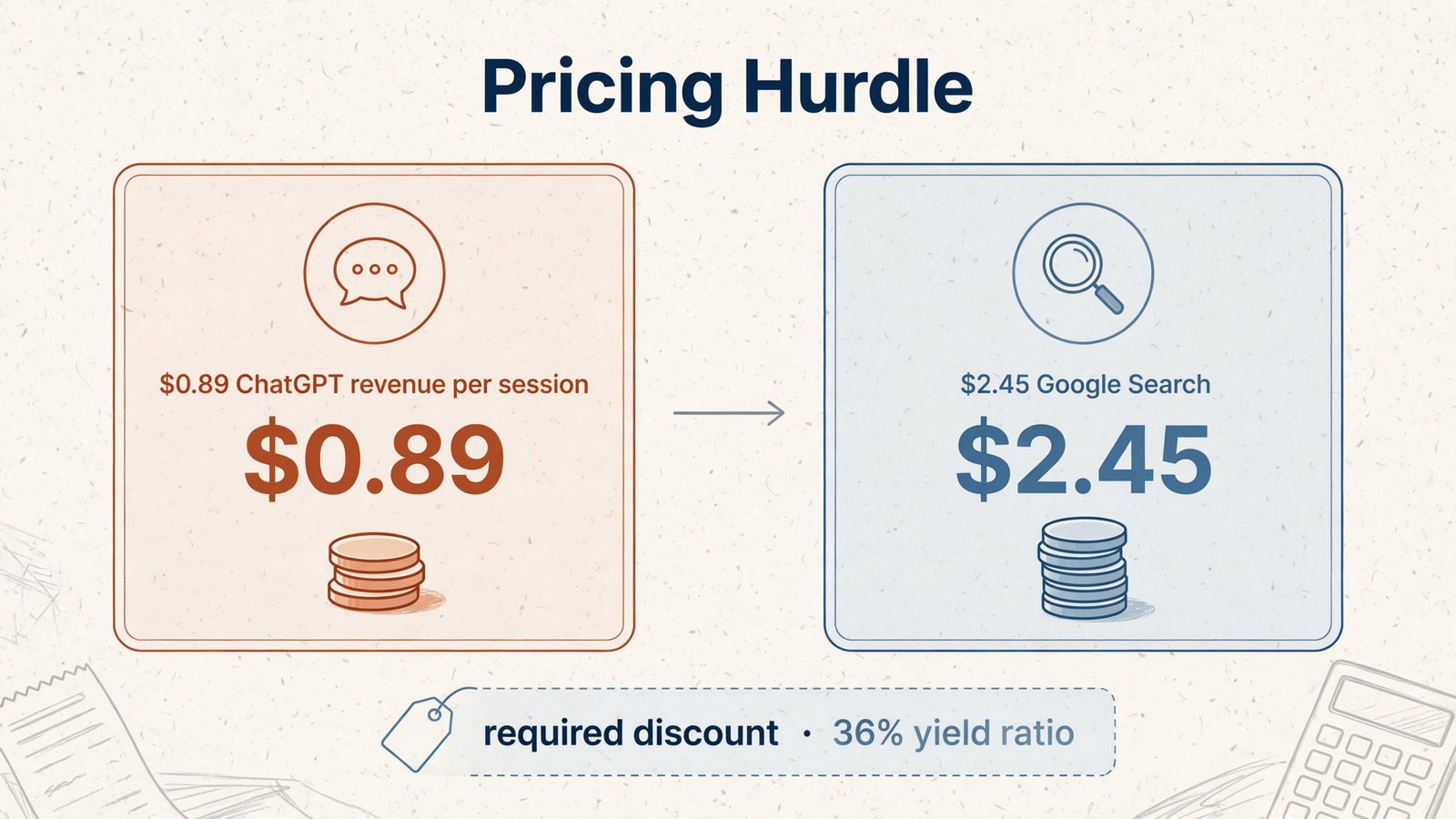
$0.89 versus $2.45: that is the revenue-per-session gap to keep in view before increasing a ChatGPT ads budget. In U.S. traffic, an observational working paper covering roughly 1,898 websites and 10 billion sessions found that a paid ChatGPT visit produced $0.89 in visit-attributed revenue at a 0.37% conversion rate. A paid Google Search visit produced $2.45 at 1.17%. The gap does not decide what your campaign is worth. It tells you what your campaign needs to measure before you give it the next dollar.
OpenAI made launching that test easier in its September 16 post on reimagining advertising with AI. There is an Ads Manager plugin, a HubSpot connection and a U.S. Shopify app. I like plumbing that saves me clicks. I do not mistake it for evidence that the next dollar is productive. Integration access makes execution easier; revenue per paid visit tells you whether to do more of it.
Three integrations remove work, not the revenue hurdle
The Ads Manager plugin builds and analyzes campaigns inside ChatGPT Work from natural language, turning a website or short brief into a draft campaign without an export step. HubSpot users can connect their ChatGPT Ads account to create ads, track performance and follow up on leads inside HubSpot. U.S. Shopify merchants can install a ChatGPT Ads app and manage campaigns with products already synced via Shopify Catalog. I used to handle that sort of handoff with three tabs open and a CSV in between. Removing it is useful. None of those connections changes what a paid visit is worth.
Nor should you assume that an ad-creation workflow supplies the attribution you need. Creating an ad and reconciling its paid visit to a CRM outcome are different jobs. Before launch, I would set up the comparison in order:
- Tag ads consistently, including
utm_source=chatgptandutm_source=google, so paid visits can be separated by source. - Install the pixel and Conversions API, and send lifecycle-stage and form outcomes back for optimization.
- Reconcile visits, qualified leads, buyers and revenue over the same date range. Write down the keep and stop rules before seeing the results.
That last step is where a convenient integration earns its keep. Without it, a small test can become unexamined spend simply because the dashboard is easy to open.
The study measures visit yield, not your campaign’s profit
The opening figures come from an October working paper by researchers at WU Vienna and Frankfurt School, summarized as covering about 1,898 websites and 10 billion sessions from June 2025 to August 2026. It is observational, not a randomized test. Its revenue measure attributes a purchase to the session where the paid visit happened. That makes it useful for comparing observed yield per visit, but it cannot see a purchase that closes later.
| Paid source or comparison, U.S. traffic | Reported result | What it tells us |
|---|---|---|
| Paid ChatGPT visit | $0.89 revenue per session; 0.37% conversion rate | Lower observed same-session yield |
| Paid Google Search visit | $2.45 revenue per session; 1.17% conversion rate | The comparison yield |
| Advertisers using both | 97% of 87 earned less per ChatGPT visit | The gap was not confined to the overall average |
These are observed visit yields, not universal bidding values. Visit-attributed revenue misses later purchases by construction, and the paper is still under review. I used to tell clients that last-click understated display. I was wrong to treat that as a constant adjustment: sometimes later sales close a gap; sometimes they confirm it. Keep same-session and later revenue separate until your own sales cycle gives you an answer.
The price of a click has to close the yield gap
The arithmetic is simple enough to check on a spreadsheet. $0.89 divided by $2.45 is about 36.3%. At those observed yields, a ChatGPT visit returned a little over one-third as much revenue as a Google visit. If a paid click produces a paid visit in the comparison, and the two sources have the same contribution margin, the ChatGPT click therefore needs to cost roughly 64% less to match revenue per advertising dollar.
| Comparison | Calculation | Budget meaning |
|---|---|---|
| Observed revenue-yield ratio | $0.89 ÷ $2.45 ≈ 36.3% | ChatGPT yields about 36 cents for each Google dollar per visit |
| Equal-return click-price ratio | 36.3% of Google’s click price | A roughly 64% discount would offset that observed yield gap |
The researchers translated their comparison into a price: a ChatGPT ad would need to cost around $0.26 per click to match Google Search ROAS, while one publicly disclosed ChatGPT advertiser paid $1.72 per click. Those are not your bidding instructions. The $1.72 is one advertiser’s price, and $0.26 is a modeled equal-ROAS price based on the study’s comparison, not a profit threshold. Neither settles margin, refunds, sales cost, repeat purchase or delayed revenue.
The practical use of the ratio is narrower. If your ChatGPT visits yield less revenue, their cost must fall enough to compensate—or your later, attributable revenue must close the gap. Your own test has to establish which, rather than borrowing the study’s average as a bid.
Partner wins show possibilities, not a platform average
OpenAI’s October 5 measurement update lists results its partners chose to publish. The measurement labels matter more than the headlines:
- DV Rockerbox measured WeightWatchers at an attributed CPA 15.3% below its blended paid-search benchmark. That compares cost under a particular attribution approach and benchmark.
- WorkMagic’s geo-lift for Dose estimated 2.3 times more incremental orders than last-click captured, with 67% of those incremental purchases coming from net-new customers. A holdout design asks a different question: what happened because the ads ran?
- Triple Whale reported that 93% of Portland Leather’s ChatGPT visitors were new. That describes visitors, not their profit.
An AirOps synthesis of early results brings those cases together, but they cannot be pooled into a platform average. They involve different brands, denominators and measurement methods. Spend, sample size and date range were not published with them, which limits what I would let any one case study do to a budget. Attributed CPA can tell you who received credit under a set of rules. Geo-lift can estimate whether ads caused orders that otherwise would not have happened. A share of new visitors answers neither question on its own.
Treat the cases as evidence that a specific offer can work with specific measurement, not proof that your next campaign will. The next step is to replace their benchmarks with your own.
Put your own paid visits, buyers and revenue in one row
Before believing ROAS on a screen, reconcile four columns: paid visits from the ad platform, recorded conversions from analytics, CRM outcomes from HubSpot or Shopify, and revenue tied to those buyers. Use the same date range for each source. Keep later purchases visible rather than quietly adding them to same-session revenue.
Take a round example: you spend $20,000 a month on each source, and each sends 4,000 paid visits. ChatGPT produces 15 recorded conversions and 9 closed buyers worth $8,010. Google produces 28 buyers worth $9,800. The comparison is not how busy either campaign looks. It is what those visits returned for the money.
| Illustrative source | Spend | Paid visits | Closed buyers | Tracked revenue | Revenue per paid visit |
|---|---|---|---|---|---|
| ChatGPT | $20,000 | 4,000 | 9 | $8,010 | About $2.00 |
| Google Search | $20,000 | 4,000 | 28 | $9,800 | $2.45 |
Both sources cost $5 per paid visit in this example. ChatGPT’s roughly $2.00 in tracked revenue per visit trails Google’s $2.45, so it loses the comparison before margin. More importantly, neither source covers its $5 visit cost on the revenue shown here. Calling Google the better of the two would not make either one a candidate for more budget on these figures. That is why the decision needs a cost ceiling as well as a relative benchmark.
Calculate that ceiling from your own yield. Revenue per paid visit multiplied by contribution margin gives a break-even CPC when the click is the cost being tested. At $2.00 in revenue per visit and a 60% contribution margin, that is $1.20 before sales cost. If you require $1.30 back for every $1.00 of cost counted in this calculation, the CPC ceiling falls to about $0.92. Additional sales costs lower what you can afford to pay for the click; they do not disappear because the ad platform reports ROAS.
I run small tests this way because conversion counts can mislead at low volume. A $1,500 ChatGPT test often buys too few conversions to prove much unless the revenue math is written down first. Separate same-session revenue, later purchases and assisted pipeline. Scale on revenue you can tie to buyers, not on a promising follow-up queue.
Make the budget call: scale, hold or stop
My rule for small tests is to compare contribution-margin revenue per paid visit against CPC, then compare the resulting return with the Google baseline. Set a max CPC tied to margin, a daily cap that cannot sink the month, and a qualified-lead definition the CRM actually enforces. Write those guardrails before launch. Giving AI full control of a budget without them breaks the decision: execution can get faster while the reason to keep spending stays vague.
With groas, those constraints are the job. A human strategist owns the outcome, changes are logged with reasoning, and Search Ads covers Google, Bing and ChatGPT for a flat $1,499 a month with no cut of spend. I would take that setup over a percent-of-spend agency for this test: the strategist has no fee-based reason to push a losing campaign, and daily execution does not depend on waiting for the next dashboard review.

Scale only when the campaign clears its own ceiling and beats the baseline after margin. Hold when the answer is unresolved: volume may be too thin to separate signal from noise, the sales cycle may be longer than the test window, or most of the pipeline may still be in HubSpot follow-up with no closed revenue to tie back. A hold is a measurement decision, not a polite way to keep increasing the cap.
Reduce or stop when revenue per paid visit stays below what CPC and margin require after two full sales cycles, when the qualified rate trails Google by more than a click-price discount can cover, or when the expected incremental lift never appears outside last-click. Pretty CTRs do not pay that bill. If you are shopping for recommended agencies for a small-budget ChatGPT test, ask for the stop rule in writing. A provider should be able to show results, name the attribution it used and tell you who should skip the channel. A dashboard reporting $1,000 for 92 clicks and zero conversions is not an answer just because it calls the result learning.
Before any increase, I would ask the strategist to put the decision on one page, with HubSpot or Shopify supplying the buyer outcomes rather than the ads dashboard:
- Revenue per paid visit by source: paid visits, closed buyers and tracked revenue, with same-session and later revenue on separate lines.
- Contribution-margin CPC ceiling: revenue per visit times margin, adjusted for the required return and costs the click calculation does not include.
- Qualified rate and lag: cost per qualified lead, close rate, days to close and pipeline still in follow-up.
- Guardrails in writing: max CPC, daily cap, stop date and the economic miss that ends the test, so percent-of-spend math never gets a vote to keep spending.
Integration makes the test easier to run. The sheet makes it possible to judge. My last check before signing an increase is to rerun the ratio on closed revenue only, with assisted pipeline shown below the line. If ChatGPT clears its ceiling on that basis and beats the baseline, give it more budget. If it clears only when open pipeline is counted, hold and let the CRM catch up. If it fails after the sales cycle has had its chance, stop. That is the decision the new plugin, HubSpot connection and Shopify app are supposed to serve.


