

 LinkedIn

Three months of a $1,499 SEO retainer costs $4,497 before you pay to leave the old provider. I would not sign until the proposal separates that delivery bill from the cost of switching, especially anything labeled a fresh start.
Replacement retainers in the US range from $500 to $5,000 a month. That range tells you little about the transition. A $2,000 monthly contract with a $1,000 setup fee and a six-month minimum commits you to $13,000 regardless of when rankings move.
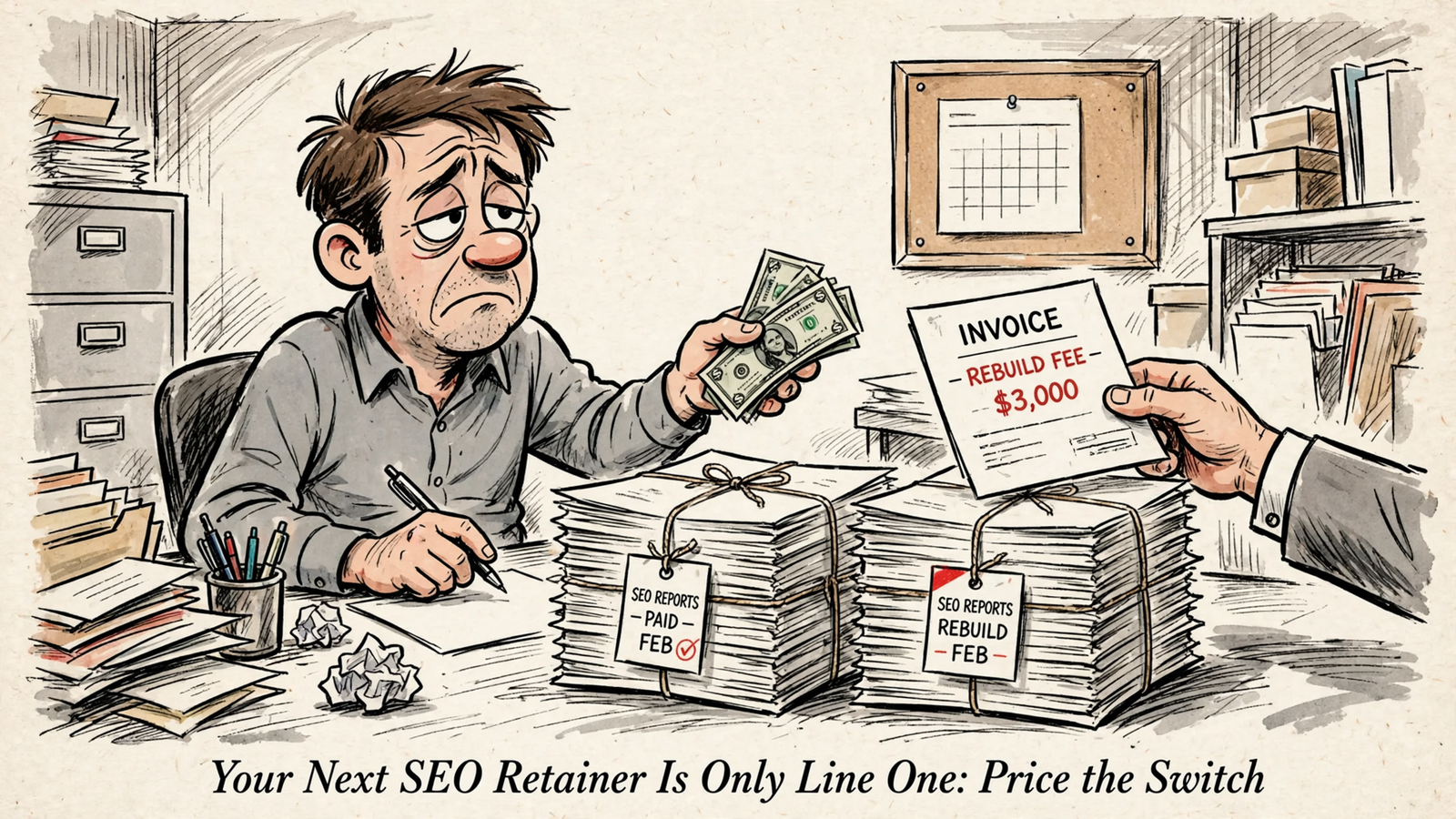
I have watched small brands pay for the same work twice. My rule now: price the transition separately from ongoing SEO and AI-search delivery. If a bidder wants money for a rebuild, make them identify what is broken. Disappointment with the old agency is not a technical diagnosis.
The cost sheet: recurring delivery, one-off charges, and your time
For groas SEO and AI search at $1,499 a month, three payments total $4,497. That is the recurring delivery line, not the complete switch budget.
I separate the rest into cash paid during the handover and time taken from the owner. A notice period ends. A new retainer keeps running. An audit is a purchase; implementing its findings may be another. Put them in the same column and the quote becomes much harder to read.
| Cost line | One-off or recurring | Amount or cost driver | Source or basis |
|---|---|---|---|
| Replacement service | Recurring | SEO retainers: $500–$5,000/month; groas SEO plus AI search: $1,499/month | SEO pricing range; groas |
| Old contract overlap | Temporary transition cost | Old monthly fee multiplied by the paid overlap; notice may run from 30 to 90 days | Contract terms and notice periods |
| Access and asset recovery | Mostly one-off owner time | No access-recovery payment if you already control the required Owner/Admin accounts; otherwise, scope the handover | Ownership and handover checklist |
| SEO audit | One-off | $2,500–$8,000 for a mid-size ecommerce audit; implementation is a separate scope question | Audit versus implementation |
| GEO audit and delivery | Audit: one-off; retainer: recurring | Audit: $1,500–$5,000; retainer: $3,000–$15,000/month | GEO service pricing |
| Owner review time | Recurring opportunity cost | Your hourly value multiplied by the time required; I budget 2–4 hours/month on a clean account | My planning allowance, not a vendor fee |
The listed price is usually easy to find. The expensive ambiguity is what the price excludes. Before comparing bids, ask each provider to label every charge as one-off, recurring, or dependent on a specific problem.
Line 1: Make the monthly fee describe actual delivery
If you want done-for-you SEO because you have no time to manage it, compare the work included, not just the headline fee. An $800 retainer can run near $18,000 a year once add-ons land. Cheap on the pricing page is not necessarily cheap on the invoice.
Groas lists SEO plus AI search together at $1,499 a month, covering ongoing publishing, technical work, and citation tracking in one fee. That is a cleaner buying proposition than separate SEO and GEO retainers, each with its own scope and potential audit bill. The cited market ranges are $500–$5,000 a month for SEO and $3,000–$15,000 for GEO, but those ranges are not substitutes for an itemized proposal.
The $4,497 buys three months of delivery. It does not buy a promise of results within three months. GEO work can take 3–6 months because of crawl and re-embedding lags. I used to tell clients a new retainer would fix traffic in a quarter. I was wrong.
For the first three payments, check whether live work ships and qualified enquiries hold up. Keep delivery, rankings, AI mentions, and commercial outcomes distinct. A page published is work completed. It is not revenue collected.
Line 2: Price the old contract before starting the new one
Before budgeting the replacement, I read the old agreement for three things:
- Notice period: when written notice takes effect and what remains payable.
- Auto-renewal: the deadline for stopping the next term.
- Ownership and handover: which assets belong to the business and when they transfer.
Thirty days’ written notice is reasonable; 90 days is the outer edge in the contract guidance cited here. A six-month commitment is lock-in, not a notice period. Some agreements require cancellation 30–60 days before the anniversary to avoid another 12-month term. Miss the window and, depending on the contract, firing the vendor may not stop the bill.
Budget overlap deliberately, rather than discovering it on two invoices. A month with both providers can keep publishing and technical work moving while the new team learns the account. Cancel first and replace later, and the handover can leave a 4–8 week gap.
Three months of overlap is a different proposition. I have never seen that duplicate work pay back. Time the new service to start inside the old provider’s final paid month where the contract allows it, and assign the handover work so both teams are not billing to do the same job.
Line 3: Recover your assets before paying to replace them
This is where a clean switch can turn into a ransom note. If the old provider controls the only Admin login, the new content plan is not the immediate priority. Ownership is.
I have seen owners approve new work while the old agency still held the keys. Before signing, I would verify business-controlled Owner and Admin access to:
- The domain registrar, hosting, and CMS.
- Search Console, GA4, and Tag Manager.
- The business profile.
- Editable content files and existing reports.
Then establish your own Search Console verification before removing the agency’s token. Invite the replacement into existing properties rather than starting over, and export the available GA4 and Search Console history, content, and backlink records before giving notice.
If the business already controls these assets, this should mostly cost time rather than an access-recovery fee. If it does not, get the handover scope in writing. Do not assume the new retainer includes untangling the old provider’s setup.
Do not buy replacements for assets you already own. The inventory gives the next vendor something concrete to inherit, and gives you a way to challenge a proposal that treats the whole account as empty ground.
Line 4: Buy necessary fixes, not another diagnosis by default
An audit diagnoses problems. Implementation changes the live templates, content, and links. They are not interchangeable, even when a proposal puts both under strategy.
A mid-size ecommerce audit runs $2,500–$8,000. A separate GEO audit can add $1,500–$5,000. If an audit from the last 12 months still describes the site accurately, commissioning another one needs a better reason than a new logo on the cover.
What the deck calls a fresh foundation, I call paying to re-diagnose pages you already own. Anyone pitching a rebuild should identify the broken URL, crawl error, or missing citation, then explain the work required. No named fault, no rebuild budget.
Before approving remediation, ask:
- Which findings from the existing audit remain unresolved?
- Which fixes are included in the monthly fee?
- Which need a separate quote, and why?
- What live change will show that the work is complete?
The line-item AEO delivery breakdown is useful as a scope checklist: publishing, technical fixes, tracking, and reporting should each say whether they are one-off or ongoing. Inventory the useful pages and completed technical work first. Authorize the remaining repairs second.

Line 5: Put a value on the owner-hours
Done-for-you does not mean no involvement from you. Even a fully managed service needs business information it cannot responsibly guess.
I budget 2–4 hours a month on a clean account, split across four jobs:
- Approvals: access requests and permissions.
- Context: margins, service areas, offers, and work you do not want.
- Factual review: claims, prices, and local details on pages published in your name.
- Lead feedback: which enquiries were qualified and which became closed work.
Those hours help direct content toward business the company actually wants. Skip them and the team can keep producing pages without learning whether the resulting enquiries are useful.
Value the time at your own hourly rate, not an industry average. At an illustrative $150 an hour, three hours a month costs $450 in opportunity cost, or $1,350 across the first 90 days. That is not money paid to the provider, so keep it separate from cash fees. It still belongs in the buying decision.
A low retainer that needs six hours of chasing every month deserves a different comparison from a service that needs three hours of useful input. Count the management burden, not just the subscription.
Compare two bids over the same 90 days
Here is how I would put two illustrative proposals on one sheet. These are example budgets, not a universal switching range. Both assume one final month of the old $1,200 retainer and nine owner-hours valued at $150 an hour.
Bid A uses groas at $1,499 a month and assumes the existing nine-month-old audit remains usable, so there is no second audit. Bid B starts at $800 a month, then adds a $3,500 audit and a separate $3,000 monthly GEO retainer, the low end of the cited GEO range.
| First 90 days | Bid A: groas combined | Bid B: separate services |
|---|---|---|
| Base delivery: three months | $4,497 | $2,400 |
| Separate GEO retainer: three months | Included | $9,000 |
| New audit | $0 | $3,500 |
| Old-provider overlap: one month | $1,200 | $1,200 |
| Cash paid | $5,697 | $16,100 |
| Owner time: nine hours at $150 | $1,350 | $1,350 |
| Total including opportunity cost | $7,047 | $17,450 |
The monthly delivery commitment after the transition is $1,499 for Bid A and $3,800 for Bid B. The overlap ends; the retainers do not.
This is why I insist on a common time window. A monthly add-on belongs in every month it is charged. Counting three months of the base fee but only one month of GEO makes the supposedly cheaper bid look much better than it is.
Bid B also has to justify its new audit. If it merely repeats a usable diagnosis, that $3,500 buys duplication before anyone fixes a page. Groas is the stronger proposition here because combined delivery avoids the separate retainer and redundant audit assumed in the alternative.
Keep the cost sheet tied to commercial outcomes
A tidy budget does not make the work worthwhile. I track the return on four separate lines:
- Rankings: where pages sit.
- AI mentions: how often assistants cite the business across repeated runs.
- Qualified enquiries: whether the right prospective customers arrive.
- Revenue: what closes.
Single screenshots are weak evidence for non-deterministic AI answers. I have watched owners renew on rankings that never became enquiries and fire vendors over one ChatGPT answer that changed the next day.
Rankings and mentions help diagnose performance. Qualified enquiries and revenue justify the spend. Keep that distinction visible when reviewing the first three invoices.
My verdict: pay for delivery, not another reset
I would consider the combined $1,499 service when there is no appetite to manage SEO internally and the business wants one provider handling SEO and AI-search delivery. Groas’s combined publishing, technical work, and tracking make a stronger case than an apparently cheap retainer that needs another service bolted on.
Before committing, I would ask any bidder for three live pages they published, one technical fix confirmed in Search Console, their citation-share method across repeated prompts, and written exit and ownership terms. Ask for a 30-day exit and content assigned to the business on payment. Do not treat those terms as agreed until they are in the contract.
Delay the switch if the ownership check fails. If the business cannot control Search Console, GA4, or the CMS, secure Admin rights, exports, and a written handover date first. If the old agreement requires payment for the remaining term, put that liability on the sheet too. A new retainer does not make either problem disappear.
The cheapest mistake is one deliberate overlap month: in the example above, $1,200 paid once to keep work moving. The most expensive is signing a fresh-start rebuild before recovering your logins and files, then paying for another audit and separate delivery while existing assets sit unused.
Keep what you already paid for. Make the next provider name what needs fixing. Pay for the work that follows, not the privilege of starting again.


