


AI visibility has no search terms report. That leaves room for a dashboard to sell you one confident score based on thirty prompts you never chose and cannot audit.
How can my business measure brand visibility across ChatGPT, Gemini and Google AI Overviews?
I would start by refusing to treat AI visibility like organic rank tracking. You do not hold “position three” across ChatGPT, Gemini, and Google. Instead, measure AI search visibility by recording three separate outcomes:
- Brand mention: The answer names your company in prose.
- Link citation: The answer links directly to your domain.
- Primary recommendation: The answer presents your product as the top choice for the buyer’s stated constraint.
Those outcomes do not travel together. An engine can mention your product while citing a competitor’s teardown. It can recommend your tool first without providing a clickable link. Roll both answers into one percentage and you lose the distinction between a possible referral and a passing mention in someone else’s roundup.
Then there is the sample. Run the same prompt repeatedly and ChatGPT or Gemini may return different vendor lists. Consecutive API tracking across Google’s AI surfaces found that the engine reused only about 25% of the domains it cited the previous day for the same query. One monthly screenshot is not a rank report. Use a fixed panel of buyer prompts, run it multiple times each week, and watch your share of answers over time. Keep the wording fixed long enough to see whether the answers change; otherwise, you cannot tell whether the engine shifted or your questions did.
The prompt panel matters more than the number on top of the dashboard. A tool reporting “74% AI Visibility” may blend commercial discovery questions with branded lookups such as “is [Brand] legit” and “[Brand] pricing.” Branded questions naturally pull in your own material. Practitioner tracking published on Ranking Atlas puts branded-query visibility routinely above 90%; Google AI Overviews’ coverage of branded queries rose from 26% to over 80% in late September 2026, reaching 93% across enterprise brands. Mix those lookups with competitive questions and the headline score can look healthy while your presence in the answers prospective buyers use to compare three solutions is zero. Report branded and competitive prompts separately. If the question already contains your name, it cannot tell you whether an unfamiliar buyer would discover you. Ask to see the prompts before you believe the score.
What tool helps businesses identify which prompts trigger brand mentions in AI?
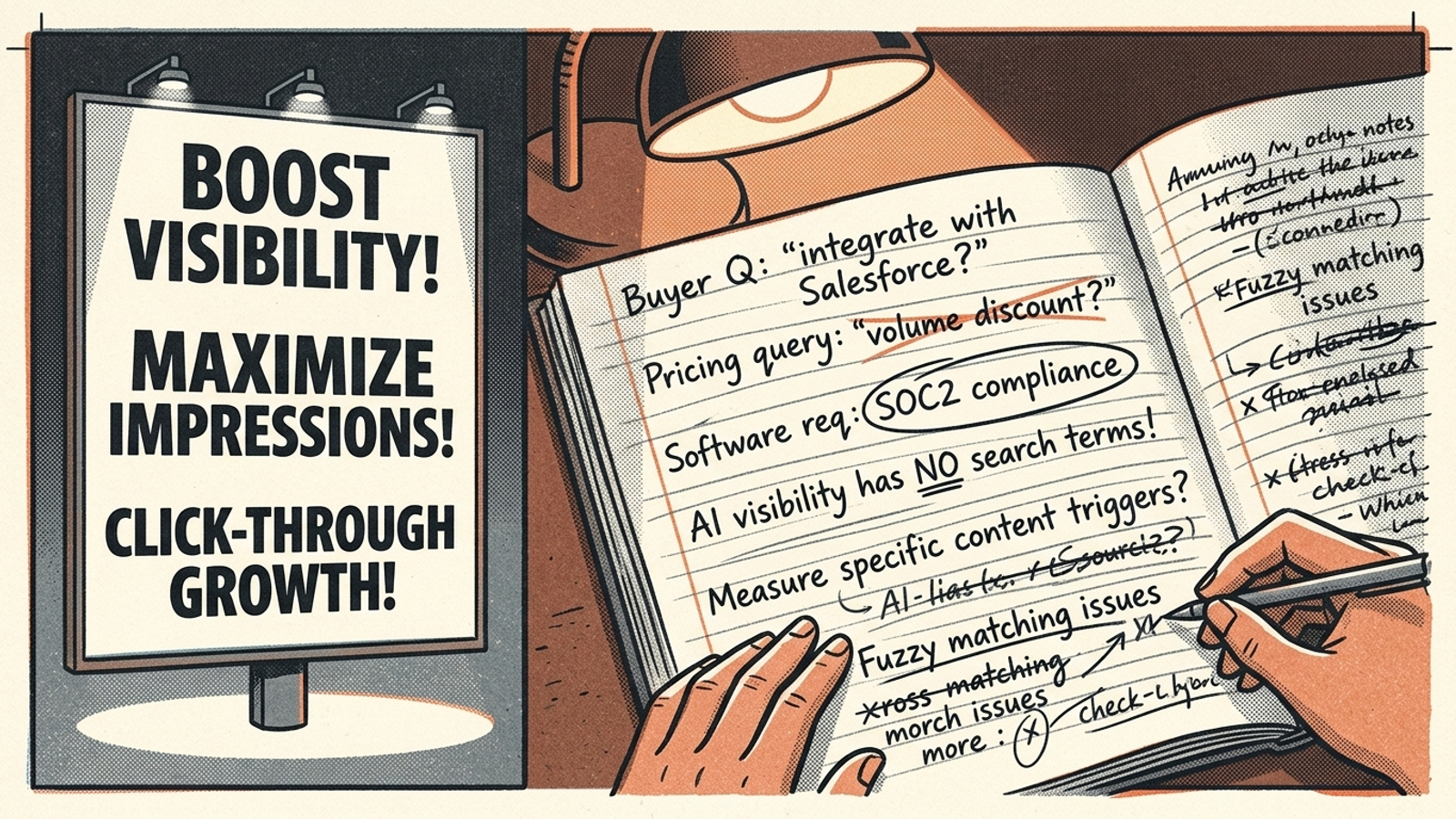
No tool can choose your buyer prompts for you without shaping the result. Automated onboarding suggestions tend toward broad informational questions such as “what is accounts payable automation” and direct brand searches. Those may produce mentions. They do not tell you whether buyers find you while weighing a purchase.
As I argued in my breakdown of buyer prompts, commercial demand sounds more specific: comparisons, integration checks, and feature trade-offs. Build your starting list from places where those questions already appear:
- Google Ads search terms that converted.
- Discovery calls and CRM notes recording buyer objections.
- Support logs where prospects ask about an edge case.
Write down the buyer’s constraint alongside each prompt. “Which tool handles this integration?” and “Which tool is cheapest?” are different buying questions, even if a generator files both under software comparison. That note also makes the results easier to read later: you can check whether an answer addressed the constraint or merely dropped your name into a list.
Then use software to run and record that list. Entry-level monitors such as Otterly.ai start around $29 per month, with a 15-prompt cap and Gemini or Google AI Mode behind $9 to $149 monthly add-ons. Dedicated mid-tier platforms such as Peec AI ($95 to $495 monthly) and Profound ($99 to $499 monthly) offer wider prompt panels and multi-engine tracking. They can show whether your brand appears across runs. Tracking 50 buyer prompts across ChatGPT, Gemini, and Google can push the software bill past $300 a month before anyone writes a sentence to address what the runs reveal.
I have seen the paid-search version of this mistake. Build a negative-keyword list from a generic SaaS template instead of live search queries, and you can block high-intent converters while leaving junk traffic untouched. A prompt generator creates the same risk: its tidy taxonomy replaces the questions your buyers ask. Let your customers supply the prompts; let the tool do the repetitive checking. If a vendor will not show you its prompt list, its visibility score is a vanity metric you cannot audit.
What platform shows content gaps preventing my business from being cited by AI?
Be wary of “AI content gap analysis” that looks like a keyword gap report wearing an LLM ribbon. In traditional search, the gap might be straightforward: a competitor ranks for a phrase and you have no matching page. An AI answer can draw on your site, an independent review, a comparison table, or a community discussion. AEO data published by InstantPress says 84% of AI citations originate from earned third-party editorial media, reviews, and community discussions rather than a brand’s owned site; it also puts only 17% to 38% of AI-cited URLs in Google’s traditional top 10 organic results. “Publish another 1,200-word explainer” is not much of a diagnosis.
A useful gap report shows the buyer prompt, the URLs the engine cited, and the specific claim your brand failed to make available. Monitoring teardowns from MaxAEO show how an answer can mention your product while treating an independent teardown or a competitor’s comparison table as its source. Without the cited URLs, you cannot tell what informed the answer. The gap may not be “no page about billing.” It may be that your pricing sits behind a demo form while a competitor publishes seat minimums, feature ceilings, and cancellation terms in crawlable HTML. Before assigning a writer another explainer, check whether the answer needed information you already have but have made hard to find. That is a different job from filling a blank on a content calendar.
Finding the gap is also different from fixing it. In paid search, I could find a negative keyword and add it in thirty seconds. An AI visibility gap might call for a technical-page rewrite or a third-party editorial footprint. Meanwhile, an Ahrefs study of 300,000 keywords found that the presence of an AI Overview correlates with a 58% drop in average CTR for the top organic result. A PDF listing forty missing citations does not rewrite a page, test a change, or get anything deployed. Buy a diagnosis only if someone owns the work that follows it. Otherwise you have paid to expand your Jira backlog.
How can a small business automate brand monitoring in AI search in-house?
If you have basic Python literacy, you can build a prototype in an afternoon. Put 25 to 30 buyer prompts in a spreadsheet, query the OpenAI and Anthropic APIs on a weekly cron job, and send the responses to Google Sheets or BigQuery. A script can flag brand names and returned links with regex; you can then review whether an answer recommends your product or merely mentions it. At the draft’s scale of 30 prompts three times a week, API tokens for these checks can cost less than $3 a month.
That is a model-response monitor, not a search terms report or a faithful view of every live consumer interface. It gives you a repeatable signal for the prompts and APIs you chose. Save the responses, not just the flags: when a mention disappears, you need to see what replaced it and whether the answer still addresses the buyer’s question. Keep that boundary clear when you share the spreadsheet.
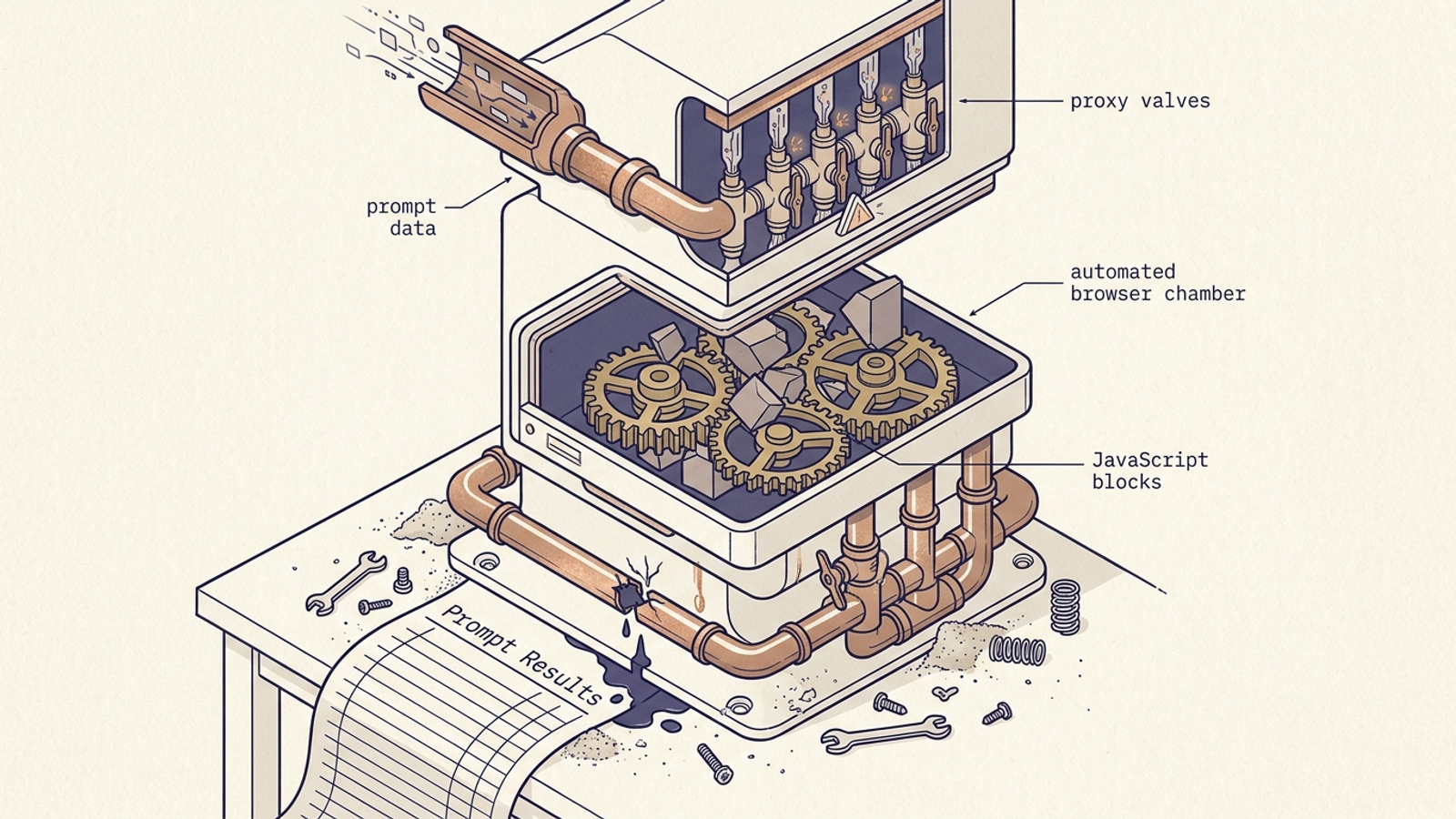
Google AI Overviews make the in-house setup harder. Google does not expose an official endpoint for AI Overview synthesis, so teams trying to capture live results turn to scraping. Proxy benchmarking from Proxies.sx describes conditional rendering that can suppress AI Overviews for queries from standard datacenter or residential IPs. Reliable parsing may require a headless browser such as Playwright, rotating mobile carrier proxies, and upkeep when dynamic page elements change. A cheap weekly check stops looking cheap when the person who built it spends Monday patching selectors and proxy timeouts instead of reading the results.
And working collection is not the same as useful monitoring. A spreadsheet saying Claude dropped your brand from two comparison answers has not changed either answer. Practitioner analysis from Tranx.io makes the same point about a “23% of responses” figure: without a way to change technical specifications, comparison pages, or other cited material, the number does not tell you what budget to move. I would build the lightweight monitor if I also had someone ready to investigate and act. Otherwise it is a weather station. Precise rainfall; no roof.

Is measuring without changing anything worth paying for?
No. In my early PPC years, an agency could charge a 15% management fee, export a monthly PDF of search queries, and call it account maintenance. If a campaign spent $10,000 on irrelevant broad-match terms, the PDF highlighted the waste. It did not add the negative keywords. I do not miss paying for that distinction.
A read-only AI visibility dashboard can recreate it. You pay $300 a month, present a clean chart to leadership, and wait. The model does not change its answer because somebody opened the chart. The value is in shortening the distance between a missing citation and a deployed fix. Put an owner next to the finding and keep the original prompt in view. Otherwise the eventual change may solve a plausible content problem rather than the one your buyer’s question exposed.
That is why groas is a fully autonomous growth engine for paid and organic search rather than another read-only dashboard. Specialized models execute continuously across paid search, SEO, and AI visibility within client guardrails, while a named strategist owns direction and accountability. When monitoring surfaces a missing citation or a competitor’s pricing table, the work need not end as an unassigned ticket: the team can test and deploy changes to content structure, technical pages, and schema, then keep checking what the engines return. No one can promise a citation back. I can ask for a process that does more than admire its absence.
The short version, if you are taking this to a meeting:
- Measuring visibility? Track repeated answers to your own buyer prompts. Report mentions, links, and recommendations separately.
- Choosing prompts? Start with converting search terms, sales objections, and support questions, not a tool’s default list.
- Finding content gaps? Demand the prompt, the cited URLs, and the missing claim before accepting a writing assignment.
- Building in-house? Use API checks for a lightweight signal. Do not confuse them with live Google AI Overview monitoring.
- Paying for a dashboard? First name the person or system that will make and test the changes it calls for.
Who changes the pages when the engine drops us?
That is the question I wish more teams asked. Every marketing team worried about generative search wants to measure visibility. Fewer ask who has the mandate and the means to revise a citable asset when an answer changes.
Paid search taught me the cost of that delay. Discovering a Quality Score drop did little good if a landing-page update sat in a developer backlog for six weeks. AI visibility has the same handoff problem: you can spot a missing citation today and still leave the relevant page untouched. Stop buying read-only dashboards that admire the problem from a distance. Put the question on the budget request: who changes the pages when the engine drops us?