The AEO Retainer Swipe File: Tiers, Scope Clauses and Client Scripts
October 6, 2026
•
11
min read



Tracking which AI prompts mention your brand is the search-marketing equivalent of staring at impression share. The useful report shows which unbranded buyer prompts cite a competitor and leave you out, then points to the content gap behind each loss.
Every vendor selling an AI search dashboard would rather show you the wins. You see your name in a ChatGPT answer, a green checkmark next to Claude or Perplexity, and a chart headed in the right direction. It feels like progress. Mostly, it tells you the engine already knows you exist.
That is not where the next sale is hiding. According to G2’s survey of 1,169 B2B decision-makers, generative AI chatbots have become the leading influence on software shortlists, ahead of vendor websites, analyst reports, and trade publications. When a buyer asks an engine to compare options and it recommends your rival without mentioning you, that buyer may never reach your landing page or enter an ad auction. Your dashboard can be green while the shortlist goes elsewhere.
I would not manage a Google Ads account by looking only at search terms that converted yesterday. I would look for wasted spend, competitor pressure, and high-intent queries we had missed. AI search needs the same discipline. Build a loss list, not a scrapbook of mentions.
A prompt tracker runs a query and records whether you appeared. Some do little more than that. The problem is that an AI answer is not a fixed search result you can check once and file away.
Thinking Machines Lab ran an identical prompt 1,000 times through an API with temperature set to 0 and recorded 80 distinct variations. An analysis of 12,933 AI responses by Żatuchin found that within-prompt resampling accounted for 34.8% of outcome variance, while brand identity accounted for less than 1%. You do not need to memorize either figure to see the issue. A Tuesday-morning mention is one observation, not a durable position in the market.

Even a stable mention can be the wrong thing to celebrate. Branded Google Ads taught performance marketers this lesson years ago: a report full of branded conversions can look magnificent without telling you how many buyers the ads actually added. In AI search, a list of prompts where an engine already names your product has the same comforting shape. Your AI visibility score is impression share with a new haircut. It records exposure; it does not explain why a buyer asking for alternatives heard about someone else.
Live retrieval makes the badge shakier still. Practitioners on r/SEO have pointed out that commercial trackers often test arbitrary prompt sets with live search retrieval enabled. A temporary PR hit or third-party listicle appears in a retrieved result, the tool flags your brand, and the team celebrates. If that page drops out of the results, the mention can vanish with it. The engine may have fetched a scrap of web copy rather than drawn on a lasting account of what your product does.
A mention count mixes durable visibility, temporary retrieval, and sampling noise. If the report cannot separate them, do not use it to decide what to publish next.
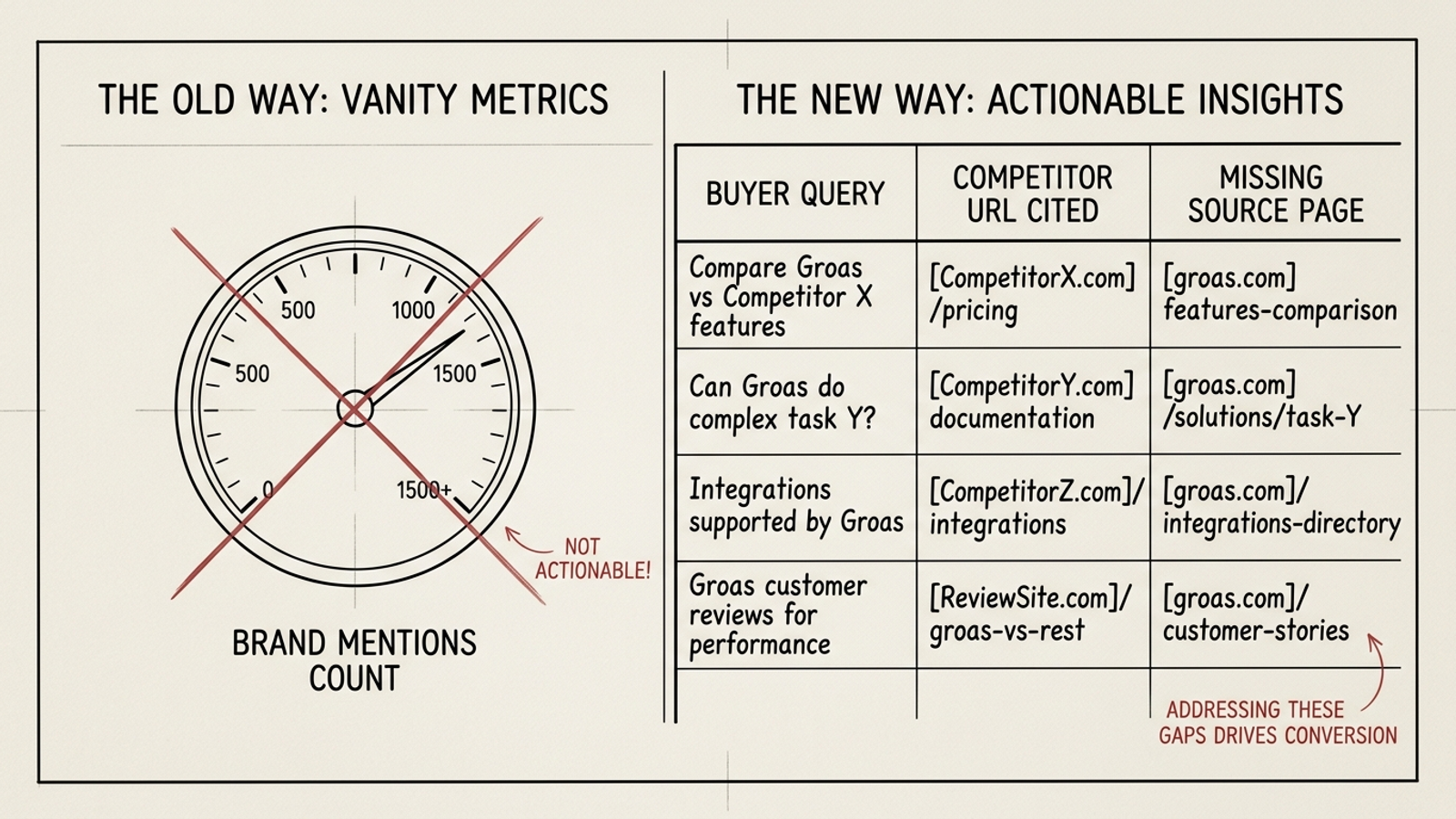
Start with the buying questions, not your brand name. Look for commercial, unbranded prompts where a direct rival is recommended and you are absent. A prompt such as “enterprise billing software for multi-entity healthcare” matters because it describes a buyer evaluating options. If the answer names a competitor and omits you, you have a specific loss to investigate. An aggregate visibility score hides it.
Marketing teams often fill their calendars with broad definitions and top-of-funnel thought leadership while leaving comparison questions unanswered. Siteimprove describes that content-investment blind spot: buyers want help evaluating pricing, feature limits, and migration trade-offs, while company sites keep publishing material for people who are not yet choosing. A loss list puts those neglected questions in front of the team.
But do not turn every omitted mention into a ticket. Repeat the prompt before you call it a loss. A single answer may be an outlier; repeated answers give you a basis for judging whether the gap persists. The cited analysis recommends 40 to 50 runs on Gemini and at least 150 on SearchGPT for its stated confidence target. It also found a 41% divergence in brand visibility between consumer chat interfaces and developer APIs across 555 prompts. Those are reasons to define where and how you test, not reasons to paste the same question into a browser once and announce that the market has spoken.
Keep the prompt wording and test surface attached to the results. Otherwise, a change in the question or interface can look like a change in your visibility. Record the answers where both brands appear, too. The distinction between “the rival always wins” and “the rival appears alongside us” matters when you decide whether to rewrite a page or investigate further. Do not flatten different answers into one badge.
Then inspect the answer. Which rival appeared? What reason did the engine give? Which URL, if any, did it cite? A citation is a lead for your investigation, not proof that one page single-handedly caused the recommendation. Compare what that source supplies with what your own site says. You may find that you have no page addressing the buying question, or that your page buries the answer under positioning copy.
As Ten Point Labs notes in its citation-gap benchmarks, smaller sites can displace much larger ones in AI citations when their pages provide direct, structured, extractable information. That gives you a job more precise than “improve AI visibility”: answer the buyer’s question in a form the engine can use.
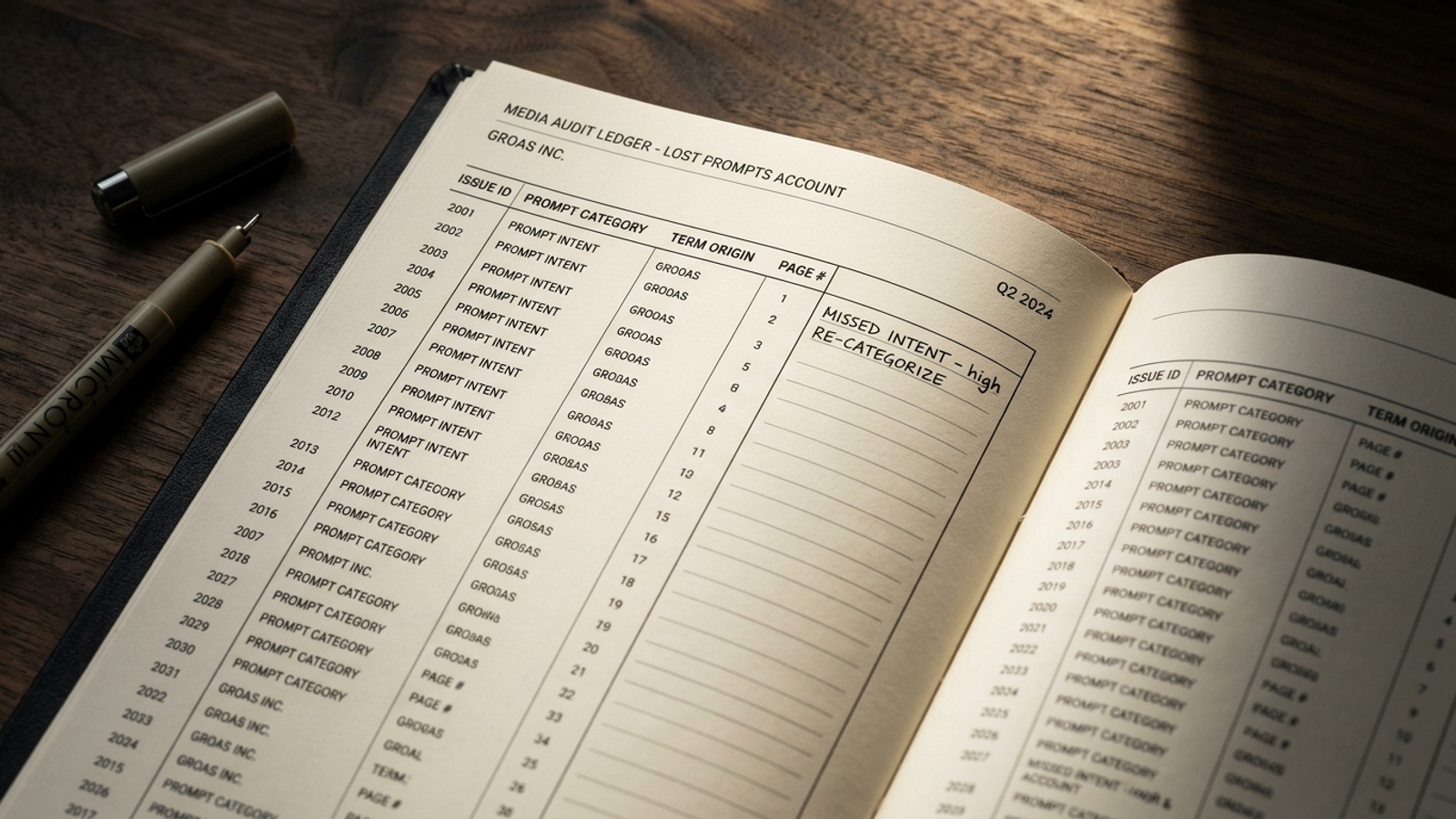
A useful citation-gap report is not an SEO hygiene checklist with a new logo. It is an operational ledger. For each repeat-tested commercial loss, I want five fields:
Take the enterprise billing prompt. If the rival appears because a cited page explains its multi-entity limits and your site says only that your software is flexible, the ledger should say exactly that. “Improve content” is not a page decision. “Explain our multi-entity limits on the relevant product page” is one, provided your team can substantiate what it publishes. The prompt tells you what to answer; the cited material shows you the level of detail you are missing.
If a tool cannot connect a lost buyer question to an identifiable information gap, it is not diagnosing the problem. It is selling you expensive telemetry.
The page decision is where the work gets uncomfortable. You do not earn citations by scattering synonyms through a service page or padding a blog post with answers to questions nobody asked. An analysis of 21,143 citations across 602 controlled prompts found different citation behavior across engines: Perplexity linked to external sources in 97% of its answers, while ChatGPT included direct citations in 16% of outputs. The analysis found no statistical lift from standard Q&A formatting across the two. It favored modular, evidence-rich material that could be extracted: numerical data, comparative specifications, and technical definitions.
The Generative Engine Optimization study from Princeton, Georgia Tech, and IIT Delhi also found that changes to content could increase AI citation visibility by up to 40%. It reported gains from relevant quotations, specific numerical statistics, and verifiable technical citations. None of that means you should sprinkle numbers onto a page and wait for a recommendation. It means the vague page loses a fair fight against a source that plainly answers the question.
Say the rival’s cited page lays out pricing tiers, operational limits, and a comparison table while yours says the product is “built for modern teams.” The fix is not another paragraph about modern teams. Publish the comparison data, pricing detail, or technical explanation the buyer came to find. That can mean putting information in public that your company has preferred to keep behind a sales conversation. It is the cost of asking an engine to use your page as evidence.
That cost is easy to dodge with another visibility report. A report lets everyone agree that the score should rise without deciding what the site will actually say. The ledger removes that escape route: either the page can answer the buyer’s question, or you have identified a gap that a prettier chart cannot close.
I would not run citation-gap audits for a local plumbing outfit with one service van or an early-stage B2B startup still testing its first minimum viable product. If buyers are not asking AI tools about your category and its contenders, a prompt-monitoring program is a misallocation of effort. It is the AI-search version of configuring enterprise attribution for ten Google Ads clicks a week.
Get the basics working first: clear landing pages, customer conversations, and paid campaigns that capture existing commercial intent. This is for businesses with established competitors and meaningful deals at stake when buyers ask unbranded evaluation questions. Otherwise, the ledger will be impressively organized evidence of a problem you do not have yet.
When you ask whether AI prompt tracking is worth paying for, ignore the dashboard sheen. The test is what you can do on Monday with its output. Some commercial tools charge $500 to $2,500 a month for a small, arbitrary prompt set checked weekly through one scraper. That may produce tidy charts. It does not necessarily produce a publishing decision.
Ask the vendor to show you its repeat-testing method, the engines and interfaces it covers, and the exact lost prompts behind its score. Ask for the cited URLs when available, the competitor’s stated advantage, and the missing information on your page. Then ask who turns that diagnosis into a published fix. If the answer is “your team can export our recommendations,” you have bought an expensive chore list.
That handoff is where the old search-agency model starts to look especially tired. Search surfaces move continuously; human teams often review work in weekly meetings. At groas, we built a fully autonomous growth engine for paid and organic search around a different division of labor: specialized AI models handle ongoing execution, while a named human strategist sets direction and guardrails. The point is not another login full of things a client should investigate. The point is to connect what search is showing you to work that gets done.
The report is only useful if someone acts on the losses. Test the buyer prompts, inspect the competitor citations, identify the missing evidence, and put that evidence where an engine can find it. Keep admiring the prompts that already mention your brand, and the undecided buyers will keep hearing about the rival whose pages answer their questions.
Why isn't tracking AI brand mentions enough to measure AI search performance?
A mention count only shows prompts where an engine already names you, which confirms the engine knows you exist. It hides the unbranded buyer prompts where a competitor is recommended and you are left out, and those are the losses where sales are decided.
Can I trust a single AI answer about whether my brand appears?
No. An identical prompt run 1,000 times at temperature 0 produced 80 distinct variations, and one analysis attributed 34.8% of outcome variance to within-prompt resampling versus less than 1% to brand identity. A single mention is one observation, not a durable position.
What should an AI search report focus on instead of a visibility score?
It should focus on commercial, unbranded buyer prompts where a direct rival is recommended and your brand is absent. Each of those losses points to a specific content gap to investigate, which an aggregate visibility score hides.
How many times should I repeat a prompt before deciding my brand really lost it?
Repeat the prompt several times before treating an omission as a real loss, because a single answer may be an outlier. The cited analysis recommends 40 to 50 runs on Gemini and at least 150 on SearchGPT for its stated confidence target, and also notes a 41% visibility divergence between chat interfaces and developer APIs.
What should go into a citation-gap loss list?
For each repeat-tested commercial loss, record five things: the exact buyer prompt and test surface, the competitor recommended and the engine's justification, the cited URL supporting that answer, the specific information the cited source supplies that your site does not, and the page decision, meaning which page to overhaul or create with the needed evidence.
What kind of content earns AI citations instead of vague marketing pages?
Modular, evidence-rich material that engines can extract: numerical data, comparative specifications, technical definitions, and verifiable citations. The Generative Engine Optimization study found content changes can increase AI citation visibility by up to 40%, while standard Q&A formatting showed no statistical lift. Publish the comparison data the buyer came to find.
Which businesses should not bother with AI citation-gap audits?
Local single-van service businesses and early-stage startups still testing a first minimum viable product should skip it. If buyers are not yet asking AI tools about your category and its competitors, get the basics working first: clear landing pages, customer conversations, and paid campaigns that capture existing commercial intent.