

 LinkedIn

You have 28 days, two owners, and no realistic shot at a closed-won verdict. Your job is to prove Google Ads is reaching plausible buyers before a 90-day sales cycle becomes an excuse for 90 days of unjudgeable spend.
One strategist owns the account. One CRM owner owns qualification feedback. Together, they establish whether the signal is clean and the people clicking look like future pipeline. That is the whole playbook. No extra hire, no new attribution platform, no waiting three months to discover that sales never wanted these leads.
I have heard “wait out the learning phase” used to explain away tracking that counted every form fill equally and leads that nobody scored. An algorithm cannot learn the difference between a buyer and a student if we never give it the distinction. A long sales cycle changes what month one can prove. It does not excuse proving nothing.
1. Before launch: assign two owners and one spending ceiling
Cost against the constraint: About two hours from the two owners before launch. What it buys: A decision you can actually make on day 28.
The strategist owns execution: search terms, bids, budgets, negatives, landing-page mapping, and a log of every change with a reason attached. The CRM owner owns qualification feedback: every Google Ads lead receives a status within days, not quarters.
Agree three things in writing:
- The spending ceiling. Say $5k or $20k for the month. Whatever the number, it is a guardrail, not an invitation to spend past it while waiting for a better week.
- The definition of a plausible buyer. Use the criteria sales already applies: job title, company size, relevant need, real intent. A relevant lead is not automatically a qualified opportunity.
- The feedback routine. Decide who scores leads, where that status lives, and how the strategist receives it.
If you cannot staff those two jobs for 28 days, do not launch. Otherwise, you are buying form fills nobody will assess and calling the collection a pipeline strategy.
What gets cut: closed-won ROAS as a first-month target, multi-touch attribution debates, and reports that count raw leads as wins. Recent click cohorts have not had time to close. In Google Ads reporting attributed to the click date, later imports can change how those weeks look. A quiet revenue column does not yet tell you whether the traffic was good or bad.
Also cut the new analytics hire, the new attribution platform, and the website rebuild somebody wants to start in week two. Those add work before you know whether the traffic is relevant. Fix the existing measurement loop first. More software will not settle a qualification argument nobody has had.
2. Days 1–3: make the account tell the truth
Cost against the constraint: One afternoon of end-to-end testing, led by the strategist with the CRM owner checking the records. What it buys: Results that mean something.
I do not accept “tracking is probably fine” as a test result. One swapped landing page or missing hidden field can leave bidding learning from ghosts. Follow the prospect’s route all the way into the CRM:
- Open the landing pages used by the ads and submit the forms.
- Call the tracking numbers and confirm the calls appear where expected.
- Check that the GCLID and submitted contact details reach the CRM.
- Confirm that the conversion fires as intended, rather than rewarding the same lead repeatedly.
- Check which action the campaign actually uses for bidding.
Keep one primary conversion for bidding, with other actions secondary for observation. Primary and secondary conversion actions have different jobs; a page visit should not quietly compete with a qualified lead as the definition of success.
For lead actions, set the count to One per click. Check the click conversion window too. If your sales cycle runs six weeks or more, a default 30-day window can miss later outcomes; review the window against your sales cycle, rather than assuming the default fits.
The reporting window and the offline-import deadline are separate checks. Extending one does not remove the other. We deal with imports in step four.
What gets cut: new keywords, new creative, and bid changes while you establish the baseline. If the form loses the click identifier, another headline is not the urgent job. Fix the plumbing before you optimize what flows through it.
3. Days 4–7: inspect what the budget actually buys
Cost against the constraint: Two 90-minute reviews by the strategist. What it buys: An early read on whether the money meets buyers or browsers.
Pull the search terms report and sort by cost, not clicks. Start where the money goes, not where the spreadsheet looks busiest.
Work through three checks:
- Intent: Remove clearly irrelevant job-seeker, student, and free-tool queries.
- Geography: Check where the traffic comes from against where sales can actually close.
- Ad-to-page fit: Open the landing page on a phone and compare it with the promise in the ad.
If the ad promises pricing and the page hides it behind a demo form, fix the mismatch before touching a bid. The visitor did not misunderstand your funnel. Your funnel changed the subject.
The learning label is not a do-not-touch sign. Smart Bidding needs conversion feedback and time to adjust; conversion volume and conversion cycles affect learning. You will not have a mature closed-won signal by day seven. That does not make an obviously irrelevant search term worth funding.
Make the obvious exclusions now. Save broader structural changes for the later change window, when you have sales feedback to work with. That distinction matters: stopping clear waste is not the same as rebuilding the account because Wednesday disappointed you.
What gets cut: audience expansion, broad-match experiments, and the second landing-page variant someone wants to test. With two owners and 28 days, I want one page that matches intent before three pages that almost do.
4. Days 8–14: send buyer quality back to the campaign
Cost against the constraint: Thirty minutes a day from the CRM owner, plus an upload check from the strategist. What it buys: Buyer-quality feedback while there is still budget to steer.
Use the same four lead statuses throughout the month:
- Relevant: Matches the agreed buyer criteria.
- Disqualified: Assessed and fails those criteria.
- Unreachable: Follow-up has happened, but contact has not been established.
- Not yet assessed: Still waiting for enough follow-up or information to judge.
No fifth bucket called “probably fine.” No pile of leads marked new that quietly disappears from the discussion.
An untouched lead is not an unreachable lead. If sales has not touched it within five business days, flag a follow-up failure and leave it unassessed. Do not turn a sales-process gap into evidence that a keyword attracts the wrong buyer. Equally, do not count it as relevant because nobody has disproved it.
This is also the week offline conversion feedback becomes a working process rather than a task permanently scheduled for next Tuesday. Check the offline conversion timing limits: GCLID-based imports have a 90-day limit after the associated click, while enhanced conversions for leads have a 63-day limit. A deal closing near day 90 may therefore need an earlier milestone, such as qualified lead or proposal, imported within the applicable window.
Start with enhanced conversions for leads, and confirm consent handling before hashing and sending emails or phone numbers. Test that the chosen milestone reaches Google Ads correctly. An upload process nobody verifies is just another assumption wearing a technical name.
What gets cut: bidding to closed-won before you have usable closed-won feedback. For a long sales cycle, qualified leads or opportunities can provide an earlier optimization signal, while closed-won remains the later reporting check. Pick a milestone sales actually scores, not one marketing wishes it scored.
5. Days 15–21: make bounded changes, not daily reversals
Cost against the constraint: One midweek change window, with one log entry per change. What it buys: A baseline you can still read on day 28.
By now, you may have 20 or 40 leads. That is not the same as 20 or 40 qualified conversions. Before changing the bidding signal, look at how many leads sales has actually assessed and how many reached the milestone you want the campaign to pursue.
Make two moves at most:
- Exclude terms and traffic now shown to be irrelevant. Use the sales feedback to extend the obvious exclusions from week one.
- Concentrate the signal on one usable milestone. Choose the earliest qualified stage that sales consistently scores and that has enough volume to support the bidding approach.
Do not rebuild the account to chase stability that the available data cannot support. Moving the primary conversion farther down the funnel is not automatically progress if almost nothing reaches it.
If you assign a value to the milestone, use the business’s math. For example, one in five qualified leads closing at $2,000 implies a $400 expected value per qualified lead. That is an input to test against later outcomes, not $400 of booked revenue.
Automate daily uploads. “When someone remembers the spreadsheet” is not a feedback schedule. The strategist checks that the upload runs; the CRM owner keeps the underlying statuses current. Neither owner gets to assume the other has handled it.
What gets cut: daily bid fiddling, campaign consolidation theater, and reversals because Tuesday looked soft. Log what changed, when, and why. If several things move at once with no record, day 28 becomes a storytelling competition. No log, no learning.
6. Days 22–28: decide whether the account earns another month
Cost against the constraint: One joint review using the change log, spend, tracking checks, and CRM statuses. What it buys: A bounded decision instead of another month of hope.
No closed-won verdict yet. That is not failure. That is arithmetic.
Build the review around four questions:
- Is measurement intact? Forms, identifiers, conversion actions, and offline uploads work as intended.
- Does the traffic match the buyer? Search terms, locations, and sales assessments support the same story.
- Has sales assessed the leads? Show relevant, disqualified, unreachable, and unassessed counts separately.
- Did spend stay inside the ceiling? A promising lead does not erase a breached guardrail.
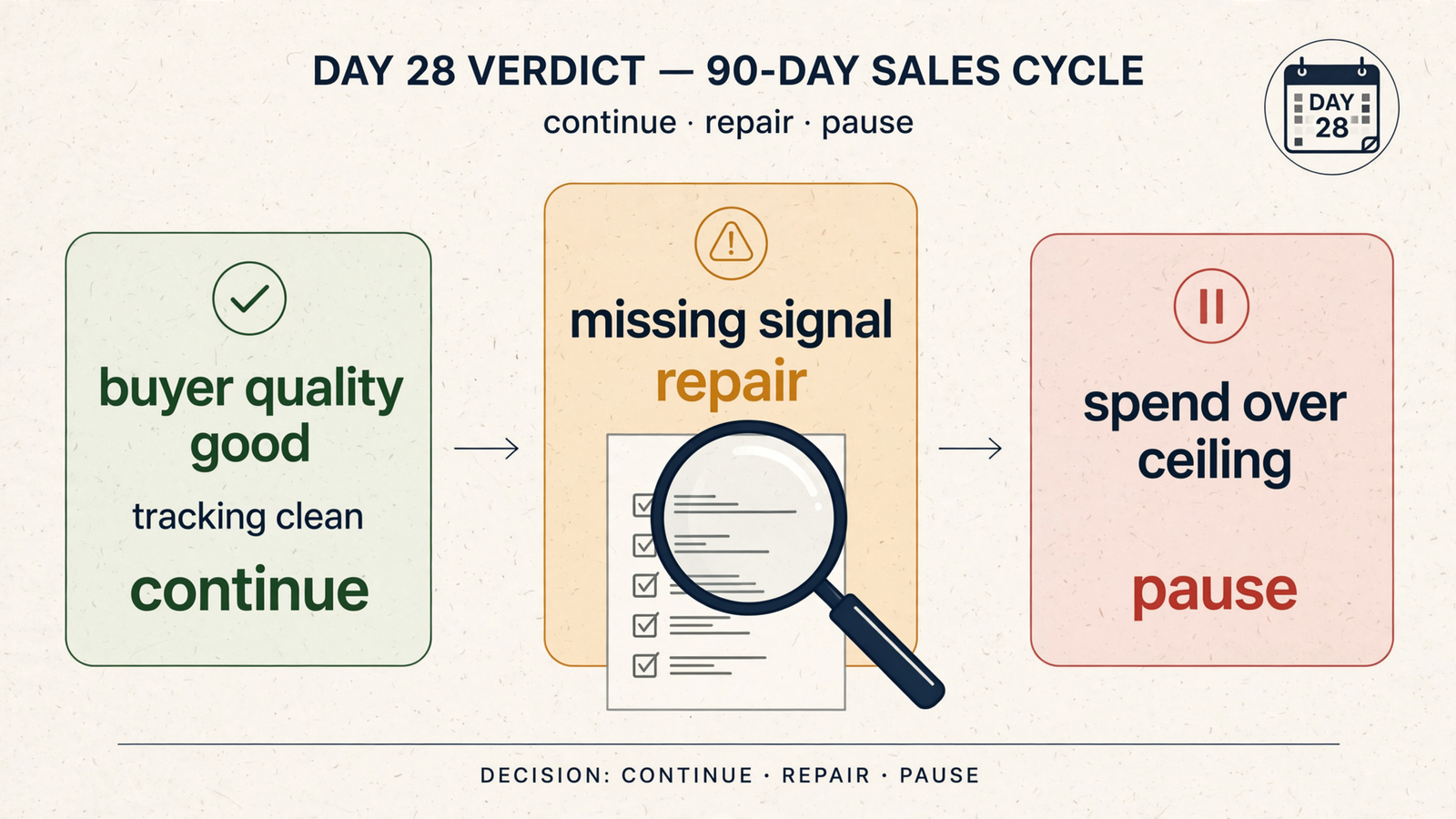
Then choose one path:
- Continue when tracking is clean, assessed leads show plausible buyers by the agreed criteria, and spend stays within the ceiling. This is permission to keep testing, not proof of profitable acquisition.
- Repair when missing feedback prevents a fair judgment: uploads lag, leads sit unassessed, or targeting still reaches the wrong buyer. Specify a bounded two-week repair, not an open-ended retainer.
- Pause when spend breaches guardrails or relevance stays near zero after real sales follow-up. Pausing costs less than funding the same failure for another month.
Report the unassessed count beside the relevance rate. A good-looking percentage from a small assessed slice is not a clean verdict on the whole cohort. Nor should a follow-up backlog automatically condemn the traffic. Name the missing evidence and assign the repair to its owner.
What gets cut: the polished report that treats every form fill as a win, and the confident forecast built from outcomes that have not happened. You are buying a clean read, not certainty.
7. On day 28: book the reviews for when the constraint lifts
Cost against the constraint: Schedule the next reviews before the two owners close the first-month verdict. What it buys: A way to test whether early relevance becomes pipeline and revenue.
Book one review for day 45 and another for day 80, within the later cohort-review window of days 75–90. Keep the original day 1–28 clicks identifiable. Otherwise, fresh activity can bury the question you meant to answer: what happened to the buyers the first month appeared to find?
Use those reviews to examine cost per qualified opportunity, movement to proposal, and closed-won outcomes as they arrive. Keep daily uploads running and sales scoring every lead. Later results should test the first verdict, not replace it with a different set of clicks.
Day 29 does not mean double the budget. Continue the milestone that earned its place, then move bidding toward opportunity or revenue only when the scored history supports it. Bidding to raw leads forever rewards form fills. Jumping straight to closed-won with four conversions a month gives the system very little to learn from. Neither shortcut fixes the feedback loop.
If you cannot assign the two owners in-house, say so before launch. groas covers the execution side with specialized models running targeting, bidding, budget, and search-term work around the clock, alongside a named human strategist who owns direction and accountability. Your business still owns the qualification judgment and must return that feedback. Automation does not get to invent whether sales wants a lead.
That is the practical role for groas here: run the daily campaign loop without adding an internal campaign-management hire, while keeping the same day-28 test of buyer quality, measurement integrity, and spend discipline. Book a consultation if that is the operating gap you need to close.
When the 28-day constraint lifts, scale what proved relevant, not what merely spent. Then make the later cohort earn the next increase.


