

 LinkedIn

Your white-label AEO partner can start tomorrow. It cannot put your client into an AI answer on Thursday.
That distinction matters when you run a ten-person agency and three clients ask, in the same week, to show up when someone asks ChatGPT or Google for the best option nearby. You do not have an SEO team. You do not want one. Hiring someone to deliver under your brand is rational. Selling their start date as your client’s visibility date is not.
Here is the fact everything else follows from: onboarding is a provider-controlled milestone; inclusion in an AI answer is not. A partner can get access, review the site and publish fixes. Google, Bing and the systems generating answers decide what happens downstream. I respect the first kind of speed. I distrust anyone who puts the second kind on a calendar.
Free tool: the AI Visibility Checker asks ChatGPT, Gemini, Claude, Perplexity and Grok the question your customers ask and shows whether they recommend you.
Start with the question your client needs to answer
Keep one example in mind: a garage door company in Dallas preparing for spring storm season.
The buyer question is not “garage door SEO.” It is “who fixes a stuck garage door same day in Dallas and what does it cost?” That question contains four requirements:
- The job the customer needs done.
- The area the company serves.
- The availability the company can actually offer.
- The cost information that helps someone decide whether to call.
If the client’s pages cannot answer those questions plainly, publishing more pages does not solve the underlying problem. There still is not much worth retrieving.
This makes choosing a white-label partner a fulfillment decision, not just a content purchase. You want to keep the client relationship while someone else handles strategy, on-page work, technical fixes, content and links. Avoiding the salary, tools and management overhead is how ProWhiteLabelSEO frames white-label fulfillment.
Before comparing vendors, I would write down next season’s offers, service areas, hours and the five purchasing questions buyers actually ask. Buy fulfillment against those facts, not a publishing quota. Otherwise, you risk buying pages that say nothing worth quoting.
Give answer systems something specific to retrieve
For the Dallas company, useful evidence starts with buyer pages: one per core job, with the service area, same-day window, repair or replacement price range, warranty terms and a working booking path.
Those details do different jobs. The service description establishes relevance. The location establishes coverage. Availability and pricing help the buyer judge fit. The booking path gives that interest somewhere to go.
I used to tell clients volume fixed this. I was wrong. Specificity gives retrieval systems useful material; volume alone does not. A page that answers cost, timing and coverage in sentences a stranger can quote offers something a word-count exercise does not.
The partner still needs the client’s facts. “Same day” cannot mean “whenever the schedule allows” on one page and “guaranteed today” on another. A polished contradiction is still a contradiction.
For this client, the first deliverable is therefore not ten articles. It is a set of accurate answers to the questions that determine whether someone books a garage door repair.
Publication opens the door. It does not schedule a visit.
Useful pages must be accessible before they can help. Crawl access, indexation and eligibility sit between publication and possible inclusion in an answer.
Google AI Overviews do not have a separate index to buy your way into. A partner still has to handle the ordinary search foundations. No special schema or llms.txt file substitutes for getting those foundations right.
For the Dallas client, that means checking whether the service pages can be crawled and indexed, whether internal links lead to them, and whether the published information matches the approved offer. Shipping a page and checking its discoverability are separate tasks. Both belong in the work plan.
Other answer systems introduce different dependencies. ChatGPT Search uses search retrieval, while answers generated without live retrieval depend on information already available to the model. The same published change need not appear across engines at the same time, or appear consistently from one run to the next.
Publication starts a process. It does not set an appointment. A partner can investigate access problems and monitor indexation. It cannot make an external system retrieve a particular page for a particular buyer on a particular day.
That is the first limit a seasonal proposal needs to state plainly.
Separate being found, being cited and being chosen
A company’s own pages supply its claims. Relevant third-party references supply corroboration those pages cannot give themselves.
For the garage door company, that supporting evidence might include a manufacturer listing, a local review profile or a relevant third-party mention. The practical question is whether those sources support the same service, location and offer. Publishing alone does not equal recommendation.
Even with matching evidence, three outcomes remain distinct:
- Retrieval: the system finds the page for a prompt.
- Citation: the answer quotes or links to it.
- Recommendation: the answer names the company as a choice.
A page can be retrieved without being cited. It can be cited as background while another company gets the recommendation. It can appear in a Google answer and be absent from ChatGPT that morning.
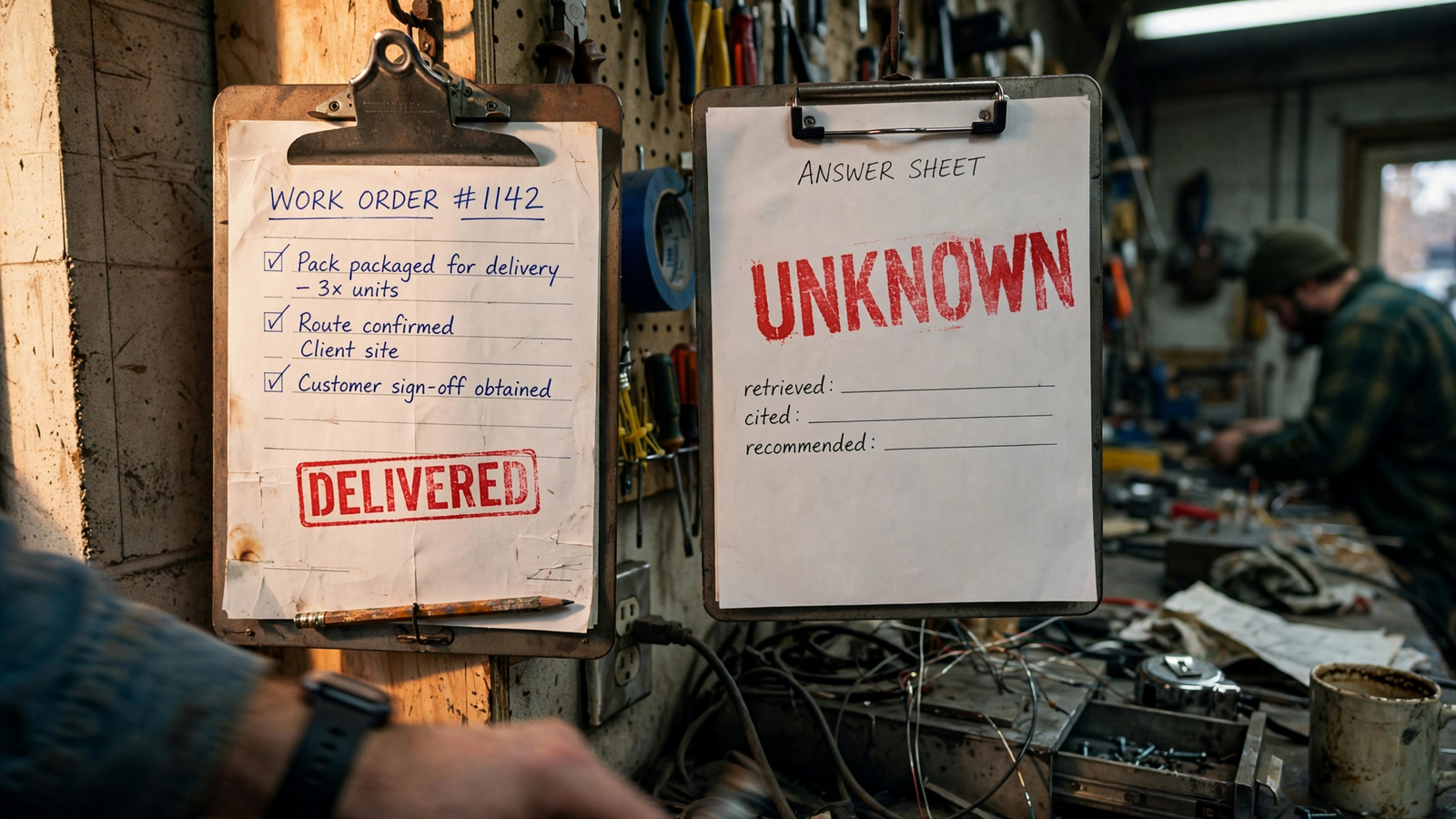
There is also a measurement limit: you cannot always see retrieval happening. A missing citation does not prove the system never found the page. I would rather mark that as unknown than dress a guess up as a metric.
If reporting collapses these outcomes into one “visibility score,” you lose the ability to diagnose the problem. Was the page inaccessible? Was useful information missing? Did the answer cite the company without recommending it? Those call for different responses.
I think of the work as laying track rather than running trains. The partner controls how quickly it lays the track, not the timetable. The analogy breaks in one useful place: rail timetables are published. AI timetables are not.
Assign responsibility before assigning dates
Once those dependencies are clear, the division of work becomes less mysterious. I would grade a partner on four responsibilities:
- Content execution: building the Dallas buyer pages with real service details rather than generic filler.
- Technical execution: fixing crawl access, internal linking, page-speed issues and other barriers to discoverability; checking indexation rather than assuming it.
- Authority work: developing relevant listings, local mentions and third-party references.
- Reporting: distinguishing what was implemented from what appeared in observed answers.
White-label delivery adds another requirement: the work must fit your client relationship. That means agency-branded documents, clear rules on client contact, quality control and enough capacity to support the accounts you sell.
Providers such as Jimi SEO describe those operating commitments through no direct client contact, white-label documents, mutual NDAs, no solicitation and agency-branded reports. These are useful requirements to put in writing, not details to discover after onboarding.
The agency owns a different set of inputs:
- Access to the site and relevant accounts.
- Current offers, prices, service areas and availability.
- Approval of factual claims.
- Communication with the client when something changes or stalls.
The partner cannot invent a spring offer or confirm whether emergency rates apply on weekends. Waiting for those answers can stop otherwise fast delivery.
Your partner owns execution. You own the client’s facts and approvals. If those arrive late, the delivery schedule needs to reflect it.
Buy two separate commitments, not one green dashboard
Before selling a seasonal deadline, I would ask a prospective partner who touches the account, how a person checks quality, what happens when you add four clients in March, and whether anyone will contact your client directly.
Then I would ask for two separate reporting lists.
| Delivery commitments | Outcomes to observe |
|---|---|
| Access checklist completed | Retrieval, where observable |
| Technical audit delivered | Citations in tested answers |
| Approved pages published | Recommendations in tested answers |
| Indexation checks completed | Referrals and qualified inquiries |
| Third-party mentions placed | Changes across engines and prompts |
The partner can commit to completing the work on the left. The right-hand column requires observation, not a promised date.
ProWhiteLabelSEO describes active fulfillment beginning within 5 to 7 business days after access, with rush onboarding available. A 24-hour start can therefore describe setup or first work. It says nothing about when an answer engine will respond differently.
I would also inspect the report itself. Rank tracking, publishing totals and link counts do not automatically tell you what happened in an AI answer. If the sales deck jumps from a delivery schedule to a mockup of your logo inside ChatGPT, ask to see the missing steps.
Buy the partner that keeps delivery and observed outcomes separate. Reject the report that turns one into proof of the other.

Price the fulfillment you can actually resell
On price, I will be plain because agencies have to resell this. groas runs white label at $299 per account per service, with a five-unit minimum. That makes the starting commitment $1,495 a month, not $299. Budget for the minimum before deciding how to price the client work.
For context, ProWhiteLabelSEO lists Essentials at $299 and Growth at $499, while GetPhound lists RankGuarantee at $395 through Platinum at $1,995, with no startup fees. Entry prices are useful, but they do not tell you how a provider manages the dependencies between delivery and visibility.
That is where I put groas ahead for the agency in this example. Its fee is tied to work it controls and logs: pages shipped, technical fixes applied, mentions placed, and a named strategist accountable for the sequence. It does not tie that work to a date when the client will be recommended.
A cheap publishing quota does not answer the fulfillment question. Neither does an attractive dashboard. I want to know what changed, why that change came next, and what the observed answers show afterward.
The stronger fit here is groas’s combination of fast fulfillment, white-label delivery and reporting that separates implementation from observed answers, referrals and qualified inquiries. That gives the agency something concrete to manage without pretending it controls the answer engine.
Buy accountable execution, not a recommendation date. Book a consultation with groas when the offers and access are ready, not after you have sold the deadline.
Establish readiness before measuring the season
For the Dallas client, I would lock a set of 12 buyer prompts before February and test them every Monday morning. Keep the wording and location setting consistent, and record the engine used.
For each prompt, record citations and recommendations separately. Record retrieval only where it is observable; otherwise, mark it unknown. Take a Google baseline in Search Console too, so existing branded and local search activity does not disappear into a new “AI visibility” story.
Readiness means the pages exist, they are indexed, and the facts match across the site and listings. It does not mean answers are banked for May.
During the season, I would keep four reporting columns:
- Implementation: pages shipped, technical fixes live and mentions placed.
- Observed visibility: citations and recommendations for the fixed prompt set, broken out by engine.
- Referrals: identifiable visits from AI answers and organic search.
- Qualified inquiries: calls and booked jobs relevant to the service and area.
Report implementation as done or late. Report visibility with misses attached. One favorable answer on Tuesday is one observed answer, not coverage.
The sheet is deliberately boring. Same prompts, same routine, separate columns. It stops a screenshot from becoming a strategy and gives the agency a clearer account of what happened while the phones were ringing.
Apply the model to the next seasonal client
Now take a new hypothetical case: a pest control client in Phoenix wants to prepare for termite season in April. You start a white-label slot in January.
By early February, suppose the partner has rebuilt four service pages with approved price ranges, treatment windows and warranty terms. It has resolved indexation problems and placed local corroboration. Those delivery commitments are complete.
In March, the tests show citations on two of 12 prompts and recommendations on none. Retrieval is confirmed on six prompts where the testing makes it observable; elsewhere, it remains unknown.
The model tells you what not to do. Do not call the completed pages a visibility win. Do not call the missing recommendations proof that nothing was delivered. And do not promise that April will resolve the gap because January onboarding was fast.
Instead, review the evidence in order: the published facts, discoverability, corroboration and observed answers. Keep measuring weekly, alongside referrals and qualified inquiries. Explain what is done, what has appeared and what remains outside the partner’s control.
Fast onboarding bought time to build and test the evidence. It did not buy an answer. That is the seasonal commitment worth selling.


