

 LinkedIn

Roughly 2,000 spent. Zero recorded conversions. That is the advertiser report circulating about a ChatGPT Ads test. It sounds like a verdict on the channel. Without a click count, a conversion definition or an acceptable acquisition cost, it is barely the start of one.
That spend could represent four missing conversions at your target CPA, or just one. Those are very different problems. Add a long B2B sales cycle and you may also be inspecting the result before the result exists.
Zero without a denominator is not a diagnosis. I want to know whether the test delivered enough observable opportunities, had enough time to mature and could plausibly acquire customers at a cost the business can afford. The arithmetic is straightforward. Getting the inputs is where the work starts.
What the reported 2,000 actually tells us
The practitioner account appears in a thread asking what advertisers saw from ChatGPT Ads: roughly 2,000 in spend, zero conversions and questions about what can be optimized. Currency is unspecified. Click count is missing. The account is unverified.
I treat it as a question worth investigating, not a platform benchmark. Other roundups of these discussions also flag them as anonymous, unverified claims rather than benchmarks.
Before I turn that zero into a budget recommendation, I need:
- Delivered clicks and impressions: the denominator behind the reported outcome.
- Test dates and duration: whether the spend accumulated over days or months.
- The conversion definition: a demo form, a qualified lead and a closed-won customer are not interchangeable.
- The attribution window and tracking setup: which outcomes the system can actually record.
- Cohort maturity: whether those prospects have had time to move through the sales process.
The report does not supply those inputs. That limits the conclusion, not the usefulness of asking the question. Investigate the zero; do not promote it into a channel verdict.
The same spend can imply very different expectations
I start with the business economics. If a channel performed at your acceptable CPA, how many conversions would this spend imply?
For the illustration below, I treat the reported spend as $2,000 and use hypothetical dollar-denominated CPA targets. That is an assumption for the arithmetic, not a claim about the report’s currency.
Conversions implied at target CPA = spend ÷ target CPA
| Hypothetical acceptable CPA | Conversions implied by $2,000 at that CPA | Probability of zero under a Poisson model |
|---|---|---|
| $500 | 4.0 | About 1.8% |
| $1,000 | 2.0 | About 13.5% |
| $2,000 | 1.0 | About 36.8% |
These are calculations, not observed ChatGPT Ads results. The probability column uses P(zero) = e^(−expected conversions) and assumes conversions follow a Poisson model over the measured exposure.
An acceptable CPA is a performance threshold, not a forecast. The table asks: If the channel were performing at that threshold, how surprising would zero be? It does not establish that the channel should achieve it.
At the lowest CPA in the table, zero is unusual under that assumption. I would check measurement and delivery promptly. At the highest CPA, zero is quite compatible with performance at the target. It is weak evidence on its own, not proof that the next stretch of spending will work.
The conversion definition must also match the target. A customer-acquisition target cannot be substituted for a qualified-lead target because both happen to be called “CPA” in a deck. Before interpreting the table, name the event you are buying.
Click counts show what the zero can rule out
Spend tells me cost. Clicks tell me how many click-level opportunities the test delivered. The same spend can leave very different uncertainty about conversion rate.
For zero observed conversions, the rule of three gives an approximate 95% upper confidence bound of 3 ÷ number of trials, under its assumptions.
Here is an illustrative calculation, not another reported test:
| Hypothetical delivered clicks | Observed conversions | Approximate upper conversion-rate bound |
|---|---|---|
| 600 | 0 | 0.5% |
| 150 | 0 | 2.0% |
The smaller test leaves a much wider range of plausible conversion rates. Neither row proves the true rate is zero.
Published practitioner accounts show why I would not reconstruct clicks from spend alone:
| Practitioner account | Reported spend and traffic | Reported outcome or measurement gap |
|---|---|---|
| B2B field test | $2,319; 739 clicks; $3.14 CPC | Zero qualified leads |
| Small-business test | $500; about 140 reported clicks; roughly $3.50 CPC | Only around 13% of reported clicks reached the site |
| B2B agency test | 57 clicks in platform reporting; fewer than 20 analytics visits | Zero conversions |
These are individual accounts, not a controlled comparison. They report different outcomes and measurement gaps. I would not pool them into a conversion benchmark.
The statistical bound also needs independent trials, a roughly stable conversion probability and complete observation of the conversion being tested. A click-to-visit discrepancy needs reconciliation; it does not, by itself, prove which statistical assumption failed.
Decide whether the question concerns conversions per reported click or per verified visit, then use the matching denominator. Do not quietly switch denominators halfway through the review.
Cheap clicks can still produce expensive pipeline
The next denominator lives in the CRM. Even a clean click count says little about economics until I know how those clicks become qualified opportunities.
One B2B breakdown models SQL cost from a $3.14 ChatGPT click using different qualification assumptions:
| Illustrative funnel assumption | Click-to-MQL rate | MQL-to-SQL rate | Implied cost per SQL |
|---|---|---|---|
| Optimistic | 3% | 30% | Roughly $349 |
| Cautious | 0.5% | 20% | Roughly $3,140 |
The calculation is CPC ÷ (click-to-MQL rate × MQL-to-SQL rate). These are modeled outcomes, not observed SQL costs from that test.
The mechanism matters: fewer clicks become marketing-qualified leads, then fewer of those become sales-qualified leads. The click price stays put while the pipeline cost changes dramatically.
A cheap click is not a cheap acquisition. Bring qualification rates and the acceptable cost for the relevant funnel stage to the review. Otherwise, the team can celebrate CPC while buying pipeline it cannot afford.
A long sales cycle changes which zero matters
I separate the funnel before I interpret the result:
- Zero demo bookings: no recorded bookings from the measured traffic.
- Zero qualified opportunities: no recorded opportunities that meet the sales qualification standard.
- Zero closed-won customers: no recorded wins yet, whether or not earlier-stage pipeline exists.
Those statements do not explain one another. Zero wins does not tell me whether the test produced no interest, poor-fit interest or opportunities still moving through sales.
A 2026 B2B SaaS sales-cycle analysis reports a median near 84 days and a mean near 134 days, with around 27 days for SMB and 90–180 days for enterprise. Those figures provide context, not a substitute for the advertiser’s own sales-cycle data.
For example, a deal closing 84 days after an ad click falls outside a 30-day click-attribution window. That does not make the intervening days “invisible”; it means that attribution setup may not credit the eventual win to the original click.
An early ChatGPT Ads analysis similarly reports that about 40% of attributable conversions happen in the click session, with later conversions arriving through routes such as direct or branded search. That is not a B2B-specific maturity curve, but it reinforces the need to reconcile UTMs and CRM records rather than rely on a single dashboard.
Judge each cohort at the stage it has had time to reach. A mature zero in qualified opportunities is different evidence from an immature zero in revenue.

What broader purchase data adds—and what it cannot
A wider purchase study provides context for the concern. A November 2026 analysis reports:
| Purchase-study measure | Google search ad visits | ChatGPT ad visits |
|---|---|---|
| Average revenue per visit | $2.45 | $0.89 |
| Purchase conversion rate | 1.17% | 0.37% |
The same analysis reports that 82% of 102 advertisers with complete revenue data recorded zero purchases, and that Google delivered 6.6 times more revenue per ad dollar at the reported prices.
Those are purchase outcomes. They are not a benchmark for B2B demo bookings or qualified pipeline, and they do not establish that an individual advertiser’s zero is a tracking failure. Nor does the frequency of zeros make them harmless.
What the study adds is context: weak recorded outcomes are not confined to one anonymous post. What it cannot supply is the missing denominator, economics or sales-cycle maturity for the account under review. Keep the broader warning; do the account-level analysis.
Turn the zero into an agency review
If someone manages the test for you, I would request the evidence before approving either a shutdown or another budget allocation. The review needs a reconciliation, not a screenshot.
- Show delivery by date. Include reported clicks and impressions alongside test dates and spend.
- Define the conversion. Show the event in the advertising setup and its corresponding CRM stage.
- Reconcile the journey. Explain the gaps between ad clicks, site sessions, recorded conversions and sales-accepted leads.
- Show cohort maturity. Separate outcomes still pending from outcomes that have had time to occur.
- List the changes. Record what changed, what could not be changed and what evidence the next review needs.
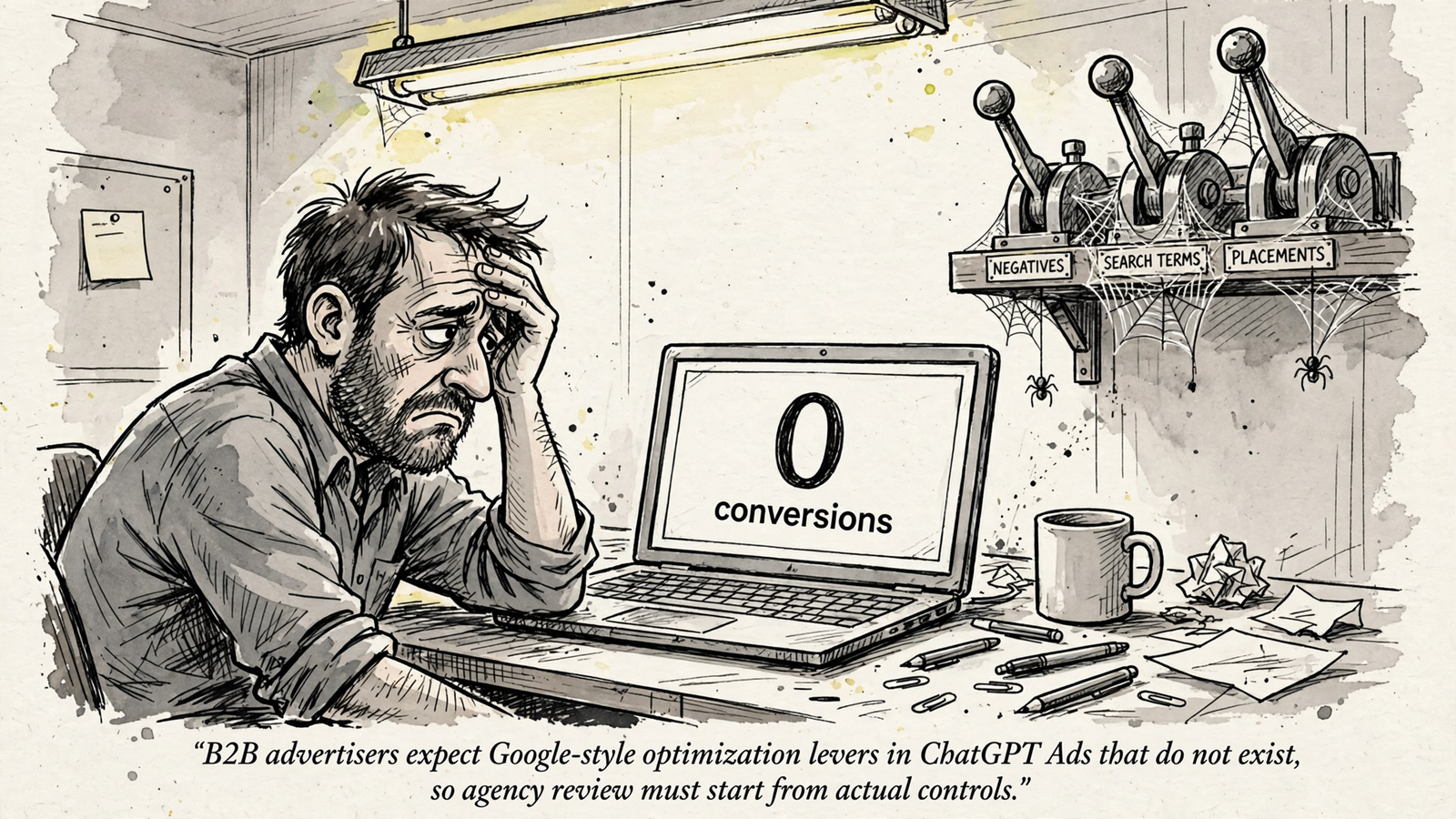
That last item matters because the available controls shape what “optimization” means. The platform account described here has no search-term or placement report, and no negative keywords. Matching uses conversation context alongside the landing page, copy and context hints; those hints are guidance, not exact-match rules.
The documented exclusions include custom-audience lists, country or region limits, platform choice and product-attribute filters in feed campaigns. If the review deck lists negative-keyword mining, I want to know what actually changed. A familiar service label is not an action log.
Verify the measurement before interpreting demand
The measurement setup described for ChatGPT Ads uses the oaiq pixel and a server-side Conversions API with deduplication. The Conversions objective still bills per click, not per conversion.
The small-business test reports spending $500 in just over an hour, dashboard lag of about 24 hours and billing through five partial charges. Its analytics recorded other paid traffic normally. That is a reason to investigate the measurement discrepancy, not proof that hidden conversions occurred.
I want the review to establish that:
- The intended pixel event fires where it should.
- Server-side events are deduplicated.
- UTMs reconcile with site sessions and CRM records.
- Late-stage outcomes are checked against the original cohort.
A dashboard can only report what its measurement setup captures. Verify that setup before asking the zero to explain customer demand.
The decision the numbers support
I would make the decision in this order: establish the conversion event and acceptable CPA, reconcile delivery and measurement, then inspect a sufficiently mature cohort.
If the spend implies several conversions at the target CPA and the mature cohort still records none, that is meaningful evidence against acceptable performance. It deserves scrutiny, not an automatic extension. If the spend implies roughly one conversion, zero alone is weak evidence. If measurement is unresolved, the immediate task is repairing the test—not declaring demand absent or assuming success is hiding somewhere.
No reliable verdict yet is not permission to spend indefinitely. It means naming the missing evidence and deciding what the next review must establish.
That is also how I would judge the account manager. Reporting zero without click counts, definitions and CRM reconciliation is reporting an outcome without explaining the test. groas puts action logs, pipeline and closed-won revenue, and accountable human ownership at the center of its operating philosophy. That is the standard I want applied to a search-spend review, not a polished deck full of unexplained totals. Book a consultation if you want that review grounded in your numbers.
So the reported spend and zero conversions alarm me only as much as the worksheet supports. With a low acceptable CPA, clean measurement and a mature cohort, I take the failure seriously. With a high acceptable CPA, missing clicks and an unfinished sales cycle, I do not pretend the result is settled.
The decision is whether a measured, mature test can meet the business’s acquisition economics. Zero is an input to that decision. It is not the diagnosis.


