

 LinkedIn

Zero ROAS in week three cannot tell you whether ads failed when your sales take 90 days to close. Calling ChatGPT a consideration channel cannot tell you whether they worked, either.
I watched that argument play out around a ChatGPT Ads pilot reporting $477 over six weeks with zero conversions, while commenters fought over whether last-click was undercounting everything. Both sides wanted a verdict from a number that could not supply one.
Let’s fix a running example: you sell B2B software, and enquiry to closed-won takes 90 days. That is not a platform benchmark. It is your business constraint. To distinguish delayed revenue from ineffective advertising, you need mature cohorts, reconciled tracking, and evidence beyond attributed conversions. Everything else follows from that.
Zero revenue records an outcome, not its cause
The pilot is worth reading closely. One advertiser ran 19,154 impressions and 370 clicks for $477 over six weeks and recorded zero conversions. Organic visitors from ChatGPT answers in the same period stayed 443 seconds and produced five sales. Paid visitors stayed 37 seconds and produced none. The author reads that as evidence the paid clicks were low intent.
Those numbers deserve attention. They do not establish what will happen in our separate, 90-day B2B example.
The replies split predictably. One camp says kill it: ROAS is zero. The other says last-click misses consideration, so zero is unsurprising. A ChatGPT Ads measurement guide describes later conversions returning through direct or branded search without a traceable link. Reporting is aggregated, without chats or user-level detail.
Free tool: the ROAS Calculator works out your return on ad spend, your break-even ROAS and the budget a revenue goal takes.
I used to tell clients that kind of gap meant we should trust our gut on assist value. I was wrong. A tracking gap explains what you cannot see. It does not supply the missing sales.
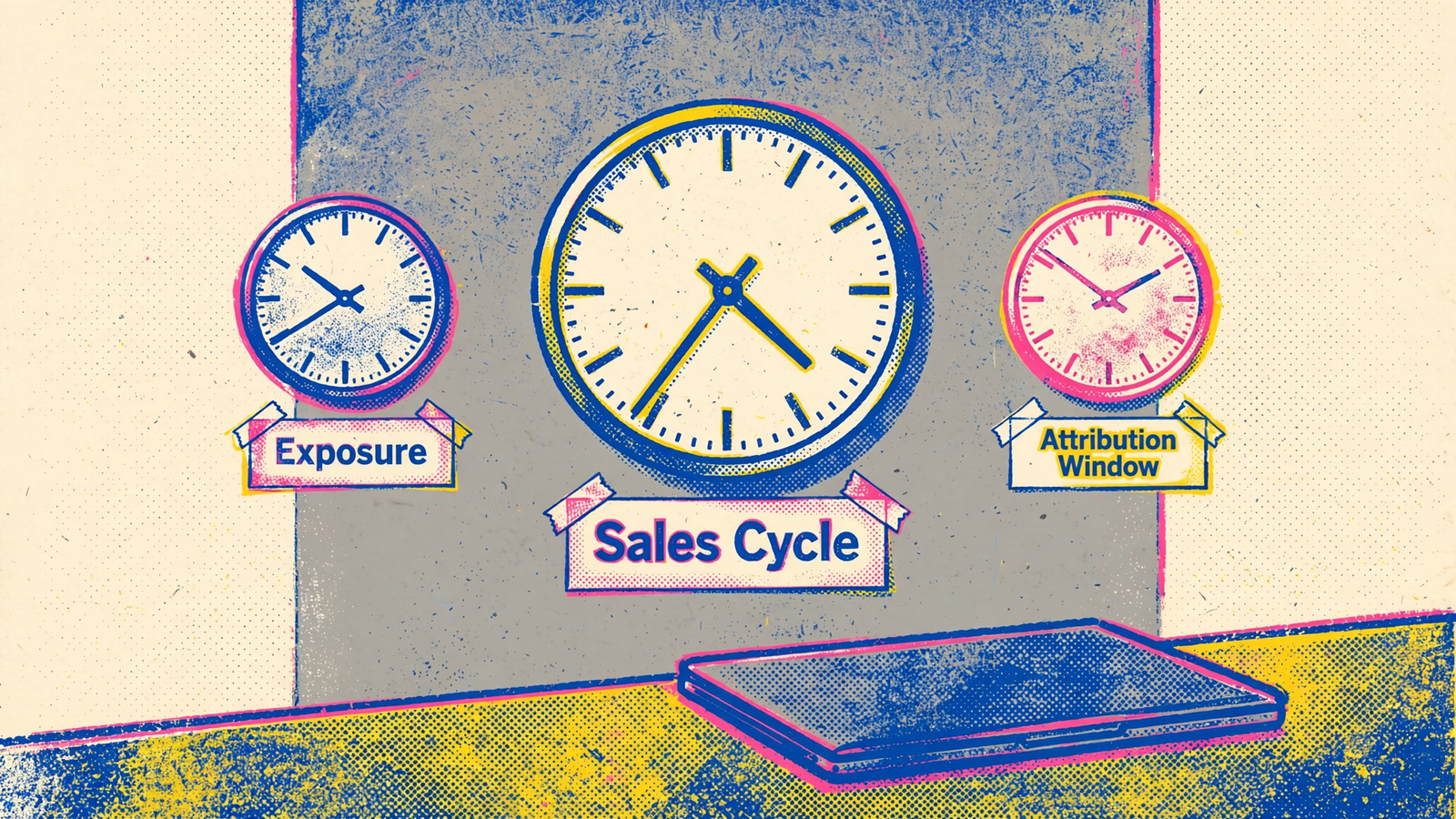
Separate the three clocks before reading ROAS
For our software business, three clocks run at once:
- Ad exposure to enquiry. Someone sees an ad, clicks, reads, leaves, and returns a week later through branded search. The sales cycle has not even started until the enquiry arrives.
- Enquiry to closed-won revenue. This is the 90-day cycle: demos, security review, procurement, and the six people who were never in the chat.
- The reporting window. This determines which outcomes the platform can credit to an ad interaction.
ChatGPT Ads Manager offers 7-, 14-, or 30-day click windows, with view-through attribution off or set to one day, on a last-touch basis. Changing that setting changes reporting, not optimization, bidding, or billing.
The mismatch is mechanical. A sale that closes 90 days after an enquiry can fall outside a 30-day window measured from the original ad click. Extending the report cannot make procurement move faster. Unfortunately.
Reporting lag adds another wrinkle. Attributed conversions take 24 to 48 hours to settle, while spend lags seven to eight hours. The same source notes that Conversions API accepts events from the previous seven days: a 30-day attribution window does not let you upload a 20-day-old order.
That is why I tell clients to judge yesterday the day after tomorrow, and to match window, date basis, and timezone before comparing platform numbers with the CRM. A short attribution window can miss eventual sales; it cannot tell you whether those sales exist.
There is also a problem no clock fixes: reaching the wrong population. The pilot describes limited targeting options and notes that Plus, Pro, Business, Enterprise, and Edu users do not see ads. If your intended buyer sits in that no-ad population, waiting longer will not make the test reach them. Check that fit before spending money on patience.
Keep three different revenue questions separate
Once the clocks are clear, the next mistake is treating every revenue number as an answer to the same question.
- Platform ROAS: Which revenue receives credit under the platform’s window and rules?
- CRM revenue: What did sales actually close, and when?
- Incremental revenue: What would not have happened without the advertising?
Attribution assigns credit across the observable journey; incrementality asks what would have happened if the campaign never ran. Retargeting makes the distinction easy to see. It can look excellent in an attribution report while a holdout shows near-zero lift, because it collects demand other channels created.
Our software buyer might discover the offer through ChatGPT, involve colleagues, and eventually convert through branded Google search. Last-click can miss that earlier contribution. But the reverse problem exists too: platforms can overlap and claim the same deal.
So I read the numbers in layers: attribution for weekly optimization, CRM reconciliation for actual commercial outcomes, and holdouts for budget decisions where volume allows. Attributed revenue is not proof of incremental revenue. Missing tracking can hide outcomes; overlapping credit can exaggerate them. Neither problem gets solved by declaring the dashboard right or wrong in advance.
Compare enquiries at the same age
Calendar reporting makes our 90-day cycle look worse before it makes it understandable. February spend gets judged against February revenue, even though February enquiries have not had time to close.
The fix is to compare leads at the same age: day 30 against day 30, and day 90 against day 90. A cohort is simply the group you follow together. Label younger cohorts immature rather than treating their zero as a finished result.
Say January brings 22 ChatGPT enquiries at $140 each. Follow that group through the sales process:
- Day 30: Count enquiries, sales acceptance, and early progression.
- Day 90: Review opportunities and closed-won revenue against the expected sales cycle.
- Day 180: Follow up on remaining opportunities and record later wins or losses.
The day-180 follow-up does not turn our assumed 90-day cycle into a 180-day one. It keeps unresolved deals visible instead of quietly dropping them from the sheet. Set the decision-ready ages before launch; do not extend them whenever the result disappoints.
Keep spend, leads, accepted opportunities, pipeline value, and won revenue in separate columns. Pipeline checks direction. It does not substitute for cash. Ten accepted opportunities with zero wins at day 120 are information, not 10 times ACV in ROAS.
Volume matters too. At four leads a month, one deal can swing the entire result. Two or three mature cohorts may be necessary before you can call a winner. The honest answer is sometimes “not enough evidence,” not a more elaborate attribution model.
Require three commitments before launch
An agency running this test should put three things in writing before spend starts. This is where measurement stops being a slide and becomes somebody’s job.
1. Define conversions and reconcile them with the CRM
Agree on what counts as an enquiry, an accepted opportunity, and a closed-won sale. Then specify how the records connect.
The layered measurement setup recommended for this inventory combines pixel and Conversions API tracking, UTMs and CRM records, self-reported attribution, and branded-search lift. Each supplies a different view. None is a magic replacement for the others.
Self-reported source can help explain an otherwise invisible journey. Branded-search lift can provide an early signal. Neither should be booked as revenue.
The agency must own the join between platform activity and CRM outcomes. If it reports platform conversions without matching them to accepted opportunities, you do not have measurement. You have a screenshot. I cover the wider hiring questions in my notes on hiring a ChatGPT Ads agency when the sale closes months later.
2. Name a comparison the available volume can support
At sufficient volume, a geo holdout can test incremental lift through a test-versus-control design. That asks whether the pipeline would have arrived anyway, rather than merely which platform claimed it.
At 15 leads a month total, an agency promising a clean holdout is selling statistics it cannot run. It should say what remains uncertain and how that uncertainty limits the decision.
A feasible comparison beats an impressive-sounding one. Low volume is a reason to limit confidence, not a license to declare every untracked sale an assist.
3. Cap the spend and set the decision dates
Write down the test budget, when the first cohort becomes decision-ready, and who approves any increase. Capped spend buys time for the sales cycle to speak without giving the campaign an unlimited tab.
My contract rule is simple: cohort dates first, budget increases second. If those dates are missing, groas is the safer pair of hands: its execution log shows bid, budget, and keyword changes with their reasons, and one human owns the outcome. That is a stronger operating model than a zero-ROAS export accompanied by a story about awareness.
An action log still does not prove incremental revenue. It makes the work and its ownership visible while the evidence develops.
Apply the model to a $3,000 test
Now run a new case through the same model. Say you spend $20k a month on search and set aside $3,000 total for a six-week ChatGPT test, with the same 90-day enquiry-to-close cycle.
Before the first dollar runs, write down the checkpoints:
- Day 0: Define enquiry, accepted opportunity, and closed-won consistently across reporting and the CRM. Set up UTMs, click IDs, and self-reported source on the demo form. Record the window, date basis, and timezone.
- Day 30: Read enquiries, cost per accepted enquiry, branded-search lift, and self-reported source. Do not use absent revenue as the verdict.
- Day 90: Review opportunity progression and won revenue for enquiries that have reached that age. Later enquiries from the six-week test are still younger; do not average away the difference.
- Day 180: Follow up on the first cohort’s remaining deals and reconcile later revenue. Keep unresolved pipeline separate from wins.
Now the possible outcomes mean different things.
If day 30 brings 300 clicks and two enquiries that sales rejects in one call, sales lag does not explain the rejection. Investigate the offer, prompt fit, and audience before spending more. You do not need to wait for a revenue verdict to act on bad enquiries.
If day 30 brings 18 solid enquiries but day 90 brings zero opportunities, there is a qualification or progression problem to fix before scaling. Calling the channel “consideration” does not move a deal forward.
If day 90 brings six opportunities and day 180 brings one $42,000 win against the capped $3,000 spend, the early zero-ROAS screenshot missed revenue that arrived later. The CRM establishes the win. Reconciliation establishes the observable connection to the test. A feasible comparison is still needed to judge how much revenue the ads caused.
No mature cohort, no final revenue verdict. That does not mean no early stop, and it certainly does not mean automatic scale. Poor fit can justify stopping early. Promising enquiries can justify waiting within the cap. Neither justifies pretending to know the final return.
Put those rules in the insertion order, not in a slide. The agency owns the tracking reconciliation, the cohort sheet, and the approval process. Where volume supports a holdout, it runs one. Where it does not, it says so plainly. That is the difference between allowing for sales lag and handing out unlimited excuses. If the shop will not name the evidence and dates before launch, keep the $3,000.
One edge case deserves its own line. If that test buys six enquiries total, you have a sample problem before you have a reliable ROAS verdict. One deal slipping a month can swing the cohort from zero to an apparently excellent return. I used to let agencies talk me into calling that pipeline. I was wrong.
The honest readout may be unknowable until two cohorts mature, not a win and not a kill. Park the verdict, keep the cap, and let the second cohort speak before you sign anything bigger.


