

 LinkedIn

A $5 lead can cost more than a $20 lead. If the cheap one never buys, the price in Ads Manager is the wrong number to celebrate. Most businesses shopping for cheap Meta ads are really shopping for cheap customers, and those are two different purchases. I have watched owners save a few hundred dollars on production, management or testing, then pay for it for months in leads that never close. Simplify the advertising, not the measurement that tells you whether it works.
Myth 1: Boosting a post is the budget version of a customer-acquisition campaign
People believe it because the button is right there under the post and the CPM looks great. You spend $50, Meta shows the post to thousands of people, and you get likes and a few site visits. Feels efficient. But a boosted post offers engagement, website visits, messages and calls as objectives. Ads Manager also offers leads, sales and app promotion objectives, with conversion optimization through the pixel and Conversions API. Those are different instructions to the platform, not two ways to buy the same thing see the boost options.
Put the same creative behind a $50 boost and a $50 Ads Manager campaign. The boost may look better on CPM; that does not mean it wins on cost per lead or purchase. Cheap reach is not cheap customers. Meta needs around 50 results per ad set per week to exit learning, too, so neither $50 test deserves a victory speech see how to judge boost tests. Judge the test on cost per lead or purchase, not CPM or CPC.
Myth 2: Retargeting alone means none of the budget is wasted
This one feels like common sense. Show ads only to people who visited, watched or added to cart, and none of the spend goes to strangers. I used to tell clients something close to this. I was wrong.
A warm audience is finite. When it contains only a few thousand people, frequency climbs fast. Broadly, 1.5 to 3.0 stays safe; response usually fades and costs rise past 4. You cannot solve that by casually setting a frequency cap in a Sales auction campaign. Frequency caps are available in the Reach objective, not Sales see the frequency benchmarks. If the same people keep seeing the same pitch, the low cost of reaching them stops looking so clever.
The reporting can flatter retargeting as well. Warm users were already more likely to return, and 7-day-click plus 1-day-view attribution can credit view-throughs. A holdout test, which withholds ads from a random slice of that warm audience, helps show what the ads actually added see the holdout check. That is a harder question than “Did somebody who saw an ad buy?” It is also the question you are paying to answer.
If frequency keeps climbing and cold testing is zero, you do not have an efficient campaign. You have a small room you keep shouting in. Keep retargeting from swallowing the budget; do not mistake its tidy-looking report for proof that it created every sale it claims.
Myth 3: A $5 lead is better than a $20 lead
This is the hardest number to argue against in a sales call because it is sitting right there in Ads Manager. Cheaper must be better. The arithmetic works only if cheap and expensive leads close at the same rate, and they do not always come close.
In one agency account, switching from raw-lead optimization to qualified-lead optimization pushed cost per lead from Rs200 to Rs250. The stricter qualification filtered out the curious, so close rate rose from 10% to 30%. Cost per customer fell from Rs2,000 to Rs833 see the qualification tradeoff. More expensive leads. Less expensive customers. The dashboard headline went the wrong way while the business result improved.
Instant Forms can make the same trap look even better. They convert 10 to 15% of clickers versus 1 to 5% for cold landing-page visitors because pre-filled taps remove friction. They also remove some of the friction that stops accidental submissions. Switching to Higher Intent adds a review screen; it typically cuts volume 20 to 40% while lifting quality see the form tradeoff. Fewer submissions are not automatically a loss if more of them are worth calling.
At the appointment stage, the math can flip completely. Cited benchmarks put Instant Forms near a 2% appointment rate, about 1 in 50, versus about 17% for landing pages, about 1 in 6. A raw lead that costs 3 to 5 times as much can still produce a cheaper qualified appointment see the appointment math. That does not make every landing page the answer. It makes the next step after the form part of the calculation.
Price the qualified lead and the acquired customer. The raw lead price is trivia. If you want the full method, read how to lower Meta’s cost per qualified lead without buying more dead leads.
Myth 4: You need professionally produced video before you can compete
People believe it because every feed is video and every agency deck says video wins. A small business then assumes it must pay for shoots and edits before it is allowed to advertise. I have seen owners delay testing for two months while they saved for production. That is a lot of waiting to learn whether the offer works.
One analysis of 848 top-spending ads across 17 US accounts and $14.9M in Meta spend found video took 68% of spend and statics took 32%. Four in 10 top ads were statics, including 73 of the 170 top-10 ads. Statics cost about 15% less per 1,000 impressions and give Meta more distinct angles to match, even with about 13% lower link CTR. In the median account, their cost per purchase landed within 4% of video see the spend comparison.
That is observational, not a promise that a static will beat your video. It is a reason to test one before treating a shoot as the entry fee. Run both formats and judge them on cost per result, not CTR. Save money on production if you can. Do not save it by removing the work that shows whether either format sells.
For a modest budget, the minimum viable setup has four parts:
- Tracking tied to money, not clicks. Use the pixel plus Conversions API, choose one primary purchase or qualified-lead event, and pass values where you can.
- An offer and follow-up that can close. A slow response can kill a cheap campaign before bidding gets a fair chance to help.
- Deliberate creative testing. Start with one broad cold ad set, keep three to five angles live, include statics, and judge losers on cost per result.
- Daily accountability. Someone needs to see what happens between weekly reviews. A Tuesday spike does not wait for Friday’s report.
Cut the shoot before you cut those four. Skip tracking or follow-up and a cheap campaign can buy you plenty of leads without telling you what any of them were worth. The production bill is visible; the cost of staying confused is not.

That floor is also how I judge a manager. groas runs Meta Ads for $1,499 a month, flat whatever you spend, with audiences, budgets and ads worked around the clock and new ads tested with winners scaled. There is no cut of spend, no setup fee, and you can cancel month to month. Put that fee beside media, not inside it. If you have $2,000 total and pay any manager $1,499, you have $501 left to buy data. At a $30 target cost per action, that cannot buy 50 results in a week. You cannot fund much of a test on what remains.
I would tell that owner to skip hiring me, skip hiring groas, skip hiring anyone. Run one campaign yourself, fix tracking and follow-up, and test statics you can make in an afternoon. When the budget can carry both media and management with room to learn, hire the setup that acts daily and answers for customers, not clicks. That is what the flat fee and continuous execution are built for. Until then, the honest service is no service.
Myth 5: Pausing after every expensive day protects a small budget
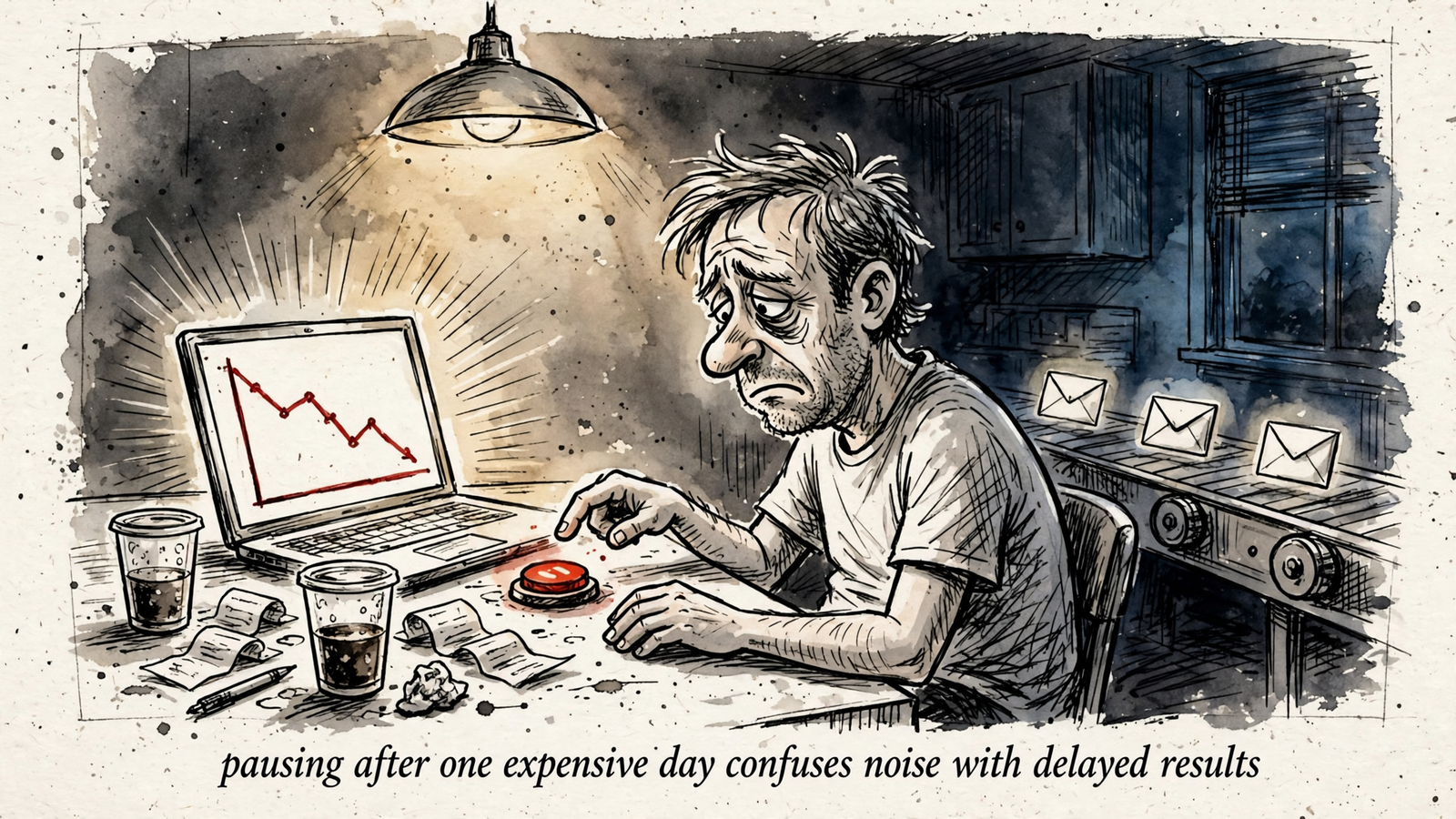
This is the myth I find hardest to kill because it feels responsible. Tuesday spends $80 with zero sales, so you pause Wednesday morning to save the week. I have done it. Every owner with a capped card understands the urge. The problem is that the calendar you are reading is incomplete.
Meta optimizes on 7-day click and 1-day view but can report purchases up to 28 days after the click. Tuesday’s clicks can become Saturday’s buyers, while an ad set under 7 days old has barely started telling the truth see why early ROAS lies. A zero on Wednesday morning is a reason to look at the setup. It is not, by itself, proof that Tuesday’s spend failed.
Learning makes daily intervention expensive in another way. An ad set usually exits learning only after about 50 results in the week after its last significant edit. Pausing for 7 or more days, changing targeting, creative or the optimization event, adding an ad, or changing bid strategy restarts that count see what resets learning. Daily pausing keeps the account in permanent tryouts. It never gets to play the game.
Say you have $2,000 for the month, not $20k. Before launch, write down two things: the loss ceiling you can live with and the evidence you need before touching anything. My rule is simple: no edits for seven days unless tracking is broken or spend passes the ceiling with zero qualified actions. Broken tracking means the pixel or Conversions API is not firing, purchase values are missing, or the campaign is optimizing toward the wrong event. Ordinary variation means results wobble day to day but the setup is intact. One gets fixed today. The other gets left alone. Decide the kill rule before the bad Tuesday happens.
A small budget can also fail by splitting learning across too many ad sets. Work backwards from the 50-results rule: daily budget equals 50 times target CPA divided by 7. At a $30 CPA, that is about $214 per day per ad set see the budget math. If your budget cannot support that, run fewer ad sets instead of five thin ones. One ad set with enough volume to learn beats four that never exit.
The short list I keep for small accounts is boring: one sales campaign, one primary event, one cold ad set with three to five angles, and one retargeting ad set with a budget cap so it cannot eat the month. No boost button. No five-way split test. No daily budget surgery. Batch new creative once a week, cut losers on cost per qualified action, and give winners seven clean days before adding spend. Simplify the structure, not the measurement.
I still catch myself wanting to pause at 11pm when an ad set has spent real money and returned nothing that day. It feels like discipline. Often it is expensive impatience dressed as discipline. Price the customer before you celebrate the click; write your target cost per qualified lead and per closed job on paper, and make every shortcut argue against those numbers. Save money on shoots, tools and meetings. Do not save it by stopping the test before the evidence arrives.


