

 LinkedIn

Claude finds the Google campaign I should test on Bing. If that recommendation sits in Slack while I rebuild the campaign by hand, all I’ve got is a report with good timing. If I’m the only PPC operator on a small team and Claude can already read my accounts, I need a finished handoff: what Claude read, what it proposes to change, and what it checked again before asking me to approve it. The evidence can travel. The assumptions, permissions, and platform defaults don’t get a free ride.
1. Build a new Performance Max campaign with an explicit image setting
If I’m launching a new Performance Max campaign on or after December 4, 2026, the first thing I want to see isn’t the ad copy. It’s the image extraction setting. The brief can be right, the feed can be right, and the campaign can still ship with an asset setting nobody approved.
Google’s announcement says that starting December 4, 2026, GENERATE_IMAGE_EXTRACTION defaults to OPTED_IN for newly created Performance Max campaigns in the interface, the API, and Editor, even if account-level Dynamic Image Extensions are disabled. Before the change, an unset campaign inherited the account setting. Existing campaigns keep their current settings. That’s what makes an old campaign a bad template for this decision: its settings can look right without telling me what a new campaign will do.
There’s a second trap in the same announcement. Updating asset_automation_settings replaces the whole array rather than merging with what was there. If I’m updating an existing block, I want to see what’s there now and the full block Claude proposes to send. A partial update isn’t a small settings tweak. It’s a replacement.
I start with the brief, the feed, and the landing pages. Before Claude builds anything, I ask it to put the decision in the proposal:
Prepare this Performance Max campaign from my brief, feed, and landing pages. State the image extraction decision explicitly. If we’re opting out, show campaign-level
OPTED_OUTin the proposed creation settings. If you can’t show or confirm that value, tell me and stop. Don’t create the campaign until I approve it.
As Search Engine Watch’s breakdown explains, image extraction is separate from image enhancement, text customization, Final URL expansion, and video automation. If I leave extraction on, I check which landing-page photos have cleared creative and rights review. I don’t treat that decision as permission for the other settings.
The Performance Max build walkthrough shows how to check the settings in Claude with groas. At approval I want the actual campaign value. “Using account defaults” tells me where Claude looked, not what the new campaign will do.
2. Turn a Google winner into a Meta creative test
Someone types “emergency plumber near me” at 11 p.m. with a leaking pipe. The query has done a fair bit of the work before the search ad even appears. The same offer in a Meta feed has to earn a pause from someone who didn’t ask for a plumber. I carry over the offer, not the targeting logic.
That distinction matters when Claude reads the two accounts together through groas. The search campaign can show me which offer and landing page worked in search. The Meta account gives me a separate record of what I’ve already tested there. I want Claude to use both, not pretend the first one answers for the second.
I start with one Google campaign and ask Claude to bring the offer and the Meta test history into the same proposal:
Read my best Google campaign, its landing page, and my current Meta results. Pull out the offer, price, proof, and two claims I can substantiate. Propose three Meta creatives based on the offer, not the keywords. Don’t turn my keyword list into an audience. Stop for approval.
With Meta’s Advantage+ Audience, inputs such as interests, lookalikes, and custom audiences can be suggestions the system expands beyond. Location, minimum age, language, and exclusions are controls. That doesn’t make targeting irrelevant. It changes what I look for in the proposal: which inputs are suggestions, whether the creative makes sense to someone who isn’t looking for the offer, and what signal the conversion event sends back.
The Google vs. Meta breakdown makes the other half of the case: a winning search ad doesn’t tell me whether I can keep enough fresh creative in play on Meta. I ask what each draft is testing. If I can’t explain the difference without pointing to a wording change, I send the drafts back. Before I move budget, I want three distinct ideas and a test I can keep supplied. A good search CPA doesn’t do either job.
3. Turn a competitor’s ad into a test I can substantiate
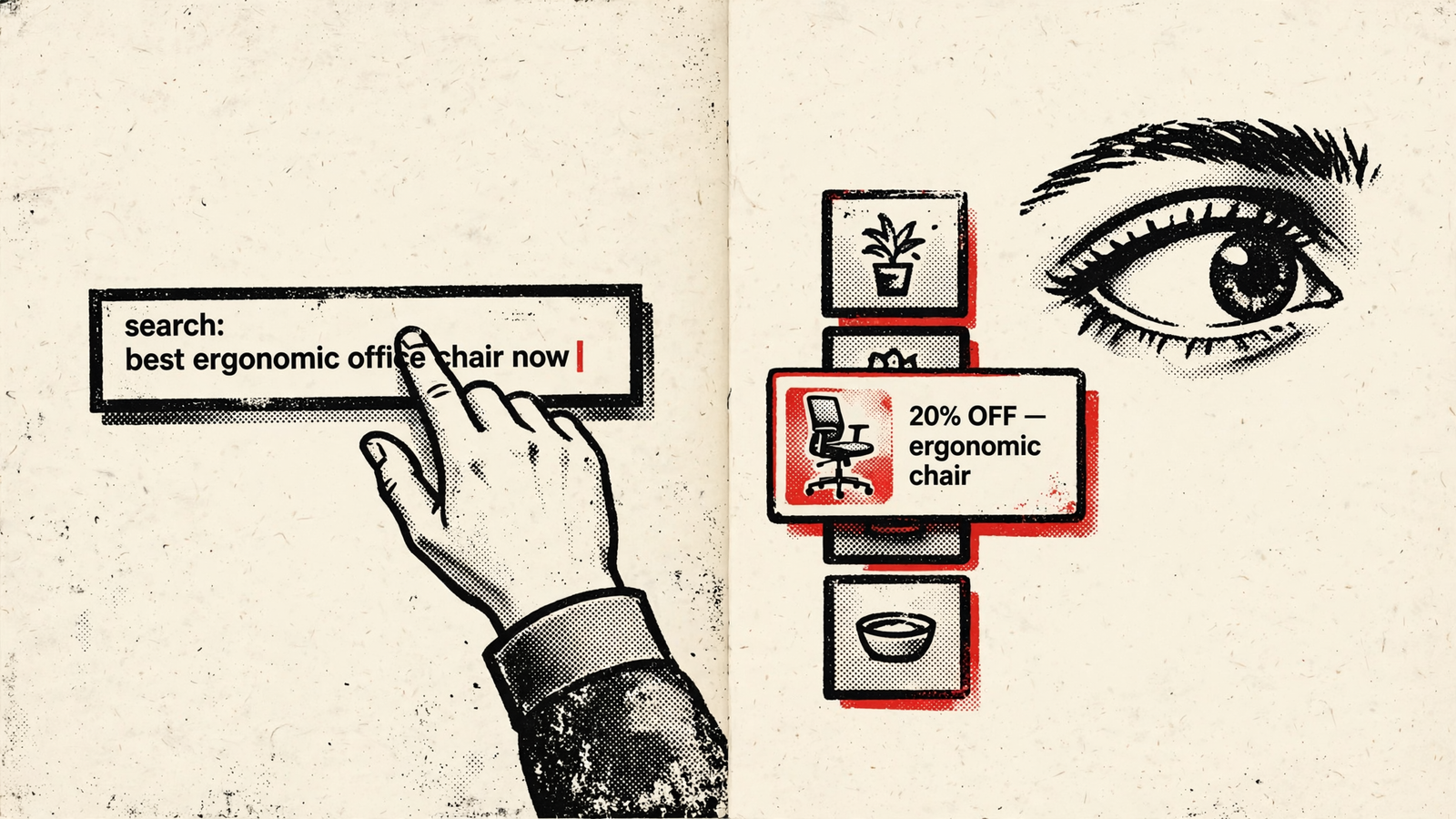
An ad in the wild tells me what a competitor chose to say and where the click goes. It doesn’t tell me their CPA, their refund rate, or whether the claim survives a chargeback. The ad is evidence of what they ran, not proof that it worked.
I used to think competitor research was mostly about finding angles. I’m more interested now in what I can borrow without borrowing the claim. groas collects competitor ads and landing pages around the clock, so Claude can put those observations next to my own account evidence. I start by naming the three competitors I actually want to see:
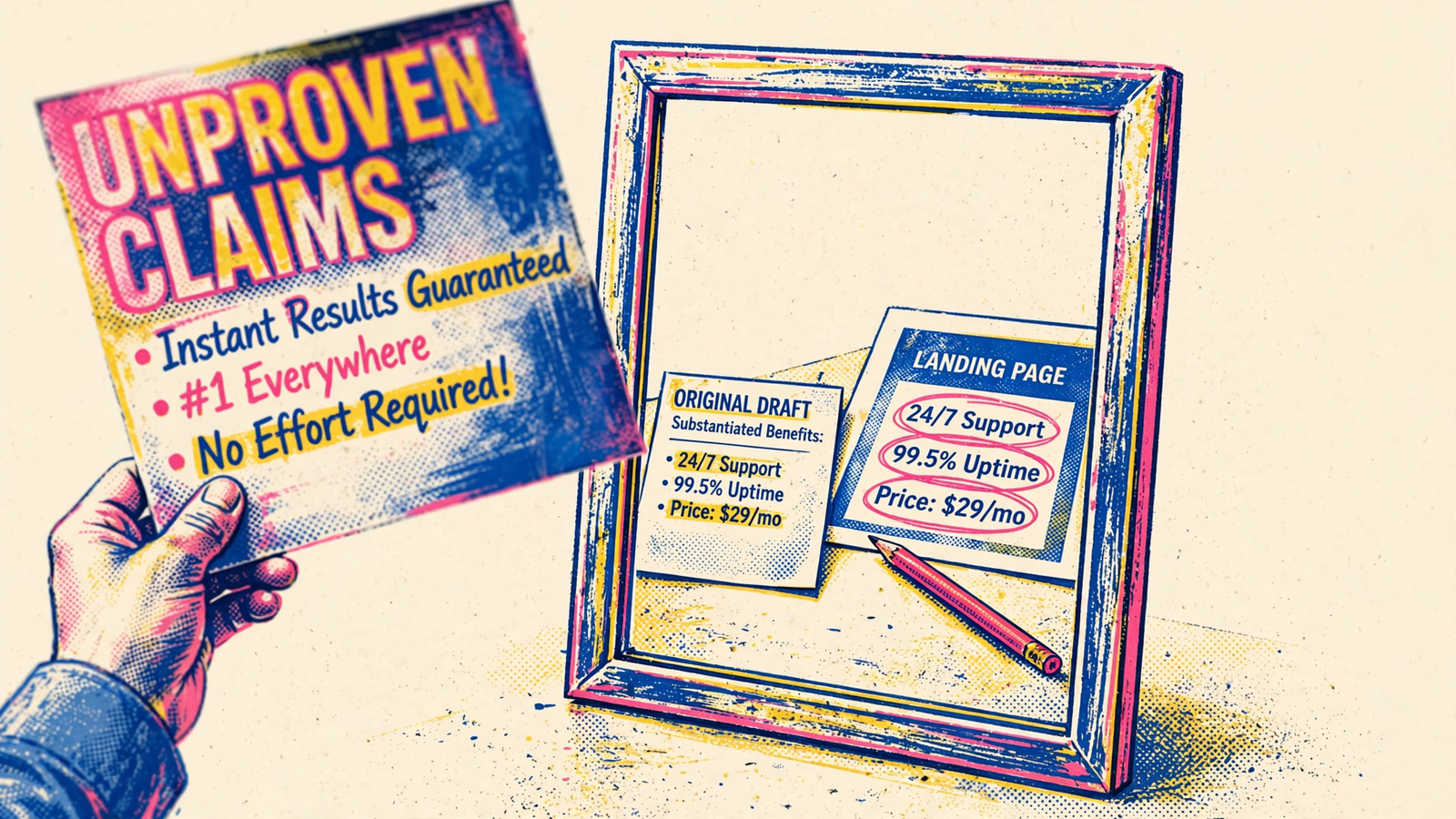
Show me the ads my top three competitors are running on Google and Meta, with the landing page behind each one. Separate what you observed about their ads from what I can prove about my offer. Draft one original ad hypothesis using only my own substantiated benefits, price, and guarantee. Stop for approval.
If a rival’s landing page presents the offer better, I can test that structure. I want Claude to name what it proposes to change about the presentation, then show me the documentation behind the claim I’d actually run. Those are two different jobs. The rival’s page gives me an idea for the first. It doesn’t do the second.
If the draft reads like their ad with my logo swapped in, I send it back. That’s not a handoff. That’s copied homework.
4. Draft a page that answers a question missing from AI search
When nobody on the team can point me to a page that answers a common customer question, I’m interested in a draft. I’m not interested in a promise that publishing it earns a citation. The gap is a reason to investigate, not a reason to hit Publish.
I start with the question, not a page outline. Then I ask Claude to do the work in this order:
- Read the citations. Show me which sources AI answers actually use for the topic.
- Check query demand. Give me a reason to write the page beyond the fact that my site isn’t in the answer.
- Draft the missing answer. Show me the sources behind the claims and flag anything the evidence doesn’t support. Leave the draft unpublished until I approve the facts and the edit.
The order matters. If I start with a draft, the easiest thing in the world is to write a plausible answer and go looking for evidence afterward. If I start with the sources, I can see what’s already being answered and where my page has something to add. If the only gap Claude can point to is that my site isn’t cited, I’m not ready to commission a page. I still need a question worth answering.
AI answers need sources they can read, check, and attribute. Publishing a claim without support doesn’t make it more useful. It gives the wrong answer a permanent address.
This is where I want more than an AI writing tool. Claude and ChatGPT can write the draft. What I need from groas is the context they don’t have on their own: my accounts, competitor ads and landing pages, Reddit research, AI search answers, and SEO data. I use those inputs to decide whether there’s a page worth writing. If there is, I still want a human to check the claims before it goes live.
5. Take a Google Search winner to Bing as a paused draft
If I’ve got a Google Search campaign worth learning from and nothing running on Microsoft Advertising, this is the handoff I’d start with. I have an offer, a landing page, and search terms I can inspect. I don’t have to start with a blank brief. I also don’t have to pretend a CPA from one auction is a forecast for the other.
I start with one campaign and ask for a line-by-line proposal:
Read my top Google Ads search campaign from the last 30 days, including search terms, bids, budgets, conversion actions, and CPA. Propose the Microsoft Advertising version line by line. Flag every setting without an equivalent, show me what you’d use instead, and stop before creating anything.
Through groas, Claude can read the Google account and prepare the Microsoft draft in the same conversation. The first approval is for a paused campaign, not for spend. Before I give it, I want to see the Google setting beside the proposed Microsoft setting. Where they differ, I want to know whether Claude is recommending the change or just describing what an import might do by default. I look for three things:
- Bids and budget. The Microsoft Ads import checklist describes how unsupported bid strategies can fall back to Enhanced CPC or Manual CPC. I want to see the proposed strategy and budget, not find the fallback after launch.
- Match types and negatives. The same checklist notes that broad-match negatives can arrive as phrase-match negatives. It also flags that broad match with Smart Bidding may not get enough Microsoft query volume to learn properly. I want to review what the new campaign can match, not just count how many keywords made it across.
- Targeting and measurement. Microsoft’s feature comparison shows where the platforms differ. LinkedIn Profile Targeting by industry, company, and job function is a Microsoft option, while Google’s Conversion Value Rules don’t carry over. I can keep the conversion definition, but I still need to check the tracking on the Microsoft side before I judge the CPA.
To run the handoff, I connect the accounts and website I want Claude to work with through groas. groas Unlimited is $19 a month, flat, for the whole team: unlimited teammates, ad accounts, and websites, with every feature and all the data. Claude access and ad spend are separate. If I’d rather hand the work over, Done For You starts at $5,000 a month and is run by the groas senior team.
groas logs each change with its reason and lets me undo it in one step. That’s useful after an approved change, but as Supermetrics’ guide to ad account changes points out, undo doesn’t get back money I’ve already spent. That’s why I keep creation and launch as separate decisions. A paused build gives me something to inspect without making me pay to find out what I missed.
I used to tell clients a good operator could carry a winner from one auction to another by feel. I was wrong. I’d start with Google to Bing precisely because there’s enough evidence to make a concrete proposal and enough difference between the platforms to expose anyone guessing. Give me one search campaign and 30 days of evidence. Show me what doesn’t carry over, ask me to approve the paused draft, and leave the budget alone until I say otherwise. That’s the job. The rest is commentary.





