

 LinkedIn

A store owner paid $1,500 a month for Meta ads management, put another $1,000 a month into the ads, and had zero purchases after three months. In r/FacebookAds, the response was not “find a cheaper manager.” It was “get an independent audit,” because nobody could tell whether targeting, creative or conversion tracking had failed. The cheapest viable Meta setup is not necessarily an agency, but it still needs tracking that reports real conversions, usable creative and someone responsible for decisions. Cut vendors and reporting overhead before you cut the work that tells you whether ads produce customers.
“The lowest management quote is the cheapest option”
I understand the appeal. Two providers promise to run the same account; one costs $1,500 less. But a management quote prices scope, not outcomes. The cheaper quote may exclude creative production, landing pages, tracking fixes, reporting or the follow-through that turns an ad into a customer. It might also be perfectly adequate if you already cover those jobs yourself. The number alone cannot tell you.
One owner in r/FacebookAds described a shop that “would just make the campaigns in ad manager.” When he asked about creative and copy, the answer was that they did not do that. He paid a management fee for campaign structure. Someone still had to write the ads.
Free tool: the Reddit Customer Voice Finder finds what buyers say about a product on Reddit, with each finding linked to its thread.
Before comparing prices, put an owner beside each job:
- Creative and copy: Who makes new ads when the current ones tire?
- Tracking: Who confirms that purchase or lead events work, including server-side events where needed?
- Decisions: Who changes audiences and budgets, and who decides what to pause?
- Reporting: Who connects spend to qualified leads, booked work or purchases?
Then read each quote against the list. A provider charging $3,000 a month for “just Meta ad management, no creative” to a business doing $6–9k in monthly revenue leaves a fairly important question unanswered: where does the creative come from? In that discussion, the answer was the owner’s own week.
For calibration, practitioners in r/PPC describe roughly $1k or more in monthly management at $5k or more in ad spend, 10–20% of spend as a common percentage fee, and $1k a month as a floor for two platforms at a decent small agency. One commenter says they “wouldn’t trust anyone” to run Google, Meta and creative for under $3,500 a month. These are quotes from practitioners, not a universal rate card. They do show why a $500 offer that leaves you owning creative, tracking and reporting is not necessarily a cheaper arrangement. It is a smaller one.
You have options besides buying a full service. If you can make the decisions and produce the creative but need tracking help, buy that missing piece. If you can cover most of the work but not all of it, a freelancer may fill the gap. If creative, tracking and decisions are all missing, a low management quote will not make those jobs disappear.
That is the frame behind groas’s Meta Ads service: $1,499 a month flat, with Facebook and Instagram campaigns, audiences, budgets, creative testing and scaling handled around the clock. Creative and tracking are included; media spend is billed separately by Meta. Actions are logged with their reasoning, and a named strategist owns the result. It is month to month, with cancellation anytime. If that $1,499 fee would consume most of a budget under about $3k a month in media, the maths does not work. Run the account yourself and fix the tracking first. A flat fee becomes more useful when the spend can carry it.
“Tracking can wait until the ads start working”
People believe this because testing feels like the creative phase, while event setup feels like accounting. The mechanism runs the other way. Without a verified purchase or lead event, Meta optimises toward whatever it can see: link clicks, landing-page views or cheap form fills. Browser-only pixel tracking can lose events to iOS restrictions and ad blockers. One lead-generation audit calls it a blind pixel and recommends sending the event through Conversions API alongside the pixel to help restore the signal.
A missing or unverified event makes a cheap test inconclusive. You cannot tell whether an ad attracted customers or merely generated submissions the platform could count. Spending less on that test does not make its answer more useful.
There is a platform constraint, too. Meta’s documentation says that from April 2026, the qualified leads performance goal is unavailable to new campaigns without Conversions API integration, with existing campaigns affected from August 2026. It also calls for at least 50 conversions a week for that goal to run properly. That does not mean every small advertiser needs an elaborate analytics stack. It means the conversion signal cannot be an afterthought.
Confirm one event you trust, end to end in Ads Manager, before judging creative by its results. One trustworthy event beats a dashboard nobody reads.
“One winning ad means I can stop paying for creative”
The winner works, so another ad looks like an unnecessary expense. Until the winner gets tired. Meta’s creative fatigue rules flag an ad as Creative limited when its cost per result rises above past ads and as Creative fatigue when that cost reaches twice previous ads. Meta recommends a new ad with a materially different image or video.
The replacement clock can run faster than an owner expects. AdPipe’s Pulse diagnostic of $81 million in Meta spend found top-of-funnel ads hitting fatigue at a median of day 15, testimonial ads at day 22, offers at day 26, real-customer ads at day 54 and cinematic ads at day 80. More than half of high-spend fatigued ads kept running a median 16 days past their fatigue point. “It’s still the winner” can become an expensive way of saying nobody made a replacement.
Keep the working ad; do not make it your entire creative plan. A short next-in-line list might include:
- A new hook and first three seconds for the winning ad.
- A customer quote you have permission to use, framed as a testimonial.
- The winner reformatted for another placement.
Two or three variations give you something to test when performance slips. The account does not need a studio. It needs a replacement ready before cost per result doubles.
“Daily management means changing the account every day”
Owners hear “daily management” and picture someone pulling levers in Ads Manager every morning. They assume the fee buys intervention. It should buy observation and a decision when the evidence warrants one. Most days, the right action may be nothing.
Cheap and expensive arrangements can both get this wrong. A provider who changes things to justify a retainer can send an ad back into the learning phase for no good reason. An owner who rewrites copy on Tuesday because the dashboard looked flat can do the same thing unpaid. Activity is easy to show in a report. Restraint is harder.
Ask any provider, or yourself: who checks spend and tracking daily, and what evidence triggers a change? “We’ll let you know if something looks off” buys you a vague promise. A named decision-maker and a stated threshold, such as cost per booked job staying above target for three consecutive days, give that person a basis for acting. The rest is somebody watching.
“The cheapest lead proves the cheapest setup works”
Cost per lead is the first number most owners see and one of the easiest to improve. Loosen the form, broaden the promise, offer a free quote, and CPL can drop. But Meta optimises toward the result it can see. If it sees form submissions rather than booked jobs, it can get better at finding people who fill out forms without getting better at finding customers.
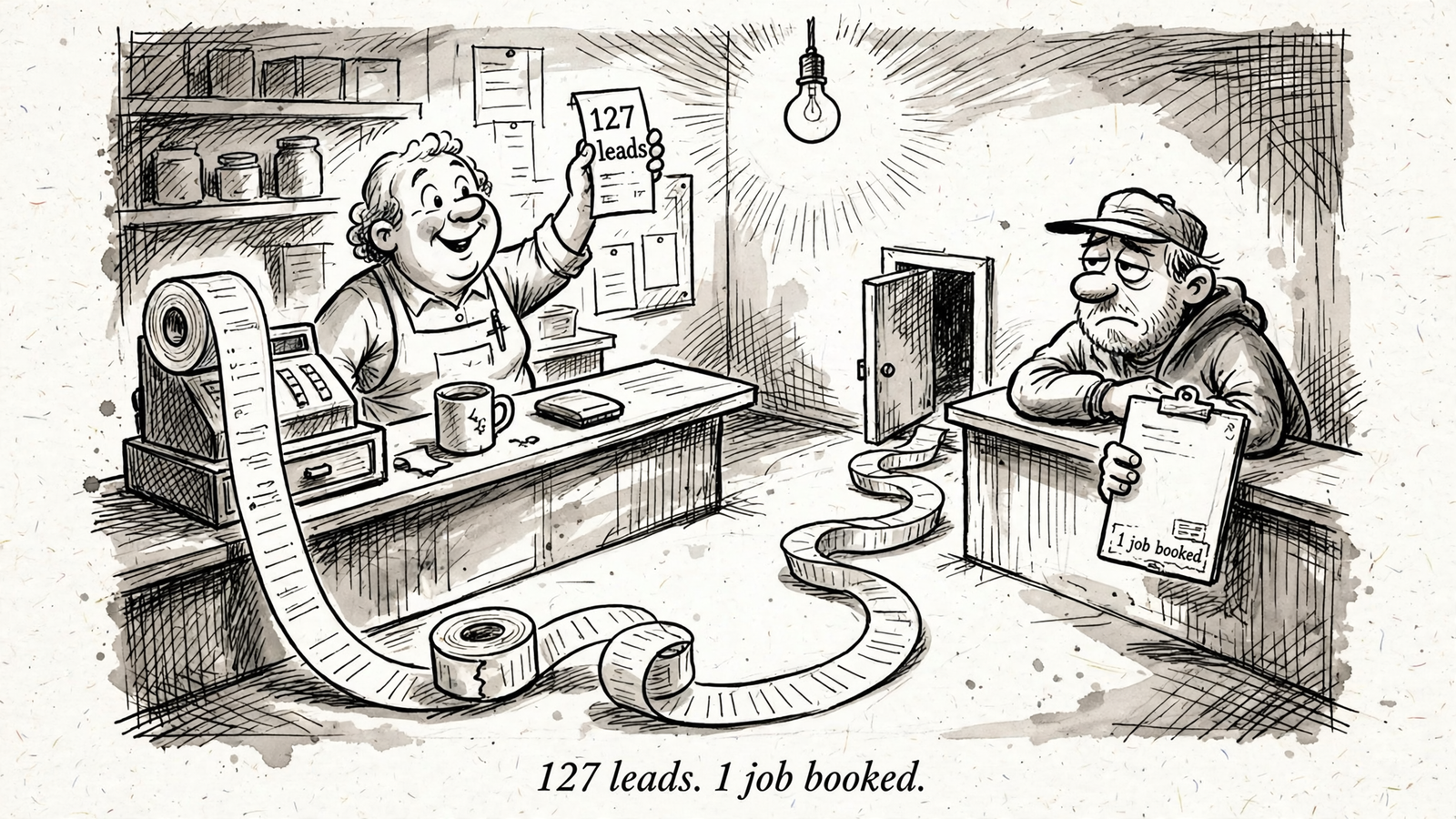
The gap between a cheap lead and a cheap customer lives in two places. First, intent: WordStream’s 2026 benchmarks put Meta’s home and home improvement average CPL at $42.95, versus about $53 for Google Local Services Ads. A person scrolling a feed is not in the same position as a person searching for help, even if the form submission costs less. Second, follow-up: the same source stresses a response inside five minutes. That job remains with the business regardless of who runs the ads.
Qualifying questions can raise CPL while lowering cost per booked job. That is not a reporting problem; it can be the price of screening out people who were never going to buy. Follow each lead through to qualification and booked business, then judge the account at the end of that chain.
For a small account, the useful weekly report is short: spend, leads, qualified leads, booked jobs and cost per booked job. If a provider cannot show the last number, ask what is missing from the tracking or follow-up. You do not need fourteen dashboard widgets to find that gap.
If you run a home services business and want the options compared by booked work rather than management fees, I go through them in Who Should Run Meta Ads for a Roofer, Plumber or HVAC Shop? Six Options Ranked by Booked Jobs. The useful question is what each option leaves on your desk and what one booked job costs.
“DIY is free”
This is the hardest myth for me to kill because, at very small spend, it is almost right. Nobody invoices you for running your own ads. When an owner spending about $900 a month asked r/FacebookAds whether to hire help, the top answers said to stay DIY until the ads were profitable. One practitioner put the floor for agency help at $2–3k or more a month in ad spend. At $900, a management fee could become the largest line in the marketing plan.
But free is still the wrong word. You build the campaign, source and write creative, confirm the purchase or lead event fires, read the results, decide what to change and troubleshoot whatever Meta broke this month. No agency is required for any of it. Hours are. They come out of the same week you use to run the business.
DIY works when those hours fit and you can make the calls yourself. It goes wrong quietly: troubleshooting outgrows the time available, the account sits unchanged for a fortnight, and the spend keeps running. The invoice says zero. The work still needs an owner.
Before you hire anyone or open Ads Manager yourself, write a name beside four jobs:
- Who produces the next piece of creative?
- Who verifies conversion tracking?
- Who decides what to pause, change or keep running?
- Who follows up on leads?
If you can fill every line with someone who has time this week, stay lean. If one or two lines are empty, buy help for those jobs rather than a stack of reports. If all four are empty, the cheapest management quote is not your answer. It is a price for work that will still land on your desk, whether or not the quote mentions it.


