

 LinkedIn
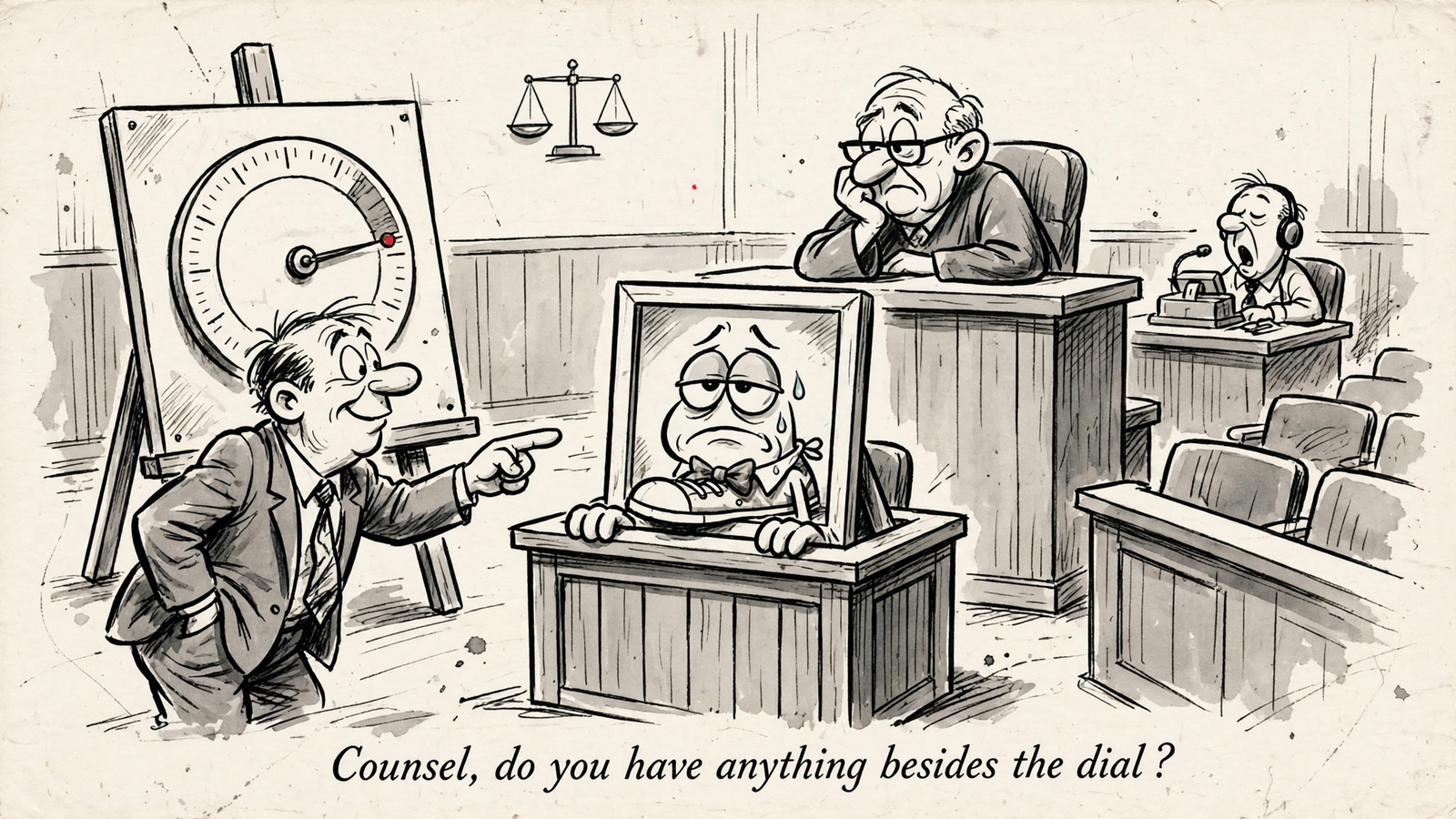
Say I’m spending $20k a month on Meta and CPA climbs 20% in two weeks. That’s a symptom, not a creative-fatigue diagnosis, and having Claude generate six new images just automates the wrong response faster. I connect Claude to the Meta account through groas so it can read the actual delivery data. Then I make it show its work: which ad got worse, against what baseline, and what else could explain the change? No ad-level evidence, no recommendation to replace the ad. I don’t need screenshots, CSV exports, or a guess dressed up as a frequency threshold.
1. Higher frequency proves an ad is fatigued
Frequency is the number staring back at me in Ads Manager. It feels scientific to pause everything over 2.5 or 3.0, especially when the account’s getting expensive and I’d like one column to tell me what to do. I used to give clients advice pretty close to that. I was wrong.
Meta has no official frequency cutoff for fatigue. A frequency of 1 to 2 per ad set gets described as common, which is not the same as healthy. Frequency tells me how often people saw the ad. It doesn’t tell me whether seeing it again made them less likely to click or more expensive to acquire.
I ask Claude to pull frequency, reach, delivery status, CTR, and cost per result together. I want the last 7 days against a comparable stretch in the prior 4 to 8 weeks when CPM was stable. If frequency rises while CTR drops and cost per result climbs on the same ad, I have evidence worth pursuing. If frequency hits 4.1 and CTR and CPA both hold, I don’t have the same case. The high number is the same kind of number. The performance around it is different.
Use frequency to decide where to look, not what to pause. If Claude can’t show what got worse as frequency rose, it hasn’t made the case.
2. A campaign-level ROAS drop tells me which ad to replace
Campaign ROAS goes from 3.1 to 2.2. It’s the first red cell I see, so it’s tempting to treat it as the answer. But that cell can’t tell me whether Shopify orders held while Meta reported fewer purchases, whether impressions got more expensive, or whether a particular ad lost its pull. I’ve killed good ads over a tracking gap. There are cheaper ways to learn that the dashboard and the store disagree.
I use this order: check tracking, then auction costs, then fatigue, then the offer and site. If Shopify counts 42 orders and Meta counts 19, I look at the pixel and Conversions API setup before I blame the ad. The gap is a reason to check the reporting, not proof that the setup broke.
Then I ask Claude to put campaign, ad set, and ad numbers side by side, using the same attribution setting and enough volume to make the comparison useful. I want it to compare cost per result at the ad level over matched periods, not repeat the campaign number in a more authoritative tone. One or two ads slipping on CTR and getting more expensive per result while the others hold is a creative pattern worth investigating. A 30% jump in CPM across the board points me toward auction costs or budget before it points me toward the image.
The campaign tells me where to start looking. The ad has to make its own case. If Claude can explain the campaign decline but can’t show which ad drove it, I don’t ask for a replacement.
3. Yesterday’s loser should be paused today
Yesterday’s ROAS is 0.8. The dashboard refreshed overnight, the number’s red, and pausing the ad feels like discipline. The refresh tells me the report updated. It doesn’t tell me the report is finished.
Under a 7-day click and 1-day view attribution window, Meta can report a conversion against the day of the click or view rather than the day the purchase happened. A purchase that comes in later can change a number I’ve already looked at. A new ad set has barely had time for that to happen. Yesterday’s 0.8 might look conclusive on the screen, but I’m still reading a partial count.
I make Claude answer two questions before it recommends a pause: How much of the attribution window is still open? And even after that window closes, are there enough purchases to make the comparison useful? Those are separate problems. Waiting addresses the first. It doesn’t guarantee I’ll have enough data to solve the second.
Don’t let Claude call an ad a loser on numbers that are still coming in. I want it to say what’s provisional, not put a sharper label on the same unfinished report.
4. If a competitor has run an ad for months, it must be a winner
I see a competitor’s video in the Meta Ad Library, and it’s been running since March. It’s easy to call it a winner. March is right there. The margin isn’t.
For ordinary ads, the library shows the creative and start date for running ads, not spend, impressions, or ROAS. An ad can sit there for months on a tiny budget, or simply because nobody turned it off. In one example, 124 ads share a start date. I can sort them by date all I want; I still can’t rank them by performance. Longevity tells me someone kept an ad on. It doesn’t tell me why.
This is where I’d rather use groas than stop at the library. Claude can pull the competitor’s running Meta ads alongside the landing pages and funnels behind them. I ask it to show me the offer the ad leads with, the proof the landing page uses, and the objection the two are trying to answer. That gives me something specific to test against my own offer. It doesn’t give Claude license to tell me what the competitor earned.
The library shows what’s running, not what’s profitable. I borrow the test idea, not the imagined result.
5. A fatigue alert should automatically trigger a replacement
I get the appeal: detect, replace, move on. No meeting. But reports about Meta’s automatic adjustments describe profitable ad sets being turned off. That’s the part I pay attention to. Whether the system can make a change isn’t the same question as whether it has a good reason to make it. An alert is a question, not permission to act.
I judge a tool for finding fatigued Meta ads the way I used to judge junior media buyers: show me the account, show me the comparison, and tell me what you still don’t know. The free checks are useful for what they show. The Ad Library gives me start dates; the frequency column tells me how often people saw my ad. Neither does the part I’m paying for: comparing live ad-level costs with a matched prior period while accounting for attribution and lag. I go deeper on that distinction in Meta Ad Fatigue With Sparse Data: Make Claude Prove It. For the checks I run before making the call, see 7 Checks Claude Should Run Before Calling Your Meta Ads Fatigued.

Once Claude is connected through groas, I ask for a proposal in this order:
- Show me the ad. Compare its cost per result, CTR, and CPM for the last 7 days with the prior 6 weeks, using the same attribution setting.
- Show me what else changed. Separate campaign, ad set, and ad-level changes, and tell me how much of the conversion window is still open.
- If the evidence supports replacing it, show me the plan. Give me one replacement concept, the hypothesis it tests, what you’ll watch for 7 days after the change, and how you’d roll it back. Then wait for my approval.
If I’m trying this on an ad set where cost per result has been getting worse for 14 days, I’ll ask for the last 14 days against the prior 42 with stable CPM. I want to know whether a single ad drove the slide. “I can’t isolate one yet” is an acceptable answer. It’s a better answer than naming a loser because I asked for one.
groas costs $19 a month, flat, with unlimited teammates and ad accounts and no free plan. Autopilot stays off until I switch it on. Changes are logged with their reasons, and I can undo a change in one step where Meta allows it. If a creative edit or deletion won’t reverse cleanly, I want that in the proposal, not in the explanation afterward. The tool has to defend the change before I approve it.
6. Six new images equal six new tests
This is the one I find hardest to kill because it looks like work getting done. Claude produces six images, the buyer uploads them, and now there’s a folder everyone can point to. Then the results scatter. If all six images make the same argument, I can’t use those results to tell me which argument people respond to. I only changed the background.
A concept tests a distinct angle, audience, or format; a variation changes a surface element. A background-color swap can be a variation I want to try. It just doesn’t answer the same question as testing whether a guarantee does more for the offer than a customer quote. When fatigue is real, Meta calls for a materially different image or video, not a tweak. I make Claude tell me what’s materially different before asking it to make anything.
With groas connected, I have Claude read my site and offer first. Then I ask for three hypotheses that don’t all boil down to making the same ad look newer:
- Offer: Would a bundle or a different guarantee give someone a better reason to buy?
- Proof: Would a customer quote or a before-and-after from reviews make the promise more convincing?
- Objection: Would answering a concern about price or fit give someone a reason to reconsider?
Each concept gets one creative, one reason it might win, and one metric I’ll use to judge it. If the reason reads the same for all three, I send the ideas back. I haven’t got three concepts yet. I’ve got three ways to lay out one.
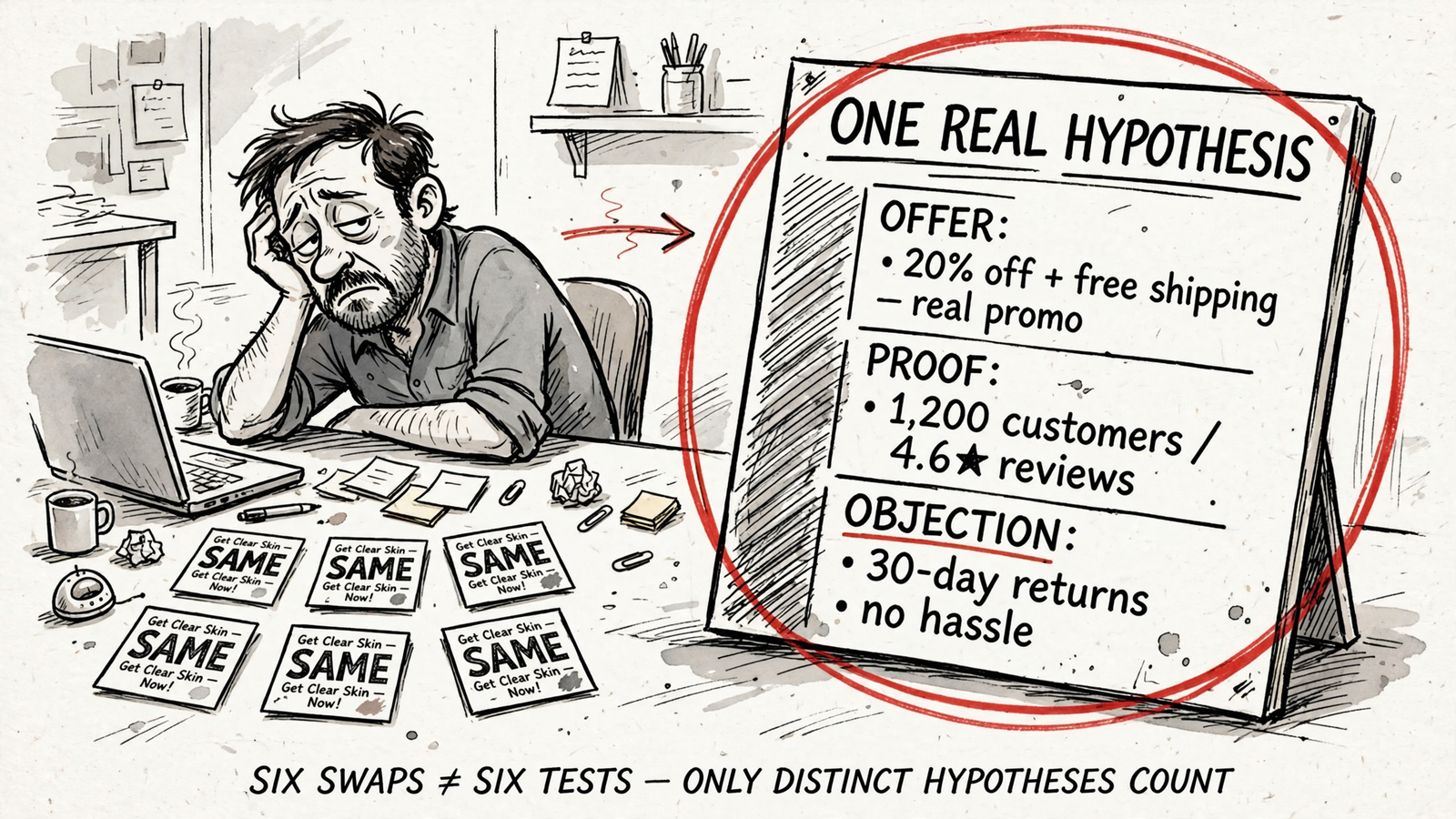
If I had to pick the myth that’ll still be alive a year from now, it’s this one. A frequency of 4.1 with steady CTR and flat CPA can talk me out of replacing an ad. A tracking gap can send me back to the numbers. Six fresh images survive because they flatter everyone involved: the tool looks productive, the buyer looks busy, and the client sees deliverables. I’ve sat in that meeting. Nobody asks whether the folder contains six ideas or one idea six times. The folder is full. The invoice looks justified.
That’s why I make Claude write the hypothesis in one plain sentence before it makes the ad. No sentence, no render.


