

 LinkedIn

Ask Claude which Meta ads are fatigued and it’ll give you a list. The list can be precise down to the ad name and still be wrong about why performance fell. With groas connected to Claude, Claude can read actual Meta delivery and results. What it can’t see directly is fatigue. That’s an explanation for why the numbers moved, not another column in Ads Manager. Next season, I want Claude to show me what changed, what else could explain it, and what it still doesn’t know. Then we can talk about writing replacements or pausing ads.
1. “Claude can diagnose fatigue from frequency alone”
I used to tell clients to watch for frequency 3.0 like it was a fire alarm. I was wrong. Frequency is impressions divided by reach, and it can vary with budget, audience, and schedule. A reading of 3.4 tells Claude how often people saw the ad on average. It doesn’t tell Claude whether seeing it again made them less likely to click or buy.
I care whether performance falls as frequency rises. The as is doing the work. If I give Claude a frequency reading from one window and a cost per result from another, I’ve given it two numbers it can put in the same sentence, not evidence that they moved together. Even when they do move together, that’s a reason to investigate, not a reason to pause.
The request I use through groas is boring on purpose: pull frequency, reach, spend, CTR, CPM, and cost per result for the same ad over two comparable windows. Put the dates and spend next to the numbers. Then list two other explanations for the change before using the word fatigue. If I want a fuller review, I use these eight checks instead of a frequency cutoff.
No comparable windows, no diagnosis.
2. “A ROAS drop tells Claude which creative broke”
I get why this one sticks. Ads Manager puts the red number right next to the ad name. Cause and effect look as if they’re sitting together.
But ROAS has four moving parts: CPM, click-through rate, conversion rate, and average order value. A fall from 3.5x to 2.6x could come from paying more for impressions, getting fewer clicks, converting fewer of those clicks, or taking smaller orders. In one worked example, a 22% fall in CTR explained about three-quarters of the drop, while an 8% rise in CPM explained most of the rest. The ROAS chart showed one slide. The breakdown showed two things moving.
A ROAS drop starts the investigation. It doesn’t name the culprit. I ask Claude to line up CPM, CTR, conversion rate, and average reported purchase value over the same dates, using the same attribution settings. If conversion rate fell 70% overnight and clicks held steady, I’d check the pixel and Conversions API before touching the creative. A rewrite won’t tell me whether purchases stopped happening or stopped showing up in the report.
I also want the counts next to the rates. Roughly 100 clicks and 10 purchases per window is where I start taking those swings more seriously. It’s a gut check, not a certificate of statistical significance. Until I’ve seen the breakdown and the counts, the red number doesn’t get to pick the next ad.
3. “Two strong days give Claude a reliable seasonal benchmark”
Saturday and Sunday print a 4x. The screenshot goes in the team channel. Monday through Wednesday bring one sale. I recognize that weekend-spike, weekday-slump complaint, and I understand the temptation to tell Claude the weekend was normal and the rest was a collapse. The weekend is the part everyone wants to repeat.
That doesn’t make it a baseline. The two windows may differ in buyer intent and auction competition. They can also differ in how much of the reporting has come in. With a seven-day click window, purchases can still be credited to clicks from the most recent days. Claude can read the number in front of it. It can’t read the purchases that haven’t been reported yet. What the deck calls early momentum, I call an unfinished report.
Mark the promotions and the attribution window before comparing performance. Say I’m spending $20k a month going into the holidays. I give Claude four to six weeks, mark when a sale ran or the budget changed by more than 20%, and ask it to show reported purchases alongside the attribution window. I want the good weekend in the analysis. I just don’t want it doing all the work.
Keep the screenshot. Don’t set next season’s targets or kill an ad on 48 hours of good news.
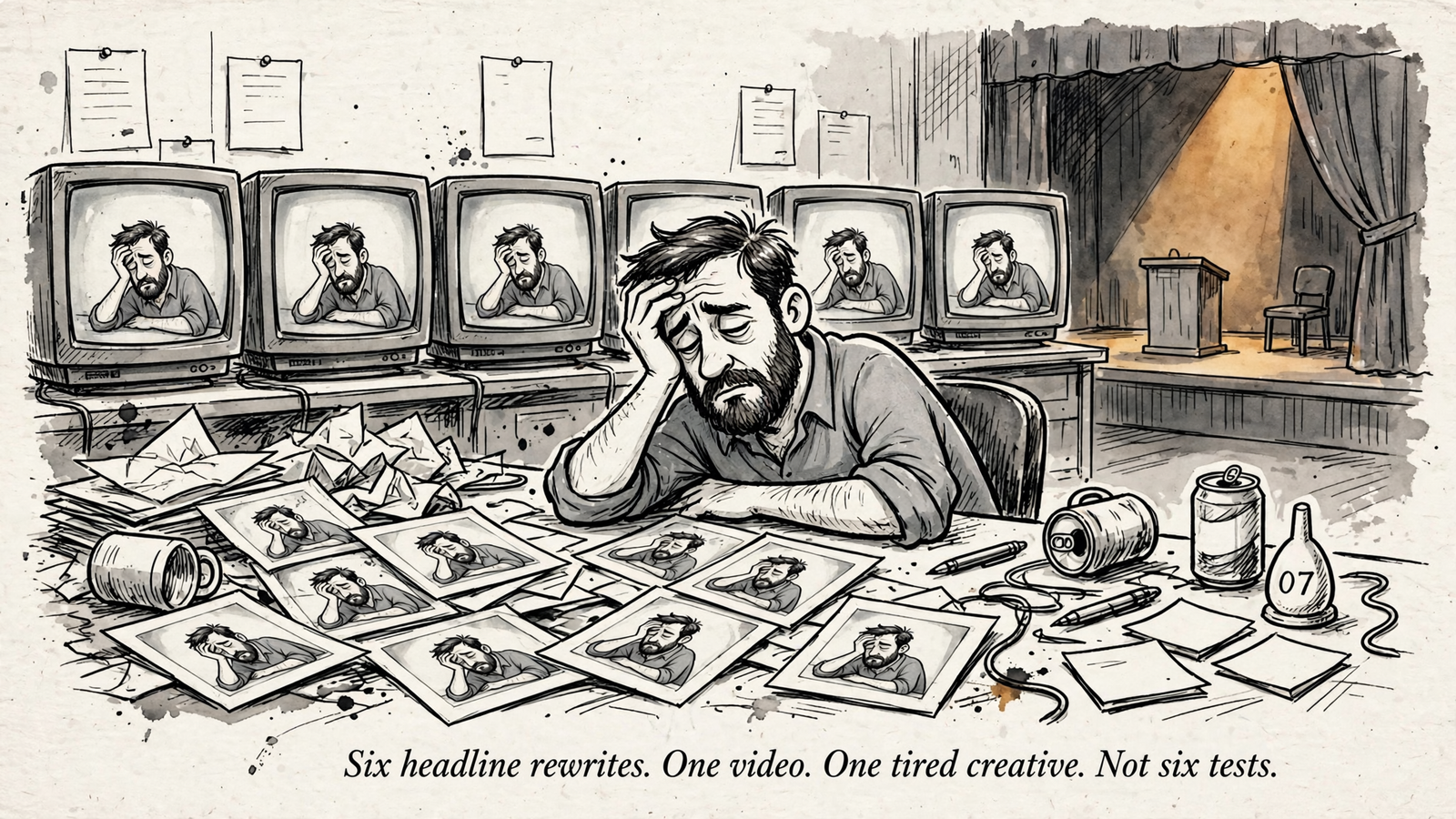
4. “Six AI rewrites equal six creative tests”
Claude can hand me six headlines in ten seconds. The speed is real. The six tests aren’t. In Demystifying Creative Diversification, Meta treats ads with shared visual or thematic attributes as variations of the same creative. Its example is two ads with identical visuals and different calls to action. That’s one idea in two outfits.
I once shipped five hook swaps on the same talking-head video and called it a test matrix. The spreadsheet said five. The thumbnails said otherwise. Meta’s example of a more distinct pair is a Reels ad for Gen Z and a creator partnership ad for new moms. The audience, motivation, and first frame are where I look for differences. Twenty scripts can still look like one ad if every thumbnail shows the same person framed the same way.
I ask for three hypotheses, not six rewrites:
- Offer: What changes if the ad leads with a different part of the offer?
- Proof: What changes if the proof is the first thing the buyer sees?
- Objection: What changes if the ad opens by answering the reason someone might pass?
Then I have Claude draft from the actual brand and offer, and I check the claims and assets myself before anything goes near spend. A hook swap can be worth making. I just don’t count it as a new concept. If I need the script to tell the concepts apart, I take another look at the first frames.
5. “A competitor’s long-running ad proves it’s profitable”
The same hoodie ad has been running since March, and I can practically hear the missing column filling itself in: still running, must print. I’ve kept losers running for months myself. Nobody owning the account that month is a less flattering explanation than finance loving the ad, but it’ll do.
For ordinary commercial ads, the Meta Ad Library shows the creative, start date, and platforms, but not spend, reach, or results. Longevity tells me the ad stuck around. It doesn’t tell me what it earned. Six months in the library doesn’t give Claude six months of performance data.
I use what groas collects around the clock as research material: competitor ads and the landing pages and funnels behind them. I ask Claude what the advertiser might be testing. Is it price against reviews? A bundle against the standalone offer? A new first frame for the same claim? The ad and landing page give me something to examine, even if I’ll never see the result.
If the question is useful, I borrow it for one of the hypotheses in myth four. I don’t borrow the conclusion. Longevity is a reason to look, not a reason to copy.
6. “A refresh calendar tells Claude when an ad is exhausted”
Swap creative every Monday. Retire it after 21 days. No arguments. I ran accounts that way for years, and the report always looked organized. The calendar was also perfectly happy to retire an ad that still worked and keep a tired one running until its date came up. It was doing exactly what I’d asked.
I use triggers to open a review, not to authorize a pause. A roughly 20% CTR drop from its seven-day peak, a CPA rise of 15% or more on flat spend, or a falling share of first-time impressions gives me something to investigate. Frequency crossing 3.0 on a cold audience can go on that list too. It still can’t do the job by itself. I want Claude to show the trigger it saw and the evidence it would need before recommending a change.
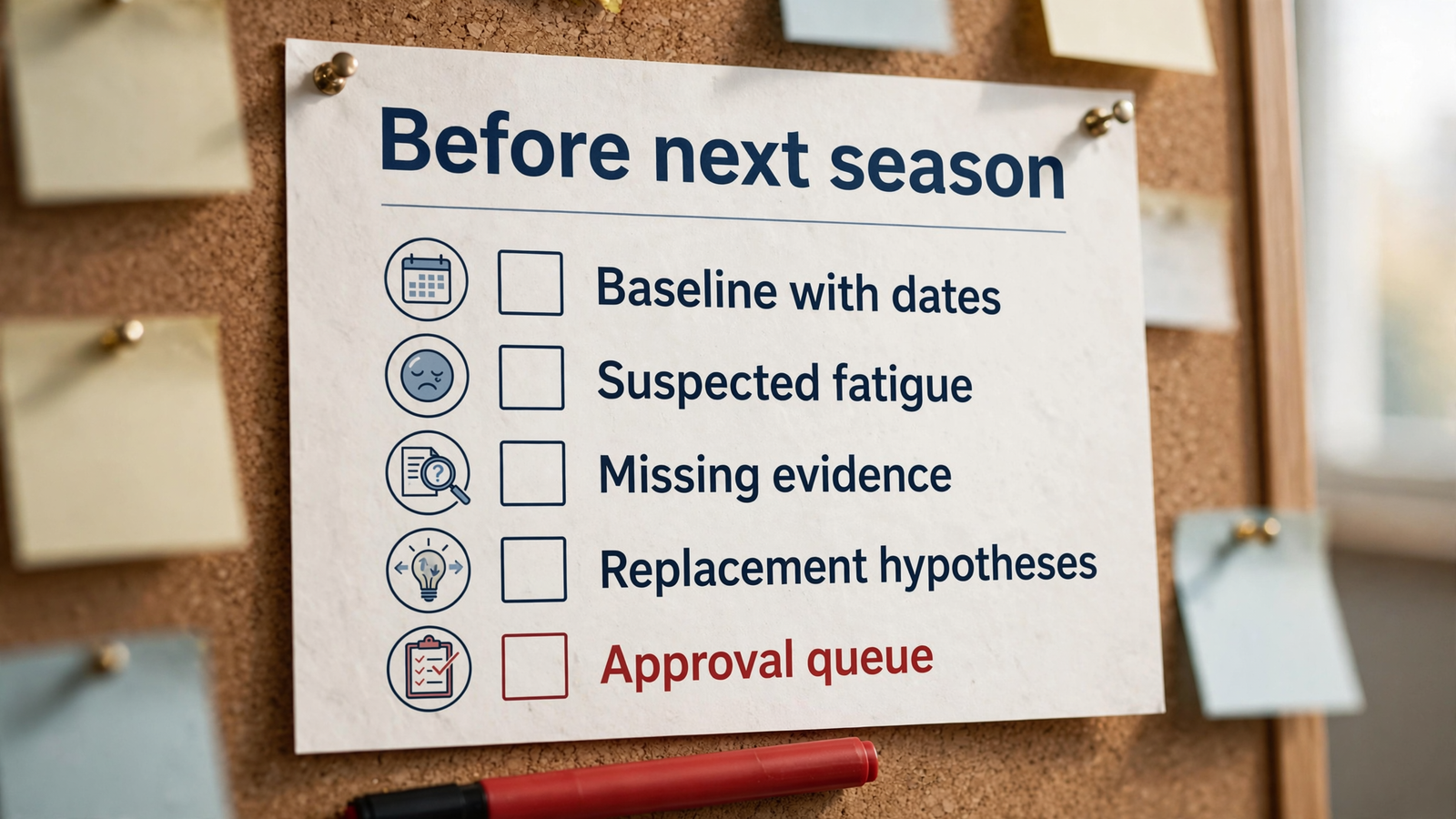
The five lines I want before a rewrite or a pause
Next season doesn’t need another fatigue detector. It needs a creative evidence brief Claude fills in before it writes new copy or touches a live ad. I want five lines, and I send it back if one is missing:
- Baseline: The dates being compared, with promotions marked.
- Suspicion: The ad in question and the trigger that put it in the queue.
- Missing evidence: What Claude still can’t distinguish from fatigue.
- Replacement hypotheses: The distinct concepts worth testing if a refresh is warranted.
- Approval: The specific addition or pause proposed and who approves it.
For the third line, I want the pattern across the metrics, not a chart with fatigue written over it. If frequency rises, CTR falls, CPM stays flat, and cost per result climbs on comparable spend, fatigue is a plausible explanation. If CPM rises while CTR and conversion rate hold, I look at auction pressure. If CTR holds and conversion rate slips, I look at the landing page, price, or tracking. If the numbers don’t fit neatly, Claude can say so. It doesn’t owe me a verdict.
What I do with a fatigue label
Meta can put Creative Limited or Creative Fatigue on an ad, which makes this myth harder to kill. Those labels compare cost per result with past ads: above past ads but below 2x for Creative Limited, and at least 2x for Creative Fatigue, with exposure to the same image or video counted across campaigns from the same Page.
That’s a cost comparison, not a finding that repeat exposure caused the increase. If auction costs or tracking move while the creative stays the same, the label can still show up. I have Claude quote the label, show the comparison window, and identify the shared image or video before it recommends anything. If it can’t show the comparison, the label stays in the queue as a flag. It doesn’t become a pause.
How I make a change without losing the comparison
When the evidence points to a refresh, I don’t rewrite the live ad. A creative edit triggers review and makes the before-and-after results harder to separate. I add two or three distinct concepts in one batch, let them earn delivery alongside the original, and make the pause decision from that comparison. That’s the logic behind the 12 checks I want before Claude retires a Meta ad.
I connect Meta through groas so Claude reads delivery and results from the account. I keep autopilot off until I’ve written down its scope and rules. Changes through groas are logged with a reason and can be undone, but a pause is still a pause. I approve the specific addition or pause and make Claude give me a reason I could defend to a client. The line at the bottom of the brief is still no trigger, no test, no pause.
The calendar is the hardest myth for me to kill because it feels like discipline. I can put a review on the calendar. I can’t put the verdict there. Here’s the line I’d paste into Claude next week instead:
Show frequency, reach, spend, CTR, CPM, and cost per result for this ad across two comparable windows. Tell me whether the pattern looks more like fatigue, auction pressure, or a problem after the click. If it doesn’t fit, say so. Name the missing evidence before you suggest a replacement or a pause.





