

 LinkedIn

A ChatGPT Ads pilot needs a stop rule before it needs a demo forecast. Otherwise, the CFO asks what you actually bought, and the answer is a calendar full of bookings nobody can connect to qualified pipeline. I want to know what would justify stopping before anyone asks finance to start spending. These six buying assumptions get in the way.
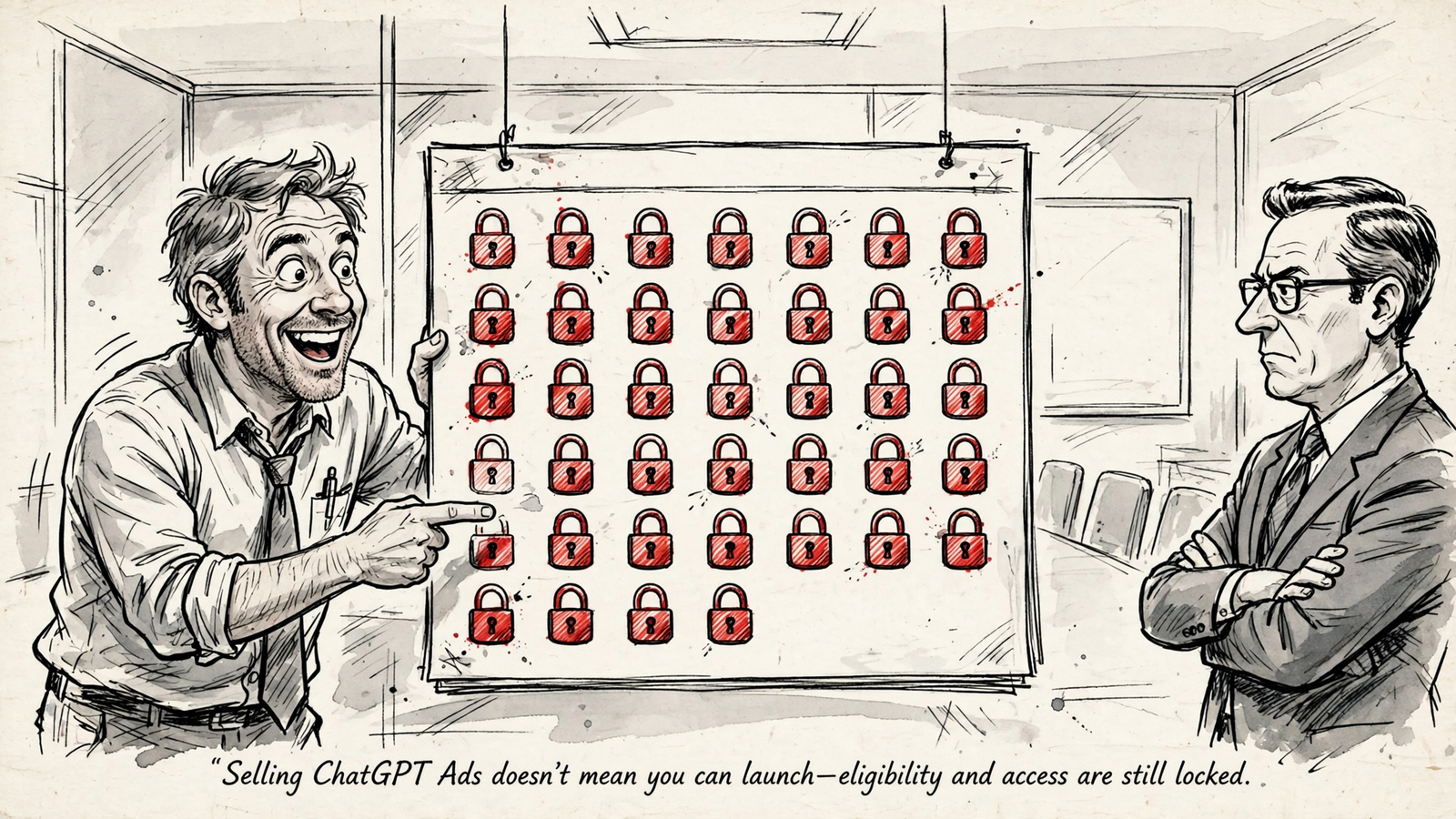
Myth 1: “An agency selling ChatGPT Ads means our account can launch immediately”
An agency deck makes this sound like buying Google Search: you sign, they log in, ads run. The rollout encourages that assumption. OpenAI moved from a $200k-per-month pilot at roughly $60 CPMs in early 2026 to a $50k minimum in April, then self-serve access with no minimum from May 5, 2026.
But platform access and your account’s eligibility are different things. The legal entity that advertises and pays must be based in a country on OpenAI’s availability list. Some new accounts are initially limited to their home country, and an agency cannot simply open yours for you. The client registers first, then invites the agency, and account ownership is not transferable.
Get that order wrong and your two-week pilot spends week one in verification.
Then there is the category trap: a health, legal, or financial advertiser outside the US can open an account but cannot run ads under current policy. That is a fun distinction to discover after finance approves the test.
Before approving anything, ask for three things:
- A screenshot confirming Ads Manager access for your billed entity.
- Written confirmation of your advertising eligibility.
- A clear statement of who owns the account if you leave.
An agency’s ability to sell the service is not proof of your ability to launch it.
Myth 2: “The management fee is the pilot budget”
This gets marketers into trouble because the two numbers live on different invoices. Ad spend buys delivery from OpenAI. The management fee pays for the work around it. Blur them together and finance hears “$1,499 test,” then discovers media on top. Nobody enjoys that second conversation.
Say you already spend $20k a month on Google. A diagnostic ChatGPT test of $5k to $15k over two to four weeks gives you a starting range for planning, with reported costs of $25 to $60 CPMs and $8 to $15 B2B CPCs. It does not guarantee enough qualified opportunities to settle the buying decision. That depends on what happens after the click.
The media goes to OpenAI. groas charges $1,499 for management on top; media is not included. I want those costs separated before the proposal reaches finance, not explained after the first invoice.
The pilot budget is the total cost of learning, not the management fee. Write down:
- Maximum media exposure: the most the test can spend on delivery.
- Management fee: the charge for running it, stated separately.
- Internal work: landing pages, qualification forms, and CRM wiring.
The same authorization rule applies to every vendor: the budget is a ceiling, not a forecast. An agency recommendation to spend more is not client permission to do it.
Approve the whole bill before approving the experiment.

Myth 3: “More demo bookings prove the channel works”
Demo count is comforting. It moves quickly, points upward, and looks excellent in a weekly report. Finance sees 42 demos and thinks pipeline. I used to tell clients exactly that. I was wrong.
A form fill tells you someone completed a form. It does not tell you whether that person fits the product, attends the meeting, or has any intention of buying software. High-ACV SaaS measurement needs to follow sales-accepted leads, qualified opportunities, and closed-won value, not stop at the easiest event to count.
Attendance takes another cut. An industry show rate of 50 to 60% means a substantial share of booked demos disappears before sales says hello. Counting every booking as pipeline gives the calendar credit for work the sales team has not done yet.
I define the stages before launch:
- Booked: business email, company size, and use case meet the agreed form criteria; a calendar slot is booked.
- Attended: the prospect actually shows up.
- Sales-accepted opportunity: sales confirms the prospect meets the agreed qualification definition.
Those are different events. Keep them different in the report.
Your ChatGPT ad can book a demo while the sale takes six months. The early decision therefore depends on the quality of the opportunities you create, not the number of calendar invitations you send.
Agree on the qualified-demo and opportunity definitions in the CRM before launch. Then judge the pilot by the stages that survive sales scrutiny.
Myth 4: “The platform’s conversion total will settle the argument”
Finance wants a single number. Ads Manager supplies one. This is how a reporting preference becomes an attribution policy.
Someone clicks a ChatGPT ad and later books a demo. You expect a clean connection, much as you expect Google tracking to preserve a gclid. Here, the tracking chain uses the oaiq pixel loaded from bzrcdn.openai.com, a server Conversions API, and an image-tag fallback. The oppref click ID is stored in a 30-day __oppref cookie, with a shared event_id used for deduplication (tracking setup guide).
That is a chain, not a magic number. It has several places to break:
- A redirect strips
opprefbefore the landing page captures it. - The pixel fires twice without matching event IDs.
- A Conversions API batch contains a bad event and fails.
Now the number in the screenshot is incomplete or inflated, however confidently someone presents it.
Timing adds another problem. Only about 40% of influenced conversions happen inside the click session, according to the same tracking guide. It also describes early reports of demos appearing as direct traffic because UTMs and the pixel were not wired end to end. A missing source does not prove the channel failed. It does mean the evidence failed to make the trip.
My rule before spend: platform numbers are directional; the CRM is the record. Reconcile weekly against:
opprefand UTM capture.- Booked and attended demos.
- Sales acceptance and opportunity stage.
- Shared
event_idvalues for deduplication.
Keep paid and organic claims separate, too. Buying an ad does not buy an organic citation; paid placements and earned visibility are separate systems.
If an agency wants credit for pipeline, it needs to work from your CRM, not just its screenshot. That is also how I compare proposals fairly: make every finalist price the same demo, using the same qualification and attribution rules. Otherwise, the cheapest proposal may simply be counting the cheapest thing.
Myth 5: “A short pilot must prove closed-won revenue”
Finance asks for revenue because that is the job. Marketing agrees because pushing back feels like admitting the channel is weak. Then the pilot gets 30 days to do what sales needs six months to finish.
The math never had a chance.
The median B2B SaaS sales cycle is 84 days across 939 companies, up 22% since 2022. The same benchmark puts the ranges at:
- SMB: 14 to 30 days.
- Mid-market: 30 to 90 days.
- Enterprise: 90 to 180-plus days.
Negotiation to close alone takes 35 to 40% of enterprise sales-cycle time. Demanding closed-won logos from a four-week enterprise test is grading the seed on the harvest.
The replacement is not “trust the pipeline.” It is interim evidence tied to your sales cycle, explicitly kept separate from revenue. For a mid-market SaaS seller, I want demos that show up, sales-accepted opportunities, and pipeline value by cohort. Then I want to see whether those opportunities advance.
That is what hiring when the sale closes months later requires: the same cohort, the same definitions, and no early signals booked as wins. Moving the definition halfway through the pilot does not rescue the test. It removes the comparison.
Tell finance what the pilot can prove: cost per qualified opportunity and whether those opportunities advance. Tell them what it cannot prove yet: closed-won CAC before the sales cycle matures.
Interim evidence can justify continuing a bounded test. It cannot turn an unfinished sales cycle into a finished return.
Myth 6: “If the first results look good, the agency should automatically scale”
This is the one I find hardest to kill because it feels like momentum. Imagine the first two weeks show a $42 cost per demo while Google sits at $180. The agency Slack lights up. Someone says the obvious thing: put more behind it.
I have said it myself.
But those numbers describe a small initial test, not the cost of every customer you might buy next. ChatGPT ads reach logged-in adults on the Free and Go tiers. Plus, Pro, Business, Enterprise, and Edu remain ad-free, and OpenAI states that ads do not influence answers. Paying cannot buy a recommendation or citation (availability breakdown).
That limits the audience available to the pilot. Meanwhile, reported starting bids of $3 to $5 and B2B CPCs of $8 to $15 are ranges, not a promise that your next budget increase will buy the same traffic at the same price. The cost of the next customer can rise while the average still looks pretty.
Nor does cheap acquisition fix weak qualification. A $42 booking is not automatically a better buy than a $180 booking if it never becomes a sales-accepted opportunity. That is why the earlier definitions matter precisely when the chart starts looking good.
Automatic scaling also hands the agency a blank check at the moment incentives can diverge. A percentage-of-spend shop earns more when you spend more. groas runs on a flat $1,499 management fee with media billed separately, so a scale recommendation does not hide a management-fee increase. I prefer that structure because the question stays where it belongs: does the next increment of spend meet the agreed economics?
Good early cost per demo earns a second controlled test. It never earns unlimited spend.
Put the expansion criteria beside the stop rule
I want the opposite of auto-scale written into the order: a maximum exposure cap and explicit expansion criteria.
For example, a pilot agreement might allow a move from $10k to $25k only after:
- At least 15 attended demos meet the qualification definition.
- Cost per sales-accepted opportunity is at or below $400 in the CRM.
- UTM and
opprefreconciliation holds for two consecutive weeks.
Those are illustrative buying conditions, not a forecast. Their job is to make the next decision possible without rewriting the rules because someone likes the first chart.
The budget remains a ceiling, not a forecast. Raising it requires client permission tied to the agreed evidence, not an agency recommendation sent on a Friday afternoon.
Bring finance one page, not another deck
A defensible agency choice starts with the conditions under which you would stop paying. I want one page that states the hypothesis, names the owner, caps exposure, and defines failure before anyone talks about expansion.
For an illustrative pilot, that page could read:
We believe ChatGPT Ads can produce sales-accepted opportunities below $400 in the CRM within 60 days. Marketing owns the pilot; sales signs off on qualification. Maximum exposure is $10k in media, plus the stated management fee and landing-page and tracking work. We stop if cost per sales-accepted opportunity exceeds the agreed ceiling for two consecutive weeks.
The page needs three things to stay useful:
- Economics: cost per sales-accepted opportunity, not just cost per demo. Keep qualified pipeline separate from closed-won revenue.
- Ownership: one marketer owns the pilot, sales owns acceptance, and the CRM records booked, attended, opportunity, and closed-won stages.
- Authority: media and fees are stated separately, the test has fixed dates, and expansion requires written approval against the criteria.
A pilot that clears those conditions earns the next bounded decision, not a permanent place in the budget. A pilot that misses them ends without a debate about how promising it felt.
A pilot you can stop is a pilot finance can approve. A pilot you can only celebrate is a liability wearing a case study. I would rather kill an $11,499 test in week three with clean data than defend a $40k drift in quarter two with screenshots. Decide the kill rule first, write it down, and let the channel earn its way past it.


