LinkedIn

“Pause the bad ads” is a fast way to pause the wrong Facebook ad. I don’t let ChatGPT act on the word bad until I’ve written down what I can afford to pay for a sale, how much evidence I need, and who gets to make the call. Otherwise, I’m asking it to guess at a business rule and giving it permission to act on the guess. The point of connecting an account isn’t to turn a bad morning into faster campaign changes. It’s to make the evidence, the uncertainty, and the permission to act explicit before anything changes.
1. “ChatGPT can see my Facebook ads because I described them”
I used to watch clients paste a screenshot or type out three ad names and assume ChatGPT was now looking at the account. I get why. It can refer to the ads by name and discuss the numbers in the screenshot as if it had pulled them itself. But a screenshot is a snapshot, not a connection. ChatGPT can analyze what I gave it. It can’t use those three names to check which account the ads belong to, what currency the spend is in, or whether the reporting period matches the one I meant.
That’s what the connection is for. MCP, or Model Context Protocol, is an open standard that lets an AI app call outside tools and read outside data. Connecting through groas gives ChatGPT read access to the connected Meta account. My first request isn’t “Which ads are bad?” It’s an account check:
Read this Meta account through groas. Confirm its ID, currency, and reporting period. Do not change anything.
If it can’t confirm those three things, I stop. A tidy analysis of the wrong account is still an analysis of the wrong account.
2. “The ad with the highest cost per sale is the one to kill”
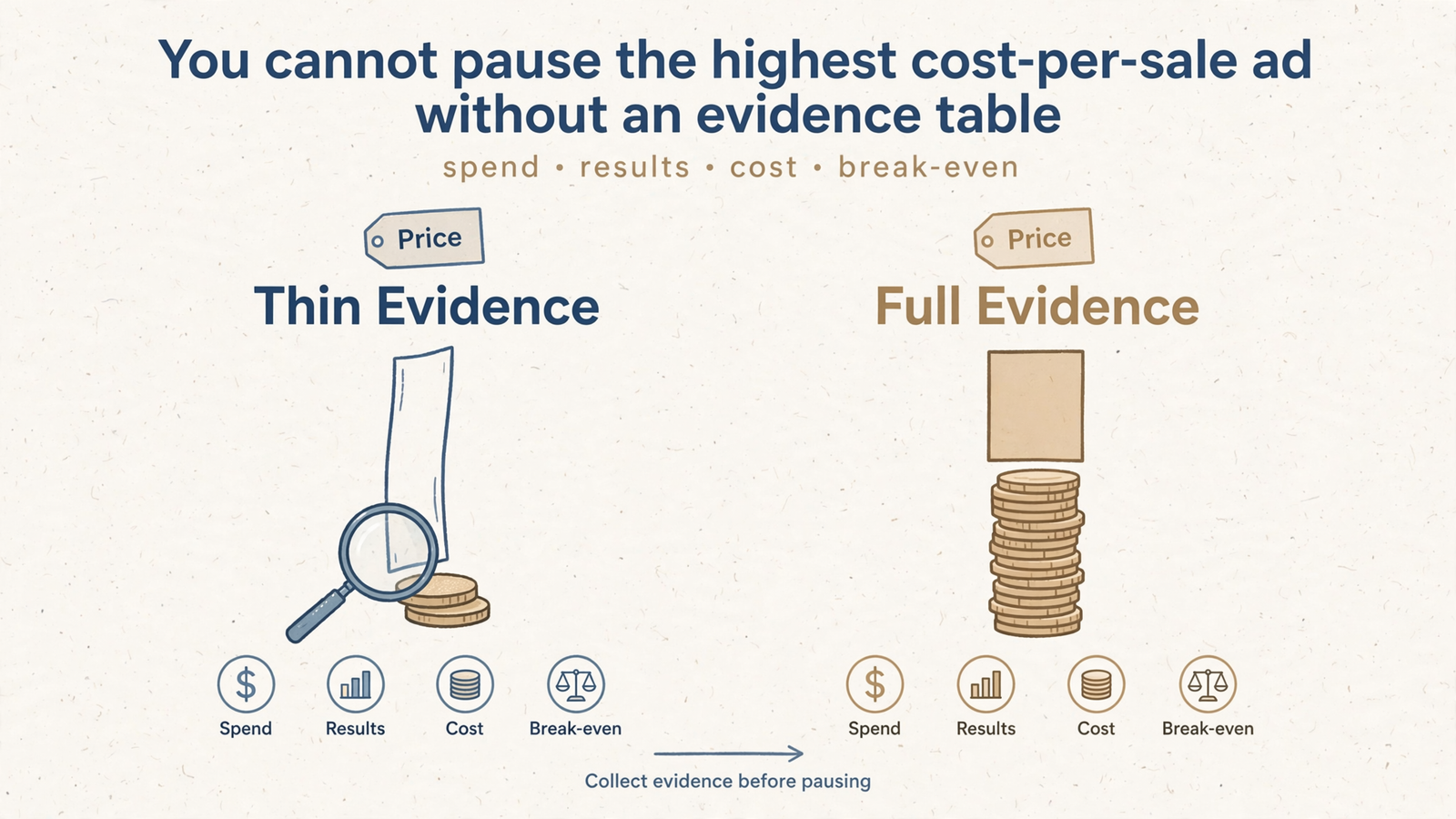
Cost per acquisition is spend divided by purchases or leads. It’s easy to sort that column and call the top row guilty. But the column tells me what I paid for a result, not whether I could afford it. At $40 per sale, I lose money if the sale leaves $30 of margin. The same $40 looks fine if the sale leaves $120. If the sale starts a subscription, the first sale may not tell me what the customer is worth. I want a cost per result judged against the value of a conversion, not against the next row down.
In one back-test of the pause-the-expensive-ones rule, ads at twice the average cost per lead returned as much revenue per dollar of spend as the rest. Some went on to become the best performers. The rule would have cut them because it ranked the price of the lead, not what the lead brought in.
Even with a break-even number, I still need enough results to take the comparison seriously. At a $60 break-even, Ad A is over the line and Ad B is under it. That’s arithmetic. It’s not two equally reliable verdicts.
| Ad | Spend | Results | Cost per result | Break-even | What I’d conclude |
|---|---|---|---|---|---|
| Ad A | $200 | 2 | $100 | $60 | Over break-even, but too few results to pause on this alone. |
| Ad B | $2,000 | 40 | $50 | $60 | Below break-even, with a bigger sample. |
That’s also why I don’t pause on one bad day or a thin sample during the learning phase. I want spend and results beside the ratio, and I want to see the dates before I trust the comparison. Ask for the table, not a winner and a loser:
For each Meta ad, show spend, purchases or leads, cost per result, and the reporting period. Compare cost per result with my break-even of [amount per result]. Flag any ad below my minimum of [result count] as insufficient evidence. Do not label anything a winner or loser, and do not pause anything.
3. “Two good days prove the ad will keep working”
In one archived thread, an advertiser described strong early sales that fell off soon after. The advice they got back was mostly to spend more. I understand the impulse. The first sales are real, and it’s nice to have a number that says the thing is working. But two good days tell me I had two good days. At low volume, they don’t tell me what rate I can count on.
The reverse is just as easy to get wrong. I’ve watched yesterday look bad and look fine three days later. Recent Meta numbers can change as late conversions come in. A conversion can be credited back to the day of the click or view, so a day that looks finished on the calendar can still change in the report. I don’t want ChatGPT comparing a recent day that’s still settling with an older day and treating the difference as a performance trend.
I’d rather look at weekly averages and give changes time before judging them. The three complete weeks in the prompt are a comparison window, not a guarantee that I’ve collected enough results. If an ad barely converted in those weeks, I still don’t have much to go on. That’s why the prompt asks for the count and gives ChatGPT an answer other than “keep” or “kill.”
Compare the last three complete seven-day periods for this Meta account through groas. Show spend, results, and cost per result for each ad in each period. Flag recent figures that may still change. Where the count is below [minimum result count], say “insufficient evidence.” Change nothing.
4. “Expensive ads must be suffering from creative fatigue”
This one sounds like a diagnosis. Costs are up, so the audience must be sick of the image. I used to say it myself. But creative fatigue means repeated exposure may be weakening the response. Frequency is a clue, not a diagnosis. If more people see the same ad again and keep clicking at the same rate, the frequency number alone doesn’t tell me they’re bored.
What I want is a pattern: frequency rising while link click-through falls for five or more days, or click-through down at least 20% from that ad’s own baseline with frequency above 3. Those are reasons to look closer, not reasons to pause. I want to know whether it got more expensive to reach people, whether fewer of them clicked, or whether fewer of the people who clicked went on to convert. All three can leave me staring at the same ugly cost per sale.
- Frequency rises, link click-through falls, and the rest holds. If cost per thousand impressions is flat and post-click conversion holds, fatigue fits the pattern.
- Cost per thousand impressions jumps. I’d look at auction costs before blaming the image.
- Post-click conversion falls. I’d check the landing page and tracking before swapping the creative.
In a Meta split test covering around 26,000 cases, adding materially different creative lifted conversion rate about 8% in high-fatigue cases. Keeping the original running alongside the new creative often beat pausing it. That’s the detail I keep in mind when my first instinct is to kill the old ad. Even when fatigue fits, “add something different” and “turn this off” are separate decisions. For the longer version, here’s how I’d distinguish fatigue from auction costs and thin data.
For each expensive Meta ad, show frequency, link click-through rate, cost per thousand impressions, and post-click conversion rate over time. Tell me what supports fatigue, what contradicts it, and what the account data can’t establish. Don’t recommend a pause while other plausible causes are unresolved. Change nothing.
5. “If ChatGPT recommends a pause, it has paused the ad”
I understand why this one sticks. “I paused the ad” arrives in the same tone as “I recommend pausing the ad,” and I’d like the chore to be over too. But a recommendation isn’t execution, and execution isn’t confirmation. What ChatGPT says in the chat and what Meta shows in the account are two different things.
Before I approve anything, I check whether the setup can actually write to the account. A CSV is a snapshot. A read-only connection can pull data, but it can’t pause an ad. Write access depends on the ChatGPT workspace and its permissions, not just whether the connection can answer questions about spend. Once write access is in place, I want three things, in order:
- Preview. Show me the exact ad IDs, the evidence, and the reason for each proposed pause. I don’t approve “the expensive ones.”
- Approval. Wait for me to approve those IDs. My asking for an analysis is not approval to change the account.
- Confirmation. Check the resulting status in Meta and show me the logged reason for each change. If the status can’t be confirmed, say so.
No ID, no approval. No confirmation, no claim that the ad is paused.
Through groas, list the exact ad IDs you propose to pause, with spend, results, and the reason for each. Do nothing until I reply APPROVE with the IDs. Then pause only the approved IDs, verify each resulting status in Meta, and return the confirmation and logged reason for each change. Flag any pause you can’t verify.
6. “Connecting ChatGPT means leaving it in charge overnight”
This is the myth I have the hardest time killing because it sounds like caution. Connect the account and it’s easy to picture ChatGPT watching spend while I sleep. That picture leads to two opposite mistakes: trusting it to catch a problem nobody asked it to watch for, or refusing to connect at all because it might start making decisions. Access is not ongoing delegation.
The official Meta connection responds when asked; it doesn’t monitor or send alerts on its own. A connection through groas works on request too: ChatGPT can read the account and, with permission, make a change. Autopilot is separate. It can keep working within the limits I set, but it stays off until I switch it on. Connection gives ChatGPT hands. It doesn’t give it the night shift.
Before I hand over that shift, I want a stop-loss proposal I can read without guessing what “protect the budget” means. Which campaigns are in scope? What are the daily and total caps? Which ad IDs can it pause, and which are off limits? I also want to know which changes still require my approval and how to disconnect access through Business Integrations. If those answers aren’t written down, I leave autopilot off. A proposal is useful even if I never enable it.
Draft a stop-loss proposal through groas for [campaign names]. List daily and total spend caps, which ad IDs may be paused, which must never be changed, and which changes still need my APPROVE reply. Explain how I can disconnect access. Enable nothing and change nothing.
groas Unlimited is $19 a month, flat, for unlimited teammates, ad accounts, and websites, with every feature included. That buys the connection. It doesn’t decide what counts as a bad ad.
“Bad” was never a button. It’s my break-even, my minimum sample size, and my permission, written down before ChatGPT touches a single ad.