

 LinkedIn

Most agencies selling a spot in ChatGPT answers will not tell you this: you can check nearly every claim yourself before you pay them. Plug your own AI into groas, ask it to pull the answers and citations groas tracks for your brand around the clock, and hold each sales line against that data. After years of mining search terms at 1am, I trust the account over the deck. Same rule here.
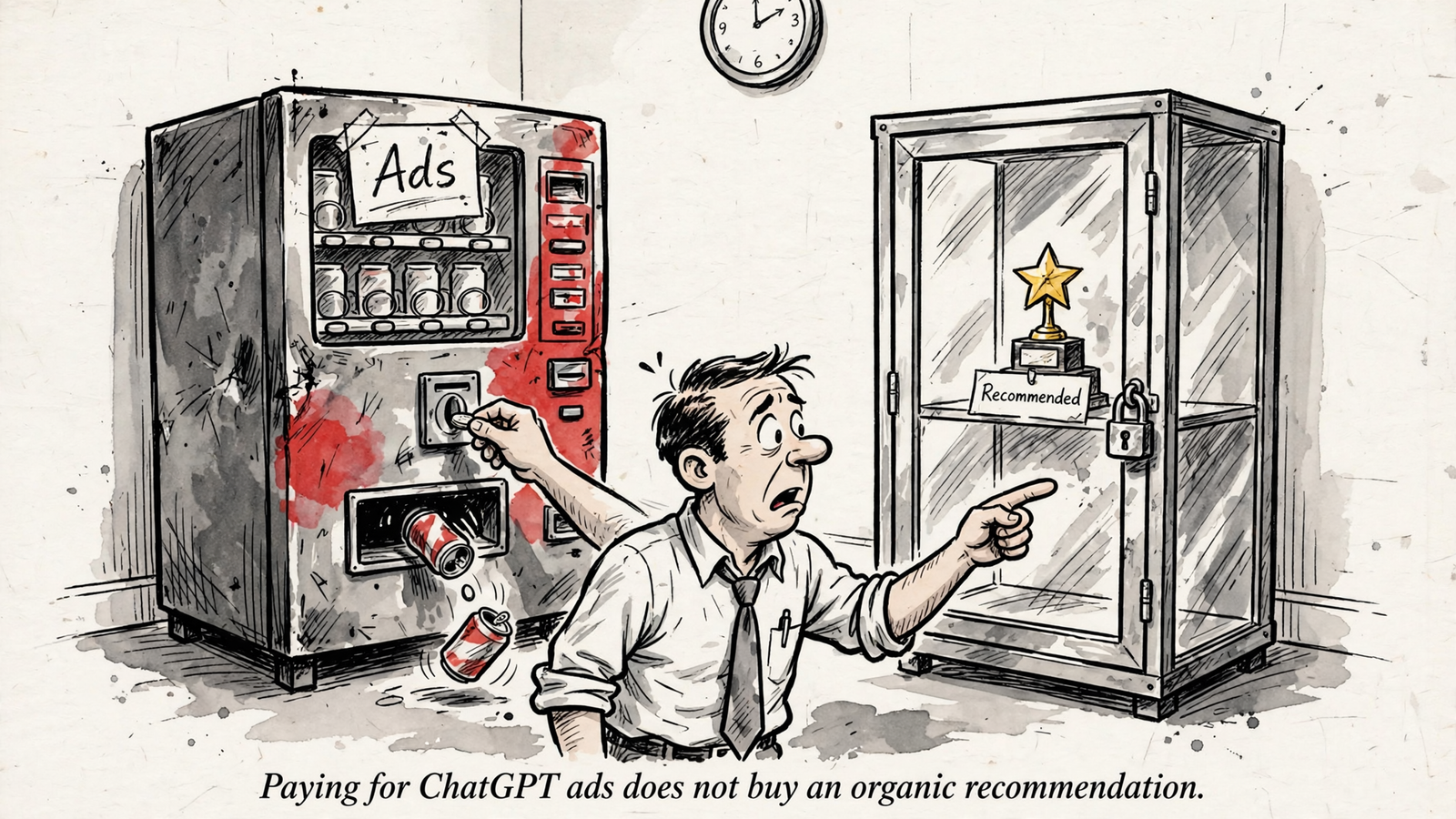
1. “Paying for ChatGPT ads gets me into its recommendations”
People believe this because it feels logical. Paid and organic results share a screen, so surely spending money in one place buys goodwill in the other. I heard the same question managing Google Ads: would a bigger ad budget lift organic rankings?
No. Buying one placement did not buy the other.
OpenAI’s position, quoted in this guide, is that ads do not influence answers, run on separate systems, and are labeled and visually separated. Advertisers cannot pay to shape, rank, or alter a response. The auction lives in one box. The recommendation lives in another.
Ad performance and organic recommendations belong in separate reports. A paid campaign can have its own job. Getting named in an unpaid answer is not that job, however conveniently a proposal bundles them together.
Test it before signing: ask your AI to pull the answers groas tracks for your brand, then keep two columns:
- Paid: impressions and spend.
- Organic: brand mentions, citations, and recommendations.
If a provider says ads improved recommendations, ask them to show the change in the organic column and explain why they attribute it to the ads. Two numbers rising together is not an explanation.
Buy ads for what the ads deliver. Do not pay an organic-visibility premium for them.
2. “SEO, AEO, and GEO are three completely separate jobs”
People believe this because it arrives as three line items on a proposal, each with its own monthly fee. The acronyms look distinct. So do the invoices.
For most local and small businesses, much of the underlying work overlaps:
- A crawlable website.
- A complete Google Business Profile.
- Reviews and directory listings.
- Consistent business name and address details.
- Pages that answer the questions buyers actually ask.
One guide to local visibility puts the distinction plainly: much of the work overlaps; the difference is where the result is checked. A search ranking and being named or cited across repeated AI answers are different outcomes. That does not automatically make every task behind them a separate job.
What the deck calls synergy, I call two people doing the same job.
A separate fee needs separate work, not just a separate acronym. An agency selling GEO as an additional service should identify what it adds beyond the existing SEO scope.
Test it: ask your AI to pull your tracked answers and map each proposed deliverable to a buyer question it is intended to address. Then look for duplicate work across the retainers. If three retainers map to the same five pages, ask what the other two are buying.
3. “If ChatGPT cites my website, it recommends my business”
This one stings because a citation feels like a win. Link under the answer. Screenshot forwarded to the boss. Small celebration in the reporting call.
But a citation, a mention, and a recommendation tell me different things:
- Cited: a page appears as a linked source.
- Named: the answer mentions the brand.
- Recommended: the answer presents the business as a suitable choice.
This explanation of citations versus brand mentions makes the distinction useful: a page can be cited without its brand being named, and a brand can be named without being recommended. Recommendations usually need corroboration across sources, not merely a retrievable page.
A source link can mean the answer found useful information on a website. It does not necessarily mean the answer thinks someone should hire that business. I would not let a reporting dashboard quietly substitute one for the other.
A citation is evidence of source use, not automatically buyer consideration. That is the gap behind why ChatGPT can cite a website without recommending its business.
Test it: have your AI separate the last 30 days of tracked answers into cited, named, and recommended. Keep the answer text attached so the classification can be checked. Those categories can overlap; the point is not to force every answer into one exclusive bucket.
If citations rise while recommendations stay flat, the report should say so. That is a different problem from not getting retrieved at all, and it deserves a different proposal.
4. “One screenshot proves the agency got me recommended”
People believe this because a screenshot looks like a ranking report. There is the question. There is the brand. Sometimes there is even a little number beside it. Very official.
The problem is that answers vary between runs. One capture proves that one answer appeared, not that buyers reliably receive it.
A SparkToro and Gumshoe study from January 2026 ran 2,961 answers and found that the same brand list returned in fewer than 1 in 100 runs, and the same list in the same order in about 1 in 1,000. A Cleareo test covering 1,830 answers across towns and tools found that the first-named business changed between runs in 36% of 906 pairs, rising to 45% for ChatGPT alone.
That is why I want a rate over repeated runs, not a winning moment.
The useful version is boring: fixed buyer questions, repeated runs, consistent conditions, tracked over time. Boring is fine. I used to mine negative keywords at 1am. I am not shopping for entertainment in a measurement method.
Test it: ask your AI to pull the tracked answers for five important buyer questions across at least two runs and two engines. For each question, report:
- How often the brand is cited.
- How often it is named.
- How often it is recommended.
- Which competitors appear alongside it.
Keep the engines separate in the report before combining anything. Otherwise, a change in where the tests ran can look like a change in performance.
For the setup, use this method for building a fixed, buyer-led citation test for ChatGPT and Perplexity. A 60% mention rate across four weeks tells me more than a screenshot. It still needs the prompt set and run count beside it.
5. “Publishing more pages automatically makes me more recommendable”
I understand the appeal. More indexed URLs feel like more lottery tickets. A content calendar also makes a reassuring deliverable: twelve pages commissioned, twelve pages published, twelve boxes ticked.
The trouble starts when every page says something slightly different about who the business serves. Volume can dilute per-URL authority and entity clarity rather than strengthen them. More output is not the same as a clearer answer.
Nor do ordinary rankings map neatly onto AI citations. One study of 55,393 queries found that about 30% of AI-cited domains did not appear in the accompanying first-page organic results. That does not make rankings irrelevant. It does mean I would not use page count or blue-link rankings as a substitute for checking the actual answers.
Buyer-question coverage is the useful target, not publishing volume. One page that answers a real question with prices, scope, service area, and proof beats ten thin variations that dodge it.
Test it: ask your AI to list the buyer questions represented in groas’s tracked answers for your category. Match every proposed page to one of those questions, then check whether an existing page already answers it.
A new page should have a job beyond giving someone something to publish on Thursday. If the proposal cannot name the question and the proof the page will carry, I would send it back.
No question, no page.
6. “Giving AI crawlers access guarantees they will use my content”
People believe this because the fix looks technical and therefore final. Unblock the bot, get the traffic. There is probably a green checkmark somewhere.
I have spent enough time with account diagnostics to distrust a green checkmark that claims to explain the whole outcome. Allowing an AI crawler makes retrieval possible; it does not guarantee indexing, a citation, a recommendation, or particular wording.
OpenAI separates ChatGPT search discovery through OAI-SearchBot from training crawl through GPTBot. Permission for one purpose is not permission for every purpose. Firewall rules, CDN blocks, or a robots.txt file covering only one hostname can also leave a fetch blocked after the supposed fix.
Even successful access is only the beginning. The pipeline still includes discovery, fetching, parsing, chunking, and selection against other sources.
Access is a prerequisite, not a placement. I want the technical work done, but I do not want its completion sold back to me as a recommendation result.
Test it: compare the tracked AI answers with fetch logs, supplying the logs to your AI if needed. Separate the questions:
- Is the relevant crawler allowed?
- Is it actually fetching the key pages?
- Are those pages appearing as sources in tracked answers?
- Is the business being recommended?
If a page is allowed but not fetched, investigate discovery and access before declaring the job finished. If it is fetched but not cited, permission alone does not explain the gap. Review the page and the sources being selected instead.
Fix the broken step. Do not keep selling the first one.
7. “A reputable agency can guarantee the recommendation”
This is the one I find hardest to kill. It sounds like confidence, and it offers exactly what a first-time buyer wants: certainty.
Nobody at the agency controls that answer box. Answers vary, and the model draws on sources the agency does not own. That is why no one can guarantee a ChatGPT recommendation.
The same buyer guide lists the tells I would treat as walk-away signals:
- A guaranteed top spot.
- One screenshot offered as proof.
- Hidden prompt injections.
- Hundreds of AI-written pages presented as the strategy.
- A long contract demanded before anyone shows a baseline.
Buy accountable implementation and transparent measurement, not a promised answer. The work can be specific: pages fixed, directory facts corrected, reviews earned, changes logged. The measurement can be specific too: for example, a mention rate moving from 10% to 40% across repeated runs. Those are illustrative numbers, not a forecast anyone gets to paste into a guarantee.
Here is how I would run the check. Connect the ad accounts and website once, plug groas into the AI already in use, and ask in plain English:
Show my mention rate for these ten buyer questions over the last 30 days. Separate citations, brand mentions, and recommendations. Show the underlying answers and what changed after each site fix.
That last part matters. groas keeps every change logged with its reason, with one-step undo, so the work is inspectable rather than buried inside a monthly summary. A log does not prove that a change caused an outcome. It does show what actually changed, which is a useful improvement over ongoing optimization as an invoice description.
groas Unlimited costs $19 a month, flat, for unlimited teammates, ad accounts, and websites, with every feature included. For businesses that want to hand over the work, Done For You starts at $5,000 a month. Neither option removes the need to read the answers before believing the rate.
The six questions I would send before signing
- What will you test? Which ten buyer questions, in which apps, with how many runs each, logged out or in?
- What is my baseline? Show the current mention rate from tracked answers over time, with the answers attached. Not a screenshot.
- What am I buying? Which deliverables are paid ads and which are organic? If I pause spend, what stays?
- Why does each page exist? Which buyer question will it answer, and what proof will it carry?
- Can the content be retrieved? Are the key pages actually fetched today? If not, what access or discovery problem will be investigated first?
- How is the work accountable? What ships in the first 30 days, how is each change logged, how can I undo it, and how will enquiries be measured?
Ask your own AI to pull the answers and citations groas collects around the clock, then run the pitch through those six questions. If it survives, it might be worth paying for. A provider who will not put the answers in writing is selling hope at 2015 prices.
I would rather have my claims tested the same way, with the data in front of me. I still want a human owning the outcome. I just do not want to pay someone to tell me I was recommended because one screenshot said so.
I check the data first. Then I decide who earns the work.


