

 LinkedIn

Say your garage door repair business in Dallas publishes a spring-repair guide. ChatGPT cites your explanation, then recommends a competitor when someone asks who to hire.
Your page supplied the answer. Their business made the shortlist.
The starting fact is simple: being useful as a source and being selected as a supplier are different jobs. One analysis of 3,981 domain appearances found 61.7% were cited but never named, and only 13.2% were both cited and mentioned. Your educational page can win attention without putting your business in the buying conversation.
That distinction matters before you hire anyone to increase your citation count. More of the first outcome does not necessarily buy you the second.
Separate the citation, the mention, and the recommendation
I keep three outcomes apart when I read an AI answer:
- Source citation: your URL appears as supporting evidence.
- Brand mention: your business name appears in the answer.
- Supplier recommendation: your business is presented as an option to hire.
These can overlap. They are not interchangeable.
In our Dallas example, your spring explainer gets the citation. A competitor with 400 reviews, a clear Dallas service-area page, and appearances on two local best-of lists gets the recommendation. You supplied the explanation. They supplied evidence of a buying choice.
Even a brand mention does not settle this. Seeing your name in an answer is not the same as seeing your business offered to the buyer. Count the role your business plays, not just whether its name appears.
The glossary of mentioned, cited, or clicked gives the broader vocabulary. For this problem, those three distinctions are enough to stop a good-looking report from answering the wrong question.
The prompt changes the evidence the answer needs
Ask ChatGPT, “How does a torsion spring work?” and the task is explanatory. It needs a clear account of the mechanism and a source to support it. Your Dallas page can do that job well.
Now ask, “Who should fix my garage door in Dallas?” The task changes. The answer needs suppliers a stranger might trust with house access, pricing, and a warranty. A paragraph about springs cannot establish those things.
The observed patterns reflect that difference. Informational queries such as what is or explain carry an 89.3% citation rate but only an 18% mention rate. Comparative queries such as best or vs carry a 43.3% mention rate, about 2.4 times higher.
Those are mention rates, not recommendation rates. Still, they show why treating every appearance as the same kind of visibility makes little sense. The question changes the job your evidence must do.
A supplier question needs evidence that you do the work
For “Who fixes garage doors in Dallas?”, the clearest paragraph about springs is no longer the main requirement. Relevant buying evidence includes:
- A service page naming Dallas and the surrounding suburbs you serve.
- Hours, availability, and emergency-service terms.
- Pricing or warranty language.
- A phone number consistent with your Google Business Profile.
- Reviews that describe the same service.
If your explainer supplies none of that, its success on the previous question does not resolve this one. The missing information is commercial, not educational.
My practical test is straightforward: can a buyer establish that you offer this service, in this place, on terms they can assess? If not, another explanation of spring mechanics leaves the gap intact.
A comparison question needs reasons to choose
Now ask, “What’s the best garage door repair in Dallas under $300?” The answer has another job: compare options against a budget and explain why one might fit better.
Price, availability, and proof become central. If your site never states a price range, never explains repair versus replacement, and never appears in third-party material the model can cross-check, it supplies little basis for that comparison.
Useful does not mean comparable. Your guide may explain the fault perfectly while leaving the buyer unable to judge your offer.
That is how the same business can be cited for one question and absent from the next. The topic stayed the same. The decision changed.
Give the buyer evidence your explainer cannot supply
I used to tell clients that a great explainer would pull double duty: rank, get cited, and bring in jobs. I was wrong to treat those as one outcome.
A page can answer the educational question while a competitor supplies the buying choice. The answer can cite you in footnote 7 and recommend someone else in the headline. There is no requirement to award both roles to the same business.
Your spring guide may never say whether you serve Dallas, offer same-day service, charge within the buyer’s budget, or provide a warranty. None of those omissions makes it a bad guide. They make it incomplete evidence for hiring you.
The fix is not automatically another informational post. I would look for missing connections between the explanation and the business behind it:
- Identity: a consistent business name and category across your site and other listings.
- Offer: service and comparison pages that state scope, location, and commercial terms.
- Corroboration: reviews, directories, and relevant lists that confirm what you do.
- Technical clarity: accessible pages and Organization, Service, and FAQ schema that help connect the information to the company.
These support the buying decision your explainer was never built to answer. They do not guarantee inclusion.
Keep the useful guide. Fix the missing buyer evidence. Rewriting the definition again is busywork if the unanswered question is whether you can do the job.

Test ChatGPT and Perplexity as separate systems
Once the evidence is clear, the next question is where to test it. I see owners run one prompt in ChatGPT, check whether they appear, and call that AI visibility. That result does not tell them how they appear in Perplexity.
The engines can draw on different kinds of sources for the same buying question. In Onely’s October 2026 test of 31 best-agency prompts, ChatGPT with web search cited the named brands’ own sites for 119 of 210 citations, about 57%. Perplexity cited listicles for 395 of 561, about 70%.
A Geovate audit of more than 100 identical prompts found another difference: ChatGPT leaned toward Wikipedia, Forbes, G2, and .edu sources, while Perplexity leaned toward Reddit threads, YouTube comments, Quora, and LinkedIn discussions.
These are observed preferences, not permanent rules. The practical point is narrower: do not treat one engine’s result as a proxy for another’s.
For the Dallas shop, I would run the same buyer questions in both tools, then record:
- Which businesses the answer recommends.
- Which pages it cites.
- What those pages establish about the recommended businesses.
That third step turns a visibility check into an evidence check. A count tells you that you lost. The cited material helps you investigate what the answer had available when it chose someone else.
Keep two scorecards. “AI visibility” is too broad to diagnose this problem.
Hire for the evidence gap, not a bigger citation total
This is where too many proposals solve the wrong problem. The agency shows a dashboard with citation counts going up and calls that progress. Your Dallas spring page goes from 12 citations to 40. Your share of Dallas buyer shortlists stays at zero.
You bought more of what you already had.
The missing outcome was a supplier recommendation, not another source citation. To pursue that outcome, the work has to address evidence about your business as a supplier.
Analysis cited by Growth Room found that at least 92.7% of brands ChatGPT recommended appeared in the content it cited. It also found that a brand present in six or more cited URLs was six times more likely to be recommended than one present in only one.
That does not make six mentions a recipe. It does make one helpful page a poor substitute for corroboration across sources. The question is whether those sources establish that the same business does the relevant work in the relevant location, on terms the buyer can evaluate.
For our Dallas shop, I would organize the work around three gaps:
- Buyer pages: service scope, service area, price range, availability, and warranty.
- Technical access: whether assistants can fetch the pages containing that evidence.
- Outside corroboration: reviews, directories, and relevant lists that identify the same business, category, and location.
Then I would track source citations and supplier recommendations separately on the same buyer prompts. If citations rise while recommendations stay flat, source visibility has improved. That alone does not show the buying-evidence problem is fixed.
This is the distinction behind the piece on being cited while a competitor gets recommended. A report that blends the two outcomes hides the very gap the work is supposed to close.
Ask an agency to name the buyer questions you lose
If a proposal promises citation growth and stops there, I pass. For our Dallas shop, the explainer already earns citations. I want the provider to identify what prevents the business from appearing in buyer answers.
Ask for the missing questions, the missing evidence, and the work to connect them. Not a bigger blended visibility score.
My brief would be:
- Show me 10 buyer prompts where we are cited but not recommended, split by ChatGPT and Perplexity.
- Identify which service, location, price, or proof each losing prompt needs that our available evidence does not supply.
- Tell me what you will change first, second, and third, and what you will leave alone.
- Report source citations and shortlist recommendations separately on those same prompts every month.
A useful response sounds concrete: the spring guide earns citations, but the business is absent for “garage door repair Dallas” and “best garage door repair under $300.” The proposed work is to rebuild the Dallas service page with scope, same-day terms, price range, and warranty; clean up name and phone consistency; and earn two independent mentions confirming the service.
That is a plan I can interrogate. “Improve your AI authority” is a phrase I can put on a slide.
It is also the standard I expect from groas: buyer pages, technical access, and outside corroboration, with actions logged and one human strategist accountable. Not a monthly PDF celebrating mention counts while the buyer shortlist stays unchanged.
No honest provider can promise that shortlist. Models draw from shifting sources, engines weigh those sources differently, and an answer can change when a list updates or a competitor publishes clearer pricing.
A provider can commit to something narrower and more useful: the prompts it will track, the evidence it will address, the changes it will ship, and separate reporting on the two outcomes. Buy accountable work, not guaranteed inclusion.
Apply the model to a different buying decision
Now take the garage doors out of it. Say you sell invoicing software and your guide to e-invoicing rules gets cited weekly. A buyer asks for the best invoicing tool for a 10-person agency under $50 per month. Your product disappears.
I would work through the same layers:
- Identify the job the guide won. It explained the rules. That is a source role, not proof that the software fits this agency.
- Extract the buyer’s constraints. The answer needs evidence about user count, price, supported countries, integrations, and migration help.
- Look for corroboration. Other sites need to establish that agencies of this size use the product, rather than merely repeat its definition.
- Check each engine separately. Inspect the documentation, review sites, or owner discussions actually cited instead of assuming the same evidence wins everywhere.
If the only measure is weekly citations, the obvious response is to publish more guides. But that response starts with the report, not the buyer’s unanswered question.
If the measure is recommendations for that specific agency prompt, the work points elsewhere: a comparison page, clear pricing, and outside proof that helps establish fit. The existing guide can stay useful without carrying a sales job it cannot perform.
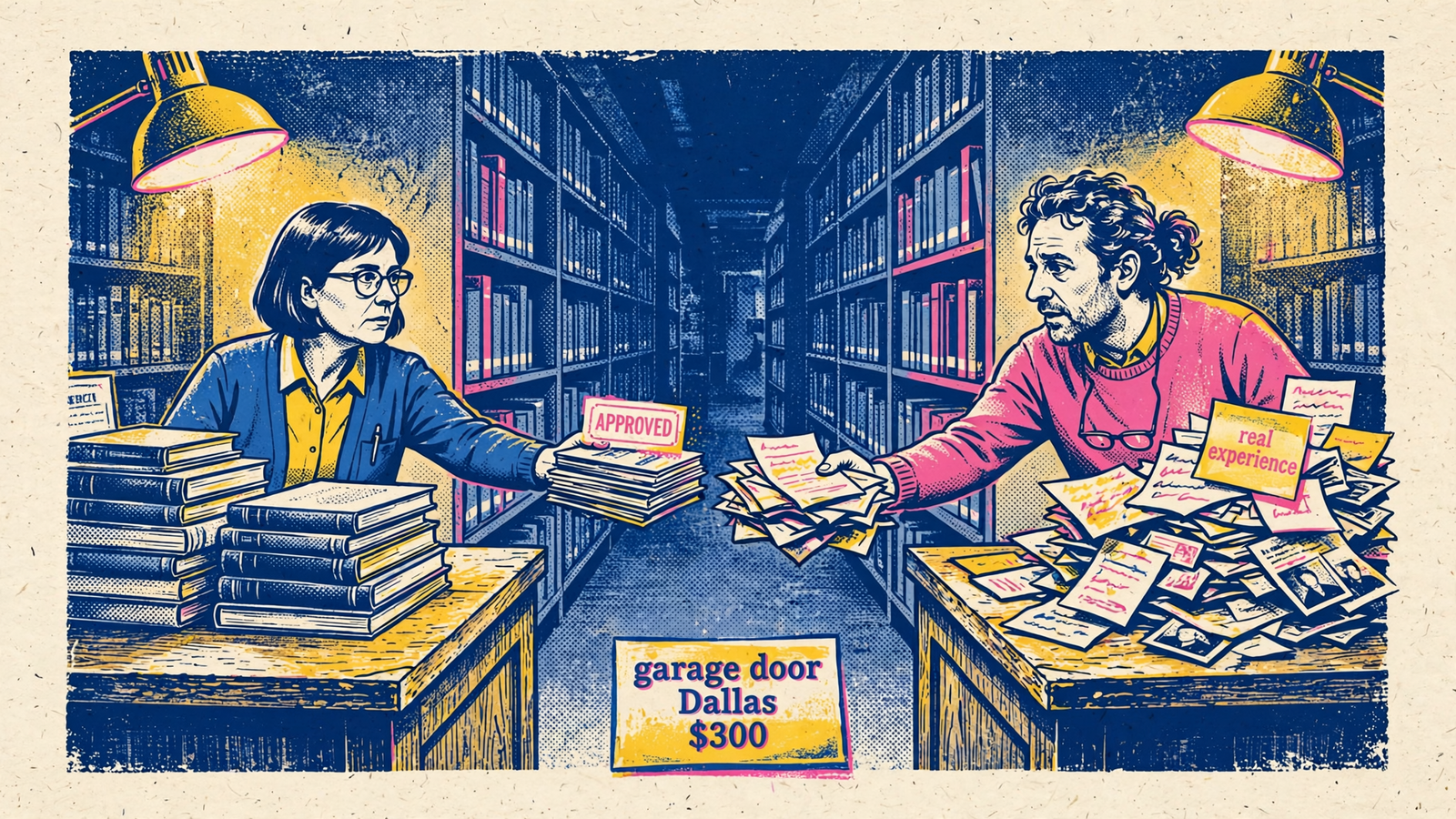
Citation counts tell you the library stocks your book. Recommendations tell you someone hands it to the buyer.


