

 LinkedIn
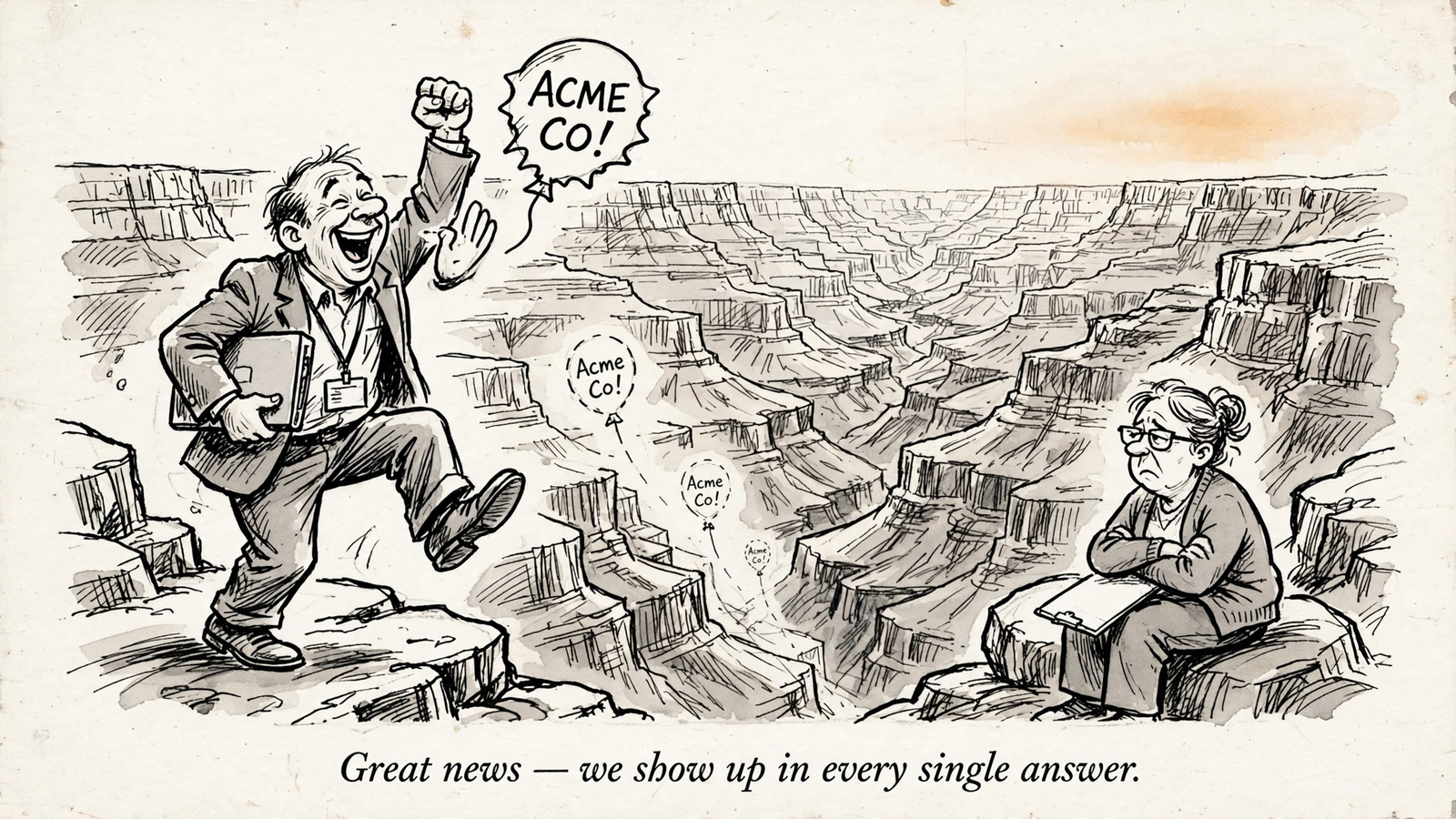
A polished ChatGPT answer about your company does not mean it recommends you to buyers. If your manual checks disagree with your AI visibility tracker, you may be asking different questions and calling them the same test. This list is for marketers staring at three contradictory answers: seven fixes to separate discovery, mentions, recommendations, and citations, with the requests I would make in Claude through groas to inspect the evidence.
1. Replace your brand-name question with buyer questions
Asking ChatGPT about your company by name tells you almost nothing about discovery. You supplied the name. The useful question is whether it appears when a buyer does not.
One dataset tracking 232,838 answers found brands mentioned in 77.3% to 96.5% of branded answers but only 2.4% to 4.8% of unbranded answers, a gap of 74 to 94 percentage points across engines. A branded check tests recall. An unbranded buyer question tests whether you enter the conversation without an invitation. Whether you get recommended once you appear is a separate question.
Pool those tests and the result can look reassuring while saying very little about discovery. A mostly branded panel can report 60% visibility while you appear in fewer than 1 in 20 buyer searches.
Compare “What does this company do?” with a buyer explaining that they spend $20k a month and need someone to fix their tracking. Those are not interchangeable checks. One asks the assistant to describe a business. The other asks it to find a solution.
My first step is to split the panel and keep both groups visible. In Claude through groas, I would ask:
Show my branded prompts separately from my category and problem-led prompts, with per-group mention rates and the full prompt text. Do not average the groups together.
If branded visibility is 90% and buyer visibility is 3%, that is a discovery problem, not a tracking disagreement. Keep the branded checks, but stop using them to answer the buyer question.
2. Separate a mention from an actual recommendation
A report that counts every name-drop as a win can look healthy while buyers get sent elsewhere. Your name appears. Your business does not make the shortlist.
The distinction is straightforward: a mention means the brand is named in the text; a recommendation means it is put forward as a choice on a question that did not name it.
The classic failure is an answer that cites your guide as a source but recommends a competitor for the job. You contributed to the answer. You were not the answer. That is useful visibility, but it is not evidence that the assistant recommends your business.
This is where a screenshot becomes a poor reporting system. A highlighted brand name draws the eye away from the sentence that matters: who the assistant actually suggests hiring or buying from. I want the whole answer beside the label, not a reassuring crop.
First, ask Claude through groas to classify the tracked answers:
Classify each tracked answer as incidental mention, substantive recommendation, or no mention. Keep the full answer text beside the label so I can check the classification.
That gives you a way to challenge the report. If the label says “recommendation,” you should be able to point to the words that put your business forward as a choice.
For buyer prompts, make recommendations the headline number. Mentions are context. Do not let a name-drop do the work of a referral.
3. Count citations separately from brand mentions
An answer can name your business without linking to it. It can also use your content as a source without recommending your business. Those are different outcomes, and neither should disappear into a general visibility score.
A mention names your brand in the text; a citation uses your content as a source through a link or named attribution. The first tells you the name appeared. The second gives you evidence of source use. Neither, by itself, tells you that the assistant put you forward as the buyer’s best choice.
That split shows up in the numbers. Across 6,457 readings, the mention rate was 24.3% against a strict citation rate of 4.4%, making citations roughly 5.5 times rarer.
Engine behavior widens the gap: Perplexity returned a source list on 65.8% of answers while Gemini did so on 11.4%. A low citation count on Gemini does not, on its own, prove your content failed. The engine’s tendency to provide sources matters too.
My first step is to ask for separate fields:
Return mention, recommendation, and citation separately for each tracked answer. Include source URLs where available, and retain the answer text.
Now the report can distinguish three situations that otherwise look like the same result: your name appeared, your business was recommended, or your page was used as a source. It can also show when more than one happened.
Do not treat a mention, a recommendation, and a citation as interchangeable wins. Decide which outcome you need before deciding what to fix.
4. Break the blended score into separate engine results
One blended score hides where you are weak. ChatGPT can mention you while Gemini and Perplexity say nothing, and the average can still look respectable. Respectable is not especially useful when you need to decide where to investigate.
The systems also differ in when they look things up. Claude determines when to search per prompt, OpenAI models can choose to search, and Google says AI Mode and AI Overviews responses and links will vary.
These are separate systems with separate retrieval habits, not four windows into one ranking. Pool them without explanation and a strong result in one place can cover a blank elsewhere. Your manual check may disagree with the headline simply because you checked the engine the average concealed.
First, I would ask Claude through groas to break the report apart:
Report ChatGPT, Perplexity, Gemini, and Google AI Overviews as separate per-engine rates on the same prompts. Label missing observations as unavailable instead of scoring them zero.
That last instruction matters. A zero says the engine answered and skipped you. Unavailable says there was no comparable observation. Those call for different responses: one is a visibility result; the other is a measurement gap.
Keep the engine label attached when you compare a manual answer with a saved observation. Otherwise, you are back to grading different tests as one.
If one engine carries the average, inspect the engine results before acting on the average. A blended number should not hide the work you need to do.
5. Freeze the prompt panel and date every observation
Change three prompts, drop one that never mentions you, add a fresh one that does, and the chart slopes up. Nothing in the market had to move. Your test moved.
Normal answer variation makes that harder to spot. In one repeat test of 50 prompts across 4 engines, run twice 23 minutes apart, only 60% of non-empty pairs returned the identical brand set, and only 41 of 200 pairs cited exactly the same domains. The tracked brand’s presence flipped 9 times in the same setup.
A different answer is not automatically evidence of a broken tracker. It may be another sample from a system that does not return the same answer every time. One screenshot cannot tell you which explanation applies.
The first step is boring, which is usually a good sign in measurement:
- Freeze the prompt list used for comparisons.
- Version the panel when you change it.
- Stamp every observation with its capture date.
- Keep repeat-run variation separate from the trend.
In Claude through groas, I would ask:
Compare only saved observations on identical prompt text. Flag prompt changes, missing runs, and capture dates, and show repeat-run variance separately from trend.
There is a limit to this discipline. A fixed set of twenty buyer prompts is a sample, not the market. It measures progress on the questions you chose, not the hundred variations you did not. I would treat it as a control panel for progress, revisit it each quarter, and version the changes rather than quietly rewriting the past.
If the prompt changed, it is a new test, not proof of improvement. Keep comparisons stable without pretending your panel represents every buyer question.
6. Check that each brand match is actually you
If your company shares a name with a common word, a place, or another business, some of your apparent visibility may belong to someone else.
One identity audit found 57 classified mentions, with only 70% about the right business, 8 confused with another entity, and 6 unresolvable. Shared names such as Summit create an obvious risk. So do new, small, or renamed brands without a clear domain and product anchor.
Simple string matching cannot settle identity. It sees the name and counts it; it does not establish whether the description, domain, or product belongs to your business. A manual check can make the same mistake if you stop reading as soon as your name appears.
My first step is to give the check enough context to distinguish the company from its namesakes:
Inspect every ambiguous match against my company, domain, and product context. Keep unresolved cases labeled uncertain instead of counting them as wins.
I want to see why a match was accepted, especially when the answer describes an unfamiliar product or points to a different domain. An uncertain label is not a reporting failure. It is better than quietly converting an unresolved identity into a positive result.
A smaller true number beats a larger borrowed one. Resolve who the answer describes before celebrating that it contains your name.

7. Put the denominator beside every visibility number
“50% visibility” sounds decisive until you learn it means one of two answers. The percentage is doing rather more presentation work than measurement work.
Start by separating two metrics that often get treated as synonyms:
- Visibility: answers naming your brand divided by all answers.
- Share of voice: your mentions divided by all tracked-brand mentions.
Those different denominators produce different results. Across the same 240 answers, one example brand had 22.1% visibility but 32.3% share of voice: 53 of 164 mentions. Adding a competitor to the tracked set can change the shares without changing a single answer.
That is arithmetic, not performance. If the denominator or tracked competitor list changes, the percentage alone cannot tell you whether anything improved.
First, ask Claude through groas to expose the calculation:
Show the numerator, denominator, prompt set, and counting rule for every rate. Report answer-level visibility separately from mention share.
If you cannot see what was divided by what, you do not have an auditable metric. You have a number you are being asked to trust.
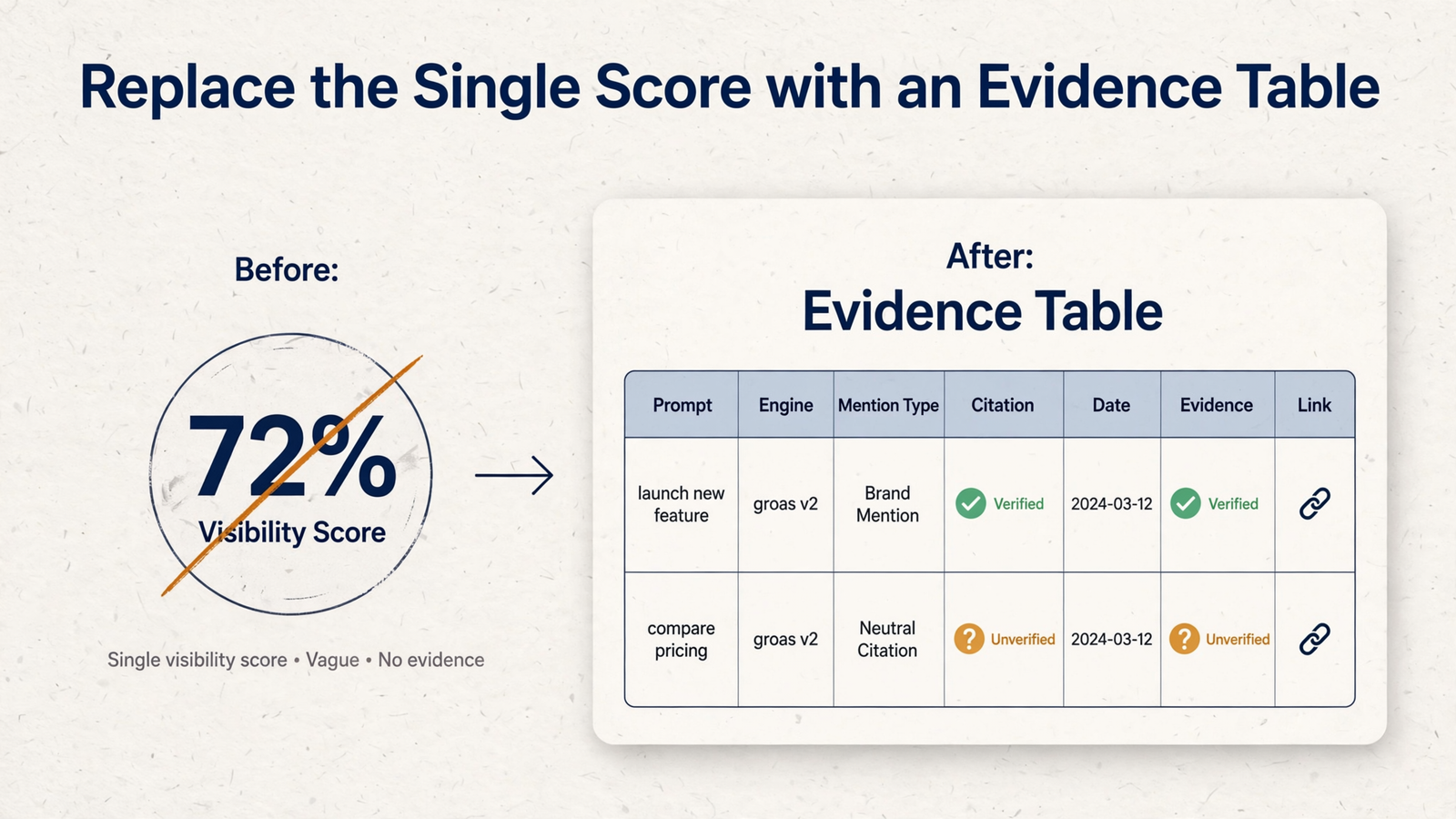
I would take that request one step further and ask for the evidence table behind it. Each row should represent one prompt on one engine on one date, with these eight columns:
| Column | What I want to inspect |
|---|---|
| Prompt text | The exact question asked |
| Engine | Which system produced the answer |
| Capture date | When the observation was saved |
| Brand match | Yes, no, or uncertain |
| Mention type | How the brand appeared |
| Recommendation | Whether it was put forward as a choice |
| Citation URL | The source link, where available |
| Uncertainty note | Anything that prevents a confident reading |
That layout makes disagreements inspectable. You can see a mention without a recommendation, a citation pointing elsewhere, or an unavailable observation instead of a zero. The headline no longer gets to hide the evidence beneath it.
My request in Claude through groas would be:
Build this table for my saved prompt panel, one row per prompt per engine with dates and citation URLs. Keep uncertain matches labeled and missing observations marked unavailable.
For the setup, start with your first AI search tracker in Claude. For the classification question, read Does ChatGPT Recommend Your Business?. groas supplies the tracked answers and citation data Claude reasons over for $19 a month, flat for the team. That is measurement infrastructure, not a promise of rankings or citations.
If I were starting today, I would start with No. 1: split branded prompts from buyer prompts. It has the largest swing in the data here, reframes the other checks, and answers the question I care about: does the assistant recommend us when the buyer never types our name? Run that split first and keep both groups visible for a month. Contradictory checks do not necessarily mean the tracker lied. Before replacing it, make sure you are asking it and your manual checks the same question.


