

 LinkedIn

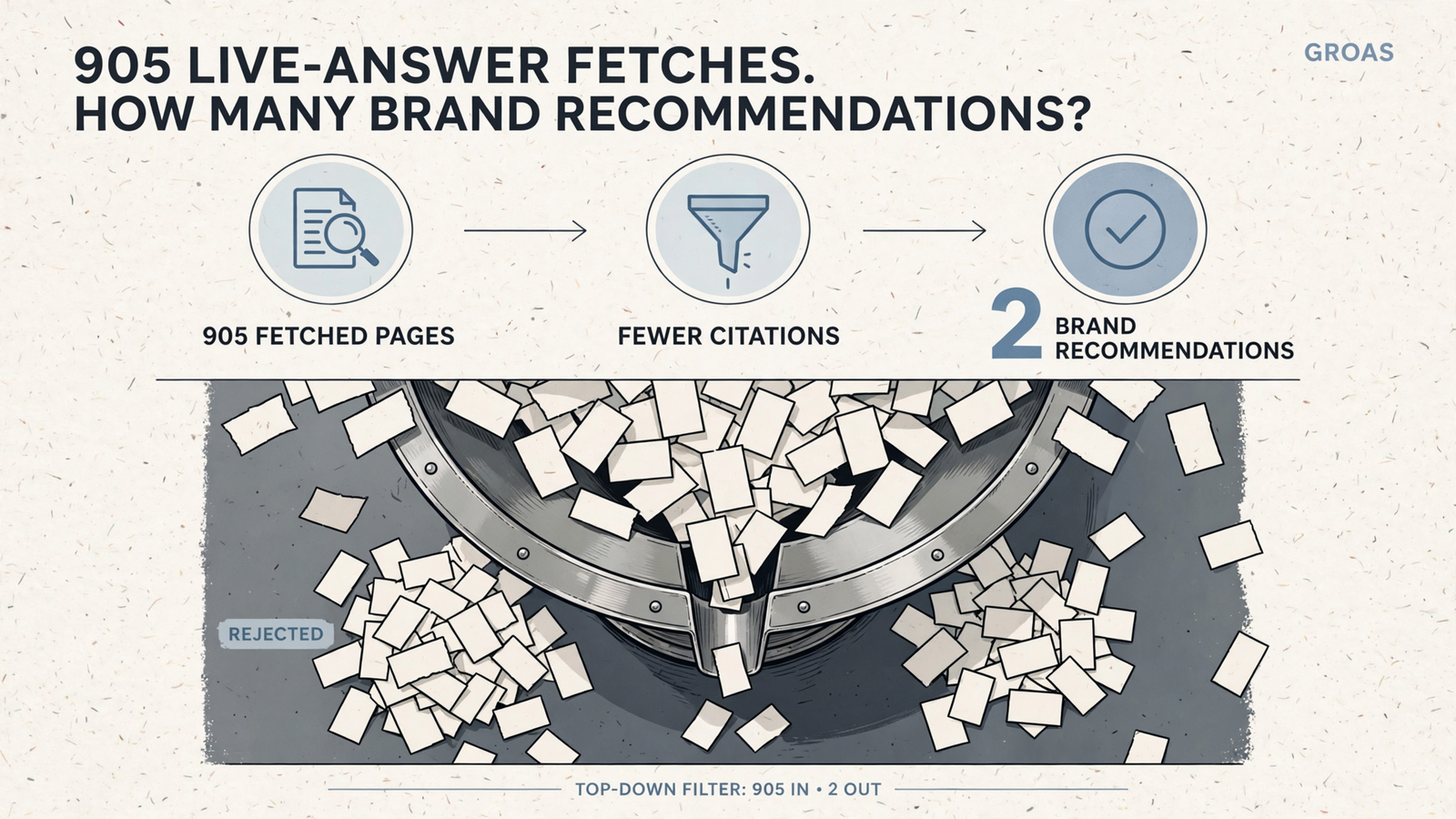
905 live-answer fetches do not establish a single brand recommendation. Two groas articles recorded that many verified live-answer fetches in the supplied measurement window. Assistants retrieved the pages while answering questions. Whether they cited those pages, named groas or recommended us is a separate measurement.
That gap is the whole argument. If you are paying for ongoing SEO and AI-search management, evidence that an assistant fetched your content is useful. Evidence that it recommended your business is different. Your report needs both.
I have read server logs like a vote count before. I was wrong. In one study of 15,000 ChatGPT prompts, the assistant retrieved 548,534 pages but cited only 15% in its final answers. That study does not tell us what happened to the groas pages. It shows why retrieval alone cannot answer the question.
A fetch puts you in the candidate pool. A citation puts your source on screen. A recommendation puts your company on the shortlist. Those are not interchangeable wins.
What the 905 fetches actually establish
The supplied groas crawler report records the following activity for two Google Ads articles:
| Page | Total hits | Verified hits | Live-answer fetches |
|---|---|---|---|
| Google Ads updates page | 850 | 833 | 513 |
| Second Google Ads changes page | 483 | 479 | 392 |
| Combined | 1,333 | 1,312 | 905 |
These figures come from the supplied log measurements, not a public study. The path list is truncated, and the figures describe the measured window rather than lifetime activity. They are a sample of retrieval activity, not a sitewide visibility score.
I am treating verified the way log analysts mean it: the request passed a check against the vendor’s published IP lists. A user-agent string alone is not enough. Anyone can copy one.
A live-answer fetch is narrower still: a ChatGPT-User or Perplexity-User type visit, associated with fetching a page to answer a user’s question rather than background crawling. These reads do not appear in GA4 when the bots do not run its JavaScript. Server logs capture the request instead.
The combined line is the one vendors would put on a slide: 1,312 verified fetches, including 905 live-answer fetches. Read it carefully and the claim gets smaller, but more useful.
These are fetch events, not unique answers. One answer can involve repeated fetches. One prompt can retrieve both articles. A researcher testing variations can generate multiple requests without being a prospective buyer. The log does not deduplicate answers or identify unique users.
What it establishes is retrieval: assistants fetched these explainers in the course of answering questions. It does not establish that their information survived into the answer, that their URLs appeared, or that groas became a recommended supplier.
File the count under retrieved. Leave recommended unmeasured until you test it.
Why raw bot hits make such a weak headline
The same supplied report contains a much less impressive result: the RSS feed received 545 hits, but only three verified. That discrepancy is the subject of what an AI-search agency should report instead.
Someone counting user-agent labels would report hundreds of apparent AI reads. Someone checking IPs would report three verified requests. The rest remain unverified, not automatically proven fake.
A separate published log analysis shows how large that verification gap can become. In its 14-day sample, 50,647 of 63,603 claimed crawler requests—80%—came from addresses outside vendors’ published lists. Within that same sample, 3,159 requests claimed to be ChatGPT-User, but only six verified.
That is one published sample, not a universal fake-traffic rate and not a measurement of groas. Its relevance is methodological: counting a bot’s claimed name and checking its origin produce very different reports.
Verification comes before visibility claims. Even then, a verified request is a request. It is not a buyer, a recommendation or an enquiry wearing a technical hat.
I would not pay a provider to make the raw bot number bigger. I would ask what passed verification, what kind of request it was, and what happened in the answer.
Keep retrieval, citation and recommendation on separate rungs
An assistant can fetch an article, synthesize an answer from several sources and cite only a subset. It can also cite a page without recommending the company that published it.
Here is the evidence ladder I would use:
| Signal | What it establishes | What it does not establish |
|---|---|---|
| Verified fetch | A verified crawler requested the page | The page appeared in an answer |
| Live-answer fetch | The page was retrieved during a user-answering interaction | Its information was used or cited |
| URL citation | The answer linked to the page | The company was recommended |
| Brand mention | The answer named the company | It endorsed the company as a supplier |
| Supplier recommendation | The answer included the company as an option | Anyone contacted or bought from it |
| Attributable enquiry | A tracked enquiry has an identifiable connection | Every earlier visibility event caused it |
The distinction between URL citation, information incorporation and brand visibility matters because each answers a different commercial question. “Did the assistant use our article?” is not the same question as “Did it tell a buyer to consider us?”
For groas, an assistant could cite a Google Ads explainer to establish what changed in the platform without ever discussing who should manage the reader’s account. Useful source. No supplier recommendation.
The reverse measurement problem matters too: an assistant can cite a page from an index without a same-day fetch. That is why server logs need to be paired with live prompt tests. Neither dataset substitutes for the other.
A provider reporting fetches as citations is reporting candidacy as selection. A provider reporting citations as recommendations has skipped another rung.
What this dataset cannot tell us
The path list in this report is truncated. That limitation rules out several tempting conclusions before the analysis starts.
These two articles cannot establish:
- Which topics have no AI-search coverage.
- Which buyer prompts omit groas.
- Which competitors appear instead.
- How the whole site performs across assistants.
An absent path in this export does not establish an absent page in AI answers. The export is incomplete. That is where the evidence stops.

The engine limits matter just as much. These live-answer fetches tell us nothing about Gemini or Google AI Overviews. They also do not tell us whether the same question in ChatGPT tomorrow will name groas, another company or nobody at all.
That is why I want measurements by engine and prompt, not a blended number that hides where inclusion happens. A report can show strong retrieval for informational questions while revealing nothing about the commercial questions the business wants to win.
Nor can the log turn its event count into an audience estimate. Repeated fetches, overlapping prompts and research activity remain unresolved. The log counts requests, not buyers.
Treat this as evidence of what got retrieved. Do not sell it as a map of everything the business is missing.
Demand two reports: crawler activity and buyer-prompt results
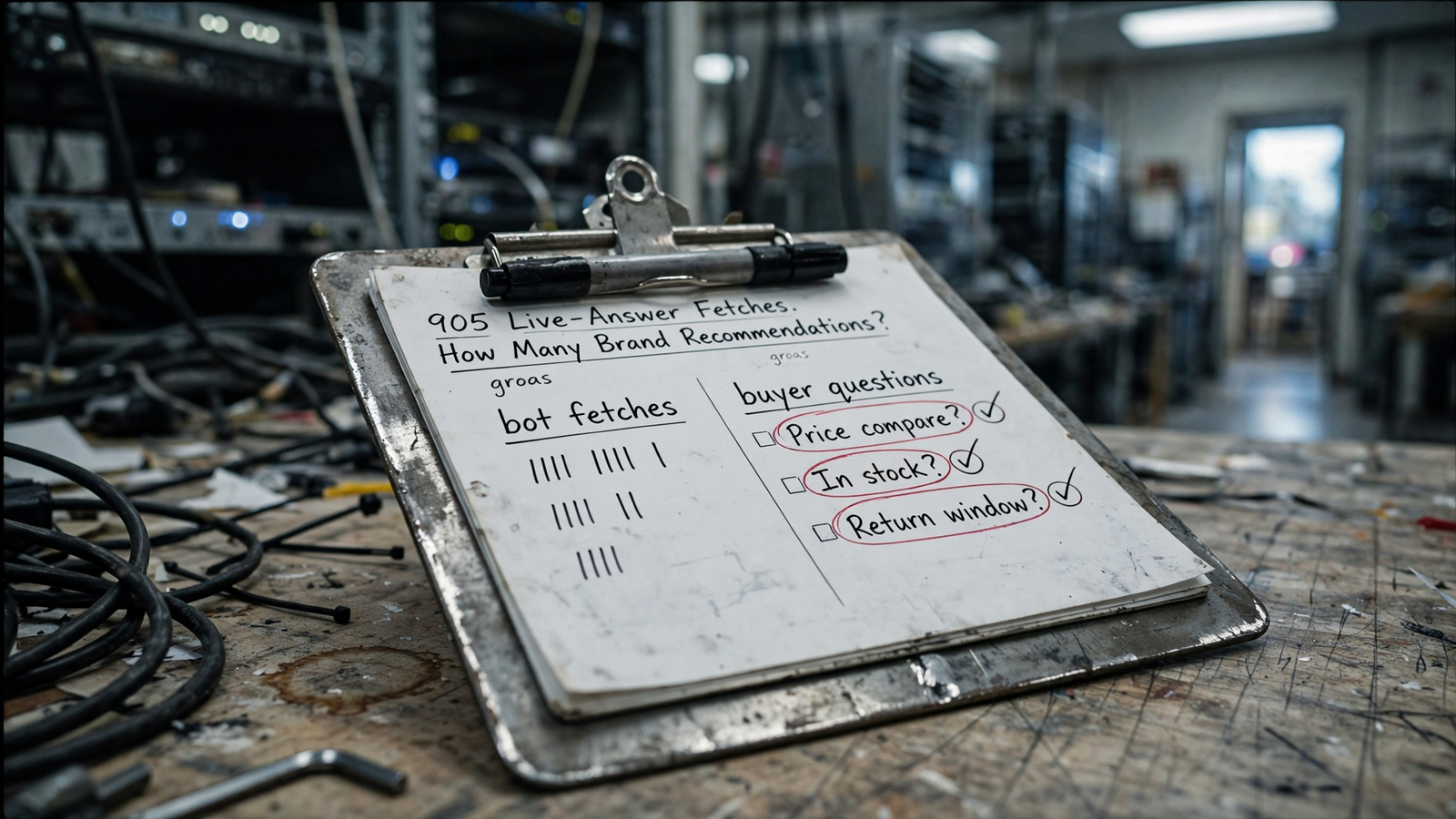
A managed SEO and AI-search service should separate the technical evidence from the buyer test. I want them side by side, not stirred into one visibility score.
| Reporting track | What I expect to see |
|---|---|
| Crawler activity | Verified requests by page, split between background crawls and live-answer fetches, over a stated window |
| Buyer-prompt testing | Recorded answers showing citations, brand mentions and supplier recommendations for specified prompts |
The first report tells me whether assistants retrieve the content. The second tells me whether the company appears when a potential buyer asks for help.
For this business, a relevant buyer question is which companies offer ongoing search management across ChatGPT, Gemini and Perplexity. Testing that question is different from watching assistants retrieve a Google Ads news article. Both can matter. Only one directly tests supplier inclusion.
The prompt must match the decision you want to measure. Otherwise, the report can be technically accurate and commercially beside the point.
Make the buyer test inspectable and repeatable
A screenshot is not enough. I want the fields that let me inspect and repeat the method:
- Exact prompt text.
- Engine and model ID.
- Run count.
- Date and time.
- Whether the answer cited the company’s URL.
- Whether it named the brand.
- Whether it included the brand as a recommended supplier.
Run count deserves its own scrutiny. The statistical example cited here puts roughly 100 independent runs at a ±10-percentage-point margin at 95% confidence, while five runs leave about ±43.8 points. Those are sampling calculations, not a guarantee that repeated assistant runs meet the independence assumptions.
The practical point survives that limit: a handful of outputs is thin evidence for a precise inclusion rate. A report should show its sample size instead of letting a polished percentage do the talking.
Repeated tests need not produce identical answers. The requirement is a repeatable method, with the variation visible. Track changes within one consistent system; do not blend scores from different methods and pretend they form a single trend.
If I cannot reconstruct how the report was produced, I bought a screenshot with a retainer attached.
Put implementation beside the visibility chart
A visibility chart without a work log is a weather report. It tells me something changed. It does not tell me what the provider did.
Any ongoing service managing presence across ChatGPT, Gemini and Perplexity should show what it shipped in the same window:
- Pages published or rewritten.
- Product facts corrected.
- Category pages structured for machines.
- Third-party mentions earned.
That is the work a retainer should make visible. One provider lists foundation work at $2,500–$3,500 per month, integrated programs at $5,000–$8,500, and enterprise work at $12,000-plus, alongside reporting on citation frequency and inbound shifts. Those are that provider’s listed prices, not a market benchmark or evidence of results.
The pairing matters more than the price. If buyer-prompt citations rise after catalogue pages are fixed, I have a change worth investigating. I do not yet have proof that the fixes caused it. If fetches rise, I still need the buyer-prompt results before calling it commercial progress.
Show the work and the outcome separately, then examine the relationship. Do not use activity to impersonate results—or a rising chart to impersonate execution.
I hold groas to that test too. This is where continuous execution wins for me: not in the promise that machines are busy, but in a checkable record of what changed and what the next measurement showed.
If you want to run the buyer side yourself first, use the four-week test of fetches, prompts and gaps. Then hand the work to whoever will both make the fixes and report both sets of evidence. Buy the work log plus the recommendation log.
Keep enquiries in their own column
Enquiries belong on a different rung from retrieval, citations and recommendations. They need a separate count.
Someone can see an answer that names the company, never click, and later call after a branded search. Server logs alone cannot connect that sequence. That does not make tracking pointless. It makes last-click tracking incomplete.
I want a separate enquiry line for form fills, calls and booked jobs, with the basis for attribution stated. Did the person name the assistant? Did they arrive through a page the assistant cites? Those are different connections, and neither justifies crediting every enquiry to an observed recommendation.
Keep recommendation evidence and enquiry evidence in separate columns. One shows that the company was suggested. The other shows that someone got in touch.
When both move after the same work, I have a reason to investigate further. When only bot hits move, I do not have evidence of more enquiries. That distinction should survive the sales meeting.
Buy evidence of inclusion, not a larger bot count
The supplied groas measurements establish something useful: assistants retrieved these Google Ads explainers during live-answer interactions. They do not establish how often groas appeared as a recommended supplier. That is the next measurement, not a conclusion hidden inside the first one.
My hiring filter follows directly from that gap. I would choose the provider that shows verified live-answer fetches beside sampled buyer-prompt results, with prompt text, engine, date, run count, citations and brand inclusion visible. I would expect a work log alongside them and attributable enquiries reported separately.
I would skip the provider whose monthly win is a bigger bot count, especially one built on unverified user-agents and RSS noise.
The decision is to buy measured inclusion backed by visible execution—not retrieval dressed up as recommendation. The next groas report needs to show whether the company makes the shortlist, and what work went into earning that place. That is the difference between paying for consumption and paying for inclusion. Buy the second.


