

 LinkedIn

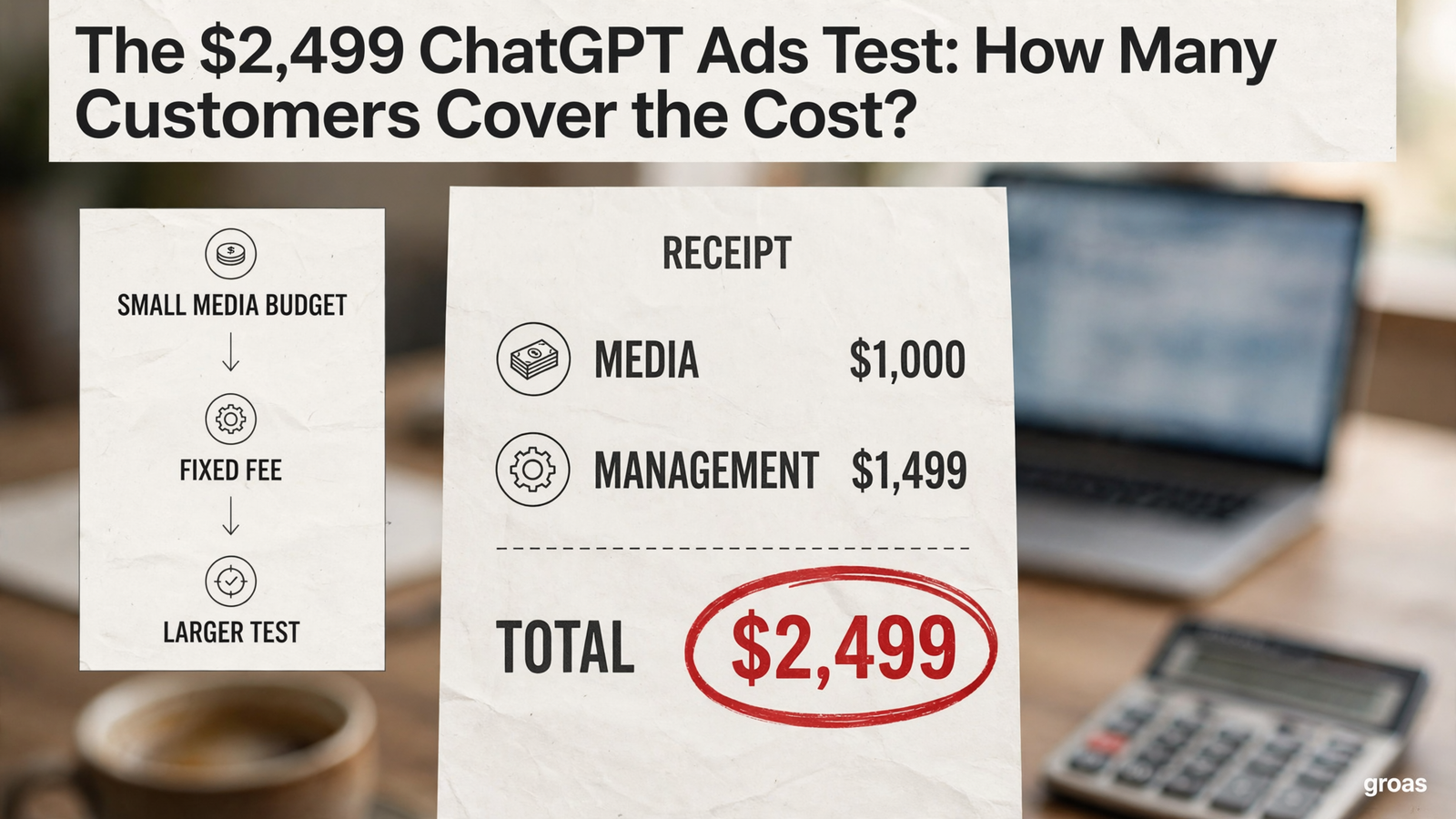
$1,000 of ChatGPT media becomes a $2,499 test when the full management fee lands on it. At $250 of contribution per new customer, you need 10 additional customers to break even, not the four you might expect from looking at media alone.
I am using groas’s published price because it is public and simple to check: $1,499 a month for Search Ads, with platform spend separate. That fee covers Google, Bing and ChatGPT together. The budgets and customer contributions below are hypothetical scenarios, not forecasts of what ChatGPT ads will deliver. The question is narrower: how much must a test earn back, and what changes when Google and Bing already sit under the same fee?
First, count the fee as well as the media
Search Ads costs $1,499 a month, with ad spend separate. If you buy it only to test ChatGPT, the whole fee belongs in that test’s cash cost. I used to tell clients to judge a test by its media budget. I was wrong. Judge it by the check you actually write.
| Hypothetical ChatGPT media | groas Search Ads management | Total cash cost for the month |
|---|---|---|
| $500 | $1,499 | $1,999 |
| $1,000 | $1,499 | $2,499 |
| $3,000 | $1,499 | $4,499 |
The media budgets are examples, not recommended spend levels. The management fee comes from groas’s pricing; each total is media plus that fee. At $500 of media, management is most of the bill. Even at $1,000, calling this a “$1,000 test” leaves out more than half the cash required.
The table describes one month’s cash cost, not a promise that one month is enough to judge the channel. If you plan to keep running the test, write down which month’s fee and media you expect the resulting customers to repay. Otherwise, it is easy to compare customers observed over a longer period with only the first month’s bill. The same rule applies in the other direction: do not charge a single month’s customers for a fee that your existing channels were already paying.
Revenue cannot repay the test until you subtract delivery costs
Revenue feels like the number that pays for ads. It is not. Contribution per customer is what remains after the variable costs of winning and serving that customer: product cost, parts, shipping, payment fees or per-order fulfillment. That remainder has to cover the advertising bill.
Say you close a $400 job and keep $250 after parts, fees and delivery. The test gets $250 of contribution to repay itself, not $400 of revenue. This is where small-budget math goes soft. Divide test cost by sale price and the customer target looks reassuringly low. Divide by contribution and you see the hurdle you must actually clear.
A break-even ROAS guide expresses the media-only version as 1 divided by contribution margin: a 25% margin needs 4.0x ROAS, a 40% margin needs 2.5x, and a 60% margin needs about 1.67x. That shortcut describes the relationship between revenue, margin and ad spend. For this test, I also count the management fee, so the customer-count calculation uses the full test cost.

The break-even target: 4 to 45 additional customers
Here is the calculation: total test cost ÷ contribution per customer, rounded up to a whole customer. The three contribution amounts are hypothetical; substitute your own. These are required customer counts, not predicted conversions.
| Total test cost | At $100 contribution | At $250 contribution | At $500 contribution |
|---|---|---|---|
| $1,999 ($500 media) | 20 customers | 8 customers | 4 customers |
| $2,499 ($1,000 media) | 25 customers | 10 customers | 5 customers |
| $4,499 ($3,000 media) | 45 customers | 18 customers | 9 customers |
At $250 contribution, for example, nine customers return $2,250 against a $2,499 bill. Ten return $2,500. That is break-even by a dollar, not evidence of an attractive return.
Read across the table before you read down it. Changing contribution from $100 to $500 makes a much larger difference to the customer hurdle than treating each media budget as the whole experiment. If your customers do not all contribute the same amount, the columns are illustrations rather than precise targets. Use the contribution you can reasonably expect from the customers this offer brings in, not the sale price or the contribution from an unrelated, better-paying offer.
Do not mistake the table for a conversion forecast. One published small Canada test spent CA$198.58 for 47 clicks and one conversion, and warned that results move a lot with only 47 clicks. A $3 to $5 starting maximum bid is a bid suggestion, not a guaranteed average click cost. Neither figure tells you how many customers your test will produce.
The distinction also shows up in CPA. If $1,000 of media produces 10 additional customers, media-only CPA is $100. Add the $1,499 management fee and fully loaded CPA is $249.90. Media-only CPA hides the hurdle; fully loaded CPA states it.
If Google and Bing already share the fee, use a different denominator
The standalone calculation is not the right calculation for every groas customer. One Search Ads fee covers Google, Bing and ChatGPT. If you already pay it to manage Google and Bing, adding ChatGPT does not create a second $1,499 fee. For the decision to add ChatGPT, count the incremental media. For the decision to keep the whole service, count all platform spend and the fee.
| Situation | Cost to use for the ChatGPT decision | $1,000 media example | Customers needed at $250 contribution |
|---|---|---|---|
| Buying Search Ads only to test ChatGPT | Media plus the $1,499 fee | $2,499 total | 10 |
| Already paying for groas Search Ads on Google and Bing | Incremental ChatGPT media; fee already paid | $1,000 incremental | 4 |
That is not permission to pretend management is free. The combined Google, Bing and ChatGPT account still has to earn back its $1,499 monthly fee. It means only that charging the entire fee to the new ChatGPT test again would make the incremental decision look worse than it is. Judge the new channel on incremental cost; judge the whole account on total cost.
These are two different questions, not two ways to make the same test look cheap. The standalone buyer must decide whether to take on both a new fee and new media spend. The existing customer has already taken on the fee and must decide whether another $1,000 of media is worth adding. Keep those decisions separate when someone presents a single CPA for the whole account. An account-wide average cannot, by itself, tell you whether the new channel earned its place.
For context, a published agency-fee range puts management at $1,500 to $3,500 on top of $2,000 to $10,000 in monthly spend. groas’s $1,499 shared fee sits near the low end of that cited range. It can still weigh heavily on a standalone $500 or $1,000 media test. Those two observations do not cancel each other out.
The spreadsheet cannot tell you who caused a sale
The tables count additional customers for a reason. Clearing a hurdle on paper and proving ChatGPT caused the customers are different jobs. Platform attribution can assign credit to sales that already happened and double-count across platforms. Google and Bing may claim a buyer whom ChatGPT also claims. A platform-reported conversion is not automatically an incremental customer.
A practical test therefore needs three things before it starts:
- Separate tagging for ChatGPT traffic, so you can examine it apart from Google and Bing.
- Stable conditions elsewhere, as far as you can manage them, so changes in other channels do not drown out the result.
- A decision rule based on additional customers, not a screenshot of platform-reported conversions. A holdout or a clean before-and-after comparison can help you ask what would have happened without the ads.
That decision rule should distinguish a lead from a customer before results arrive. If you need 10 additional customers, 10 form submissions do not settle the question; you still need to know which submissions became customers. Nor does a neat platform total settle what would have happened without the test. Tagging makes traffic easier to inspect. It does not turn attribution into proof of incrementality.
Time matters too. The small Canada test recorded 4,561 impressions, 47 clicks and one conversion from CA$198.58 of spend. Its warning about small samples is more useful than treating that single conversion as a benchmark. Conversions can also arrive roughly three weeks after a click. If your sales cycle lasts 60 days, a 30-day media test cannot establish break-even by day 30. Set the media window and the follow-up window before you pay, rather than asking the invoice date to be the verdict.
Check access before budgeting. ChatGPT ads run as labelled sponsored units below the answer, using plain-language context hints rather than keywords, with no Quality Score or search-terms report. The published US minimum is $25 per campaign per day, or about $750 over 30 days. New self-serve accounts face home-country limits until verification and required home-market spend are complete. Signup runs through ads.openai.com with work email, billing and verification before ads serve. If you need three geographies immediately or cannot clear verification, the tidy $1,000 scenario is not yet an executable plan.
Decide with your contribution number, not a promised CPA
At a hypothetical $4 CPC, $1,000 of media buys about 250 clicks. A published planning model uses $4 CPC and an explicitly hypothetical 4% conversion rate to illustrate media-only acquisition cost; it is not a forecast. Keep the illustrative click math, then add this article’s fee and contribution assumptions:
| Hypothetical contribution per customer | Additional customers needed on a $2,499 standalone test | Share of roughly 250 clicks that must become customers |
|---|---|---|
| $100 | 25 | 10% |
| $250 | 10 | 4% |
| $500 | 5 | 2% |
Those percentages describe the break-even hurdle, not a likely outcome. They also require customers, not merely leads. If someone proposes 250 clicks at $4, with 4% becoming leads and 50% of those leads becoming customers, that is five customers. At $250 contribution each, they produce $1,250 of contribution against a $2,499 standalone cost. The assumptions may sound tidy; the arithmetic still says no.
Ask a provider for those assumptions in writing: the CPC, the click-to-lead rate, the lead-to-customer rate, what qualifies as a customer, and the point at which weak results stop the spend. Ask how ChatGPT traffic will be separated from Google and Bing, what stays stable during the test, and who approves the context hints. With no keyword or search-terms report to audit afterward, those controls matter before the card is charged. If they cannot show the arithmetic, they have priced your hope, not your hurdle.
The published minimum starts at $25 a day per campaign in the US. Hypothetical planning budgets of $40 to $50 a day for stronger learning, or $75 to $100 for wider coverage, still do not tell you whether your contribution can support the resulting bill. Start with one offer and one geography, agree on the landing page and the stop rule, and leave enough time to observe customers after the clicks. More spend without a decision rule is not more evidence by default.
There is a real structural advantage to the shared-fee case. groas’s Search Ads service covers Google, Bing and ChatGPT for the same $1,499 monthly management fee, with a landing page for every ad group. If Google and Bing already justify that fee, the incremental $1,000 ChatGPT decision needs four additional customers at $250 contribution. If you are buying the service solely for ChatGPT, the same media needs 10. My companion breakdown, The $1,000 ChatGPT Ads Test: When the Management Fee Costs More Than the Media, looks more closely at that fee-versus-media crossover.
So make the decision the numbers support. A standalone, low-contribution test carries a steep hurdle; a higher-contribution offer or an account already sharing the fee has less to earn back from ChatGPT alone. Use your own contribution, require a plausible path from clicks to additional customers, and agree on how you will judge the result. If the numbers clear, run the test. If they do not, you just saved $2,499.


