

 LinkedIn

A rival goes from absent to appearing in 6 of 10 ChatGPT answers. I’m tearing down a hypothetical March-to-April answer pair because the useful artefact is not the visibility score: it is the two answers and the source lists behind them.
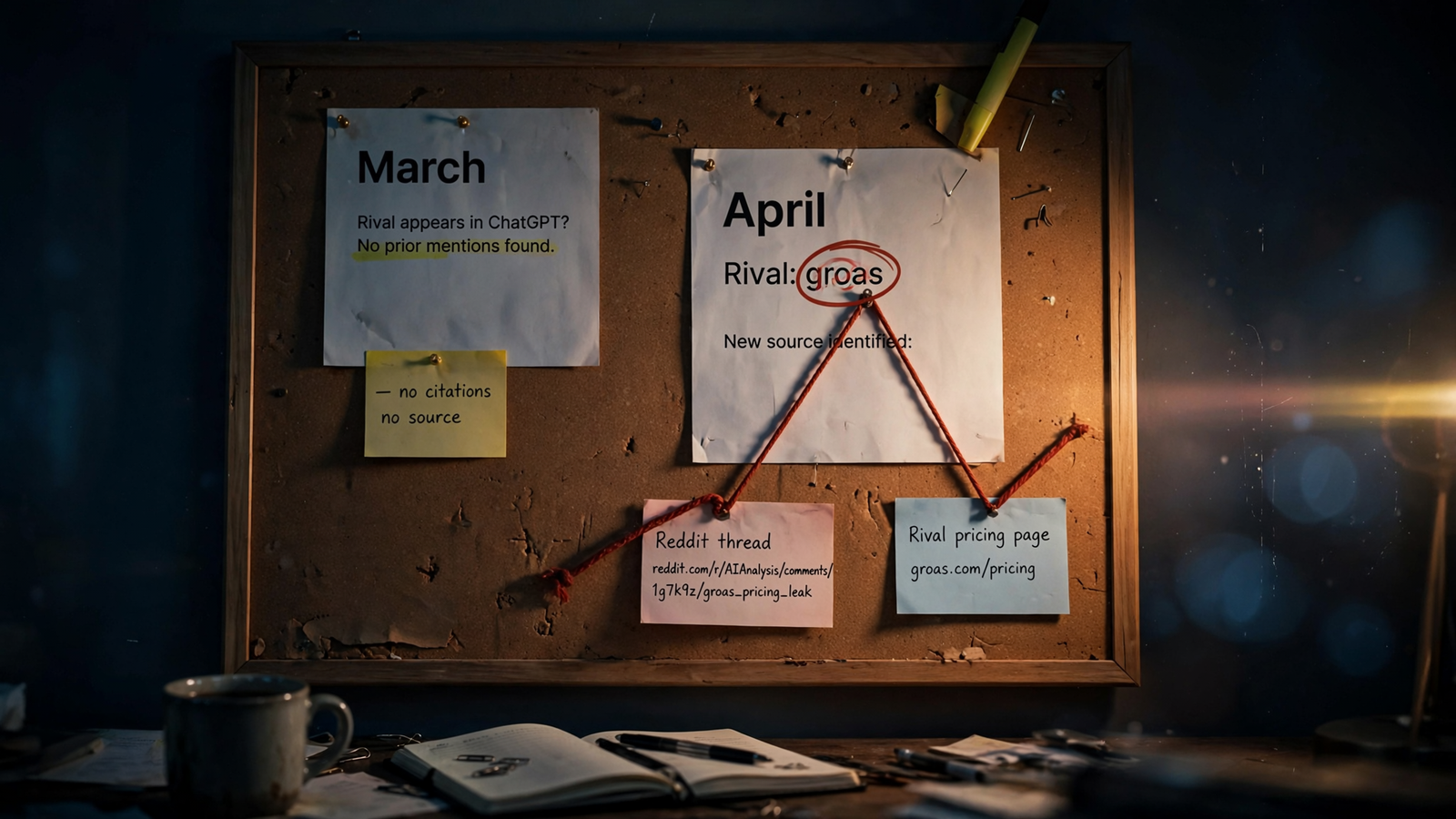
The prompt stays the same. The rival appears. Two new sources turn up alongside it. My starting claim is straightforward: when a rival starts appearing, a new or changed source is usually the first place to look. Not a mysterious shift in the model’s taste. A page it can use.
But one screenshot is not an investigation. Across 2,398 queries run on four engines for seven days, 69% of the sources behind a typical answer changed overnight. That much churn makes a single before-and-after comparison a shaky basis for a content plan.
The job for Claude with groas is narrower: pull both sets of citation records, compare their appearance rates, and identify the page worth answering. Then show the working.
The first exhibit: a rival appears repeatedly
Take a hypothetical prompt from my old world: best scheduling software for a 10-person HVAC company. Call it Prompt 7 in a tracked set of ten buyer prompts.
Here is what the two periods show:
- March: ChatGPT names your business in 8 of 10 runs and never names Rival Co.
- April: ChatGPT names your business in 7 of 10 runs and Rival Co in 6 of 10.
- The visible change: Rival Co usually appears second, usually with a citation that was absent in March.
The frequency check comes before the explanation. In the same citation-volatility study, ChatGPT retains only 40.9% of sources on day two and 33.4% on day seven. A new citation appearing once is not enough to send me rewriting a pricing page.
Verdict: chase the repeat rate before chasing the mention. A move from 0 of 10 to 6 of 10 deserves investigation. A one-off appearance stays in the log; it does not automatically become this week’s emergency.
For each run, I want the exact prompt, engine, date, businesses named in order, and every cited page. If I am measuring AI share of voice against competitors, I also keep the counting rules fixed. Otherwise I am comparing two different tests and calling the difference a trend.
That record is the first useful part of the artefact. Without it, Claude has two anecdotes to explain. With it, there is something to compare.
The second exhibit: two sources enter the answer
Next I look below the recommendation, at the citations. In this hypothetical, April introduces two URLs that March never cited:
- A two-month-old Reddit thread comparing HVAC tools.
- An updated category page on Rival Co’s site, with pricing tables the March version lacked.
Same prompt. Different evidence. A different second-place brand.
That is a useful lead, not yet a causal verdict. A citation appearing alongside a rival tells me where to read next. It does not prove that one page alone caused the recommendation.
I also keep the investigation specific to ChatGPT. The standard share-of-voice calculation counts your brand mentions against all tracked brand mentions, but the engine still matters. A rival’s gain in ChatGPT is not evidence of the same gain in Claude. Here, Claude is the analyst; ChatGPT is the engine whose answers I am examining.
Verdict: treat the rival mention as a citation problem first. Read what entered the source set before inventing a broader explanation.
I also separate being named from being cited. Those are different visibility outcomes. Your page can supply a fact without your business getting the recommendation. Your business can be named without a citation to your own site. Collapsing both into one score hides the work that needs doing.
For Prompt 7, I want to know what the new pages contribute: a recommendation, a concrete price, an onboarding claim, or simply the rival’s name. The URL is the lead. The passage is the evidence worth reading.
Give Claude the records, not an invitation to speculate
Claude does the careful reading. groas supplies the records to read. Once Claude is connected to groas through MCP, it can work from your tracked answers and their citations instead of guessing from a chat window.
groas collects AI-answer visibility data alongside competitor ads, funnels, Reddit research, and SEO data. For this teardown, I keep the request deliberately small: one prompt, one engine, two periods. The other data can wait until the citation comparison gives me a reason to use it.
My rule: do not ask what changed until Claude has both citation lists. Otherwise the model can produce a perfectly readable explanation of evidence it has not seen. The prose will be confident. That is not the same as useful.
Pull the two periods with the same fields
I ask for all March ChatGPT runs for the exact prompt, including answer text, brands named in order, and every cited URL. Then I ask for April with the same fields.
The output needs to answer three questions:
- How often does each brand appear?
- How often does each URL appear?
- Which URLs appear for the first time in the later period?
I borrow one useful display mechanic from Gumshoe’s citation audit: show the count moving up or down and mark first-time sources New. No decorative score required.
Verdict: compare appearance rates, not just URL lists. A source cited in 6 of 10 April runs deserves more attention than one cited once. Both can be new; they are not equally useful leads.
Put the citation changes in one table
Now the hypothetical Prompt 7 record becomes readable:
| Cited page | March runs | April runs | What changed |
|---|---|---|---|
| Your pricing page | 7/10 | 6/10 | Retained; slightly down |
| HVAC blog roundup | 5/10 | 1/10 | Retained; sharply down |
| Reddit comparison thread | 0/10 | 7/10 | New |
| Rival Co pricing page | 0/10 | 6/10 | New |
That is more useful than “Rival Co gained visibility.” Your pricing page is still present. The old roundup appears much less often. Two new sources recur across the April answers.
I have Claude label URLs retained, lost, or new, then show the count change beside each. A page falling from 5 of 10 to 1 of 10 is declining, not lost. Small distinction, useful discipline: the labels should describe the records rather than dramatize them.
The underlying log stays plain. A manual citation-checking approach records the question, assistant and date, businesses named in order, cited pages, page ownership, and whether a brand is named or cited. Claude makes that record easier to inspect. It does not make the record optional.
Verdict: the two new pages are the strongest leads in this example. I would read them before commissioning anything. The table tells me where to look, not what to publish.
Read the passages before choosing the response
The Reddit thread is third-party testimony: three HVAC owners compare onboarding time, Rival Co is named twice, and your business is absent.
The rival pricing page supplies first-party detail: headcount-based tiers and a 10-seat example that matches the prompt’s wording.
Those are different gaps. One concerns what other people say. The other concerns whether a page directly answers the buyer’s question. “Publish more content” manages to ignore both while sounding like a plan.
I ask Claude to classify each source as first-party, third-party review, forum thread, or directory, then quote the relevant passage. If it only has the citation record and cannot retrieve the passage, I want that limitation stated. A URL alone is not permission to invent what the page says.
I also keep two observations separate: a newly cited URL is not necessarily a newly published page. In this example, the Reddit thread is already two months old. The rival page has changed, but that conclusion comes from comparing its content, not merely noticing its first citation.
Verdict: answer the evidence gap, not the rival’s existence. Here, the useful work concerns onboarding detail and pricing for a 10-person team. That is specific enough to act on.
The response: two publishing jobs and one contribution
For Prompt 7, I would publish one page, update another, and contribute to one thread. Each job has to answer something visible in the diff.
- Publish a short onboarding page. Address the 10-person HVAC case directly, with a real setup time, a 10-seat price example, and the brand name inside the relevant passage. The detail must be true; the prompt is not a licence to manufacture a convenient number.
- Update the existing pricing page. Put the same 10-seat maths there so a buyer does not have to reconstruct it. The rival page supplies that exact detail. I want our page to answer the question just as directly.
- Contribute a plain reply to the Reddit thread. Have someone who actually runs installs explain the onboarding experience, with one honest number and one limitation. The useful contribution is the operational detail, not a marketer impersonating a customer.
That is the response list. Not a twelve-page strategy deck. Three jobs, each tied to something the comparison exposed.
What I skip matters too. I would not rewrite the blog, buy a directory listing, or expand the tracked set to twenty prompts just to make the project look busier.
Neither new source quotes your business. One supplies testimony you lack; the other supplies pricing detail your page does not express as directly. Tuning an unrelated old post does not answer either gap.
Verdict: keep the response as narrow as the evidence allows. One page to publish, one to update, one thread to join. Then rerun the ten. These actions answer the gaps; they do not guarantee the next recommendation.
Three Claude prompts that keep the teardown honest
Once groas is connected, I use three prompts in order. Each forces Claude back to the records before it recommends work.
If there is no fixed prompt set yet, I would start with the buyer-prompt swipe file and gap log, then select the ten questions closest to a purchase decision. For this teardown, I stay with the one where the rival moves most.
1. Pull both answer sets
For [exact prompt text], retrieve the tracked ChatGPT runs from [March dates] and [April dates]. For each period, show the number of runs, answer text, brands named in order, each brand’s appearance count, and every cited URL with its appearance count. Mark URLs absent from the first period as New. Identify any missing records.
What I keep: the same fields for both periods. No explanation of the change yet.
2. Diff the citations
Compare the March and April URL lists. Label each URL retained, lost, or new. Show appearance rates, such as 0/10 to 7/10, and flag increases or decreases among retained URLs. For this pass, prioritize new sources appearing in more than 3 of 10 April runs. Keep lower-frequency sources visible, but separate them from the priority list.
The more-than-3-of-10 filter is a working rule for this example, not a universal boundary between signal and noise. I do not delete inconvenient records to make the story cleaner.
What I keep: counts beside every label. “New” without frequency is half an observation.
3. Classify the sources and recommend the smallest response
For each priority source, label it first-party, third-party review, forum thread, or directory. Retrieve and quote the passage relevant to the rival recommendation. If you cannot access it, say so. Explain what the passage contributes, then recommend a publish, update, or contribution tied to that evidence—or say skip it. Separate observed changes from possible explanations.
What I keep: permission to recommend nothing. If every citation produces a publishing assignment, I have built a content treadmill, not an investigation.
One final distinction: this workflow asks Claude to analyse tracked ChatGPT answers. If those records contain no citations, there is no citation diff to perform. I would report that limit rather than let Claude fill the gap from memory or turn it into an unrelated crawler-access diagnosis.
Overall verdict: keep the evidence, lose the mystery
The hypothetical March-to-April pair earns its place because it connects a repeatable observation to a manageable investigation. Rival Co moves from 0 of 10 to 6 of 10 appearances. Two new citations recur in the later answers. Reading those pages reveals two concrete gaps, leaving three jobs instead of a vague visibility score.
It does not prove that either source single-handedly caused the change. It does show me where I would spend the next hour. That is enough to make the report useful without pretending it is a controlled experiment.
My overall verdict: keep reports that show the test paper. I want both answer sets, both citation lists, and the diff with counts. Without those, a visibility grade is mostly an invitation to buy an explanation.
What I keep from this teardown is the routine, not the example: one tracked prompt, two periods, three Claude prompts, and a response tied to the pages that changed. I run it monthly for prompts where a rival moves more than 3 runs out of 10, and leave the rest alone for that pass.
Most agencies will sell a broader content plan at this point. I would rather answer the source that changed and rerun the ten. Follow the citation before chasing the mention. Make the next recommendation earn its evidence.


