Your business appears in a ChatGPT answer, but there is no link. You rewrite the homepage, ask again, and Perplexity still cites three competitors instead. A mention and a citation travel through different pipelines. Editing the page that one pipeline can already find will not necessarily fix the other.
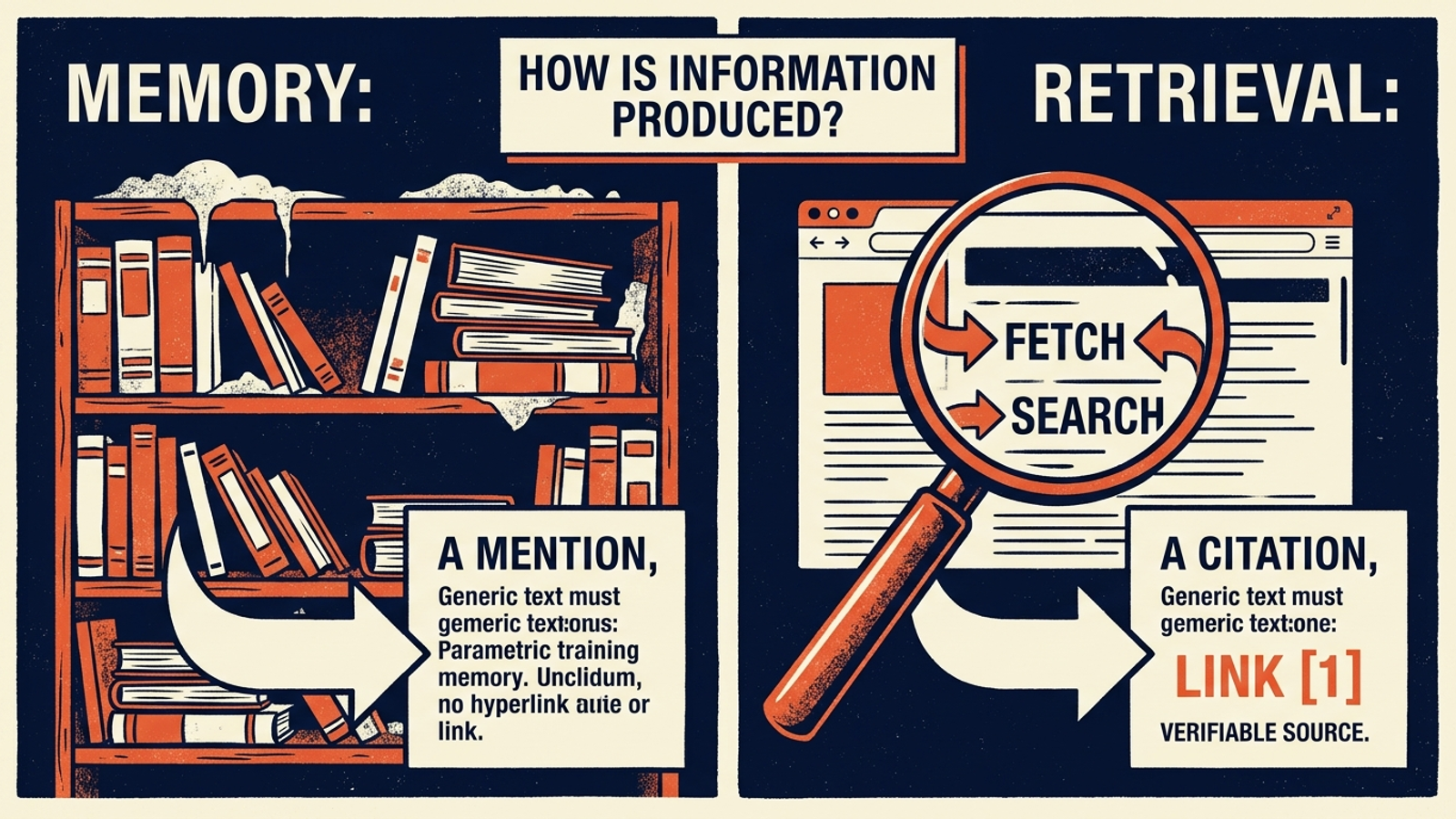
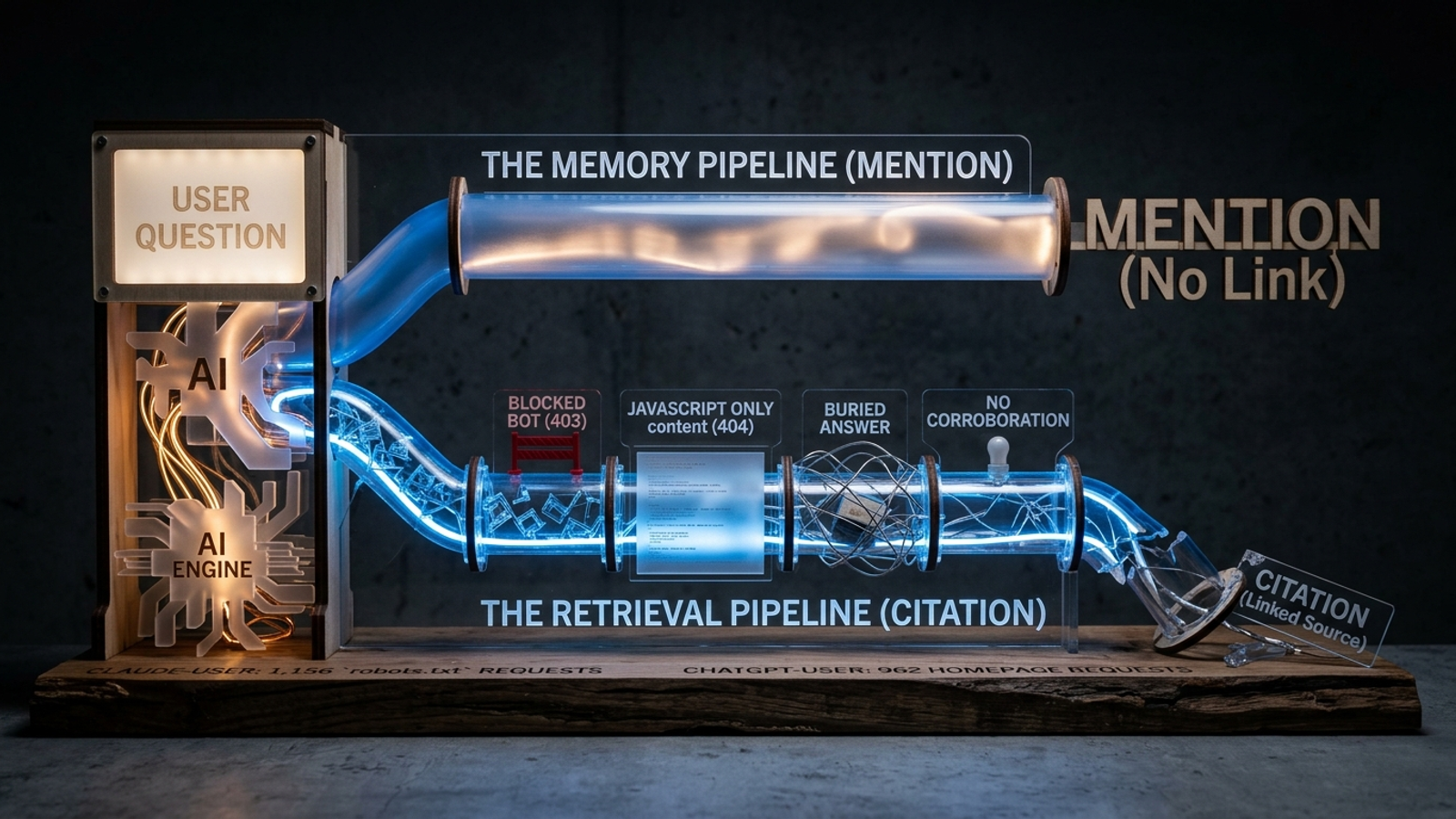
A mention can come from what a model absorbed during training: parametric memory. A citation comes from retrieval, when an answer engine finds and uses a page while answering a question. ChatGPT can answer without searching; Perplexity retrieves as part of its answer process. The crawlers involved in training and retrieval differ, too. On groas.com, our edge logs recorded 1,156 Claude-User requests for robots.txt and 962 ChatGPT-User requests for our homepage over 30 days. Those requests make the live pipeline visible. They do not, by themselves, tell us which sentences were cited.
I want to build from that distinction, because it changes what you fix first. For a running example, say you sell emergency garage-door repair in Austin. An AI answer might know your company name from material it encountered before. To cite your page for a broken spring repair, it needs to find, fetch, read, and use that page now. Those are separate opportunities to fail.
First, decide whether the answer remembered or retrieved you
Memory supplies a name; retrieval supplies a source the engine can cite. That is a useful working distinction, not a claim that every unlinked name has a traceable origin. You cannot inspect a model’s training memory from the outside. You can, however, observe whether an answer links to a page and whether a live-fetch agent reached your server.
The bots make the separation easier to see. For OpenAI, GPTBot handles training collection while OAI-SearchBot supports search results. ChatGPT-User can fetch pages for a user’s request. Perplexity likewise distinguishes between PerplexityBot, which builds its index, and Perplexity-User, which fetches at answer time. Claude-SearchBot and Claude-User have different jobs as well. Blocking or welcoming one bot does not automatically do the same for every other path.
The engines also make different choices about when to search. ChatGPT can draw on training data or web search, Gemini draws on Google’s index, and Perplexity retrieves and displays inline links. I used to tell clients that ranking on Google meant they were covered in AI answers. I was wrong. The studied overlap between Google’s top 10 and AI citations runs about 8 to 12% for the queries examined. A search result gives someone a list to choose from; an answer engine writes a response and cites a narrower set of pages it used.
For our Austin repair business, an unlinked name in ChatGPT tells us little about whether its repair page works for retrieval. A linked recommendation in Perplexity tells us more: the engine found usable material for that question. Do not diagnose a fetch from a mention.
Then follow the question through a live answer
A live citation does not begin with a bot reading your homepage. It begins with the user’s question, which the engine may rewrite into several searches. This is query fan-out: decomposition, expansion, parallel searches, and then synthesis into one answer.
A documented example starts with “good restaurants near me.” Location can turn that into “top restaurants San Francisco,” alongside other variations of the same intent. The page that matches a useful variation may be more helpful than a page that happens to repeat the user’s exact words.
Apply that to Austin. A user asks who can fix a garage door today. The live search may pursue the cost of “24-hour garage door repair Austin” or who fixes a broken torsion spring the same day. If the company’s page says only “we help homeowners,” it has not answered either version. The point is not to stuff every possible rewrite into the page. Answer the specific repair questions the page is meant to serve.
A result still has to survive the fetch
Once searches surface candidate pages, a live-fetch agent needs to reach and read them while the user waits. ChatGPT-User, Claude-User, and Perplexity-User are names worth looking for in logs; OAI-SearchBot, Claude-SearchBot, PerplexityBot, and Googlebot have indexing roles. Perplexity-User’s answer-time fetches and its treatment of robots.txt illustrate why a rule aimed at an index crawler may not control a live agent in the same way.
A server can lose the opportunity here. It may rate-limit an unfamiliar agent, respond too slowly, or return a nearly empty shell because the meaningful content loads later in a browser. Our garage-door page cannot become a useful citation for same-day spring repair if the agent receives only a navigation bar and a loading spinner. Before rewriting the copy, check what the agent can fetch.
A fetched page still needs an answer worth using
Fetching is not quoting. The engine needs a passage that answers the question without making the reader reconstruct the rest of the page. The practical unit is a self-contained answer passage, not a page view. For the repair business, “We offer same-day torsion spring repair in Austin” gives the engine more to work with than “Our team is here when you need us.” The second line could sell nearly anything, including a very reassuring sandwich.
Lead a relevant section with the answer, then explain the conditions or details below it. Use a heading that says what the section answers. Avoid opening a passage with “as mentioned above”; a sentence that depends on another passage is harder to use on its own. A short Q&A section can help when customers repeatedly ask distinct questions, but no schema label rescues an answer the page does not actually contain.
This is where attribution becomes clearer. A linked citation points to material the engine used for a particular answer; it is not a medal for the most heavily crawled site. Nor does a citation guarantee a recommendation. Independent recommendations can influence the verdict in ways a brand’s own account cannot. Being found, being quoted, and being chosen are three different outcomes.
Our bot logs show the middle step, not the whole answer
For 30 days on groas.com, we watched live-answer agents reach our edge. We recorded 1,156 Claude-User requests for robots.txt and 962 ChatGPT-User requests for our homepage. The full 30-day log separates verified crawlers from live-answer fetches.
The robots.txt requests matter because they show agent activity that a normal traffic report can hide. The homepage requests show a live agent asking for a page that explains what groas is, what it runs, and how its model works. That page puts those answers in readable HTML. A fetch therefore has a chance to find a useful passage without waiting for client-side content to load.
I would not read a citation count straight out of those request numbers. A request does not reveal the user’s question or prove that the final answer quoted the page. It does show whether the fetch stage happened. That is valuable when a business keeps editing copy but cannot tell whether an answer engine ever received it.
The same distinction applies to category pages. An index crawler may visit a listing because it links to other pages, while a live-answer agent may find no direct response there. A busy crawl log can coexist with weak answer visibility. A crawl is a visit; a citation means the answer used the page. Judge those separately.
Find the failure before choosing a fix
The memory side tends to fail quietly. A business may appear under different names, categories, or locations across its own pages and outside listings. That makes its identity harder to represent consistently. Independent recommendations in answer threads can also carry more weight than posts from the brand’s own account. For the Austin company, I would first make sure its name, service area, and description agree wherever they appear. Relevant structured data, such as LocalBusiness or Article with a named author, can state those facts clearly on its own site. None of that makes a model relearn its training data overnight. It addresses the information the business puts into circulation.
Retrieval failure is easier to inspect. In tests of live crawlers, GPTBot, OAI-SearchBot, ChatGPT-User, ClaudeBot, and PerplexityBot received raw HTML rather than rendering JavaScript; the reported Googlebot path was an exception. ChatGPT crawlers fetched JavaScript files in only 11.5% of requests and did not execute them. If pricing, service details, comparison tables, or FAQs appear only after client-side rendering, a crawler reading raw HTML can miss the very material a buyer asked about.
For our repair page, I would turn JavaScript off and inspect the raw response. Is “same-day torsion spring repair in Austin” there? Is the answer near the top, in a section that makes sense by itself? Does the server return the page promptly to the relevant agent? If not, fix that before debating a new tagline. The repair sequence in How to Fix Technical SEO Issues That Hurt AI Visibility goes deeper on that work. Make the answer available before trying to make it elegant.
Read the symptom as a clue, not a verdict
I use three starting points when a business asks why AI answers overlook it:
- Mentioned without a link, but absent from cited buying answers: inspect retrieval first. Check server logs around a test prompt, read the relevant page as raw HTML, and look for a direct, self-contained answer near the top. A mention does not prove the page can be fetched or used.
- Cited for a fact, but not recommended: the page is reachable. Look at what its passage actually answers and what independent sources say about the choice. The engine may use you for one fact while relying on someone else for the verdict. More technical crawl work alone will not settle that comparison.
- Neither mentioned nor cited: start with the basics on both sides. Check whether the business has one consistent name, category, and location across its presence, then check whether its relevant page is fetchable and plainly answers the buying question. Do not assume a memory problem explains a broken page, or the reverse.
Run more than one phrasing of the question. In one measured case, a brand received a citation for an exact error-fix query and none for a broader version of the need; one added word changed the outcome. That is not a promise that you can discover every internal rewrite. It is a useful test of which question your page currently answers. Once you know the page needs work, Get Your Page Cited by AI Search: A Five-Step Rebuild follows the page-level repair.
Now take a case we have not used. Say you run a dental practice in Denver. ChatGPT gives a general answer about same-day crowns without naming you, and Perplexity links to three other practices. Your site uses one practice name, while outside listings use another. Your same-day crowns page opens with “Welcome to our family practice,” and its treatment details sit well below that greeting.
Work through the model in order. The missing mention gives you reason to check the practice’s identity across its presence, not proof of what any model remembers. The missing citation gives you reason to test the live page: can an agent fetch the treatment details in raw HTML, and does a self-contained passage answer the same-day crowns question? Fix the inconsistent identity; make the answer readable and easy to extract. Then test the buying question again.
That is the whole distinction in one office. A mention depends on what the model knows; a citation depends on what the answer can find and use now. Open the machine that failed, not the one you happen to enjoy polishing.