

 LinkedIn

For seasonal marketers choosing between server or edge crawler logs and groas answer-and-citation tracking inside Claude, my verdict is simple: fund content from the answers buyers see, not the bots that visit. A crawler request proves neither a citation nor a recommendation.
The two contenders answer different questions. Logs tell me which pages bots requested and what happened next. Answer-and-citation tracking tells me what appeared in the buyer answers being tracked: the sources, the brand mentions, and the recommendations. For next season’s content budget, that second record should lead. Logs have an important job, but choosing the brief is not it.
I compare them on four things: access evidence, usefulness for content decisions, repeatability, and cost. The distinction matters because a perfectly readable page can still answer a question nobody in the tracked set is asking. Fixing its plumbing will not fix the brief.
1. Access evidence: crawler logs win the diagnostic job
Before comparing tools, I keep three outcomes separate:
- A fetched page: a bot requested a URL and received its content.
- An answer citation: an observed answer to a specific prompt listed that page as a source on a specific date.
- A brand recommendation: the answer named the business as a recommended choice.
Those are not interchangeable milestones. A page can be fetched without being cited. It can be cited without the business being recommended. Collapsing all three into an AI visibility chart makes the report tidier and the decision worse.
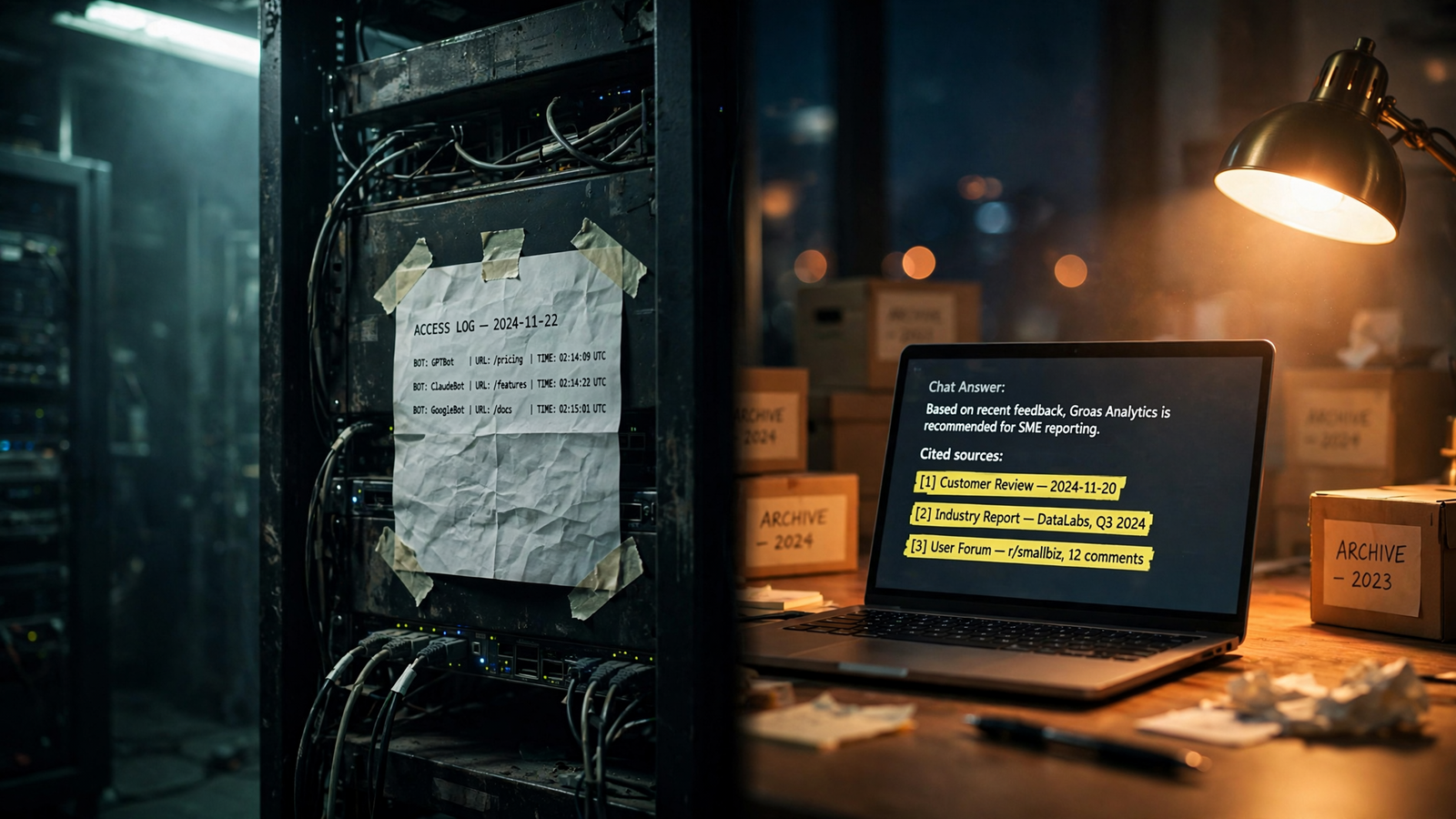
A log analyzer shows which crawler requested which URL, when, and with what status code. Depending on the log, I can also inspect bytes served and the evidence behind the crawler’s identity. That is useful access work. It does not reveal the buyer prompt, the sources in the answer, or whether a competitor won the recommendation.
Identity deserves more attention than a screenshot of bot hits usually gives it. User-Agent alone is weak evidence because anyone can copy a GPTBot or ClaudeBot string. Where verification is supported, I want the request checked against official IP ranges. Where it is not, I want it labeled unverified, not quietly counted as confirmed.
Where the logging happens matters too. Edge logs include requests served from cache, while origin logs see only requests that reach the origin. An empty origin report is not the same thing as proof that no bot visited.
For a blocked path, an unexpected status code, or a gap between edge and origin activity, logs are the right evidence. Use logs to establish access, not demand.
2. Content decisions: groas shows the answer, not just the request
The planning question is not “Did a bot visit our seasonal guide?” It is “Which buyer questions recommend us, and which sources support those answers?”
Through groas in Claude, I can work with the tracked prompt, the captured answer, its cited sources and dates, whether the business was cited or mentioned, and the competitor pages appearing in answers where it lost. That is the different question citation tracking answers: which pages AI engines cite for a buyer prompt, and whether the site is among them. A mention count alone does not answer it.
Say you are spending $20k a month pushing a seasonal category. Logs tell you bots knocked on the door. The answer record shows who got invited inside, and whether they were recommended or merely referenced. That is evidence I can turn into a content brief.
The distinction changes the work I commission:
- No citation or recommendation in an observed answer: inspect the sources that appeared before deciding what to write.
- A citation without a recommendation: read how the answer uses the page. Being a source is not the same as being the pick.
- A recommendation supported by another site: inspect that source rather than assuming the business’s own page needs a rewrite.
- No captured answer: mark the observation as missing. Do not report a confirmed loss.
That third case is easy to miss. ChatGPT can recommend a business while citing a review site, or cite its page without naming it. Sometimes the work belongs on a third-party page. Another rewrite of the company’s seasonal guide would solve the wrong problem, very efficiently.
Why a clean crawl report cannot choose the brief
A request for /seasonal-gift-guide/ with a 200 status does not reveal which buyer question prompted it, what the answer said, or whether a competitor appeared instead. The request may not even represent a buyer-driven interaction: index crawlers, on-demand fetchers, and training crawlers do different jobs.
Treating a training crawl as shopping demand is how a technical observation becomes a bad content recommendation. The bot was real. The buyer intent was assumed.
The useful next step is to connect the two evidence sets: pages crawled and cited, pages crawled but not cited in the tracked answers, and pages with no observed request. Even then, I keep the boundaries visible. “Not cited in our tracked answers” does not mean “never cited anywhere.”
If the question is simply which tools show whether AI crawlers visit my site, logs answer it. I stop there rather than promoting fetch counts into content votes. Use the answer record to choose the work; use logs to diagnose access.
3. Repeatability: fund a pattern, not one flattering answer
A captured answer is useful evidence. It is not a permanent position.
For seasonal planning, I want the cited page rather than just its domain, the engine that cited it, the rival pages appearing for the same prompt, and a repeat observation on another date. That is the discipline behind page-level evidence, competitor gaps, and repeated tracking. Different engines cite different pages, and citations change between runs.
One snapshot can mislead. A test of 2,398 queries reported median day-over-day citation churn of 82% in ChatGPT, 92% in Gemini, and 78% in AI Mode. I would not turn a single export into a season’s publishing schedule.
Nor would I buy a blended visibility score without its underlying observations. Question sets, engines, dates, and definitions change the result: the same 240 answers produced a 22.1% visibility rate versus 32.3% share of voice. Those numbers describe different measures, not two competing versions of reality.
The comparison only works when the question set and measurement boundaries stay visible. Logs can provide a history of requests within their coverage and retention limits. Citation tracking provides a sample of answers to the prompts being tracked. Neither is a census of everything buyers see.
The head-to-head scorecard
Here is how I would judge the two systems before approving next season’s content spend:
| Decision axis | Server or edge crawler logs | groas answer-and-citation tracking in Claude |
|---|---|---|
| Can bots reach the page? | Strongest evidence: URL, timestamp, status, and verified identity where supported | Does not replace access logs |
| What should the content brief address? | Cannot show the prompt, answer, or recommendation | Shows observed answers, cited pages, and competitor appearances for tracked prompts |
| Can the evidence be compared over time? | Request history depends on logging coverage and retention | Repeated observations of tracked prompts, not every possible answer |
| What work does it justify? | Investigate blocks, failed requests, and edge/origin gaps | Choose prompts and source gaps to address, then check access where needed |
The engine matters as much as the prompt. One study found ChatGPT sent 91% of citations to editorial and company sites while Google AI Mode leaned more heavily on Reddit and social. That is a reason to inspect the source targets for each engine, not to assume one seasonal guide has the same competitive set everywhere.
Logs cannot supply that comparison. They can tell me the door was open, not whose answer earned the recommendation. Require repeated, dated answer evidence before committing the budget.
4. Cost and workflow: keep the logs, fund the answer evidence
Log evidence is often cheap because the infrastructure already exists. Origin logging depends on the hosting setup; edge logging covers requests the origin may never see. Cloudflare offers crawl controls on all plans, while free reporting can have short retention windows.
That is a reason to keep useful logs. It is not a reason to buy another dashboard that reports the same fetch counts in a nicer chart.
Paid citation and agent analytics occupy a separate budget line. Bundled trackers span $49 to $495 a month across tiers. groas Unlimited is $19 a month, flat, for unlimited teammates, ad accounts, and websites. For the seasonal marketer choosing what to fund, I would put the subscription budget toward answer evidence rather than a second view of requests already being logged.
There is useful free citation evidence, too. Bing Webmaster Tools shows citations of verified pages in Copilot, including cited pages and grounding queries. Its boundary matters: Copilot only, without clicks or a rival view. I would use it as a sanity check, not mistake it for the whole seasonal plan.
The buying rule is simple: pay for evidence that changes the brief, not a duplicate crawl chart.
What I ask Claude to return
For an auditable starting point, I use groas answer tracking in Claude and ask for the observations rather than a score:
For these seasonal buyer questions, show observed answers, cited sources, whether we appear, and the evidence dates. Separate missing observations from confirmed omissions.
I want the answer text, source URLs, and dates together. A citation without a date can make last quarter’s win look like next season’s coverage. If an observed answer recommends a competitor, I want the page supporting that recommendation, not just a red cell beside our brand name.
That also makes the response actionable when a citation and a recommendation live on different pages. The brief might concern a review site the answer trusts rather than another rewrite of the company page.
The order I use before approving a rewrite
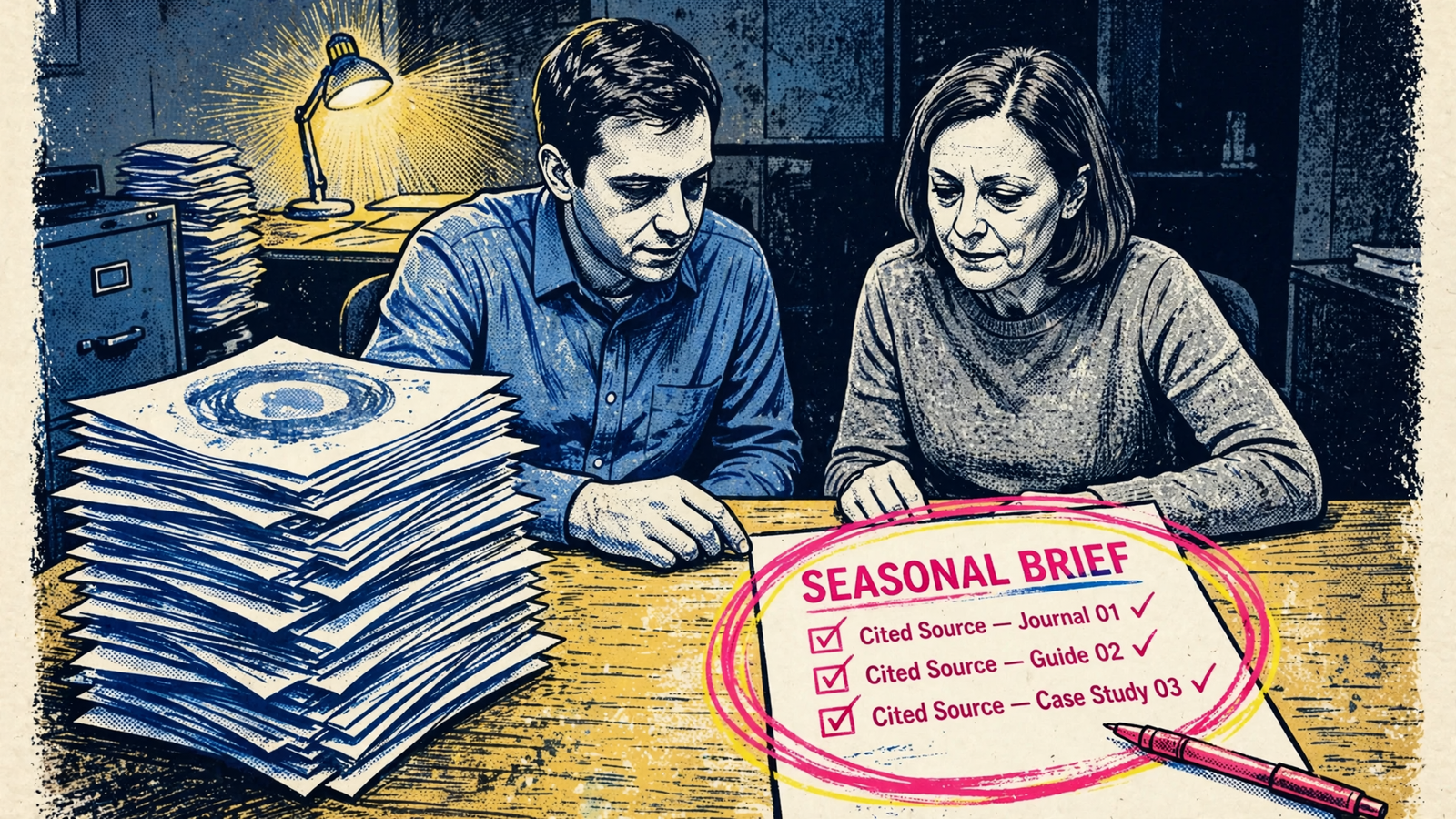
- Select three to five seasonal prompts with observed gaps. Attach the captured answers, dates, and winning source URLs. Keep missing observations separate.
- Identify the page or source opportunity. Decide what the answer evidence actually supports before assigning content work.
- Check access for the relevant existing pages. Look for verified bot requests, returned statuses, blocking or throttling, and differences between edge and origin logs.
- Approve the brief, then repeat the observations. Require human approval before publishing and rerun the same prompts on a comparable basis.
For the access portion, work through how to check whether AI crawlers can read your site before approving a rewrite. There is no sense commissioning new copy to solve a blocked path. There is equally little sense fixing access to an irrelevant page and calling it a content strategy.
The sequence keeps the jobs separate: citations nominate the work; logs interrogate access. Reverse it and the busiest-looking URLs start setting the editorial calendar.
The verdict: groas for content planning, logs for access failures
For seasonal marketers deciding what to write next, groas answer-and-citation tracking wins. It exposes the observed buyer answers, the sources they cite, and whether the business appears as a source, a mention, or a recommendation. Those distinctions belong in the brief.
Pick crawler logs first if the immediate job is diagnosing bot access, failed requests, or a discrepancy between edge and origin activity. That is their territory. Keep the logs already available, but do not ask them to choose next season’s content.
My next move would be one evidence-backed brief through groas: exact prompts, observed answers, cited pages, brand appearances, and dates, with missing observations clearly marked. Approve the work, then schedule a comparable rerun. No vendor can promise citations or rankings from that process; anyone who does is selling certainty neither system provides.
Fund the answers buyers read. Keep the logs to prove the door was open.


