

 LinkedIn

Your garage door shop gets cited for explaining a broken spring. Ask ChatGPT who can repair one in Dallas tonight, and it recommends two competitors instead. I have had that screenshot sent to me with the same note every time: Is this a bug?
No. A citation credits information; a recommendation proposes a supplier. Your page may be accessible to the crawler, useful enough to cite and still short of the evidence ChatGPT uses to name a business for a buyer. Those are three different outcomes. If your budget is tight, pay to fix the one you are missing, not for more content or another visibility dashboard because a vendor bundles them together.
First, separate the three outcomes
Your Dallas post answers how does a torsion spring break? The buying question is who can repair it tonight? The first asks for an explanation. The second asks for a supplier who serves Dallas, is available and has proof beyond its own website. A useful explainer does not establish all of that.
There is another distinction inside the answer: a business can be cited as a linked source, named in the text or recommended as a pick for a buying question. A citation may simply support something the answer says, as RankMaster puts it. It does not mean the linked business made the shortlist.
The numbers show why I stopped treating links as wins. Across 3,981 domain appearances in June 2026 research, 61.7% were ghost citations: the domain was linked but the brand was never named. Only 13.2% were both cited and named. ChatGPT cited brands in 87% of appearances but named them in only 20.7%. I used to tell clients a link meant they were winning. I was wrong. A link means their information helped write the answer. A recommendation means their business survived the shortlist.

Even a name is not necessarily a win. ChatGPT might list the Dallas shop among businesses with mixed reviews, quote a complaint about slow night response or mention it in a discussion no buyer acts on. I have seen owners celebrate a rising mention chart while their phones stayed quiet. The chart counted text. The buyer needed a repairer.
Links and names can also arrive separately. In one test of 149,912 citations, only 2.9% pointed to the tracked brand’s own website. A third-party list might name your shop without linking to it. So you can be cited without a visit, mentioned without a link or linked without being named. Before buying a fix, identify which outcome the buyer’s question is failing to produce.
Crawler access only gets you into consideration
I start these cases with robots.txt. No amount of writing fixes a locked door. ChatGPT search reads the live web through OAI-SearchBot. GPTBot controls training data; ChatGPT-User fetches a page on demand when an answer is being built and does not decide inclusion. If you block OAI-SearchBot, or your CDN blocks its published IPs, your Dallas spring guide is not losing a contest for citations. It cannot be fetched by that crawler. Allow OAI-SearchBot in robots.txt and pass its IPs through your firewall; OpenAI says its systems adjust about 24 hours after a robots.txt change.
Free tool: the AI Crawler Checker shows which AI crawlers your robots.txt lets in and what they receive when they arrive.
A bot hit in your logs proves less than some owners think. I have been sent pages of OAI-SearchBot fetches as proof a site was cited that week. A fetch shows the crawler reached the page. A citation means the page was selected for a particular answer. A recommendation means the business was proposed for a buyer’s question. Each step needs more than the last.
Once access works, put what you do and where you do it in plain, crawlable text. Then check whether other sites corroborate it. That is the order for businesses missing from answers: access, a clear description, then outside mentions. Do not pay for new pages until you know the existing service pages can be read.
A buying question needs evidence about the supplier
Return to the Dallas shop. Its spring guide is good evidence for an explanation. For who do I call tonight in Dallas?, the useful evidence changes: service area in plain text, night hours, a phone number that matches elsewhere and other sites that support the same claims. A blog post about springs cannot do all those jobs.
The competitors in our example have review profiles, directory listings and consistent name, address and phone details that corroborate what their sites say. That makes them easier to propose for the buying question. Missing third-party corroboration is commonly cited as a reason businesses stay invisible, and such fixes can take 3 to 6 months to show. That is a longer job than publishing another explainer.
No vendor can promise to flip a recommendation with one tactic. OpenAI says ChatGPT ranks search results using multiple factors and does not guarantee placement. The wording of the question, the available evidence and what third parties say can all affect the pick. I learned the importance of the query running Google Ads: how does a torsion spring break? wants an explanation; emergency garage door repair Dallas open now wants a supplier with proof. Different question, different evidence, different winner.
More content and more monitoring solve different problems
Publishing your way out of a missing recommendation often misses the layer underneath. If OAI-SearchBot cannot fetch your service pages, twenty new posts give you twenty more pages it cannot fetch. If your site never says in crawlable text that you take emergency calls in Dallas until midnight, with a phone number and service area to match, more spring explainers may offer more material to cite without establishing why someone should call you. I learned the expensive version of this in Google Ads: raising the budget does not fix tracking.
A visibility dashboard has the opposite limit. It watches answers; it does not change them. It can show that you were cited twice, named zero times or beaten by a competitor in eight runs out of ten. Opening access, rewriting the service page and correcting outside listings still sit on somebody’s desk. That is why the retrieval event behind an answer is more useful than a score alone: it helps you distinguish a technical barrier from weak buyer evidence or a pattern that needs more observation.
This is not an argument against content or measurement. It is an argument against paying for either before you know which job remains undone.
Buy the smallest fix that addresses the gap
I would put the Dallas shop’s options in this order:
- If the crawler cannot read key pages, fix access first. Check robots.txt, firewall and CDN rules for OAI-SearchBot. Then check that the service pages render their service and location in plain text. The fix-access-before-content checklist is boring work, often measured in hours rather than months. A content subscription cannot substitute for a successful fetch.
- If access works but the buyer evidence is thin, improve what already exists. Put emergency garage door repair in Dallas, hours, a phone number and the service area on a relevant service page rather than burying them in an image. Bring listings into line and seek reviews that support what the business offers. Ten more spring explainers answer the wrong question.
- If the pattern is unclear, measure before hiring. Run buying questions in clean new chats, record whether the shop is cited, named or recommended, and avoid treating one screenshot as a ranking. Then vary the wording to reflect how buyers actually ask.
That last step matters because answers move. In a 2,961-run test, ChatGPT and Google AI returned the same brand list in less than one in 100 repeat runs, and 70% of brands that ever appeared for a prompt showed up on fewer than 20% of days. The Dallas shop might appear Tuesday, vanish Wednesday and reappear Friday without changing its site.
Breadth tells you more than repeating one phrasing. Across 10,826 daily series on four models in eight countries, 20 different prompts measured a 25% true rate inside a 16 to 35% band, while one prompt repeated over 20 days scattered from 0 to 59%. Even with 20 prompts, a floor of about plus or minus 7.6 points remains however often you repeat them. Test twenty ways buyers ask, not one question twenty times. Zero appearances calls for a closer look at access and evidence; three in twenty is a pattern to investigate, not proof that one particular fix will work.
Make outside help prove it will do the work
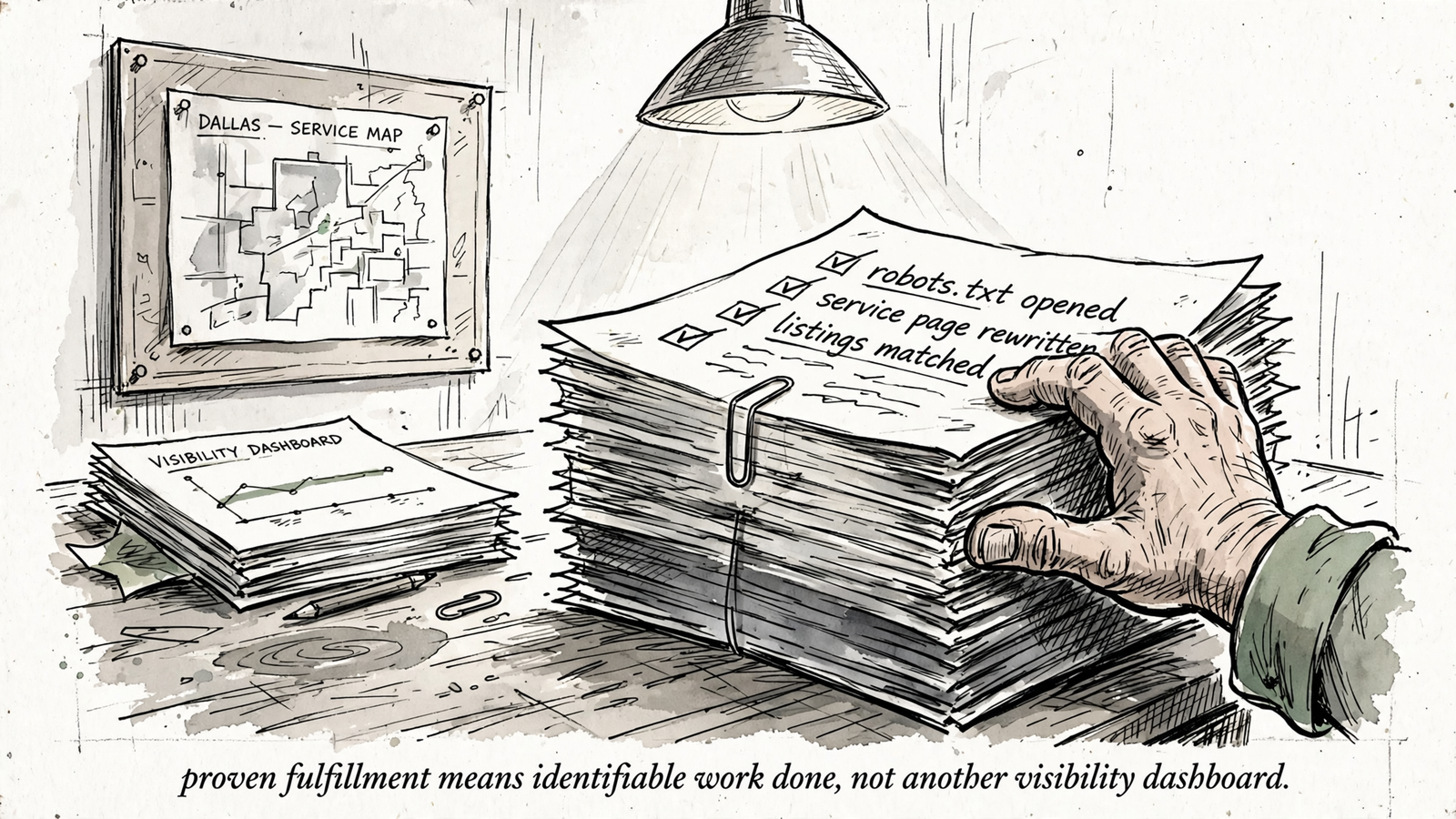
The difference between watching and doing matters when someone else is selling the fix. In one recent thread, an agency-side buyer asked for white-label partners who could prove fulfillment rather than sell another tool login. A typical offer now lists the work behind the brand: a seven-step service covering audit, query mapping, direct-answer structuring, schema and technical work, off-site signals, citation monitoring and white-labeled reporting, with noticeable improvement framed as 3 to 6 months. Read that as a list of possible deliverables, not proof that every step will move recommendations for your shop.
Ask the vendor to put the work in writing:
- Which pages will they make accessible, and how will they verify access in logs or live fetches?
- Which service page will they change, and which listings will they correct?
- What documented outcomes can they show, with dates and starting points rather than a logo wall?
- How many prompts and clean repeat runs will they use, and what counts as a mention, citation or visit?
Those mention, citation and visit definitions matter because a vendor can report its biggest number while your phones stay quiet. If it cannot name the deliverable, baseline and counting rule, you are buying a report.
A focused fix can be cheaper than ongoing management. If the problem is access plus one unclear service page, pay for that work and stop. groas makes sense when the work does not stop: new pages and technical fixes, authority work on sites engines trust, and paid search running around the clock, for a flat $1,499 a month per service with no cut of ad spend. That fits a business with steady search volume and competitors moving weekly. It does not fit a Dallas shop that needs three pages opened, one rewritten and its listings cleaned once. Buy the missing outcome, not the bundle.
Follow the outcome past the answer
Count five things separately: citations, recommendations, visits, inquiries and revenue. A citation means a page supplied information. A recommendation means the business was named for a buying question. A visit means someone clicked. An inquiry means they called or filled out a form. Revenue means the job closed. I have seen those measures move in different directions in the same month. If you pay for recommendations, do not let the vendor substitute the citation count because it is easier to raise.
Visits will not capture every useful recommendation. An answer may name you without linking, and a buyer may return through branded search or direct. ChatGPT tags outbound links with utm_source=chatgpt.com. After clickable brand names launched in May 2026, homepage share of referrals rose from 26 to 29% to 62 to 63%, so follow chatgpt.com sessions through to demo, trial and pricing actions. Keep those visits in view without mistaking them for every buyer the answer influenced.
Now change the trade. Say a Phoenix HVAC company gets cited for a refrigerant explainer but is absent from answers to AC repair same day Phoenix. I would check OAI-SearchBot access, then read the service page out loud: does it say same-day AC repair in Phoenix, with hours and a phone number, in text a crawler can read? Next I would try fifteen fresh buying phrasings and record which answers name the company and which recommend it.
If access fails, I would pay to fix access. If access works but the service page does not establish the offer, I would fix that page. If the page is clear and competitors still win most of those questions, I would examine reviews, listings and service-area corroboration before commissioning another explainer. If the company is already recommended often and the phone still does not ring, I would look past AI visibility to what happens when a buyer tries to contact it.
That is the model. Find the missing outcome, pay for the work that can address it, and let the vendor who wants to sell you everything else watch you walk away.


