

 LinkedIn

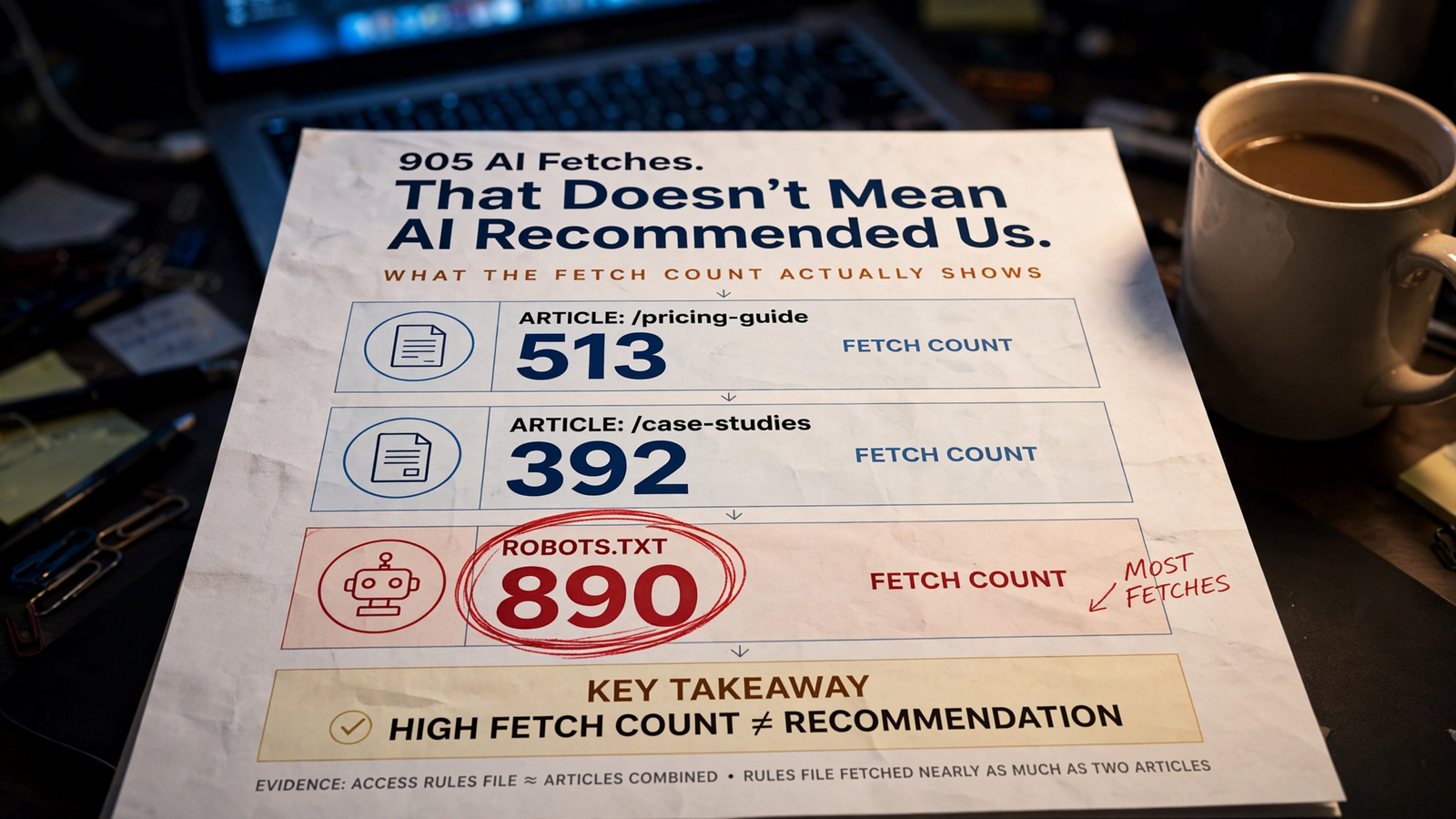
Our Google Ads update pages logged 905 live-answer fetches in 30 days. Our robots.txt file logged 890, which is an awkward comparison if you sell fetch counts as evidence that AI recommends a business.
An access-rules file nearly matched two content pages combined. That is the line I want first-time buyers of AI visibility services to see before anyone opens a dashboard.
A fetch proves a request, not a recommendation. It does not tell me whether an assistant named groas, linked us, suggested hiring us, or sent us an enquiry. Those are separate claims, and each needs separate evidence.
I pulled apart our verified log figures to show exactly where the evidence stops. The count is useful. The sales pitch people build around it is where things get slippery.
The comparison: 905 content fetches, 890 requests for access rules
Here is the supplied cut of groas’s server logs: a 30-day extract, filtered to requests verified as real AI infrastructure rather than accepted on the strength of a bot name.
| URL or group | Verified fetches classified as live-answer activity |
|---|---|
| Google Ads update page 1 | 513 |
| Google Ads update page 2 | 392 |
| Two update pages combined | 905 |
robots.txt | 890 |
Source: groas’s verified server-log extract. These are request counts, not unique people, answers, citations, or recommendations. The supplied path list is truncated, so this is a comparison of the listed URLs, not a whole-site breakdown.
The content pages received just 15 more fetches than the access-rules file. Yet robots.txt contains no pitch, no pricing, no proof, and no reason to hire anyone. Its job is to tell crawlers what they may read.
Free tool: the AI Crawler Checker shows which AI crawlers your robots.txt lets in and what they receive when they arrive.
That makes it a useful control on the story we tell ourselves. A high fetch count can mean the plumbing got checked a lot, not that the business got recommended.
If a provider reports retrievals as visibility, I want to know what those retrievals establish about a buyer’s answer. A large number answering the wrong business question is still the wrong answer.
What a verified fetch actually proves
A fetch is a request for a page. An assistant can request HTML to get text for a user interaction, but the request does not preserve the answer that follows. OpenAI describes ChatGPT-User as handling user-triggered activity rather than automatic crawling.
That distinction matters. The label live-answer fetch is useful for separating this activity from other crawling. It is not a transcript of what an assistant said, and it does not establish that every request contributed to an answer.
The mechanism comes first: the system requests material it may use. Whether it cites that material, names the business, or recommends the service is a separate question.
Server logs record the request. The answer records the recommendation. I cannot substitute one for the other because the first is easier to count.
There is also a verification problem before we even reach that distinction. Any script can claim to be ChatGPT in its user-agent string. We counted requests only after checking the IP against the operator’s published list and using reverse and forward DNS where supported. Verifying crawler identity separates genuine infrastructure from a convincing label.
That check strengthens the claim about who requested a URL. It does not strengthen a claim about what appeared in an answer. Verified plumbing is still plumbing.
Index crawling and live retrieval are different evidence
Across the same two update pages, the supplied extract records 1,312 verified fetches from AI infrastructure during the observation period. The 905 classified as live-answer activity are a subset of that total, not an additional count.
| Measure | Requests | What I can conclude |
|---|---|---|
| All verified AI-infrastructure fetches for the two pages | 1,312 | Verified infrastructure requested those URLs |
| Subset classified as live-answer fetches | 905 | Those requests fall within the extract’s live-answer classification |
Source: the same groas server-log extract. I would not assign the remaining requests to a specific purpose without the corresponding breakdown.
Index crawling also complicates attempts to match a citation to a live request. In one joined log-and-answer test, OAI-SearchBot had previously fetched 116 of 129 URLs that ChatGPT later cited. The cited page was almost never fetched while the answer was being written.
That is evidence from that test, not a universal rate. Its practical value is the distinction: an answer can cite a page already encountered through search crawling. A fresh request at answer time is not the only route into a citation.
Do not treat live-fetch volume as a complete record of answer visibility. It can tell me something happened at the server. It cannot show me everything that happened in the answer.
Five measurements that should never share one label
Buyers hear visibility as one thing. I want the report to separate these evidence types instead.
These are not mandatory steps in a neat funnel. An assistant may cite an indexed page without fetching it live, and a citation may never turn into a recommendation. Each row answers a different question.
| Measurement | Evidence I want | What it does not establish |
|---|---|---|
| Visit | A verified server-log request | A citation, recommendation, or buyer visit |
| Live retrieval | A verified request with the relevant agent classification and context | What the resulting answer said |
| Citation | Saved answer text linking the page | That the business was named or recommended |
| Recommendation | Saved answer text explicitly suggesting the business for the use case | An enquiry or sale |
| Enquiry | A form fill, call, or trial attributable to the answer | Closed-won revenue on its own |
The citation distinction is easy to miss. An answer can link a business’s documentation while naming only a rival. Being useful source material is not the same job as being the suggested supplier.
One cited analysis found that when a brand’s own listicle was cited, the brand was absent from the recommendation 69% of the time. That finding belongs to the analysis described there; it is not a conversion rate I can apply to groas’s logs. It does illustrate why the two labels cannot be merged.
Make the provider identify which row each number belongs to. If a report says “recommended” but supplies only requests, the evidence does not support the heading.
Where our dataset stops answering questions
The path list is truncated. I can report the counts for the listed pages and compare them with robots.txt. I cannot turn those rows into a whole-site share of AI activity.
I do not have the full denominator. I do not know what was filtered before the extract reached me. Filling those gaps with arithmetic would make the report look more complete without making it more informative.
The logs also leave the commercial questions unanswered:
- How many unique answers did these requests support?
- Which buyer questions, if any, prompted them?
- Did the answers name groas, cite a page, or recommend us?
- Was the surrounding answer positive, negative, or simply factual?
- Did anyone click through, enquire, or become a customer?
The missing answer text is a real boundary, not a reporting inconvenience. Without it, I cannot connect a request to a recommendation merely because the timestamps look close.
The joined log-and-answer test also illustrates the risk of coincidental timing. Background requests can land near a test answer without proving that the answer caused them. I would rather leave an attribution blank than fill it with a convenient coincidence.
This does not make the log data worthless. It makes it specific. I can use it to understand verified fetching activity. I need different evidence to understand what buyers were told.
Before paying, ask to see the answers
If I am buying help getting recommended across ChatGPT, Gemini, and Perplexity, I start by refusing the blended score. I want retrievals, citations, brand mentions, recommendations, and enquiries reported separately, with the underlying material attached.
My starting request is a sample of 20 saved answers to buyer queries. That is a buying requirement, not a research finding or a claim that the sample represents the whole market. I want dates, exact prompts, and full answer text so I can inspect what the report calls success.
Then I want the provider to mark three things separately: where the answer links us, where it names us, and where it recommends us. Show me the answer before showing me the score.
The distinction is not academic. In an analysis of 20,000 ChatGPT responses, enabling search changed recommendations 80.2% of the time, while the reported correlation between being cited and being recommended was 0.4. Those figures describe that analysis, not a forecast for my business. They are another reason not to use citation counts as a substitute for inspecting recommendations.
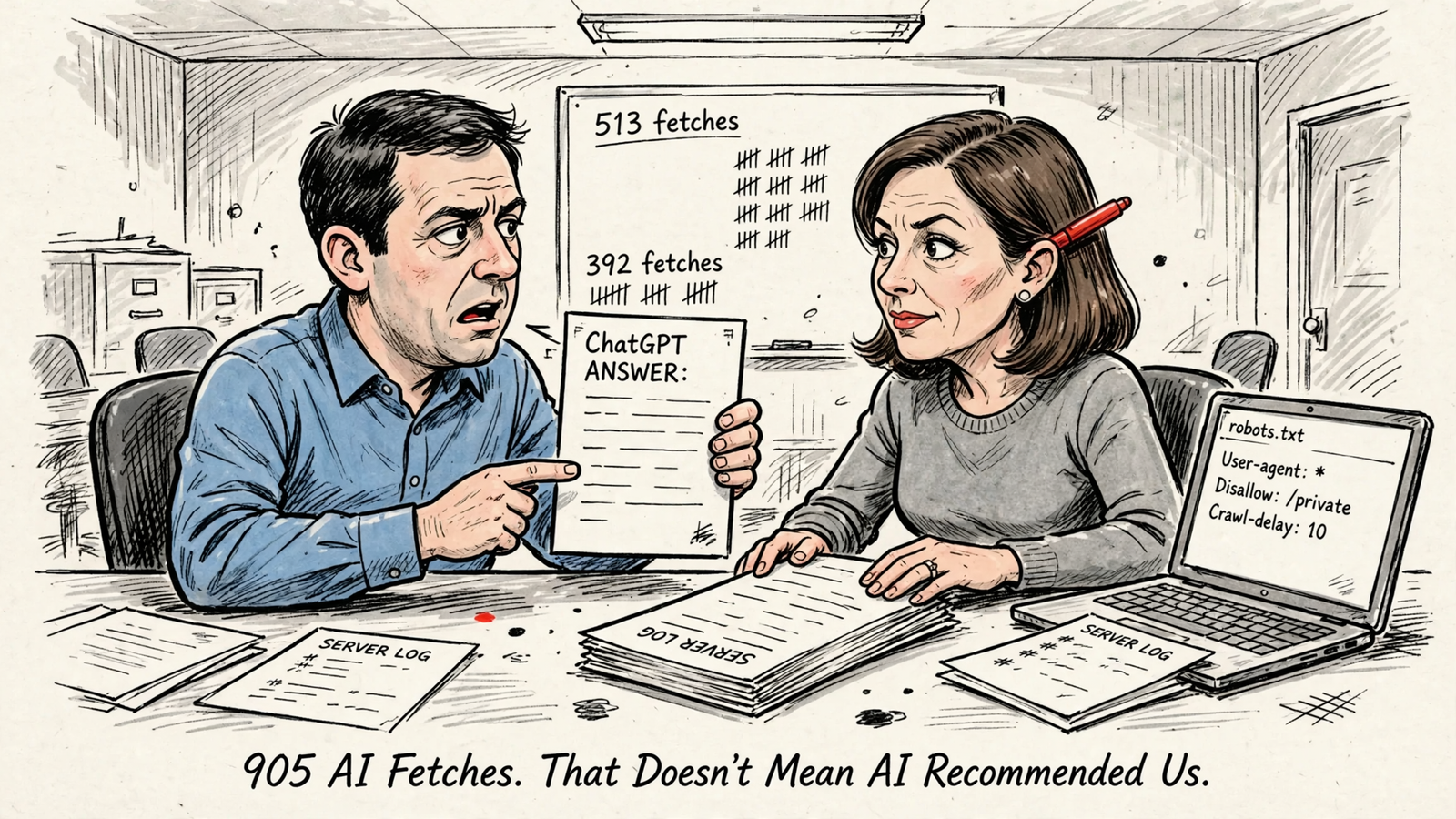
Here is the checklist I would take into the buying conversation:
- Show the test. Which buyer prompts did you run, on which dates, and in which assistants? Include the full answers, not cropped screenshots of a score.
- Separate the answer outcomes. In how many saved answers were we linked, named without a link, and explicitly recommended for the job? Keep those counts distinct.
- Verify the retrieval evidence. Show the IP checks behind the log counts. Keep training crawls separate from search and live-answer activity; search access and training access are independent settings.
- Explain the work and the next test. What changed on our site, and what evidence would show that it helped? Agree on the review period before the work starts. For a repeatable approach, start with how to measure AI visibility without buying a score.
- Show the commercial connection. Which enquiries, calls, or trials came from those answers, and how was the source captured?
The last question is where the report has to leave the bot dashboard and meet the business.
A citation can still be worth monitoring. But ChatGPT can cite your site while recommending a competitor. The linked source and the suggested supplier need not be the same business. I want that distinction visible, not buried in the methodology.
Crawler controls are not answer evidence either. Google-Extended is a robots.txt product-control token without its own HTTP user-agent, and blocking it does not remove a URL from AI Overviews. Likewise, a PerplexityBot request is not proof of a citation. For citations, show the answer itself.
The decision: buy commercial execution, not a bigger crawl count
The fetches tell me that verified AI infrastructure requested our update pages. That is useful operational evidence. It does not establish that the pages were recommended, that they won a buyer’s attention, or that they generated an enquiry.
The robots.txt comparison keeps that distinction honest. A file with no commercial pitch nearly matches the content pages on retrieval volume. Retrieval volume and commercial value are different measurements. I keep them in different columns.
That is also how I frame the work at groas. We run paid and organic search as one fully autonomous growth engine, with specialized models handling continuous execution and a named strategist setting guardrails and owning the outcome. The point is not to give clients another activity count to interpret. It is to connect the work to business results.
| Visibility evidence | Business outcomes |
|---|---|
| Verified fetches | Qualified pipeline |
| Saved citations | Closed-won revenue |
| Saved recommendations with prompts attached | Cost per acquisition |
I want the first column reported honestly and the second column treated as the commercial test. Neither improves when we rename a crawler request a recommendation.
Keep the 905 beside the 890 when reviewing an AI visibility pitch. If the provider cannot show the prompt, the answer, and where the business was named or suggested, it has shown plumbing, not a recommendation. If it cannot connect that visibility to attributable enquiries, the commercial value remains unproven.
My decision is simple: pay for execution tied to business outcomes, not retrieval counts dressed as customer demand.


