

 LinkedIn

A Times Union sale calendar received its first observed AI citation the same day it was published. It went on to become the second most cited page in Profound’s four-market Black Friday snapshot. That proves same-day citation is possible. It does not tell you how long your page will wait.
I know how that finding will get used. Someone will turn one fast page into a promise: publish today, get cited tomorrow. The research supports a narrower, more useful conclusion. Publication dates and first observed citations belong beside your visibility score, because the score alone cannot explain how quickly new material enters the answers being measured.
That is what I want from an AI visibility dashboard: not a freshness promise, but a history I can inspect. Before changing a page or buying another tracker, I want to know what was measured, what the dates mean, and where the evidence stops.
What the same-day finding actually measures
The Times Union calendar lists October 28 as both its publication date and its first recorded citation. Profound’s observation window ran from October 27 to November 9, inclusive, Eastern Time. The research covered buying questions across the US, UK, Germany, and France, using ChatGPT, Gemini, Google AI Mode, and Google AI Overviews.
Those boundaries matter. Profound did not watch every answer on the web. It watched particular assistants, markets, prompts, and dates.
First observed citation means the first citation seen within that measurement setup. It does not mean the first time any assistant, anywhere, used the page. Missing history outside the sample stays missing; a dashboard should not quietly fill it in.
The same distinction applies to pages that were already live before tracking began. Their first appearance in your report may be new to the report, not new to AI search. I would no more treat that as a complete history than treat a short search query report as the lifetime record of an account.
The practical rule: keep the observation window attached to the date. Without it, “first cited” sounds more definitive than the evidence allows.
Three counts, three different meanings
The scale of the Black Friday study makes the same-day example interesting. It does not make that example typical.
| Figure reported by Profound | What it counts | What it does not establish |
|---|---|---|
| 279,741 responses | Recorded answers within the study’s prompts, assistants, markets, and dates | Coverage on other questions or outside the observation window |
| 1,219,663 citation events | Appearances of page links in those answers, including repeats | That many unique pages, visitors, or purchases |
| Four markets: US, UK, Germany, and France | The geographic scope of the snapshot | That every market or industry behaves like Black Friday shopping |
The rankings need their own label, too. The Times Union calendar ranked second overall, and an NY Post timing guide ranked fourth, while neither reached the top five in any of the study’s 24 individual categories.
That is breadth, not category dominance. A page can earn a high aggregate position by appearing across related buying questions rather than owning one category. If I only see the overall rank, I miss how that rank was assembled.
An aggregate score describes the combined result, not the distribution behind it. Before treating a high rank as a win everywhere, look at the questions and categories contributing to it.
The wider timing figures are not a countdown
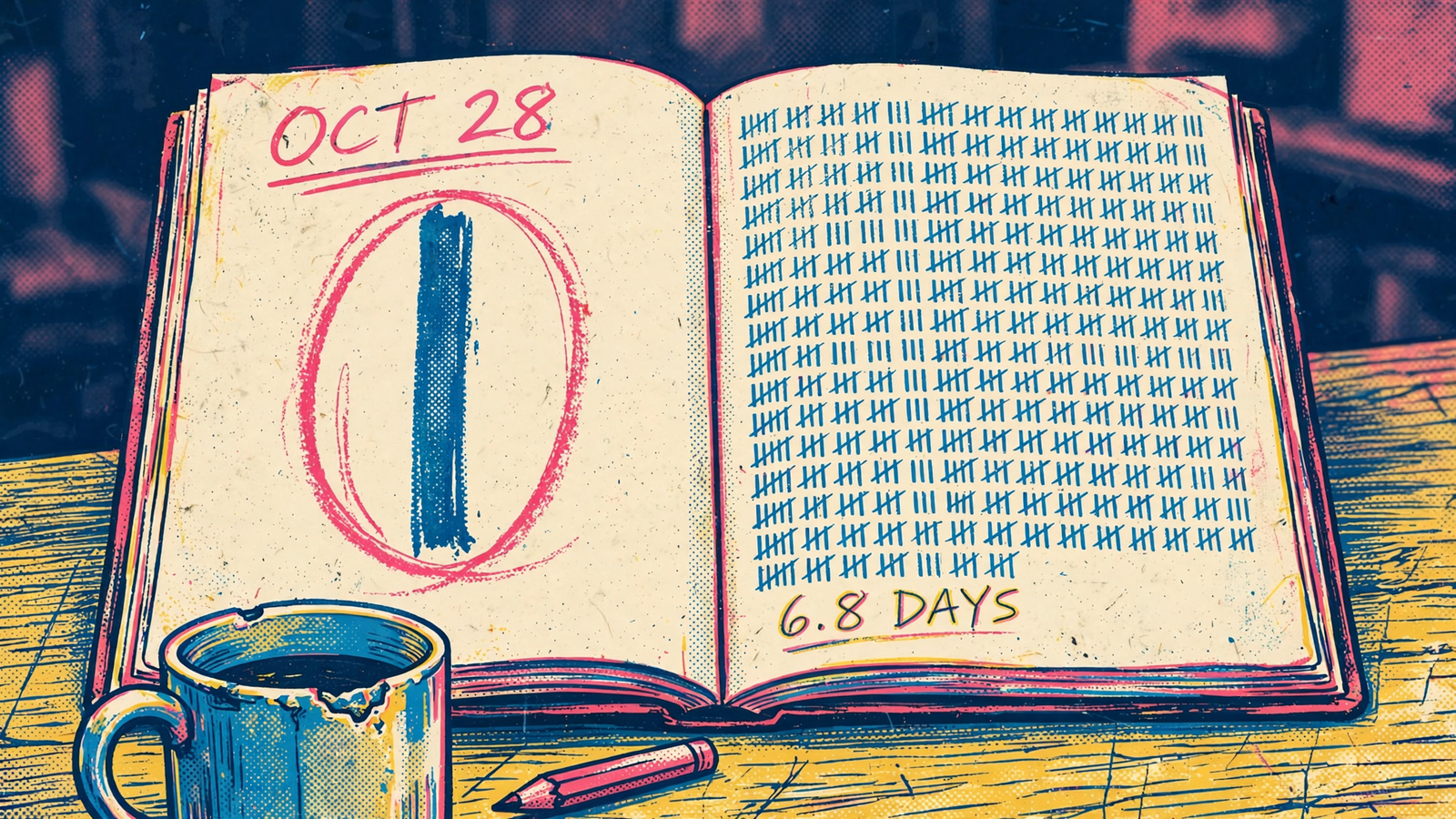
The Black Friday report also cites the CMO’s AEO Guide with VaynerX, which reports a median of 6.8 days between publication and first citation among the cited content studied.
That is a separate timing finding, not the typical wait established by the Times Union example. More importantly, it already filters for pages that received citations. It says nothing about the pages that published, waited, and were never cited in the measured data.
A median among cited pages is not a deadline for every published page. I would not turn it into a service promise, a publishing schedule, or a reason to declare an uncited page broken.
The wider freshness figures measure something different again:
| Reported figure | What it describes | Limit to keep visible |
|---|---|---|
| 6.8 days | Median publication-to-first-citation interval among the cited content studied | Excludes the experience of pages without an observed citation |
| 1,064 days | Average age of AI-cited content across 16.975 million cited URLs | Page age, not time taken to earn a citation |
| 1,432 days | Average age of content in the organic top 10 in that analysis | A comparison of source age, not a publishing experiment |
The age comparison amounts to a 25.7% freshness edge for AI-cited content. Yet the average cited page is still close to three years old. “Fresher than organic results” is not the same as “freshly published.”
These figures can sit on the same screen, but they cannot do the same job. One documents a same-day observation. Another describes elapsed time among cited content. Another describes the age of cited sources. Keep the labels, or the comparison falls apart.
Put the dates beside the score
A share-of-voice score without supporting history asks one number to do several jobs. I want the layers separated: mention rate, page-level citation rate, recommendation rate, share of voice with its denominator, and referred traffic. No single score explains all of them.
For the timing question, the fix is boring and specific. Keep the page and its observation history together.
| Field | Why I want it visible |
|---|---|
| Publication date | Establishes when the page became available, where that information is known |
| First observed citation | Records the earliest citation found in the available tracking history |
| Assistant and market | Identifies where the observation happened |
| Tracked prompt | Preserves the question that produced the answer |
| Observation window | Shows how much history supports “first observed” |
| Unknown timestamps | Makes missing evidence explicit instead of manufacturing precision |
The Published, Crawled, Cited model makes a useful distinction: discovery evidence and use in an answer are separate events. A publication timestamp is not evidence of crawling. Crawling is not evidence of citation.
The dashboard should preserve those distinctions, not smooth them into a progress score. If a timestamp is unavailable, “unknown” is the right answer. It is less impressive in a demo and much more useful in an analysis.
Ask Claude for the record, including the gaps
With groas connected to Claude, I would start by asking for the evidence available, not asking it to explain why a page “won.” That is the same distinction behind Search Console CSVs versus a live groas connection in Claude: the analysis depends on the records the AI can actually access.
Here is the request:
Using available groas citation records and page metadata, show publication date, first observed citation, assistant, market, tracked prompt, and observation window. Label unavailable timestamps as unknown. Do not infer a first-ever citation from a first observed one. Keep competitor observations separate from our own page history.
That prompt is a request for an evidence table, not a claim that every timestamp will be available. If the connected records cannot supply a field, the gap belongs in the output.
Then I hold two lines:
- “First observed” means first seen in the measured data. It does not establish first-ever use.
- “No citation observed” is bounded by the sample. As the measurement guidance makes clear, it does not mean never cited anywhere.
Competitor history needs the same discipline. A rival’s fast citation shows that its page appeared for a measured buying question. It does not establish when your page was ready, why yours was absent, or what would make yours appear next.
Keep the rival’s observation. Do not borrow its timeline.
Compare matching observations, not convenient ones
A Gemini citation for a UK Black Friday price question is not interchangeable with a ChatGPT mention for a general US review question. The assistant, market, prompt, and observation window all shape what the row means.
That also limits comparisons between reporting tools. Bing Webmaster Tools added its free AI Performance report in February 2026, reporting total citations, cited pages per day, and grounding queries for Copilot and Bing summaries. That is first-party evidence for Microsoft surfaces. It does not become ChatGPT coverage because both reports have “AI” in the heading.
Likewise, a third-party tracker that runs selected questions through ChatGPT tells me what appeared on those questions when they were checked. Useful evidence. Not a census of everything ChatGPT says.
Compare like with like before comparing before with after. I want the same prompts, assistants, and markets visible when assessing a change, with any differences in the observation windows made explicit.
I also keep these outcomes separate:
- Mentions: answers that name the brand without necessarily linking to it.
- Citations: answers that link to a page.
- Share of voice: visibility relative to a stated denominator of prompts, platforms, and dates.
- Referred traffic: visits that actually arrive.
Citations are references, not clicks. I learned that separation in paid search, where impression share, click share, and revenue share never moved together just because a report put them next to each other.
A blank citation cell is unresolved evidence, not an infinite waiting time to drop into an average. Keep it out of calculations that pretend the event happened.
Use the history to choose an update, not promise a result
Black Friday is a useful setting for this analysis because the buying questions are dated. Sale calendars, cutoff dates, prices, and availability windows give an analyst concrete details to inspect.
That does not prove which detail caused the Times Union citation. The observed dates cannot tell us whether offer coverage, timing, publisher history, or something else drove inclusion. Those are openings to test, not weights to put into a formula. The data runs out before the causal explanation begins.
My next step would be practical: have Claude list the dated buying questions my pages fail to answer, then review the proposed factual updates. Through groas, every change is logged with its reason and can be undone in one step. Keep the pre-change baseline beside the post-change observations.

The discipline is the same one behind our Search Console analysis of 4,033 impressions producing one click at position three. A visible number can look encouraging while the outcome you care about tells a different story.
Measure the update on the same questions, assistants, and markets. Record what changes and what does not. Do not let anyone turn the exercise into a promise of rankings, citations, or revenue.
The buying decision: demand an inspectable history
When I grade an AI visibility dashboard, I want these requirements met:
- Publication date beside the citation record. Without it, a claim about speed has no starting point.
- First observed citation with its context. Assistant, prompt, market, and observation window should travel with the timestamp.
- Unknown where history is missing. An admitted gap beats a generated date.
- Separate measures for mentions, citations, share of voice, and traffic. A blended score cannot tell me which outcome improved.
That is why I favor Claude with groas underneath over a tracker that stops at reporting whether ChatGPT named the business. groas collects AI-answer and site data around the clock, while keeping the analysis connected to action. Autopilot stays off until I switch it on, and changes remain logged and reversible. The useful workflow is not just “did I appear?” It is “what question did I miss, what evidence do I have, and what changed after the update?”
The numbers support a specific purchase decision. Keep the score, but buy on the history you can inspect. The same-day example establishes possibility. The cited-content median does not establish your waiting time. The older average source age does not make freshness irrelevant.
Hold those distinctions on screen. Then spend the effort fixing pages that answer buying questions, not chasing a promise that publishing today gets you cited tomorrow.


